Leidsid 33 sarnast õppematerjali, mis on seotud failiga "Town Hall Square and Town Hall". Need materjalid aitavad sul teemat sügavamalt mõista.
square, there, beside, center, festivals, days, gothic, northern, europe, construction, spire, aerial, march, worked, until, museum, representative, building, thomas, watchingHistory The building history of the Town Hall goes back to the 13th century. In its present form it was completed in 1404. The management of the city worked in the Town Hall until 1970. Since 1975 the Town Hall functions as the ceremonial building of the city government, but it also serves as a concert hall and a museum. The tower The tower was constructed together with the Town Hall in 1402 1404. The original Gothic pyramidal spire was replaced by a Late- Renaissance spire in 1627. The height of the Town Hall from the bottom of the arcade to the top of the spire is 64 meters. The spire was destroyed in an aerial bombing on March 9, 1944. It was rebuilt in 1952. Tallinn Town Council used to have its own guards, who maintained order in town and watched for possible enemy troops or destructive fire from the tower. When something endangered the city, an alarm bell in
The parliament has 101 members and is chosen for 4 years. Stenbock House - the official seat of the Estonian Government since 2000; the building started in 1787, originally meant to be a courthouse. After russians ran out of fund, house went into Jakob Pontus Stenbock’s possession. Renovation was carried out in 1996-2000. Tall Hermann - tower in the south-west corner of the castle; 49 m built in 1371; ten floors and a viewing platform. Estonian flag is raised there every morning at sunrise but not before 7am and lowered at sunset but not later than 10pm; except at midsummer June 23, when it’s not lowered at all. It’s commonly recognised that whoever’s flag flies on top of this tower is the ruler of Estonia. Toompea as a tourist attraction Alexander Nevsky Cathedral - largest and grandest orthodox cathedral crowning the hill of Toompea. It was finished in 1900, when the country was a part of the Russian empire. Time of
lose a bloody battle, the sky suddenly opened and a red flag with a white cross on it dropped down upon them from the heaven. This is how the Danes obtained their national flag. In 1346 the Danish king sold his Estonian lands to the Teutonic Order, who a year later resold them to the Livonian Order. The Germans renamed Tallinn and called it Reval. Toompea became the seat of the German-born gentry. A fortified wall was built between Toompea (the Upper Town) and the Lower Town, as there were conflicts between the two. The Lower Town was the home of simple people, the artisans and the merchants. The doors and gates in the wall were locked at night. Tallinn joined the German-dominated Hanseatic League in 1285 and became a junction of trade between East and West: furs, honey, leather and seal fat moved west, while salt, cloth, herring and wine moved east. Its geographical position was very favourable, with
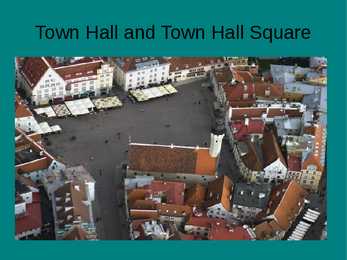
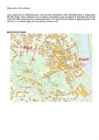
Old Market square (Vanaturg) is the former market square in Tallinn old town. Five streets meet here: Vene, Viru, Suur Karja and Kuninga streets, and Vana Turu Kael sidestreet. The market location perfectly suited for trade: five trade routes started there. The square is connected to Town Hall Square by a short sidestreet. Town Hall Square Was used as marketing place, for festivities as well as for executions. In summer it is filled with outdoors cafes In winter it becames a magical christmas market The L-shaped sigh There has been a town hall in Tallinn since at least 1322. Town Hall Built in 13th century The management of the city worked in the Town Hall until the year 1970 The only gothic town hall on Northern Europe Weathervane Old Thomas
Later came Reval (presumably after the old county of Rävala), the name used by the Germans who ruled the country for seven centuries. Russians then modified Reval to Revel. For Estonians, the town came to be called Tallinn from Taanilinn (Danish town) after Danish conquest in the 13th century. Over the course of time, Taanilinn was shortened to Tallinn The place is believed to have been settled by Finno-Ugric peoples about 2500 BC. The Danes, led by King Valdemar II, conquered northern Estonia in 1219. Legend has it that one day, when the Danes were about to lose a bloody battle, the sky suddenly opened and a red flag with a white cross on it dropped down upon them from the heavens. This is allegedly how the Danes obtained their national flag, the Dannebrog in a battle against the Estonians. In the middle of the 14th century Denmark sold its possessions in Estonia to the German Teutonic Order. Toompea became the seat of the German-born gentry
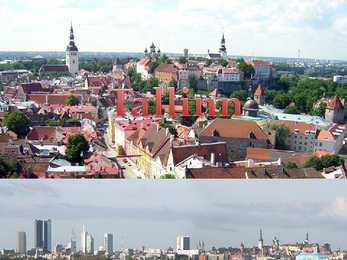
as a centre for contemporary art. The complex itself is a work of art - it was opened in 2006 after nearly a decade of planning and construction, and is considered a modern architectural masterpiece. Tallinn Old Town Tallinn's medieval Old Town is known around the world for its well- preserved completeness and authentic Hanseatic architecture. Enchanting atmosphere, rich cultural scene, beautiful surroundings and plenty of galleries, cafes and restaurants to choose from: there is something for everyone in Tallinn. Whether you have only few hours to spare or few days to walk around: Tallinn's Old Town is beautiful and enchanting during all seasons. Be sure to enjoy the outdoor cafés during summer and cosy fire and luxurious gourmet experiences in winter, indulge in local chocolateries and don't forget to take your camera! Tallinn Town Hall Tallinn Town Hall is one of the most important symbols of the city and a unique architectural monument in Europe
My Town I live in Tallinn. It's the capital and main seaport of Estonia. Tallinn is a very beautiful city that lies on the Baltic Sea. It covers 158 square kilometres. The Mayor of Tallinn is Jüri Ratas. The population of our capital is about 400000 people. About 55% of them are Estonian, 37% Russians and the other 8% are from different nations. The people here are mostly engaged in industry- mainly the food industry (23%), trade (16%) and transport and communication (14%). History. Tallinn has a great history. It was first marked on a map of the world by the Arab geographer al-Idrisi in 1154, its name then being Kolyvan. In the 13 th-
Above the door is the founder of the union, king Knut 7. Suurgildi hoone - gothics. Belonged to Tallinn's Suurgildile, where were the town's most powerful and richest merchants. Hoone Ehitus kestis 14071410, siseviimistlus lõpetati 1417. 8. Holy ghost church - 14. Century. One of Tallinn's oldest churches, and the only sacred building that preserved its original form.and still retains its original exterior, except for the Baroque spire. The clock in northern side is one of the oldest in Tallinn and though it has been blanched with rain and window, the clock strick the time exactly. It has a Baroque wooden carvings, made by Christian Ackermann. 9. Saiakäik (White Bread passage) suubub raekoja platsile Raekoda mainitakse esimest korda 1322, säilinud hoone valmis 1404. Raeapteek- mainitakse 1. korda 1422. Raekoja platsile suubuvad tänavad: Vanaturu kael, Kullassepa, Dunkri, Voorimehe, Kinga, Mündi, Saiakäik, Apteegi.
Kalevipoeg is said to have been buried according to a legend. (There are many such legendary burial places of him in Estonia.) The cathedral was built during the period of late 19th century Russification and was so disliked by many Estonians as a symbol of oppression that the Estonian authorities scheduled the cathedral for demolition in 1924, but the decision was never implemented due to lack of funds and the building's massive construction. As the USSR was officially non-religious, many churches including this cathedral were left to decline. The church has been meticulously restored since Estonia regained independence from the Soviet Union in 1991. http://en.wikipedia.org/wiki/Alexander_Nevsky_Cathedral,_Tallinn The church's towers hold Tallinn's most powerful church bell ensemble, consisting of 11 bells, including the largest in Tallinn, weighing 15 tonnes. You can hear the entire ensemble playing before each service.
● Koluvan - found in old Russian chronicles, the name possibly deriving from the Estonian mythical hero Kalev ● Reval - used after 1219; comes from two german words ‘reh’ and ‘fall’, meaning the falling of the deer - as they fall down the Toompea hill, probably when escaping from the Danish occupation or just the hunters. ● Tallinn - used after Estonia gained its independence in 1918, origin is definitely estonian; meaning Taani-linn, tali- linn. Liberty Square ● The central square of Tallinn, it was renovated in 2008. There used to be Harju gate, which can now be seen through glass. ● The statue of Liberty, 2009; represents freedom, Estonia has been under many foreign powers, starting with Danes, Sweden, German and Russia. The clock of liberty, 2004. Kiek in de Kök ● The cannon tower, founded in 1475-1483. Kiika kööki, peek into the kitchen, from up there it was possible to peek into the enemy’s kitchen
Tallinn Tallinn is a beautiful city in NorthEstonia. It is washed and influenced by the Gulf of Finland in the north. Tallinn has a lot on sights and I'm going to introduce some of them. Town Hall Square the square in front of Tallinn's Town Hall functioned as a marketplace for centuries, dating back to times even before the Town Hall itself was built. Through the years this served as a place of celebrations as well as executions. St. Olav's Church was the tallest church in Medieval Europe. The earliest data on St. Olav's Church come from 1267. Little is known about the building of this Gothic style church and its early years.
Tallinn Old Town It was built up from the 13th to 16th centuries, when Tallinn was a thriving member of the Hanseatic trade league. It is built on a big hill and is surrounded with big walls. There is a lot of medieval style houses and inns, courtyards, churches and museums and a lot more. Many have described Tallinn Old Town as mystic and addictive. Unlike other capital cities in Europe, Tallinn has managed to preserve the completeness and structure of it's medieval and Hanseatic origin. Even after 7 centuries, Town Hall Square still remains as the social heart of the city and is hosting many concerts and fairs. Town Hall on Town Hall square is the only intact Gothic town hall in Northern Europe, now operates as a museum and concert hall.On top of the Town Hall tower, you will see a beloved guard of Tallinn Old Town Vana Toomas.One of the most impressive churches in Old
Instructor:Teacher Kristi Aron Kunda 2012 Introduction Like most cities with an eight-hundred-year-old past, Tallinn is a patchwork of historic areas. The city's pride and joy is without a doubt its Medieval Old Town, but equally enchanting is the Kadriorg district, a throwback to the time when Estonia was ruled by the Russian Tsars. Tallinn is the capital and largest city of Estonia. It occupies an area of 159.2 km2 with a population of 416,470. It is situated on the northern coast of the country, on the shore of the Gulf of Finland, 80 km south of Helsinki, east of Stockholm and west of Saint Petersburg. Tallinn's Old Town is in the list of UNESCO World Heritage Sites. It is ranked as a global city and has been listed among the top 10 digital cities in the world.The city was a European Capital of Culture for 2011, along with urku, Finland.Tallinn is the oldest capital inNorthern Europe. The city was known as Reval from the 13th century until the 1920s. http://en
Sculptures and monuments St. John's Lutheran Church St John's Church was probably built in the first third of the 14th century. There is no other brick church decorated with so much terracotta plastic in Europe Eduard Tubin Monument The Eduard Tubin monument, marking the 100th birthday of the composer, was dedicated in 2005. The authors of the statue are sculptor Aili Vahtrapuu, architect Veronika Valk, with sound installations by Louis Dandrel.Eduard Tubin (1905-1982) was a versatile composer and conductor, one of the most recognized symphonists throughout history. He served as concert master and conductor at the Vanemuise Theatre. In 1944, when the theatre was destroyed, he left Estonia to Sweden.
same time, the biggest icebreaker in the world preserved through two world wars. All the 3 original steam engines as well as most of the original arrangement of space and late Jugendstil interior of the officers' rooms are preserved. In 1914 the first home port of the ship was Tallinn. The ship ensured a regular winter sea navigation for Tallinn up to the end of the independency period. 2. The Tallinn Song Festival Grounds The Tallinn Song Stage was built in 1959 for arranging the Song Festivals. The stage was meant to hold over 15 000 singers. Indoor rooms can be used as a backstage area during the concerts but those are also suitable for all kind of events, parties, concerts, 2 banquettes, fairs, exhibitions etc.In the northern side of the song stage there is 42 m high fire tower, which is used during the famous Song Festivals. It is also opened for the public all year long. 3
Tallinn is a small port town in which the population is 371 000 people, and the area is only 159,2 km².( square kilometers). Tallinn, the capital of Estonia, is named after taani linnus, which means Danish castle. The Castle in question was built by King Waldemar of Denmark in the 13th century. The settlement quickly developed itself into a busy port. -The Old Town In medieval age Tallinn was called Reval and it was as big as the Tallinns Old Town is now. Uniqueness of Tallinn is that it is one of very few European cities, where the historical lay-out is
Street that runs parallel to it is not. The aim of the report is to be helpful for the students of Tallinna Mustamäe College who study the history of Tallinn and would like to get additional information about Lai Street, as they need to pass the guide practice exam in form eleven. The report is divided into chapters so that each chapter deals with one of the important houses in Lai Street. In the beginning there are also two introductory chapters about Lai Street in general and the origin of the name "Lai". 3 Lai Street in general Lai Street is 520 m long and begins at a small green patch below the Toompea slope, where a graceful bronze statue of a Roe Deer by Jaan Koort (1883-1935), one of the best-known Estonian sculptors, has been standing for several decades. Lai Street stretches from Nunne Street to Pikk Street. Parallel with Pikk Street, Lai Street, too, ends at the Great Coast Gate
Urban trail in Tartu old town. Tartu, small town in southern-Estonia. Town was first mentioned in 1030. Nowadays there is living nearly 100 000 people. Tartu is known as city of students, and students come to improve to Tartu from all over the world. But Tartu is also known as a Hansa town, that is why one of the most attractive sightseeing place is the old town. It is a valuable place for Tartu and for Estonia as well. PHOTO HUNT MAP: Start the photo hunt on the corner of Lai and Jakobi street. Go up to the Toome hill, it's a great upturn and a great test for legs
The square in front of Tallinn's Town Hall functioned as a marketplace for centuries, dating back to times even before the Town Hall itself was built. Through the years this served as a place of celebrations as well as executions. Today the square remains a cultural focal point for the city. In summer, it's filled with outdoor cafés and is home to countless openair concerts, handicraft fairs and medieval markets. In winter, an annual Christmas Market enchants the crowds on the square, as does the town's Christmas tree (a tradition whose roots stretch back to 1441), which stays up for a month or more. Town Hall Square has also become the traditional centre of the Old Town Days festival, a modern version of a medieval carnival. Traditions from the Middle Ages are kept alive here, including parades, a knights' tournament, a parrotshooting contest and the election of the May Count.
Tallinn Mustamäe College G2K Jaana-Kristiina Jõgevest The Four oldest churches of Tallinn Report Supervisor: Ingrid Teigar Tallinn 2009 The Dome Church The Danes began fortification of Toompea after the conquest of Tallinn in 1219 and probably also built the first church there. It was presumably a wooden building located at the site of the present cathedral. However, a serious conflict with the Order of the Brothers of the Sword broke out soon as the latter wanted to gain control of the entire Estonia. The order succeeded in subordinating Tallinn and the whole of North Estonia to its rule in 1227. The monks of the Dominican Order began the construction of a stone church in Toompea in 1229
TALLINN TOWN HALL Tallinn Town Hall is the only surviving Gothic town hall in Northern Europe. Built in the heart of Tallinn, next to a marketplace, the Town Hall has witnessed trade and social activities for over 700 years. It has still remained the most important representational building in town. The building history of the Town Hall goes back to the 13th century, but it acquired its medieval appearance in 140204. It was as early as 1248 when King Eric IV Ploughpenny of Denmark granted the Lübeck Charter to Tallinn
TALLINN TOWN HALL Britt Viks Haapsalu Gümnaasium 2011 HISTORY Tallinn Town Hall was very important building in the Tallinn Old Town. There were many events like : trading or killings. It was built in 13th century. In the past it was city goverment. It is the only gothic style building in the Northen Europe. NOW Now is the building concert hall and a musem, what is very valued. Every Estonian should know about Christmas in the Tallinn Town Hall. ( There is biggest Christmas Tree in the Estonia ) INTERESTING There is round stone, what put in place all the distances. City Hall Tower, the Old Thomas curious tip of the city of Tallinn is one of the symbols. QUESTIONS
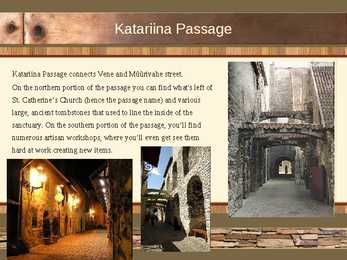
Katariina Passage Katariina Passage connects Vene and Müürivahe street. On the northern portion of the passage you can find what's left of St. Catherine's Church (hence the passage name) and various large, ancient tombstones that used to line the inside of the sanctuary. On the southern portion of the passage, you'll find numerous artisan workshops, where you'll even get see them hard at work creating new items. City wall Tallinn's medieval city wall is a sub-facility that was built
Kildu Basic School Viljandi by Eisi Kõiv Supervisor: Margit Kirss Kildu 2008 Our 700 years old Viljandi Viljandi is a town (24,000 inhabitants) in Estonia, 160 km south of the capital Tallinn. The town is the administrative capital of the county with the same name as the town. In Viljandi there is theater Ugala, cinema Rubiin, museum, art gallery. Give a concert in Culture centre, Jaani- and Pauluse church, but in Cultureacatemy, too. Folk Summer in Viljandi culminates with the annual folk music festival. The Viljandi Folk Music Festival is a music festival in Estonia with a central focus on European folk music.In the year 2006, over 24,000 people attended the concerts, but many more just came to take part in the festivities. As such, it is the largest annual music festival in
ideal crossing point, they built London Bridge. Less than 20 years later the native Iceni tribe, led by Queen Boudicca, rose up against the Romans in revenge for mistreatment and burnt Londinium to the ground. The well disciplined Roman army defeated her forces and Londinium was rebuilt. By AD 100 it had also become the capital of the Roman province. A massive wall was built to protect the city from further attacks. The Roman Empire came under increasing attack across Europe and in AD 410 they retreated. The Romans gave us a language based on Latin, the calendar, law and legal system, the census and also straight roads, central heating and concrete. Anglo- Saxons around AD 400 Anglo- Saxons were warrior farmers from Germany, Denmark and the Netherlands. Later in the 5th century, Anglo-Saxons settled just west of Londinium, around the Strand, and formed the town of Lundenwic. The area of the old Roman city became a landing-place for ships and a centre for trade
Fifth level The Building The Revaler Handels Bank built our magnificent buliding at Vene Street 9 in 1878. Designed by the architect Peter Schreiberg from St. Petersburg, it was originally a four storey house, the two topmost floors added later. When the Republik of Estonia was established in 1918, the building was used as the post and telegraph center. The building retained this function in Soviet period.I In 2005, the wing of our building which had been destroyed in World War II was rebuilt. Location Click to edit Master text styles Vene Street known as the Second level historic area of culture is Third level one of the most favoured Fourth level spots in the Old Town.
The City of London History The City of London occupies one square mile in the middle of the capital. It once made up the entire town of London, surrounded by the wall first built by the Romans. The Roman Londinium grew up on the northern side of the "London Bridge" in the past. Products such as olive oil, wines and fruit were brought by ships from different parts of the Roman Empire and unloaded onto wooden quays along the river. In AD 61 the native Celtic Iceni tribe, led by Queen Boudicca, rose up against The Romans. They burnt Londinium to the ground but Roman armies eventually defeated Boudicca. The city was rebuilt and was gradually surrounded with a wall of stone and brick which lasted for many centuries.
THE CITY OF LONDON History The City of London occupies one square mile in the middle of the capital. It once made up entire town of London, surrounded by the wall first built by Romans. The Romans also built a bridge over the Thames and there has been one in the same area ever since. The Roman Londinium grew up on the northern side of the bridge. In AD 61 the native Celtic tribe, led by Queen Boudicca, rose up against the Romans. They burnt down Londinium to the ground and killed most of its inhabitants. Roman armies eventually defeated Boudicca and Londinium was rebuilt. At the end of the fourth century AD the Roman Empire began to crumble and the Roman armies were recalled from Britain to defend Rome itself. Once they had left, tribes such as Angles,
Estonian cities Tallinn is the capital and largest city of Estonia. It occupies an area of 159.2 square kilometers with a population of 413,000. It is situated on the northern coast of the country, on the banks of the Gulf of Finland, 80 km south of Helsinki, east of Stockholm and west of Saint Petersburg. Tallinn was founded in the 12th century and has been under the rule of Denmark, Sweden, and Germany as well as Russia, and all left their mark on the city's architecture. It is one of the best preserved medieval towns in northern Europe, and makes a beautiful impression from the sea, with its ancient city walls, church spires, and red-tile roofed homes
till the end of a XIX-th century. It was the centre of medieval marketing that has provided him well- being. Now it is the most popular place among tourists with shops and big variety of restaurants. It was opened 22 july 1718 year.Kadriorg it is the largest park in Tallinn.Kadriorg`s founder was the Peter I. He named the park in honour of his wife Ekaterine I. Y ou can walk around this beautiful park and enjoy delightful sights of nature. Tallinn Hall square is the area, popular in summer months and is filled with street cafes. In winter, by the tradition which has remained since 1441, Hall square is the area decorated by a huge Christmas tree. Town Hall Square for centuries been used as a market and fairs square and also served as a gathering place for people. The Kumu Art Museum is a modern multifunctional art building, which contains exhibition halls, a lecture hall offering diverse facilities, and an educational centre for
Sightseeing in Estonia Tallinn TV Tower The Tallinn TV Tower (Tallinna teletorn) is a free-standing structure with an observation deck, built to provide better telecommunication services for the 1980 Moscow Summer Olympics regatta event (see Sailing at the 1980 Summer Olympics). It is located near Pirita, six km north-east of the Tallinn city center. The tower has a specified height of 314 m (1030.2 ft), though some sources put it at 312.6 m (1026.6 ft). The building is administered by the public company Levira (formerly Estonian Broadcasting Transmission Center Ltd) and is a member of the World Federation of Great Towers. The tower was designed by architects David Baziladze and Juri Sinis. The cornerstone was laid on September 30, 1975, and the building was inaugurated July 11, 1980 (although the first transmission took place in 1979)
The first theatre house in Tallinn was mentioned in written materials which date from the late 17th century; the house was used by travelling theatre groups. Tallinn was already known then as a theatre-loving city. The first prominent name in Estonian history of theatre, August von Kotzebue, dates from the same period. The Russian authorities sent him from St. Petersburg to Tallinn to work as an official. Kotzebue's entertaining productions became famous all over Europe. He founded the first theatre with its own permanent cast, and brought the Estonian language to the stage. Theatre became especially popular amongst Estonians in the second half of the 19th century, as part of the national awakening process. Theatres in Estonia, like elsewhere in the world, may be divided into three categories according to their form of ownership: state, municipal and private theatres. In Estonia, the
Tallinn's small coat of arms is also the Great Guild's coat of arms. Guild was led by Alderman, with the assistance of two advisers. Guild only accepted merchants, who had a house, wife and who was local. Great Guild activity ended in 1920, when Estonia abolished guilds. The Great Guild Hall The Great Guild Hall is one of the most outstanding buildings of medieval Tallinn. In 1406, it was purchased Burgomaster Gosschalk Schotelmund's house on Pikk street. In 1410, the construction was completed. Same year the Great Guild moved into the building. The facade was designed in a style characteristic of gothic Tallinn. The 16th century witnessed the addition of a gable tower with wind vane, as well as a light latern above the main portal. In 1551, the excise chamber was built at the end of Börsi passage facing Pikk street. The Great Guild Hall The wind vane and coat of arms In the 19th century, the Guild Hall's windows were remodelled in the neo-gothic style and
 annaabi.ee