Leidsid 33 sarnast õppematerjali, mis on seotud failiga "Questions negative sentences 2". Need materjalid aitavad sul teemat sügavamalt mõista.
work, night, children, live, birthday, mary, christmas, morning, trips, late, visit, days, four, went, first, weekend, snow, year, usual, winter, monday, present, often, practice, month, mother, expensive, hard, whom, came, eitav, during, holidays, good, party, finish, close, gates, stories, piano, pamela, grow, kids, film, granny, yesterday, presentsTower, the Simpsons A – AN - THE Time Expressions • we don't use an article: at night, at noon, every We don't usually use an article week, every day, every night, last morning, last • to talk about things in general. • before the names of countries, cities, towns and villages. week, all night, all day, tomorrow, yesterday,... • with plural nouns and uncountable nouns when talking about them • use the with in the morning, in the afternoon, generally
sentence: The dog is barking. Come here! 4Always use a capital letter for the word I : I am eight years old. Tom and I are good friends. 4Use a capital letter for the names of people: Alice, Tom, James, Kim, Snow White 4Use a capital letter for the names of places: National Museum, Bronx Zoo, London, Sacramento 4Use a capital letter for festivals, holidays, days of the week, months of the year: New Year's Day, Christmas, Labor Day, Mother's Day, Sunday, Monday, Friday, January, May, July, October Exercise 1 Circle the letters that should be CAPITALS. Then write the correct letter in the space above them. 1 peter and i are good friends. we are going to chicago during our summer 2 vacation. 3 there is an interesting football game on sunday. 4 jason lives on thomson avenue. 5 january is the first month of the year. Exercise 2
Here's a breakdown of how you can express how you really are without complaining too much. · Fine, thanks. / On top of the world, thanks. · OK, thanks · Not so bad, thanks. / Can't complain, thanks. · So so, thanks. / So and so, thanks. · Not so good, actually 1 The English alphabet Spelling Work with your partner and spell out first your name and then some names of places. Write down each letter as you hear it, and then say the word. The English alphabet on the phone: You might find the following alphabet (used by international airlines) useful when trying to spell a word on the telephone. A Alpha O Oscar Ä Alpha-Echo Ö Oscar-Echo B Bravo P Papa
in brackets. _ 1 She is in a band and she _________________________________ (record) a CD at the moment. _ 2 She is an actress and often _________________________________ (appear) on television. _ 3 At the moment she _________________________________ (have) a rest because she is tired. _ 4 Mike is a doctor and he _________________________________ (live) in Manchester. _ 5 I _________________________________ (start) work at 8.30 every morning. _ 6 He is a good cook but she _________________________________ (prefer) to eat out. _ 7 English tests _________________________________ (get) more and more interesting. _ 8 They _________________________________ (have) a party because it's her birthday. _ 9 I sometimes _________________________________ (ride) my bicycle to school. 10_ She usually _________________________________ (go) to the gym on Friday evenings.
.....................................................6 Word Order in General Questions.........................................................7 Word Order in Special Questions ..........................................................8 Word Order in Subject Questions ..........................................................9 Types of Sentences There are four basic types of sentences in English. AFFIRMATIVE and NEGATIVE sentences both end with a full stop ( ) : . I live in Tallinn. I do not live in Tallinn. I never watch soap operas. INTERROGATIVE sentences end with a question mark ( ? ) : Do you live in Tallinn? Why do you never watch soap operas? EXCLAMATORY and IMPERATIVE sentences end with an exclamation mark ( ! ) : What a beautiful day! Do your homework at once! Parts of the Sentence The basic parts of the sentence are: THE SUBJECT (WHO? WHAT?) , THE PREDICATE (does, is doing, has done, etc – action/statement),
Exercises 1. Use the Present Simple of the verb be or have. ( 10 points ) Mary........blue eyes and blond hair, but her brother ........dark hair. He ........in his late twenties. He........married and........two sons. I........short, but my sister........tall. We........a dog and a cat. Our uncle........two dogs. They........brown. 2. Choose the correct item. ( 5 points ) e.g. The residents were made...D....their homes by the authorities. A leave B leaving C left D to leave 1) Ann is my best friend! We........each other for years A know B knew C knows D have known
· When do we board the plane? Examples: · The party starts at 8 o'clock. · When does class begin tomorrow? · I play tennis. · She does not play tennis. USE 4 Now (Non-Continuous Verbs) · Does he play tennis? · The train leaves every morning at 8 AM. · The train does not leave at 9 AM. · When does the train usually leave? · She always forgets her purse. · He never forgets his wallet. Examples: · Every twelve months, the Earth circles the Sun. · I am here now. · Does the Sun circle the Earth? · She is not here now. · He needs help right now.
He/she/it has been going He/she/it has not been going Has he/she/it been going? We/you/they have been making We/you/they have not been making Have we/you/they been making? Kestev täisminevik väljendab: · Tegevust, mis on hiljuti või alles lõppenud, kuid mille algust ega lõppu pole teada. You are wet. Have you been running in the rain? They have been talking to Mary and they have decided... · Tegevust, mis algas enne kõnemomenti, kestab selleni või peale seda. Sel juhul rõhutakse tegevuse kestvusele (how long, for, since etc). How long have you been learning Italian? I have been drawing for almost two hours now. Past Continuous Kestva mineviku moodustamine Jaatav vorm Eitav vorm Küsiv vorm
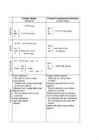
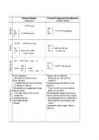
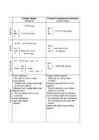
She is marta we aren't are we German? you aren't, they aren't. It is a school. you aren't are you German? We are students they aren't are they German? You are in class 12 They are teachers Unit 2 / present simple + - ? yes- I do, you do, he/she/it does. I work I don't work Do I work no I don't, you don't, he/she/it doesn't You work you don't work do you work? He/she it works he/she/it doesn't works does he/she/it work We work we don't work do we work You work you don't work do you work? They work they don't work do they work? Unit 6 / Present Continuous be- verb-ing / kestev olevik
1. Write the verbs in the present continuous or the past continuous tense. Do you remember? am is are was were verb -ing 1 Sorry. I ... (write) a report at the moment. I can't come with you. 2 When Peter arrived, his friends ... (play) football. 3 I ... (sleep) when the alarm went off in my sister's room. 4 Dad's mobile phone is switched off because he ... (fly) to Paris. He's on the plane at the moment. 5 I ... (read) an interesting book. It's a collection of memories. 6 Leo was late again. He ... (step) out of his father's car when the bell rang. 7 Helen ... (lie) on the sofa when an ambulance stopped in front of the house. 8 I ... (give) this report from inside the school radio studio. Right now, the two teams ... (take) their places on the football field. 9 Mrs Watson ... (make) her speech when the girls rushed in. --- 4 2. Write the verbs in the past simple, the future simple, or the present perfect tense. Do you remember? I started I'll start
klassile Õpik: I love English 4 Kokkuvõte aasta jooksul õpitust. Koostaja: Gea Gutmann Viljandi Maagümnaasium Juhendaja: Toomas Rähn Final Test Form 7 Name................. 1. Use the right tense. (15 p) 1) Look! She....................................(carry) a heavy bag. 2) Mrs. Brown...................................(play) the piano at the concert next week. 3) Mary is a good girl. My mother............................(meet) her every day since she and her father moved here. 4) Yesterday at two o`clock Tom ..............................(sing) and his sister ........................... (draw) a pictuture in the living room. 5) The wind ........................(be) very strong some days ago. 6) Where are the children? They ...................................... (play) with their ball in the garden. 7) He...............................(go) to work every day
34. Are sports days held at your school? 35. What sports events do you watch on TV? 36. Do you read the sports page in a paper? Do you watch/listen to sports news? Could you tell us the latest sports news? 37. Who is the best athlete in your class? 38. Who is your favourite athlete? What do you know about him? 39. What sports events are popular in Estonia? How many Estonian Olympic gold medalists can you name? 40. Do you think it is necessary for children to play sport? Why? 41. Do you know any Estonian people who are known to everyone and liked by all? Are they politicians, writers, scientists, musicians? 42. Can you name some Estonian writers who are famous for their humour? Which of their books have you read? 43. What kind of books do you like to read? 44. When did you last read a poem? 45. Do you enjoy reading poems? http://www.abiks.pri.ee 46
" "I desire you will do no such thing. Lizzy is not a bit better than the others; and I am sure she is not half so handsome as Jane, nor half so good-humoured as Lydia. But you are always giving her the preference." "They have none of them much to recommend them," replied he; "they are all silly and ignorant like other girls; but Lizzy has something more of quickness than her sisters." "Mr. Bennet, how can you abuse your own children in such a way? You take delight in vexing me. You have no compassion for my poor nerves." "You mistake me, my dear. I have a high respect for your nerves. They are my old friends. I have heard you mention them with consideration these last twenty years at least." "Ah, you do not know what I suffer." "But I hope you will get over it, and live to see many young men of four thousand a year come into the neighbourhood."
.................................................... 8 Prepositional Phrases ......................................................................................... 8 Prepositions of Time – in, on & at • in is used with centuries, decades, years, seasons and months, parts of the day, periods of time • on is used with dates, special days, days of week, day of week + part of day, day + of ... • at is used with holidays, exact time, meals and with night in on at • the 20th century • the 29th of November • Christmas / Easter • the Middle ages /August the first • six o’clock / 7.30 • the 1980s • Christmas Day / New • midday / noon / • 2006 Year’s Eve / Easter midnight • winter / summer Sunday • the weekend /
In London you'll also find Indonesian, Mexican, Greek... Cynics will say that this is because English have no "cuisine" themselves, but this is not quite the true. Vocabulary: to criticize - tasteless overcooked - ingredient - to invent - sauces - to disguise - spice herb - delicious - disappointing - to lend cuisine British Youth (2) Most 18 and 19 year-olds in Britain are quite independent people. English people say that children grow up more quickly now. Relationships within the British family are different now. Children have more freedom to make their own decisions. For example, children aged 13 may be employed part time in Great Britain. Age 15 is legally a "young person" not a "child". Age 16 is a school leaving age. They can leave home, drive a moped, marry with "parents' consent" buy beer. Age 17 can drive a car. Age 18 can vote, get married, drink in pubs.
Chapter1: An unknown woman was found lying in the street and brought into the workhouse. She delivered a sickly child who had trouble breathing. The woman, without a word of who she was, died and left her new born boy, Oliver, to the drunken nurse that stood by. Chapter2: The State gave Oliver to Mrs. Mann who housed a number of orphaned children. Mrs. Mann took a large portion of the money given to her by the authorities for each child's food so Oliver grew up small and malnourished. On his ninth birthday, the town beadle, Mr. Bumble, came to collect Oliver and take him to the board for an interview. They told him he was to live with other wards of the state to become educated and learn a trade. Oliver did not mind this, but soon after he arrived, the state
hurt. Will you take these to your room and keep them safe? I dont want to run the risk of their being missing. What does she do with the ring? She gives that ring back. What do the slippers symbolize in this act and throughout the play? These symbolize Higgins' feeling over Eliza and also Eliza's internal strength. He demands that she fetch his slippers for him and she throws them at him, which eventually leads to her departure and decision that she will live without him, showing her integrity. Why does Eliza leave in the middle of the night? She has an argument with mr.Higgins. Who does she meet behind the front door? Freddy Why does Eliza want to go to the river and is she able to go through with her plan? To make a hole in it Where does she go next morning? (See from the movie) Back to the gutter. What is Mrs. Higgins's opinion of why Eliza has gone away? She thinks that mr. Higgins frightened Eliza away.
3 a to have b criticising 2A Value and price page 11 4 It didn't rain on either Tuesday or 4 a playing b to teach 1 1 priceless 6 economic Wednesday. 5 a taking b to take 2 pricey 7 profitable 5 None of the shops are open. 3 worthy 8 valuable 3 1 I advised Mike to get an early night. 6 The food was neither cheap nor 4 financial 9 worthless 2 I agreed to give Jenny a lift into good. 5 costly 10 economical town. 7 There are no easy answers.
Use: 1. Things in general. Nurses look after patients in hospitals. 2. Things that happen all the time or repeatedly. She usually goes away at weekends. 3. Laws of nature (things that are true in general). The sun rises in the east. 4. Timetable events. The train leaves at 6.50 p.m. Negative form: I don't (do not) normally eat my lunch here. He doesn't (does not) like this film at all. Question form: Do you live here? How often does it rain around here? Signal words: always, every day/month, never, normally, often, seldom, sometimes, usually etc. PRESENT CONTINUOUS/PROGRESSIVE (kestev olevik) Form: am/is/are + ing Use: 1. Unfinished actions happening at or around the time of speaking. Listen! Somebody is crying. They are building a new bridge in our town. 2. Changes happening around now
) How long have you been in this country? (NOT How long have you been in that country?) 20. Use a plural noun after one and a half. We waited one and a half hours. (NOT We waited one and a half hour.) A mile is about one and a half kilometres. (NOT A mile is about one and a half kilometre.) 21. Use the present perfect, not the present, to say how long things have been going on. I've been waiting since 10 o'clock. (NOT I'm waiting since 10 o'clock.) We've lived here for nine years. (NOT We live here for nine years.). 22. The majority is normally plural. Some people are interested, but the majority don't care. (NOT ... but the majority doesn't care.) The majority of these people are very poor. (NOT The majority of these people is very poor.) 23. Use too much/many before (adjective +) noun; use too before an adjective with no noun. There's too much noise. I bought too much red paint. Those shoes are too expensive. (NOT Those shoes are too much expensive.) 24
Home and family Ex. 3 p. 31 a. When she was 15. Emma's behavior got worse. b. It's very hard for them it they have suddely leave and live out in the world on their own. c. Caroline was a real friend. d. She has friends, a boyfriend and a busy social life. e. I have to treat her like an adult and give her space. Ex. 4 1. Emma was unhappy. She was smoking and drinking. She kept missing school and getting terrible fights. She stayed out at night, wen clubs, often got into trouble with the police and even started taking drugs. 2. Caroline was fostered a lot of teenagers before
5 ’s 6 high 6 talked 7 catching 10 8 feeling 2b 9 is 3a 10 couldn’t 4a 5b 5 6b 2 come 7b 3 live 4 came 11 5 study 2 My pleasure. 6 like 3 I’m fine, thanks. 7 got 4 Lovely day today. 8 have 5 It doesn’t matter. 9 can 6 What’s the problem? 10 go 7 Same to you.
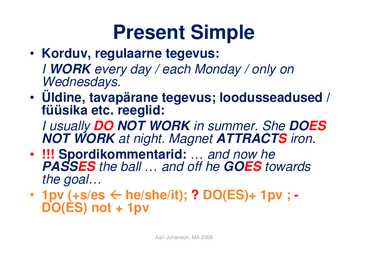
Present Simple · Korduv, regulaarne tegevus: I WORK every day / each Monday / only on Wednesdays. · Üldine, tavapärane tegevus; loodusseadused / füüsika etc. reeglid: I usually DO NOT WORK in summer. She DOES NOT WORK at night. Magnet ATTRACTS iron. · !!! Spordikommentarid: ... and now he PASSES the ball ... and off he GOES towards the goal... · 1pv (+s/es Å he/she/it); ? DO(ES)+ 1pv ; - DO(ES) not + 1pv Aari Juhanson, MA 2008 Present Progressive · Hetkel toimuv, pooleliolev tegevus: S/he IS TALKing on the phone now. I AM READing an interesting book. · Ajutine, regulaarsele ja tavapärasele vastanduv tegevus (tulevikku viitav): This summer they ARE not GROWing
Time Warner Book Group 1271 Avenue of the Americas, New York, NY 10020 Visit our Web site at www.lb-teens.com First Edition: September 2005 The characters and events portrayed in this book are fictitious. Any similarity to real persons, living or dead, is coincidental and not intended by the author. Library of Congress Cataloging-in-Publication Data Meyer, Stephanie, 1973-- Twilight : a novel / by Stephanie Meyer. -- 1st ed. p. cm. Summary: When seventeen-year-old Bella leaves Phoenix to live with her father in Forks, Washington, she meets an exquisitely handsome boy at school for whom she feels an overwhelming attraction and who she comes to realize is not wholly human. ISBN 0-316-16017-2 [1. Vampires -- Fiction. 2. High schools -- Fiction. 3. Schools -- Fiction. 4. Washington (State) -- Fiction.] I. Title. PZ7.M57188Tw2005 [Fic] --dc22 2004024730 Printed in the United States of America For my big sister, Emily, without whose enthusiasm this story might still be unfinished.
Kordamine inglise keele eksamiks A 1.1 Read the text and answer the questions below. Dear Mary-Alice, It's been ages since I last wrote to you, isn't it weird? Yes, so it is, but, I do have a certain reason. Do you remember Sir Thom of the Minquettes'? That fine young man with fascinating blue eyes... Oh, my sweet Mary, you will never guess what happened yesterday! It was about seven o'clock in the evening when Lillian called me out for a walk you know I can't say `no' to my little sis. Anyway we went to the forest near the Swan Lake and, believe it or not, got lost! Awful! I was so scared... We walked and walked, not even knowing the direction we were heading to, until we reached a huge mansion. And the garden around it was so extraordinary... That is something you just must see
pre-eminent dramatist. He is often called England's national poet and the "Bard of Avon" (or simply "The Bard"). His surviv- ing works consist of 38 plays, 154 sonnets, two long narrative poems, and several other poems. His plays have been trans- lated into every major living language, and are performed more often than those of any other playwright. Shakespeare was born and raised in Stratford-upon-Avon. At the age of 18 he married Anne Hathaway, who bore him three children: Susanna, and twins Hamnet and Judith. Between 1585 and 1592 he began a successful career in London as an actor, writer, and part owner of the playing company the Lord Chamberlain's Men, later known as the King's Men. He ap- pears to have retired to Stratford around 1613, where he died three years later. Few records of Shakespeare's private life survive, and there has been considerable speculation about such matters as his sexuality, religious beliefs, and whether the
2. Present Simple [VERB] + s/es in third person. Tegevus on korduv või tavapärane. You speak English. I play tennis. Cats like milk. The train leaves tonight at 6 PM. I am here now. Active= Once a week, Tom cleans the car. Passive= Once a week, the car is cleaned by Tom. 3. Present Continuous [am/is/are + present participle]. Tegevus toimub/ei toimu praegusel hetkel. You are watching TV. You are learning English now. I am studying to become a doctor. I am meeting some friends after work. Active= Right now, Tom is writing the letter. Passive= Right now, the letter is being written by Tom. 4. Past Simple [VERB+ed] or irregular verbs. Tegevus algas/lõppes minevikus täpsel ajal. . You called Debbie. I saw a movie yesterday. I finished work, walked to the beach, and found a nice place to swim. I lived in Brazil for two years. I studied French when I was a child. Active = Tom repaired the car. Passive= The car was repaired by Tom. 5
forehead. I've seen photos of her when 1E Phrasal verbs page 8 5 (possible answers) she was my age and apart from the 1 1 go ahead 5 come to eighties hairstyle we're the spitting 1 Well, you will go to bed late every night. 2 fall through 6 bring about image of each other! Some people 2 Well, you will refuse to wear a 3 tip off 7 go down with say that they can see a strong family coat. 4 mistake for 8 come up with
o'clock. 39. It lasts ..................two hours and forty-five minutes. 40. That's interesting. I haven't been ..................the cinema for so many years. 2.Tenses ( Active/ Passive ) 1. Once a week, Tom ................................................ the house.(CLEAN) 2. The customer by the salesman .........................................when the thief came into the store. (HELP) 3. Recently, John ............................................................................... the work.(DO) 4. Many tourists ......................................................................... that castle.(VISIT) 5. Sally ................................................................................ a beautiful dinner tonight.(MAKE) 6. The work ............................................................................. by 5:00 PM.(FINISH) 7. That castle ............................................................ by many tourists.(VISIT) 8. Right now, the letter ........................
Am he Is I vorm+ing (playing) Does she I vorm Are it (Does ... play ... ?) Korduv tegevus: Praegu toimuv tegevus: We have art twice a week. What are you doing there, Püsiv olukord: children? Children start school at the age Praeguse perioodi vältel toimuv of seven in Estonia. tegevus: Sõiduplaanide ja ajagraafikutega They're building a new railway KASUTAMINE seotud tulevik: station in our town. The train leaves at 9 o'clock Ettekavatsetud tegevus tulevikus, tomorrow
Am he Is I vorm+ing (playing) Does she I vorm Are it (Does ... play ... ?) Korduv tegevus: Praegu toimuv tegevus: We have art twice a week. What are you doing there, Püsiv olukord: children? Children start school at the age Praeguse perioodi vältel toimuv of seven in Estonia. tegevus: Sõiduplaanide ja ajagraafikutega They're building a new railway KASUTAMINE seotud tulevik: station in our town. The train leaves at 9 o'clock Ettekavatsetud tegevus tulevikus, tomorrow
Am he Is I vorm+ing (playing) Does she I vorm Are it (Does ... play ... ?) Korduv tegevus: Praegu toimuv tegevus: We have art twice a week. What are you doing there, Püsiv olukord: children? Children start school at the age Praeguse perioodi vältel toimuv of seven in Estonia. tegevus: Sõiduplaanide ja ajagraafikutega They're building a new railway KASUTAMINE seotud tulevik: station in our town. The train leaves at 9 o'clock Ettekavatsetud tegevus tulevikus, tomorrow
Test 2 1 Translate. 1 Küll on kahju, et sa ei saanud tulla. What a pity that you couldn´t came. 2 Mitte keegi ei olnud närvis. Nobody was nervous. 3 Klass oli täis juttu ja naeru. The classroom was full of laughter and talk. 4 Õpilased tervitasid oma õpetajat rõõmsalt. The students greeted their teacher cheerfully. 5 Ma õppisin selle luuletuse pähe. I learned this poem by heart. 6 Lapsed olid enne pidu ootusärevil. The children were excited before the party. 7 osasid vahetama swap the role 8 kahe nädala pärast in two time a week 2 Complete the sentences with the correct verb form 1 Did you meet Ann at the party last night? (meet) 2 Do you think our team will win the football match tomorrow? (win) 3 I can´t go out because I haven´t done my homework yet. (not do) 4 Somebody has broken the lock. I can´t get in. (break) 5 Next year Mary will spend two weeks in Liverpool. (spend)
 annaabi.ee