Leidsid 33 sarnast õppematerjali, mis on seotud failiga "Old Tallinn". Need materjalid aitavad sul teemat sügavamalt mõista.
hill, century, medieval, toompea, russia, museum, danes, part, northern, came, 14th, there, houses, place, atop, first, became, wall, stands, including, towers, several, interesting, church, cathedral, filled, easily, settle, built, showed, convert, local, christianity, wanted, improved, expanded, league, trading, hundred, sold, order, branch, plaguerestaurants, sport and cultural centres. Every five years national song and folk dance festivals take place in Tallinn. The yachting regatta of the 1980 Moscow Olympic Games was held at Pirita. History Tallinn means in English "Danish town". The place is believed to have been settled by Finno-Ugric people about 2500 BC. It was first marked on a map of the world by the Arab geographer al-Idrisi in 1154. The Estonians were the first to build a stronghold on the spot of the Toompea Hill, but the real Tallinn was built by the Danes who conquered the north of Estonia in 1219. Legend has it that one day, when the Danes were about to lose a bloody battle, the sky suddenly opened and a red flag with a white cross on it dropped down upon them from the heaven. This is how the Danes obtained their national flag. In 1346 the Danish king sold his Estonian lands to the Teutonic Order, who a year later resold them to the Livonian Order. The Germans renamed Tallinn and called it Reval.
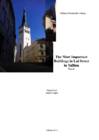
Tallinn English College English Sergo Vainumäe 9A TALLINN Report Supervisor: Inge Välja Tallinn 2006 Order of contents: 1.Introduction 2.Toompea 3.Lower Town 4.Kadriorg and Pirita 5.Museums 1. Introduction Tallinn, the capital of Estonia, lies on the Baltic Sea. It is on almost the same latitude east St. Petersburg in Russia, Stockholm in Sweden and Stavanger in Norway, and covers 158 sq km. Tallinn was first marked on a map of the world by the Arab geographer al-Idrisi in 1154, its name then being Kolyvan (probably derived from the name Kalev). In the 13th-century Chronicle of Henricus de Lettis the town was called Lyndanise. Later came Reval (presumably after the old county of Rävala), the name used by the Germans who ruled the country for seven centuries. Russians then modified Reval to Revel
2 Towns (Upper & Lower Town) Tallinn used to be divided into 2 parts - Upper Town where lived the aristocracy, gentry and the clergy; and Lower Town with traders, craftsmen and merchants. Legend says the Toompea Hill is actually the tumulus mound of the great Kalev. Linda carried rocks to his grave. It is a naturally- formed limestone hill. Lower Town was a merchantile centre, Tallinn also belonged to the Hansaetic League (1285). It is often referred to as the town of citizens. Any grown-up, married and economically independent person, born in a legal marriage between two free people and having lived in the town for at least 3 months, could apply to the Magistracy for citizenship. Serfs could escape from serdom after having successfully hidden in town for a year and a day.
Tallinn Tallinn is situated on the southern coast of the Gulf of Finland, in north-western Estonia. A limestone cliff runs through the city. It is exposed, for instance, at Toompea and Lasnamäe. However, Toompea is not a part of the cliff, but a separate hill. Coastline is 46 kilometres long.The highest point of Tallinn, at 64 meters above the sea level, is situated in the district of Nõmme, in the south-west of the city. The first human steps, that archeologists found, are about 5000 years old. Tallinn`s first fortress was built in Toompea, in 1050. As an important port for trade between Russia and Scandinavia, it became a target for the expansion of the Teutonic Knights and the Kingdom of Denmark
Kunda Ühisgümnaasium Tallin Old Town Report Student: Kristin Karu Teacher: Kristi Aron Kunda 2012 The Alexander Nevsky Cathedral The Alexander Nevsky Cathedral is an orthodox cathedral in the Tallinn Old Town,Estonia. It was built to a design by Mikhail Preobrazhensky in a typical Russian Revivalstyle between 1894 and 1900, during the period when the country was part of theRussian Empire. The Alexander Nevsky Cathedral is Tallinn's largest and grandest orthodox cupola cathedral. It is dedicated to Saint Alexander Nevsky who in 1242 won the Battle of the Ice on Lake Peipus, in the territorial waters of present-day Estonia. The late Russian patriarch, Alexis II, started his priestly ministry in the church. Interior of the Cathedral. The Alexander Nevsky Cathedral crowns the hill of Toompea where the Estonian folk hero
Names of town ● Lindanise - it was first used in 1219, derived from mythical Linda, the wife of Kalev and the mother of Kalevipoeg, national hero. ● Koluvan - found in old Russian chronicles, the name possibly deriving from the Estonian mythical hero Kalev ● Reval - used after 1219; comes from two german words ‘reh’ and ‘fall’, meaning the falling of the deer - as they fall down the Toompea hill, probably when escaping from the Danish occupation or just the hunters. ● Tallinn - used after Estonia gained its independence in 1918, origin is definitely estonian; meaning Taani-linn, tali- linn. Liberty Square ● The central square of Tallinn, it was renovated in 2008. There used to be Harju gate, which can now be seen through glass. ● The statue of Liberty, 2009; represents freedom, Estonia has been under many foreign powers, starting with Danes,
trade (16%) and transport and communication (14%). History. Tallinn has a great history. It was first marked on a map of the world by the Arab geographer al-Idrisi in 1154, its name then being Kolyvan. In the 13 th- century chronicle of Henricus de Lettis the town was called Lyndanise. Then it was called Reval for some time and finally Estonians started to call the town Tallinn from Taanilinn (Danish town) after the Danish conquest in the 13th century. The Knights of the Sword took Tallinn from the Danes in 1227 and made Toompea their fortress. In the middle of the 14th century Denmark sold its possessions in Estonia to the German Teutonic Order; Toompea became the seat of German-born gentry. A fortified wall was built between the Toompea (the Upper Town) and the Lower Town (inhabited by people of a lower social standing), as there were conflicts between the two. The doors and the gates of the wall were locked at night, a
Kunda Gymnasium Rait Türkel Old Tallinn Report Instructor:Teacher Kristi Aron Kunda 2012 Introduction Like most cities with an eight-hundred-year-old past, Tallinn is a patchwork of historic areas. The city's pride and joy is without a doubt its Medieval Old Town, but equally enchanting is the Kadriorg district, a throwback to the time when Estonia was ruled by the Russian Tsars. Tallinn is the capital and largest city of Estonia. It occupies an area of 159.2 km2 with a population of 416,470. It is situated on the northern coast of the country, on the shore of the Gulf of Finland, 80 km south of Helsinki, east of Stockholm and west of Saint Petersburg. Tallinn's Old Town is in the list of UNESCO World Heritage Sites
TOOMPEA Toompea (from German Domberg – Cathedral Hill ) is a limestone hill with an area of about 7 hectares in the central part of Tallinn. It towers about 30-40 m above the surrounding areas. According to the legend it´s the tumulus mound over the grave of the national hero Kalev, erected stone by stone in his memory by his grieving wife Linda. It is the birthplace of Tallinn - a place where in 1229 the Knights of the Sword built a fortress instead of the wooden Estonian stronghold. Toompea Castle is also one of the most potent symbols of the reigning power. Today Toompea is the seat of the Government of Estonia as well as the Riigikogu, both of which are often simply colloquially referred to as Toompea. For centuries there was only one access to Toompea - Pikk Jalg - but there is also another way leading up to Toompea - Lühike Jalg, which was made in the 14th century. At present Pikk Jalg and Lühike Jalg are used only by pedestrians. Until
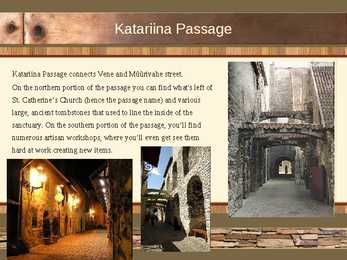
Katariina Passage Katariina Passage connects Vene and Müürivahe street. On the northern portion of the passage you can find what's left of St. Catherine's Church (hence the passage name) and various large, ancient tombstones that used to line the inside of the sanctuary. On the southern portion of the passage, you'll find numerous artisan workshops, where you'll even get see them hard at work creating new items. City wall Tallinn's medieval city wall is a sub-facility that was built
ideal crossing point, they built London Bridge. Less than 20 years later the native Iceni tribe, led by Queen Boudicca, rose up against the Romans in revenge for mistreatment and burnt Londinium to the ground. The well disciplined Roman army defeated her forces and Londinium was rebuilt. By AD 100 it had also become the capital of the Roman province. A massive wall was built to protect the city from further attacks. The Roman Empire came under increasing attack across Europe and in AD 410 they retreated. The Romans gave us a language based on Latin, the calendar, law and legal system, the census and also straight roads, central heating and concrete. Anglo- Saxons around AD 400 Anglo- Saxons were warrior farmers from Germany, Denmark and the Netherlands. Later in the 5th century, Anglo-Saxons settled just west of Londinium, around the Strand, and formed the town of Lundenwic
The Historic Centre (Old Town) of Tallinn is an exceptionally complete and well-preserved medieval northern European trading city on the coast of the Baltic Sea. The city developed as a significant centre of the Hanseatic League during the major period of activity of this great trading organization in the 13th-16th centuries. The combination of the upper town on the high limestone hill and the lower town at its foot with many church spires forms an expressive skyline that is visible from a great distance both from land and sea. The upper town (Toompea) with the castle and the cathedral has always been the administrative centre of the country, whereas the lower town preserves to a remarkable extent the medieval urban fabric of narrow winding streets, many of which retain their medieval names, and fine public and burgher buildings, including town wall, Town Hall,
Tallinn was granted the Lübeck law in 1248 and became the member of the Hanseatic League in 1285. General Data l Country - Estonia l County - Harju County l First appeared on map - 1154 l Town rights - 1248 l Mayor - Edgar Savisaar l Aera - Total 159.2 km2 (61.5 sq mi) l Population - (1 Mar 2012) Total - 416,470 Denisty - 2,614.0/km2(6,766.6/sq mi) Tallinn Coat of arms Flag Top 5 Attractions 1. Kiek in de Kök Visitors to the museum will see examples of Medieval firepower, displays detailing how the city's system of walls and towers developed through the centuries and an exhibit on crime and punishment in Old Tallinn. 2. Kadriorg Palace - Kadriorg Art Museum A trip to Tallinn isn't a trip to Tallinn without a visit to this magnificent northern baroque palace, built by Peter the Great for his wife, Catherine I, in 1718. The grandiose palace with its surrounding manicured gardens is
............................................... 11 47 Lai Street............................................................................ 12 50 Lai Street............................................................................ 13 Summary................................................................................. 15 References.............................................................................. 16 2 Introduction Pikk Street as the longest and also the main street from medieval times is well-known, but Lai Street that runs parallel to it is not. The aim of the report is to be helpful for the students of Tallinna Mustamäe College who study the history of Tallinn and would like to get additional information about Lai Street, as they need to pass the guide practice exam in form eleven. The report is divided into chapters so that each chapter deals with one of the important houses in Lai Street
Tallinn Mustamäe College G2K Jaana-Kristiina Jõgevest The Four oldest churches of Tallinn Report Supervisor: Ingrid Teigar Tallinn 2009 The Dome Church The Danes began fortification of Toompea after the conquest of Tallinn in 1219 and probably also built the first church there. It was presumably a wooden building located at the site of the present cathedral. However, a serious conflict with the Order of the Brothers of the Sword broke out soon as the latter wanted to gain control of the entire Estonia. The order succeeded in subordinating Tallinn and the whole of North Estonia to its rule in 1227. The monks of the Dominican Order began the construction of a stone church
THE CITY OF LONDON History The City of London occupies one square mile in the middle of the capital. It once made up entire town of London, surrounded by the wall first built by Romans. The Romans also built a bridge over the Thames and there has been one in the same area ever since. The Roman Londinium grew up on the northern side of the bridge. In AD 61 the native Celtic tribe, led by Queen Boudicca, rose up against the Romans. They burnt down Londinium to the ground and killed most of its inhabitants. Roman armies eventually defeated Boudicca and Londinium was rebuilt. At the end of the fourth century AD the Roman Empire began to crumble and the Roman armies were recalled from Britain to defend Rome itself. Once they had left, tribes such as Angles,
Tallinn Old Town It was built up from the 13th to 16th centuries, when Tallinn was a thriving member of the Hanseatic trade league. It is built on a big hill and is surrounded with big walls. There is a lot of medieval style houses and inns, courtyards, churches and museums and a lot more. Many have described Tallinn Old Town as mystic and addictive. Unlike other capital cities in Europe, Tallinn has managed to preserve the completeness and structure of it's medieval and Hanseatic origin. Even after 7 centuries, Town Hall Square still remains as the social heart of the city and is hosting many concerts and fairs. Town Hall on Town Hall square is the only intact Gothic town hall in Northern Europe, now operates as a museum and concert hall.On top of the Town Hall tower, you will see a beloved guard of Tallinn Old Town Vana Toomas.One of the most impressive churches in Old Town is 15th and 16th century, St
Sculptures and monuments St. John's Lutheran Church St John's Church was probably built in the first third of the 14th century. There is no other brick church decorated with so much terracotta plastic in Europe Eduard Tubin Monument The Eduard Tubin monument, marking the 100th birthday of the composer, was dedicated in 2005. The authors of the statue are sculptor Aili Vahtrapuu, architect Veronika Valk, with sound installations by Louis Dandrel.Eduard Tubin (1905-1982) was a versatile composer and conductor, one of the most recognized symphonists throughout history. He served as concert
Kildu Basic School Viljandi by Eisi Kõiv Supervisor: Margit Kirss Kildu 2008 Our 700 years old Viljandi Viljandi is a town (24,000 inhabitants) in Estonia, 160 km south of the capital Tallinn. The town is the administrative capital of the county with the same name as the town. In Viljandi there is theater Ugala, cinema Rubiin, museum, art gallery. Give a concert in Culture centre, Jaani- and Pauluse church, but in Cultureacatemy, too. Folk Summer in Viljandi culminates with the annual folk music festival. The Viljandi Folk Music Festival is a music festival in Estonia with a central focus on European folk music.In the year 2006, over 24,000 people attended the concerts, but many more just came to take part in the festivities. As such, it is the largest annual music festival in
INTRODUCTION Tallinn is the capital and largest city of Estonia. It occupies a surface of 159.2 km2 in which 404,000 inhabitants live. It is situated on the northern coast of the country, on the banks of the Gulf of Finland, in north-western Estonia. Tallinn is the location of many institutions of higher education and science. As an important port for trade between Russia and Scandinavia, it became a target for the expansion of the Teutonic Knights and the Kingdom of Denmark. Historically, the city has been attacked, sacked, razed and pillaged on numerous occasions. Although extensively bombed by Soviet airforces during the latter stages of World War II, much of the medieval Old Town still retains its charm. Since independence, improving air and sea transport links with Western Europe and
Turu Kael sidestreet. The market location perfectly suited for trade: five trade routes started there. The square is connected to Town Hall Square by a short sidestreet. Town Hall Square Was used as marketing place, for festivities as well as for executions. In summer it is filled with outdoors cafes In winter it becames a magical christmas market The L-shaped sigh There has been a town hall in Tallinn since at least 1322. Town Hall Built in 13th century The management of the city worked in the Town Hall until the year 1970 The only gothic town hall on Northern Europe Weathervane Old Thomas The height of the towe is 64 metres Town Hall pharmacy Is one of the oldest working pharmacies in Europe and the oldest company in Tallinn Was first mentioned in 1422 There were also sold other goods like: ground bats, dried frog feet etc You can try spiced wine claret which was known and valued during the middle
1. Fat Margareta - 16. Cent. Tallinn's most impressive defensive structures, the Great Coastal Gate (Suur Rannavärav) and Fat Margaret's Tower. They were built not only to defend the city from the seaward side of town, but also to impress any visitors arriving via the harbour. Fat Margareta used to be a prison. It is a town wall's building. Now it's home to the Estonian Maritime Museum, which provides a detailed look at the nation's seafaring past. 2. The Great Coastal Gate - with the Viru Gates, are the last of six gates that controlled access to the town in Medieval times. 3. Kolm Õde - a hotel. In 2003, three of Tallinn's splendid merchant houses, built in 1362, were renovated and united to create The Three Sisters, which now offers modern amenities with great design and a backdrop of medieval history. 4. Oleviste church baptism
Tartu, small town in southern-Estonia. Town was first mentioned in 1030. Nowadays there is living nearly 100 000 people. Tartu is known as city of students, and students come to improve to Tartu from all over the world. But Tartu is also known as a Hansa town, that is why one of the most attractive sightseeing place is the old town. It is a valuable place for Tartu and for Estonia as well. PHOTO HUNT MAP: Start the photo hunt on the corner of Lai and Jakobi street. Go up to the Toome hill, it's a great upturn and a great test for legs. As you move forward you will see the famous ,,Musumägi". In english it is called ,,The Kissing Hill" Take a picture with your crew members in the background of the hill. After a brief walk in the Toome Park you see the Ruins of Toome Cathedral. Is it possible to visit the ruins of the Cathedral? Now, go straight ahead until you reach the Lossi street, turn right. Soon you will see The Devils Bridge.
Tallinn English College Topic Estonia Tallinn 2008 1. Introduction Estonia is a small country about the size of Switzerland, or New Hampshire and Massachussetts combined. Estonia is named after the people called "Ests" who lived in the region in the 1 st century AD. The Republic of Estonia is one of the three countries commonly known as the "Baltic States". The other Baltic States are Latvia and Lithuania. 2. Geographical position Estonia is situated in northeastern Europe. Estonia is bounded on the north by the Gulf of Finland, on the east by Russia, on the south by Latvia and on the west by the Baltic Sea. In the north it borders on Finland. The coastline of the Baltic
Art Museum of Estonia Art Museum of Estonia was founded on November 17th, 1919, but it was not until 1921 that it got its first permanent building the Kadriorg Palace, built in the 18th century. In 1929 the palace was expropriated from the Art Museum in order to rebuild it as the residence of the President of Estonia. The Art Museum of Estonia was housed in several different temporary spaces, until it moved back to the palace in 1946. In September, 1991 the Kadriorg Palace was closed, because it had totally deteriorated by then. At the end of the year the Supreme Council of the Republic of Estonia decided to guarantee the construction of a new building for the Art Museum of Estonia in Kadriorg. Untill then the Knighthood House at Toompea Hill served as the temporary main building of the Art Museum of Estonia
LANDMARCS HYDE PARK: Hyde Park is one of the largest parks in central London, England and one of the Royal Parks of London, famous for its Speakers' Corner. The park is divided in two by the Serpentine. The park is contiguous with Kensington Gardens; although often still assumed to be part of Hyde Park, Kensington Gardens has been technically separate since 1728, when Queen Caroline made a division between the two. THE TOWER OF LONDON: Her Majesty's Royal Palace and Fortress, more commonly known as the Tower of London (and historically as The Tower), is a historic fortress and scheduled monument in central London, England, on the north bank of the River Thames. It is located within the London Borough of Tower Hamlets and is separated from the eastern edge
The City of London History The City of London occupies one square mile in the middle of the capital. It once made up the entire town of London, surrounded by the wall first built by the Romans. The Roman Londinium grew up on the northern side of the "London Bridge" in the past. Products such as olive oil, wines and fruit were brought by ships from different parts of the Roman Empire and unloaded onto wooden quays along the river. In AD 61 the native Celtic Iceni tribe, led by Queen Boudicca, rose up against The Romans. They burnt Londinium to the ground but Roman armies eventually defeated Boudicca. The city was rebuilt and was gradually surrounded with a wall of stone and brick which lasted for many centuries.
The UK & London The United Kingdom (or the UK) is a short way of saying the United Kingdom of Great Britain and Norther Ireland. The UK is situated north-west of the European continent between the Atlantic Ocean and the North Sea. The UK consists of England, Wales, Scotland and Northern Ireland. Its highest point is Ben Nevis in Scotland followed by Snowdon in Wales. The Severn is the longest river in the United Kingdom. Other important rivers are the Trent, the Mersey, the Tyne, etc. Lough Neagh which lies in the centre of Northern Ireland is thr UK's largest freshwater lake. The climate in the UK is variable. The weather changes so frequently that it is difficult to forecast. It is not unusual for people to complain that the weathermen were wrong
Estonia lies on the eastern shores of the Baltic Sea on the level northwestern part of the rising east European platform. Estonia is a flat country covering 46 226 square kilometers.Estonian's neighbours are Finland, Sweden, Latvia and Russia. Estonia is rich in islands. The two largest are Saaremaa and Hiiumaa . Saaremaa is famous for its big meteorite crater called Kaali and Hiiumaa is famous for its nature and plants. The countries highest point Big Egg hill ( Suur- Munamägi) reaches 318 meters above sea level. Estonia has many uplands too. The uplands are: Pandivere upland, Otepää upland, Vooremaa upland, Karula upland Haanja upland, Sakala upland. Estonia is covered by about 18 000 square kilometers of forest. Estonia is also rich in lakes and rivers The largest lake is Peipsi and the second-largest lake is Võrtsjärv. The largest river is Võhandu whinch is 162 meters long. Estonia has many national parks. A national park is a protected area
Festivals and events dedicated to the consumption of beer are a lot of fun, but if you want to get the true feel of the country, you need something a little more ethnic. Like a town fair. Just as July becomes August, the seaside town of Haapsalu will host a grand spectacle of rural Estonian entertainment. The White Lady Days is a summer celebration filled with amusement for all the family. Held in and around the remains of the Teutonic-knights-era castles, the fair combines enchanting medieval legends with modern countryside charm to create a comprehensive experience of Estonia beyond the big cities. But the legend of the White Lady of Haapsalu, which is at the heart of the festival, is perhaps the most famous tall tale of the many that are so abundant in Estonia's folklore. It is the story of a poor girl who falls in love with the son of the village elder, and disguises herself as a choirboy in order to sneak into the castle
Tallinn Lillekyla Gymnasium Report Legends of Tallinn Tallinn 2009 Introduction I chose the topic ,,Legends of Tallinn", because I had heard some splendid myths about Tallinn from my history lessons and I was eager to widen my horizon. I am quite interested in history in general and I especially love tales about medieval Tallinn. I hope that I will find out some entertaining stories to tell my friends. Legends of Tallinn There are many interesting legends about buildings or sights in Tallinn. Nobody can tell, if they are all true or not, but at least they make the medieval capital much more intriguing and attractive for tourists as for the locals.
The ship ensured a regular winter sea navigation for Tallinn up to the end of the independency period. 2. The Tallinn Song Festival Grounds The Tallinn Song Stage was built in 1959 for arranging the Song Festivals. The stage was meant to hold over 15 000 singers. Indoor rooms can be used as a backstage area during the concerts but those are also suitable for all kind of events, parties, concerts, 2 banquettes, fairs, exhibitions etc.In the northern side of the song stage there is 42 m high fire tower, which is used during the famous Song Festivals. It is also opened for the public all year long. 3. Kiek in de Kök tower The cannon tower Kiek in de Kök was founded in 1475-1483. In 1696 the present name Kiek in de Kök was also
Topic London Tallinn English College Tallinn 2007 1. Introduction London is the capital city of the United Kingdom and the largest urban area in England. The ancient City of London, to which the name originally belonged, still maintains its medieval boundaries, but the name "London" has long applied more to the whole metropolis that has grown up around it. London has been an important settlement for over two millenniums. It is also one of the world's leading business, financial and cultural centres and its influence in politics, education, entertainment and even fashion contribute to its status as a major global city. London is a major tourist attraction with four world heritage sites, several royal parks
 annaabi.ee