 10 punkti
Autor soovib selle materjali allalaadimise eest saada 10 punkti.
10 punkti
Autor soovib selle materjali allalaadimise eest saada 10 punkti.
 ~ 12 lehte
Lehekülgede arv dokumendis
~ 12 lehte
Lehekülgede arv dokumendis
 2016-01-15
Kuupäev, millal dokument üles laeti
2016-01-15
Kuupäev, millal dokument üles laeti
 2 laadimist
Kokku alla laetud
2 laadimist
Kokku alla laetud
 0 arvamust
Teiste kasutajate poolt lisatud kommentaarid
0 arvamust
Teiste kasutajate poolt lisatud kommentaarid
 egelelele
Õppematerjali autor
egelelele
Õppematerjali autor
of the inhabitants of their imaginary kingdoms. Charlotte and Branwell wrote stories about their country -- Angria -- and Emily and Anne wrote articles and poems about theirs -- Gondal. Charlotte continued her education at Roe Head, Mirfield, from 1831 to 1832, where she met her lifelong friends and correspondents, Ellen Nussey and Mary Taylor. During this period (1833), she wrote her novella The Green Dwarf under the name of Wellesley. In May 1846, Charlotte, Emily and Anne published a joint collection of poetry under the assumed names of Currer, Ellis and Acton Bell. In June 1854, Charlotte married Arthur Bell Nicholls, her father's curate, and became pregnant very soon thereafter. Her health declined rapidly during this time, and according to Gaskell, her earliest biographer, she was attacked by "sensations of perpetual nausea and ever-recurring faintness
Washington Irving Washington Irving was born in New York City (near present-day Wall Street) at the end of the Revolutionary War on April 3, 1783. His parents, Scottish-English immigrants, were great admirers of General George Washington, and named their son after their hero. Irving had many interests including writing, architecture and landscape design, traveling, and diplomacy. He is best known, however, as the first American to make a living solely from writing. Initially, he wrote under pen names; one was "Diedrich Knickerbocker." In 1809, using this pen name, Irving wrote A History of New-York that describes and pokes fun at the lives of the early Dutch settlers of Manhattan. Letters of Jonathan Oldstyle 1802 Salmagundi 1807-1808 A History of New York 1809 Emily Elizabeth Dickinson Emily Elizabeth Dickinson (December 10, 1830 May 15, 1886) was an American poet. Born in Amherst, Massachusetts to a successful family with strong community ties, she lived a
prominently but credibly in his work. At least, Cooper tried to declare that the acculturation that took place in the WhiteNative American encounters was a twoway appropriation, even in a limited sense. He wanted to show that while acculturation mostly occurred in the form of Native Americans gradually conforming to white cultural standards, the white colonists could and did appropriate certain elements of native culture, particularly those practical elements which proved useful under colonial conditions. Such an acculturation was a conscious move on the part of the white colonists because, as David Murray observes, "Given the context of radical inequality of power between the two cultures, representation and comprehension of Indians by whites involves an appropriation, even an expropriation, parallel to the economic expropriation which is its context." They believed that
English literature is one of the oldest literatures in Europe; dates back to the 6th century AD. Oral literature, i.e. not written down, spread from person to person. In 449 AD Anglo-‐Saxon tribes invaded England – beginning of the Anglo-‐Saxon period in English literature. The first form of literature was folklore, carried by scops and gleemen, who sang in alliterative verse (a kind of simple poetry). Prose developed much later. The first form of recorded English literature was the epic Beowulf, which was produced sometime near the end of the 7th and beginning ?
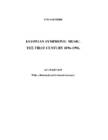
IV. THE TWENTIES. ARTUR KAPP: ROMANTICIST AND DRAMATIST. V. THE INFLUENCE OF NEW WESTERN MUSICAL TRENDS. HEINO ELLER: A PROGRAMME PAINTER. VI. THE THIRTIES. THE WIDENING OF NATIONAL SYMPHONISM. THE RISE OF ATTENTION TO HISTORY AND FOLKLORE: JUHAN AAVIK, EDUARD TUBIN, EUGEN KAPP. VII. FURTHER MATURING OF SYMPHONIC MUSIC: HEINO ELLER, EVALD AAV, EDUARD TUBIN. THE FIRST ESTONIAN BALLET. SUMMARY OF THE REPUBLICAN PERIOD. HALF A CENTURY UNDER SOVIET OCCUPATION. IDEOLOGY OVER MUSIC. EXTENSIVE INFLUX OF CONTEMPORARY TRENDS. VIII. THE FORTIES. TRANSFORMATION OF ESTONIAN LIFE. THE WAR-TIME SYMPHONIC OUTPUT. IX. THE PLANTING OF NEW CREATIVE PRINCIPLES DURING THE POST-WAR YEARS. X. THE SECOND HALF OF THE FIFTIES. TOWARDS A MODERN IDIOM: EINO TAMBERG AND VELJO TORMIS. XI. THE NEOCLASSICISM AND CONSTRUCTIVE THINKING OF JAAN RÄÄTS. XII. THE FIRST HALF OF THE SIXTIES. DODECAPHONY OF ARVO PÄRT. XIII
work as a ship chandler's clerk. Jim tries to remain incognito, but whenever the opprobrium of the Patna incident catches up with him, he abandons his place and moves further east. Nostromo (1904)- Nostromo is set in the South American country of Costaguana (a fictional nation, though its geography as described in the book closely matches real-life Colombia). Costaguana has a long history of tyranny, revolution and warfare, but has recently experienced a period of stability under the dictator Ribiera. Charles Gould is a native Costaguanero of English descent who owns an important silver-mining concession near the key port of Sulaco. He is tired of the political instability in Costaguana and its concomitant corruption, and uses his wealth to support Ribiera's government, which he believes will finally bring stability to the country after years of misrule and tyranny by self-serving dictators.
For example he even mentions the origin of the first owners of the houses of New Bay town. Some of their ancesters were pirates. They got their original capitals by pirating. Now the family say that they are old familys with old money. The protagonist is Ethan Allen Hawley. He is well educated, he comes from a good family, wife and two children, at the beginning he is a honest, good man. His family has alost all of his money , he is forced to work in a grocery store under Marullo who is illegal immigrant from Italy. Gradually he starts thinking about how life is unfair, and he from a noble family from aristocratic family has almost nothing , has lost almost everything. Just three months and we see how in these months he changes, how he is tempted and falls into corruption, his transition from a honest man is symptomatic of entire American society. In fact when Steinberg was writing the novel, it was the time of public scandals of America
The Project Gutenberg EBook of Pride and Prejudice, by Jane Austen This eBook is for the use of anyone anywhere at no cost and with almost no restrictions whatsoever. You may copy it, give it away or re-use it under the terms of the Project Gutenberg License included with this eBook or online at www.gutenberg.org Title: Pride and Prejudice Author: Jane Austen Release Date: August 26, 2008 [EBook #1342] [Last updated: August 11, 2011] Language: English Character set encoding: ASCII *** START OF THIS PROJECT GUTENBERG EBOOK PRIDE AND PREJUDICE *** Produced by Anonymous Volunteers, and David Widger PRIDE AND PREJUDICE By Jane Austen
 annaabi.ee










Kõik kommentaarid