Leidsid 33 sarnast õppematerjali, mis on seotud failiga "Introduction tallinnasse". Need materjalid aitavad sul teemat sügavamalt mõista.
north, pirita, kadriorg, museum, west, east, built, northern, western, europe, easily, residence, gardens, district, inland, introduction, surface, live, situated, country, banks, finland, location, institutions, higher, science, important, between, russia, became, target, expansion, denmark, historically, sacked, although, bombed, soviet, during, latterA limestone cliff runs through the city. It is exposed, for instance, at Toompea and Lasnamäe. However, Toompea is not a part of the cliff, but a separate hill. Coastline is 46 kilometres long.The highest point of Tallinn, at 64 meters above the sea level, is situated in the district of Nõmme, in the south-west of the city. The first human steps, that archeologists found, are about 5000 years old. Tallinn`s first fortress was built in Toompea, in 1050. As an important port for trade between Russia and Scandinavia, it became a target for the expansion of the Teutonic Knights and the Kingdom of Denmark during the period of Northern Crusades in the beginning of the 13th century when Christianity was forcibly imposed on the local population. Danish rule of Tallinn and Northern Estonia started in 1219. In 1285 the city became the northernmost member of the Hanseatic League - a military alliance
Then it was called Reval for some time and finally Estonians started to call the town Tallinn from Taanilinn (Danish town) after the Danish conquest in the 13th century. The Knights of the Sword took Tallinn from the Danes in 1227 and made Toompea their fortress. In the middle of the 14th century Denmark sold its possessions in Estonia to the German Teutonic Order; Toompea became the seat of German-born gentry. A fortified wall was built between the Toompea (the Upper Town) and the Lower Town (inhabited by people of a lower social standing), as there were conflicts between the two. The doors and the gates of the wall were locked at night, a procedure which carried on until the end of the 19th century. Tallinn joined the German-dominated Hanseatic League in 1285 and became a junction of trade between East and West: furs, honey, leather and seal fat moved west,
Tallinn, general overview Prepared: Hanna Bergmann 16.04.2011 Tallinn's Old Town is in the list of UNESCO World Heritage Sites. Tallinn is ranked as a global city and has been listed among the top 10 digital cities in the world. Tallinn is a European Capital of Culture for 2011, along with Turku, Finland. Location Tallinn is situated on the northern coast of the country, on the banks of the Gulf of Finland, 80 km south of Helsinki, east of Stockholm and west of Saint Petersburg. Tallinn is situated on the southern coast of the Gulf of Finland, in north-western Estonia. Tallinn Population The registered population of Tallinn is 412,341 (as of 1 Dec 2010). According to Eurostat, in 2004 Tallinn had the largest number of non-EU nationals of all EU member states' capital cities.As of 2009 around 22% of its population are not EU citizens. In addition to the native Estonian language ,
Tallinn English College English Sergo Vainumäe 9A TALLINN Report Supervisor: Inge Välja Tallinn 2006 Order of contents: 1.Introduction 2.Toompea 3.Lower Town 4.Kadriorg and Pirita 5.Museums 1. Introduction Tallinn, the capital of Estonia, lies on the Baltic Sea. It is on almost the same latitude east St. Petersburg in Russia, Stockholm in Sweden and Stavanger in Norway, and covers 158 sq km. Tallinn was first marked on a map of the world by the Arab geographer al-Idrisi in 1154, its name then being Kolyvan (probably derived from the name Kalev). In the 13th-century Chronicle of Henricus de Lettis the town was called Lyndanise. Later came Reval (presumably after the old county of Rävala), the name used by the Germans who ruled the country for seven centuries. Russians then
Instructor:Teacher Kristi Aron Kunda 2012 Introduction Like most cities with an eight-hundred-year-old past, Tallinn is a patchwork of historic areas. The city's pride and joy is without a doubt its Medieval Old Town, but equally enchanting is the Kadriorg district, a throwback to the time when Estonia was ruled by the Russian Tsars. Tallinn is the capital and largest city of Estonia. It occupies an area of 159.2 km2 with a population of 416,470. It is situated on the northern coast of the country, on the shore of the Gulf of Finland, 80 km south of Helsinki, east of Stockholm and west of Saint Petersburg. Tallinn's Old Town is in the list of UNESCO World Heritage Sites. It is ranked as a global city and has been listed among the top 10 digital cities in the world.The city was a European Capital of Culture for 2011, along with urku, Finland.Tallinn is the oldest capital inNorthern Europe. The city was known as Reval from the 13th century until the 1920s. http://en
centre and one of the main ports in the Baltic States. Tallinn is one of the oldest cities on the Baltic Sea. It is unique for its well-preserved architecture from the 13-15 centuries. In contrast to the ancient town-walls and towers, Tallinn of today offers modern hotels, restaurants, sport and cultural centres. Every five years national song and folk dance festivals take place in Tallinn. The yachting regatta of the 1980 Moscow Olympic Games was held at Pirita. History Tallinn means in English "Danish town". The place is believed to have been settled by Finno-Ugric people about 2500 BC. It was first marked on a map of the world by the Arab geographer al-Idrisi in 1154. The Estonians were the first to build a stronghold on the spot of the Toompea Hill, but the real Tallinn was built by the Danes who conquered the north of Estonia in 1219. Legend has it that one day, when the Danes were about to
Tallinn was granted the Lübeck law in 1248 and became the member of the Hanseatic League in 1285. General Data l Country - Estonia l County - Harju County l First appeared on map - 1154 l Town rights - 1248 l Mayor - Edgar Savisaar l Aera - Total 159.2 km2 (61.5 sq mi) l Population - (1 Mar 2012) Total - 416,470 Denisty - 2,614.0/km2(6,766.6/sq mi) Tallinn Coat of arms Flag Top 5 Attractions 1. Kiek in de Kök Visitors to the museum will see examples of Medieval firepower, displays detailing how the city's system of walls and towers developed through the centuries and an exhibit on crime and punishment in Old Tallinn. 2. Kadriorg Palace - Kadriorg Art Museum A trip to Tallinn isn't a trip to Tallinn without a visit to this magnificent northern baroque palace, built by Peter the Great for his wife, Catherine I, in 1718. The grandiose palace with its surrounding manicured gardens is
Tallinn The first traces of human settlement found in Tallinn's city center by archeologists are about 5000 years old. In 1050 the first fortress was built on Tallinn Toompea.[3] In 1285 the city became the northernmost member of the Hanseatic League. Medieval Tallinn enjoyed a strategic position at the crossroads of trade between Western and Northern Europe and Russia. On 24 February 1918, the Independence Manifesto was proclaimed in Tallinn, followed by Imperial German occupation and a war of independence with Russia. On 2 February 1920, the Tartu Peace Treaty was signed with Soviet Russia, wherein Russia acknowledged the independence of the Estonian Republic. Tallinn became the capital of an independent Estonia. After World War II started, Estonia was occupied by the Soviet Union (USSR) in 1940, and later occupied by Nazi Germany from 1941–44
It is also set into the small coat of arms of Tallinn. Great coat of arms - three lions, a knight, and Danish queen; leaves around Old Thomas - quardian of Tallinn, put on top of the spire of Tallinn Town Hall in 1530; boy that excelled springtime contests thrown by Baltic German elite, because of his low-born status was unable to receive a prize, therefore was granted the position of town guard. Right now there’s third Old Thomas, first one can be seen at Tallinn City Museum. Toompea as a symbol of power Toompea palace - wooden fortification was originally built in the 9th century, Danes made the castle the centre of secular power; Toompea palace hosts the parliament of the Republic of Estonia, designed by Eugen Habermann and Herbert Johanson. The parliament has 101 members and is chosen for 4 years. Stenbock House - the official seat of the Estonian Government since 2000; the building started in 1787, originally meant to be a courthouse
Estonia Where it is? Republic of Estonia is a state in the Baltic region of Northern Europe .It is bordered to the north by the Finland, to the west by the Baltic Sea, to the south by Latvia (343 km), and to the east by lake Peipus and Russia (338.6 km). Across the Baltic Sea lies Sweden in the west and Finland in the north. Towns Tallinn is the capital and the largest city of Estonia. It lies on the northern coast of Estonia, along the Gulf of Finland. There are 33 cities and several town-parish towns in the country. In total, there are 47 linna, with "linn" in English meaning both "cities" and "towns". More than 70% of the population lives in towns. History • Estonia was settled near the end of the last glacial era, beginning from around 8500 BC. Before the
Estonian cities Tallinn is the capital and largest city of Estonia. It occupies an area of 159.2 square kilometers with a population of 413,000. It is situated on the northern coast of the country, on the banks of the Gulf of Finland, 80 km south of Helsinki, east of Stockholm and west of Saint Petersburg. Tallinn was founded in the 12th century and has been under the rule of Denmark, Sweden, and Germany as well as Russia, and all left their mark on the city's architecture. It is one of the best preserved medieval towns in northern Europe, and makes a beautiful impression from the sea, with its ancient city walls, church spires, and red-tile roofed homes. Tallinn has previously been named as Kolõvan, Lindanise and Reval.
Art Museum of Estonia Art Museum of Estonia was founded on November 17th, 1919, but it was not until 1921 that it got its first permanent building the Kadriorg Palace, built in the 18th century. In 1929 the palace was expropriated from the Art Museum in order to rebuild it as the residence of the President of Estonia. The Art Museum of Estonia was housed in several different temporary spaces, until it moved back to the palace in 1946. In September, 1991 the Kadriorg Palace was closed, because it had totally deteriorated by then. At the end of the year the Supreme Council of the Republic of Estonia decided to guarantee the construction of a new building for the Art Museum of Estonia in Kadriorg. Untill then the Knighthood House at Toompea Hill served as the temporary main building of the Art Museum of Estonia. The exhibition there was opened on April 1, 1993. Art Museum of Estonia premanently closed down the exhibitions in that building in October 2005.
Topic Estonia Tallinn 2008 1. Introduction Estonia is a small country about the size of Switzerland, or New Hampshire and Massachussetts combined. Estonia is named after the people called "Ests" who lived in the region in the 1 st century AD. The Republic of Estonia is one of the three countries commonly known as the "Baltic States". The other Baltic States are Latvia and Lithuania. 2. Geographical position Estonia is situated in northeastern Europe. Estonia is bounded on the north by the Gulf of Finland, on the east by Russia, on the south by Latvia and on the west by the Baltic Sea. In the north it borders on Finland. The coastline of the Baltic Sea in Estonia is characterized by numerous gulfs and bays, the biggest of them being the Gulf of Finland, the Gulf of Riga and the Gulf of Pärnu. Bays include the Narva Bay, Matsalu Bay, Kolga Bay, Kunda Bay, Tallinn Bay etc. Estonia has over
Kunda Ühisgümnaasium Tallin Old Town Report Student: Kristin Karu Teacher: Kristi Aron Kunda 2012 The Alexander Nevsky Cathedral The Alexander Nevsky Cathedral is an orthodox cathedral in the Tallinn Old Town,Estonia. It was built to a design by Mikhail Preobrazhensky in a typical Russian Revivalstyle between 1894 and 1900, during the period when the country was part of theRussian Empire. The Alexander Nevsky Cathedral is Tallinn's largest and grandest orthodox cupola cathedral. It is dedicated to Saint Alexander Nevsky who in 1242 won the Battle of the Ice on Lake Peipus, in the territorial waters of present-day Estonia. The late Russian patriarch, Alexis II, started his priestly ministry in the church.
Estonia. Estonia, officially the Republic of Estonia is a country in Northern Europe. It is the smallest of the three Baltic countries. Estonia has land borders with Latvia (339 km) to the south and Russia (229 km) to the east. It is separated from Finland in the north by the narrow Gulf of Finland and from Sweden in the west by the Baltic Sea. Estonia has been a member of the European Union since May 1, 2004 and of the NATO since March 29, 2004. The area of Estonia is about 45000 square kilometres and the population is about 1.4 million people. The capital of Estonia is Tallinn and the official language is Estonian. The currency is Eesti kroon. The main religion is Lutheran. Anniversary of the republic is celebrated on February 20. The national flower is cornflower, national
Australia Australia is the smallest continent in the world. It is 7.6 million square kilometres big. It is often called the island continent because it is rather small for a continent and very big for an island. There are only five countries bigger than Australia in the World. There are five states in the mainland. Tasmania is also considered as a state so there are six states. The Northern Territory and Canberra are also independent but they are not states. Canberra is the capital of Australia and it is situated between Sydney and Melbourne because both of these cities wanted to be the capital. The population is about 19 million people and growing. New South Wales is the most populated state and Victoria is the most densely populated state. The national language is English. It is English because British settlers came to live in Australia in
Sightseeing in Estonia Tallinn TV Tower The Tallinn TV Tower (Tallinna teletorn) is a free-standing structure with an observation deck, built to provide better telecommunication services for the 1980 Moscow Summer Olympics regatta event (see Sailing at the 1980 Summer Olympics). It is located near Pirita, six km north-east of the Tallinn city center. The tower has a specified height of 314 m (1030.2 ft), though some sources put it at 312.6 m (1026.6 ft). The building is administered by the public company Levira (formerly Estonian Broadcasting Transmission Center Ltd) and is a member of the World Federation of Great Towers. The tower was designed by architects David Baziladze and Juri Sinis. The cornerstone was
Tallinn is a small port town in which the population is 371 000 people, and the area is only 159,2 km².( square kilometers). Tallinn, the capital of Estonia, is named after taani linnus, which means Danish castle. The Castle in question was built by King Waldemar of Denmark in the 13th century. The settlement quickly developed itself into a busy port. -The Old Town In medieval age Tallinn was called Reval and it was as big as the Tallinns Old Town is now. Uniqueness of Tallinn is that it is one of very few European cities, where the historical lay-out is kept in it's original form , and has a lot of monuments of that time. Thanks to that in 1997 Old Tallinn has been included in the list of a world heritage of UNESCO.
After thorough reforms in Estonian economy the people living in villages and small towns are searching for new possibilities for self-realisation and one of the outputs is tourism. This can also be seen in Southern Viljandimaa as there are continuously more establishments providing accommodation, caterers and organisers of active holidays. Many tourism maps have been put beside the road as well as many hiking trails have been built and marked. History of Estonia Human settlement in Estonia became possible 11,00013,000 years ago, when the ice from the last glacial era melted away. The oldest known settlement in Estonia is the Pulli settlement, which was located on the banks of the river Pärnu, near the town of Sindi, in southern Estonia. According to radiocarbon dating, it was settled around 11,000 years ago, at the beginning of the 9th millennium BC
Old Tallinn Old Town, a medieval walled city filled with old buildings and fortifications. The sheltered bay and the easily defended Toompea Hill made it a natural place to settle. Sometime about 1050 A.D. a fortress was built atop the hill, the first of many. In 1219 the Danes showed up as part of the Northern Crusade to subjugate the Baltics and convert the local pagans to Christianity whether they wanted to or not. The Danes improved the fortifications and expanded the town, which became part of the Hanseatic League, a trading organization of a hundred northern cities. The Danes sold Tallinn to the Livonan Order, a branch of the Teutonic Knights, in 1346. The Swedes came next in 1561. Tallinn weathered plague and the Great Northern War and became part of Russia in 1710. In 1918, Estonia declared
... Gümnaasium English Project Sights of Estonia Student: .............................. Class: 6 ... Teacher: ............... Harjumaa 2011 1 1. Steamer-icebreaker Suur Tõll The ship was built in 1914 in Stettin (Szczecin) by Vulkan-Werke A. G. Suur Tll is the only pre-war steam ship of the Republic of Estonia remained up to now and, at the same time, the biggest icebreaker in the world preserved through two world wars. All the 3 original steam engines as well as most of the original arrangement of space and late Jugendstil interior of the officers' rooms are preserved. In 1914 the first home port of the ship was Tallinn
FACTFILE Area: 45 228 sq km Poplulation: under 1.4 million Capital: Tallinn Language: Estonian Currency: Eesti kroon (EEK) Main religion: Lutheran National holiday: 24 February (anniversary of the republic) National flower: Cornflower National bird: Barn Swallow National stone: Limestone LOCATION The Republic of Estonia is the northernmost and smallest of the three Baltic States. It is located on the eastern shores of the Baltic Sea in the north east of Europe. To the east the country borders Russia. Latvia is the countries neighbour to the south. From the west the coast of Estonia is washed by the Baltic Sea and from the north by the Gulf of Finland. The length of the coastline is approximately 3 800 km. The longest distance from east to west is 350 km, while north to south Estonia stretches 240 km. THE NAME The name EESTI was apparently derived from the word AISTI, the name given by ancient Germans to the peoples living northeast of the Vistula
London History The Romans AD 43- AD 410 The Romans finally invaded Britain in AD 43 from Kent. The Romans lead by Julius Caesar attempted to invade Britain twice before that in 55 and 54 BC but the invasions were unsuccessful. They made their way to the river Thames and sailed up it. The Romans knew it was important to control a crossing point at the river Thames, so they decided to build a settlement on the north bank. Although small settlements had been built on the banks of the Thames, the Romans were the ones who built the first city. They called their city Londinium. The Roman engineers noticed that the point where the swampy river narrowed would make an ideal crossing point, they built London Bridge. Less than 20 years later the native Iceni tribe, led by Queen Boudicca, rose up against the Romans in revenge for mistreatment and burnt Londinium to the ground. The well disciplined Roman army defeated her forces and Londinium was rebuilt
V. Jannsen. It was officially adopted after the War of Independence in 1920.The same melody with different words is also Finland's national anthem. The current coat of arms of Estonia is a golden shield which includes three slim, blue leopards (or lions) in the middle, with oak branches along the side of the shield. It originates from Denmark. It was officially adopted in 1925. Geography Estonia is the northernmost of the three Baltic States. It is located on the northern hemisphere on the eastern shores of the Baltic Sea in the north-east of Europe. It has land contact with Russia from the east and Latvia from the south. In the north The Gulf of Finland separates Estonia from Finland. The Gulf of Riga is situated to the south-west. Estonia has more than 1500 islands. The biggest ones are located to the west. The four biggest islands are Saaremaa, Hiiumaa, Vormsi and Muhu. The highest point in Estonia and also in the Baltic region is Suur Munamägi. It is 318
London London is the capital of Great Britain. It is situated on the river Thames. The Thames is a river flowing through southern England and connecting London with the sea. The Thames has a length of 346 kilometres (215 miles). The first bridge was the tower bridge, built in the 12th century. The second bridge was built in the year 1750. .The river Thames divides London into the northern and the southern part. The port of London is one of the greatest trade centres in the world. The river Thames is certainly the most famous water body in London. London is also the seat of the government of Great Britain. It is one of the largest cities in the world with its population of about seven million. Before the great fire in 1666 there were many wooden houses and narrow crooked streets in the town but after the fire it became a well-planned city
Tallinn to join in the celebrations. Visitors from other countries converge in Tallinn to experience the powerful singing, lively dances and intricate, colourful folk costumes at first hand. If you're interested in seeing this spectacular live performance, or maybe even taking part in a festival, the next event happens in 2004, 2009 and 2013. The song festivals began in 1869, part of the romantic and nationalist movement in Europe. They developed a network of interactions among people along with making folk customs more widely known and practiced. The solidarity that the continued performance of the song festivals fostered, along with the logistics of moving large numbers of people around the country, served the Estonians well in their enormous demonstration for freedom in 1989, the Baltic Chain. The official Üldlaulupidu site gives a route to ordering VHS tapes and DVDs of the song and dance festivals
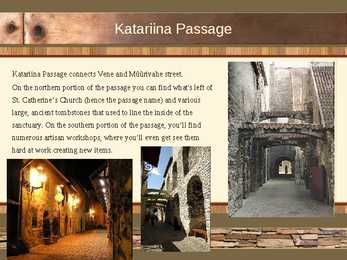
Katariina Passage Katariina Passage connects Vene and Müürivahe street. On the northern portion of the passage you can find what's left of St. Catherine's Church (hence the passage name) and various large, ancient tombstones that used to line the inside of the sanctuary. On the southern portion of the passage, you'll find numerous artisan workshops, where you'll even get see them hard at work creating new items. City wall Tallinn's medieval city wall is a sub-facility that was built
Topic Estonia, Tallinn The Republic of Estonia is the northernmost of the three Baltic States on the eastern shore of the Baltic Sea. To the east Estonia borders on Russia and Lake Peipsi and on the south on Latvia. The area of Estonia is 45 100km2, its coastline is 774km long. The geography of the land is surprisingly varied. Islands make up 9,2 per cent of Estonian's total territory, the largest islands are Saaremaa, Hiiumaa and Vormsi. The highest point is Suur Munamägi, which is 317m high. Estonia has a surprisingly mild climate for an area so far north. Sea winds keep the weather from becoming very cold or hot.
Estonia Estonia, officially the Republic of Estonia, is a state in the Baltic region of Northern Europe. It is bordered to the north by the Gulf of Finland, to the west by the Baltic Sea, to the south by Latvia, and to the east by Lake Peipus and Russia. Across the Baltic Sea lies Sweden in the west and Finland in the north. The territory of Estonia covers 45,227 km 2, and is influenced by a humid continental climate. The Estonians are a Finnic people, and the official language, Estonian, is a Finno-Ugric language closely related to Finnish, and distantly to Hungarian and to the Sami languages. The population of Estonia is 1.5 million. Of this number 62 per cent are Estonians. The geography of the land is surprisingly varied. Islands make up 9,2 per cent of Estonian’s total
It is the capital of Viljandi County. The town was first mentioned in 1283, upon being granted its town charter by Wilhelm von Endorpe.The city is situated on the north-western shore of Lake Viljandi, which lies in the primeval valley. Green zones cover 27% of the city area. Since 1920, Viljandi has had the Ugala drama theatre. The tradition of open-air performances dates back to the same year. The Viljandi Puppet Theatre also works there.In 2002, a new library was built, which is also a venue for exhibitions, meetings with famous people, culture seminars, etc. There are several exhibition halls and galleries in Viljandi. A meeting place for artistic people is the Kondas Centre. The popular Estonian newspaper Sakala was founded in Viljandi in 1878.
TOOMPEA Toompea (from German Domberg – Cathedral Hill ) is a limestone hill with an area of about 7 hectares in the central part of Tallinn. It towers about 30-40 m above the surrounding areas. According to the legend it´s the tumulus mound over the grave of the national hero Kalev, erected stone by stone in his memory by his grieving wife Linda. It is the birthplace of Tallinn - a place where in 1229 the Knights of the Sword built a fortress instead of the wooden Estonian stronghold. Toompea Castle is also one of the most potent symbols of the reigning power. Today Toompea is the seat of the Government of Estonia as well as the Riigikogu, both of which are often simply colloquially referred to as Toompea. For centuries there was only one access to Toompea - Pikk Jalg - but there is also another way leading up to Toompea - Lühike Jalg, which was made in the 14th century
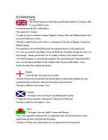
1) General facts The UK: * the United Kingdom of Great Britain and Northern Ireland was formed in 1801 * it covers 243,610 sq km * everybody from the UK is called British * the capital city is London * is made up of four constituent countries: England, Scotland, Wales and Northern Ireland which in turn are divided into counties * the flag is called the Union Jack which is a combination of the flags of England, Scotland and Northern Ireland * the population is about 60,000,000 people, the population density is 242 people/sq km * its coasts are washed by the Atlantic Ocean, the North Sea, the English Channel, the Celtic Sea, Saint George's Channel, and the Irish Sea. It is linked to France by the Channel Tunnel * the United Kingdom is a constitutional monarchy
.............................3 2. History.........................................................................................................4 3. Early History...............................................................................................4 4. The Post-War Years....................................................................................5 5. Recent History.............................................................................................6 6. Estonian Maritime Museum and the Seaplane Harbour.............................6 7. Comments on the Seaplane Hangars...........................................................7 8. Restoration..................................................................................................7 9. Interesting Facts..........................................................................................8 10. Summary...................................................................................................9 11
 annaabi.ee