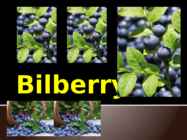
Bilberry Bilberry Bilberry is any of several Eurasian species of low-growing shrubs, bearing edible, nearly black berries. Bilberries are distinct from blueberries but closely related to them. Bilberryis a plant. The dried, ripe fruit and leaves are used to make medicine. Bilberriesare found in very acidic, nutrient-poor soils throughout the temperate and subarctic regions of the world. Are related to North American wild. It can be picked… Bilberryhas sharp-edged, green branches and black berries, which
htm 19.04.2014 http://entsyklopeedia.ee/artikkel/p%C3%B5der1 19.04.2014 http://et.wikipedia.org/wiki/Ehhinokokk 19.04.2014 http://et.wikipedia.org/wiki/P%C3%B5der 19.04.2014 http://etv.err.ee/index.php?0551987#.U1I_Nfl_suE 19.04.2014 http://lemill.net/lemill-server/content/webpages/poder 19.04.2014 http://www.arkive.org/eurasian-elk/alces-alces/ 19.04.2014 http://www.ejs.ee/images/stories/suured/trofeeope.pdf 19.04.2014 http://www.lhnet.org/eurasian-elk/ 19.04.2014 http://www.loodusajakiri.ee/eesti_loodus/artikkel3190_3169.html 19.04.2014 http://www.looduskalender.ee/node/13313 27.04.2014 http://www.looduspilt.ee/loodusope/?page=liigitutvustused_liik&id=118 19.04.2014 http://www.tumblr
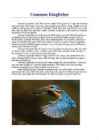
Common Kingfisher Common Kingfisher is 16-20cm tall and weighs 38-45 grams. It's wings are short and wide and about 7-8cm long. It has short and straight-cut tail. Beak is long, straight and with suddenly outreaching end. Common Kingfisher's head, back and wing feathers are azurite blue, pate has black and light blue stripes. Common Kingfisher is also known as Eurasian Kingfisher or River Kingfisher. Common Kingfisher lives in Eurasia and North-Africa, except for North-Scandinavia. In Finland it lives at south coast, in Africa it lives in north from Sahara. In Asia it lives in North-Turkey, Caucasia, West-Iran, India, East-China and more. It is resident in much of its range, but migrates from areas where rivers freeze in winter. In winter Common Kingfisher travels from north to Mediterranean countries
Of all the tigers known to the world, the Caspian tiger was the third largest. The body of this subspecies was quite stocky with strong legs, big wide paws and unusually large claws. The ears were short and small. Around the cheeks the Caspian tiger was generously furred and the rest of its fur was long and thick. The colouration resembled that of the Bengal tiger. It assumebly became extinct in 1970. *CAVE LION: The cave lion, also known as the European or Eurasian cave lion, is an extinct subspecies of lion known from fossils and a wide variety of prehistoric art. This subspecies was one of the largest lions. An adult male, which was found in 1985 near Siegsdorf (Germany), had a shoulder height of around 1.2 m and a length of 2.1 m without a tail, which is about the same size as a very big modern lion. It apparently went extinct about 10,000 years ago, during the
Average weight 300-500 kg Teine tase (max 600kg) Kolmas tase Life-span 20 years. Neljas tase Multiplicity 12 700 Viies tase Last hunting season 5126 moose were caught Lynx (lynx lynx) Hunting season 01.12-29.02 Estonia has the highest Klõpsake juhtslaidi teksti laadide redigee known density of the species in Europe Teine tase Kolmas tase The Eurasian lynx is the Neljas tase largest lynx species Viies tase Average weight 10-20 kg (max 32 kg) Life-span 15 years Multiplicity about 600 Last hunting season 87 lynx'es were caught These stealthy cats avoid humans and hunt at night, so they are rarely seen. The lynx are so dependent on their prey that their populations fluctuate with a periodic plunge in their predators numbers. Last hunting season 87 lynx'es were caught, but only 16 lynxes this season.
palju autode alla. Noor mäger on kodustatav ja siis sõbralik lemmikloom. Internetis oli palju pilte mägrakujulistest mänguloomadest. 8. SLAID Kirjandus: J. Aul, H. Ling, K. Paaver, Eesti NSV imetajad, 1957 Euroopa imetajad, 2002 Väike entsüklopeedia, 2002 Euroopa imetajate määraja, 2003 J. Aul, Eesti NSV imetajad, 1957 F. Reindolf, Jahinduse käsiraamat, 1938 Väike entsüklopeedia, 2002 www.badgers.org.uk/.../ eurasian-badger-23.html www.faunistik.net/BSWT/ MAMMALIA/CARNIVORA/MUS... www.Eesti Jahimeeste Selts - Väikeulukid.htm www.sunsite.ee/loomad www.folklore.ee/rl/ pubte/ee/eluolu/elu2/205.html
water Conservation status ● Most common swan species of North America ● Tundra swan numbers are stable over most of its range, but they are increasingly depent on agricultural crops to supplement teir winter diet ● The tundra swan is not considered threatened by the IUCN due to its large range and population ● Bewick's swan is one of the birds to which the Agreement on the Conservation of African- Eurasian Migratory Waterbirds (AEWA) applies. Mating system ● Breed from late May through late June ● Nests – composed of moss, dead leaves, grasses; built in late May (diameter 122 to 183 cm) ● Can range 3 to 7 eggs ● Incubation period – 31 to 33 days ● Leave their nests immidiately Lifespan/Longevity ● Longest known – 24,1 years old (in wild) ● Expcted lifespan – 15 to 20 ● In captivity – 20 to 25
2 Climate The climate in Southern Finland is a northern temperate climate. In Northern Finland, particularly in the Province of Lapland, a subarctic climate dominates, characterised by cold, occasionally severe, winters and relatively warm summers. The main factor influencing Finland's climate is the country's geographical position between the 60th and 70th northern parallels in the Eurasian continent's coastal zone, which shows characteristics of both a maritime and a continental climate, depending on the direction of air flow. Finland is near enough to the Atlantic Ocean to be continuously warmed by the Gulf Stream, which explains the unusually warm climate considering the absolute latitude. A quarter of Finland's territory lies above the Arctic Circle, and as a consequence the midnight sun can be experienced for more days, the farther north one travels. At Finland's
· "The Great Paris Concert" 1963 · "A Morning in Paris" (1963) · "Ella at Duke's Place" 1965 · "The Symphonic Ellington" (1965) · "Ella and Duke at the Cote D'Azur"1966 · "The Far East Suite]]" (1966) · "...And His Mother Called Him Bill" 196 · "Francis A. & Edward K." 1968 · "Latin American Suite" (1968) · "Yale Concert" (1968) · "70th Birthday Concert" 1969 · "New Orleans Suite" 1970 · "The Afro-Eurasian Eclipse" 1971 · "Live at the Whitney" 1972 · "Duke's Big 4 1973 Auhinnad Tunnustus Aasta Kategooria 2009 Commemorative U.S. quarter 2008 Gennett Records Walk of Fame Nesuhi Ertegün Jazz Hall of Fame 2004 at Jazz at Lincoln Center 1999 Pulitzer Prize 1986 22¢ commemorative U.S. stamp 1978 Big Band and Jazz Hall of Fame
piiksumine. Tähtsat osa etendavad mitmesugused hoiatavad häälitsused territooriumi kaitsmisel ja valvamisel (Laanetu, Veenpere, 1971). Jõesaarmal on saba all lõhnanäärmed, mis eraldavad tugevat muskuselaadset lõhna (Kennedy, 2003). Eritatavast lõhnast on tuvastatud üle 100 erineva lõhnakomponendi. Umbes 17 lõhnakomponenti sisaldavad informatsiooni soo, vanuse ja teste isendite äratundmise kohta (Eurasian otter (Lutra lutra), 2009). Lõhnade märgistamisega toimub saarmate kommunikatsioon nende territooriumi, identiteedi ja seksuaalse seisundi kohta. Saarmad mitte ainult ei märgista lõhnaga taimestikku ja puid, vaid katavad sellega ka oma karva (Kennedy, 2003). 2. LEVIK JA ARVUKUS 6 Joonis 2. Saarma levila (punane).
Notions for The New World Native Americans Origin of Native Americans Nearly one-third of Native American genes come from west Eurasian people linked to the Middle East and Europe, rather than entirely from East Asians as previously thought, according to a newly sequenced genome. Native peoples of North and South America descended from ancestors who arrived via land bridges from East Asia, possibly in a single migration. Different tribes and their way of life The men were hunters, warriors, and protectors, while the women tended to the children, their homes, and farmed. It depended on the tribe when it came to artwork
10. What do you think is the national tree of Wales? 11. What do you think is the national tree of Scotland? 12. Who is the heroic outlaw in English folklore? 13. Do you know that Saint George is the patron saint of England? 14. Do you know that Saint Andrew is the patron saint of Scotland? 15. What do you think is the national drink of Scotland? 16. What do you think is English national food? 17. Do you know the national bird of Wales? 18. Do you know that the Eurasian Wren is the national bird of England? 19. Are you interested in knowing British National symbols? 2.5 Analysis of the questionnaire 2 1. What form do you study? Picture 19. What form do you study? 9 class 15 50% 10 class 15 50% 24 2. Do you know anything about British National symbols? Picture 20. Do you know anything about British National symbols? Yes 6 20% No 14 47%
1. Three strong forces (John F. Kennedy): - Religious persecution - Political oppression - Economic hardship 2. The first permanent British colonies in America were Plymouth (1620) and Jamestown (1607). 3. Immigrants: - Before the mid-19th century from England - The second half of the 19th century and the early 20th century Continental Europe - At present Mexico, China, India 4. Native Americans they probably have West Eurasian origins; used to live on Indian Reservations, now most live off the reservations; tribes have their own government and mainly are in casino business; there has been a rapid growth in their number recently. Hispanic Americans (aka Latinos) they are of Mexican, Puerto Rican and Cuban origin; the largest ethnic minority in the US; African Americans they are of Western African origin (slavery); it is the second
Ukrainians, and others should continue to be subsidized. The simple Russian proposition has had dramatic consequences for Ukraine. Ukraine's terms of trade would change from a windfall to a downpour of cold rain. And Ukraine had not made the necessary domestic reforms to prepare for such a turn of events. There have been aspiring political leaders who have thought that the Russian decision may be turned or at least postponed by playing on the Slavic or Eurasian Union cards: Ukrainians will continue to entertain prospects of Eastern integration if Russia continues postponing inevitable price hikes. Trying to avoid the price revolution is surely seen by some inside Ukraine as a potent argument for joining post-Soviet reintegration schemes, like Belarus has done. Others in Kiev found virtue in necessity. In the end the price revolution would benefit Ukraine by making long-postponed reforms inevitable. Perhaps as well, excessive
bluebell. The "Scottish Bluebell" is Campanula rotundifolia, (known elsewhere as the "Harebell") rather than Hyacinthoides nonscripta, the "Common Bluebell". Trees held an important place in Gaelic culture from the earliest times. Particularly large trees were venerated, and the most valuable such as oak , Common Hazel and Apple were classed as "nobles". The less important Common Alder, Common Hawthorn and Gean were classed as "commoners", and there were "lower orders" and "slaves" such as Eurasian Aspen and Juniper. The alphabet was learned as a mnemonic using tree names. Rowan was regularly planted close to Highland houses as a protection from witchcraft.
Part 1. Linguistics Linguistics is often said to deal with language as a universal human faculty. Nonetheless, scholarly reflection on language and linguistic inquiry strongly interact with society: on the one hand, societal developments determine the linguistic agenda to a greater extent than linguists are prepared to admit; on the other hand, linguistic reflection sometimes sets the agenda for changes in a society, especially through educational systems. This is particularly true in the Eurasian area, where the Russian national language has been constructed out of a diglossia situation as a top-down process in a partly multi-lingual environment. Over the last few centuries, the development of society and its political upshots have produced agendas for linguistic inquiry and discourse on language, some of which have had an impact on the development of Russian and contingent languages and their social functions, as well as on the development of linguistics as a global discipline
järgne (19. saj. lõpp ja 20. saj. algus - raudtee võtab merelt võimu üle ja sisemaa muutub jälle tugevamaks) ● Saksa koolkond - Friedrich Ratzel (andis geopoliitikale nime, peetakse selle teadusharu loojaks), Rudolf Kjellen, Karl Haushover - Orgaaniline riik ● Saul Cohen -> jagab maailma kolmeks - Geostrateegilised suurregioonid -> India ookean, Ida-Aasia piirkond (Hiina), Eurasian continental realm, jne. - geopoliitiline piirkond - riik ● Ideed: - tasakaal - tuum-perifeeria - tsivilisatsioon Külma sõja ajal kolm maailma: 1) lääneblokk, USA liitlased; 2) kommunistlik blokk, NSVLi blokk; 3) kõik ülejäänud, kes ei tahtnud olla kummaski blokis (suurem osa Aafrikast, Lõuna- Ameerikast, Mehhiko, Iirimaa, Soome, Rootsi). Kultuuriline jaotus ● Kultuur kui muutuja ● Autorid: - Spengler, “Õhtumaade allakäik”
 annaabi.ee