Sir Ahmed Salman Rushdie is a British Indian novelist and essayist. He is born on 19. June 1947. He is the only son of Anis Ahmed Rushdie and Negin Bhatt, a teacher. Rushdie was born in Bombay, India, into a Muslim family of Kashmiri descent.[10][11][12] He was educated at Cathedral and John Connon School in Mumbai, Rugby School, and King's College, University of Cambridge, where he studied history. Rushdie's first career was as a copywriter, working for the advertising agency Ogilvy & Mather
At puberty he became unapproachable and introverted He read a lot, laying the foundation of his education He turned to painting and in 1802 traveled to Paris to work in the Louvre In 1805 he turned to metaphysics and the study of philosophy, publishing his first book: On the Principles of Human Action Marriage In 1808 he married Sarah Stoddart, They went to live at Winterslow on Salisbury Plain Critic, journalist and essayist By the end of 1811 Hazlitt was penniless He then gave a course of lectures in philosophy in London Began reporting for the Morning Chronicle, quickly establishing himself as critic, journalist, and essayist. His collected dramatic criticism appeared as A View of the English Stage in 1818 Some Hazlitt's works The Round Table, 2 vol. (1817), 52 essays of which 40 are by Hazlitt In 1817 Hazlitt published his Characters of
One of the most influential Enlightenment thinker. Believed that human nature allowed men to be selfish. Believed that all people were equal. Jean-Jacques Rousseau June 28, 1712 July 2, 1778 . Philosopher, literary figure, and composer of the Enlightenment... Saw a fundamental divide between society and human nature . François-Marie Arouet 21 November 1694 30 May 1778 . Known as "Voltaire" French Enlightenment writer, essayist, deist and philosopher... Outspoken supporter of social reform. Important thinker. Thank you for listening!
When life gives us a chance to explore something new and exciting and meet interesting people, we should definitely use the oportunity. I think you have to be quite spontaneous to enjoy life. It is important to appreciate the people around us. You have to let them know how much you care about them and how much you need them in you life. And you have to do it today, because tomorrow we might not have the chance to do it. In conclusion, I want to quote an American essayist and philosopher Henry David Thoreau. He once said: ,,You must live in the present, launch yourself on every wave, find your eternity in each moment. There is no other life but this." Merit Vislapu 10R
Famous People from Ireland 2011 Oscar Wilde One of the most famous Irish person in history Writer and poet Born 16th Oct. 1854 Died 3oth Nov. 1900 Notable works: "The importance of being Earnest"; "The picture of Dorian gray" Jonathan Swift An Irish satirist, essayist, political pamphleteer, poet, cleric Notable works: "Gulliver's Travels"; "A modest proposal" Born 30th Nov. 1667 Died 19th Oct. 1745 Colin James Farrell Irish actor Appeared in: "In Bruges"; "Miami Vice"; "Tigerland"; "Odine" Born 31st May 1976 Won the golden globe award for "In Bruges" Saint Patrick The patron saint of Ireland Lived 4th to 5th century S.t Patrick's day celebrated in honor of him brought Christianity to Ireland
· What were his most famous work? · What was John keats? · What was the main theme of his work? Second Generation Poets · The poets of the second generation: George Gordon Byron, Percy Bysshe Shelley and john Keats. · They lived through the dissillusionment of the post-revolutionary period. · The Britain they knew was highly fearful of the possibility of revolution. Percy Bysshe Shelley (1792-1822) · He was a Poet, a Dramatist, a Essayist and a Novelist · Shelley was born at Field Place in Broadbridge Heath. · The most revolutinary of the Romantic poets. · He was an individualist and idealist · His ideas were anarichic · Many of his poems address social and political issues · He is best remembered for "Ode to the West Wind" and "To a Skylark." George Gordon Byron (1788-1824) · He was a Poet and a politician · Byron was born in a house on Holles Street in London.
John Anthony Burgess Wilson(penn name Anthony Burgess) was a British novelist, critic and composer. He was also a librettist, poet, playwright, screenwriter, essayist, travel writer, broadcaster, translator, linguist and educationalist. He composed over 250 musical works, including a first symphony around age 18, wrote a number of liberetti, and translated, among other works. His most famous book is "A Clockwork orange" John Anthony Burgess Wilson was born in 25. Feb, 1917, in Manchester, England, to Catholic parents, his mother died of the flu when he was two years old, and he was brought up to his aunt and later his stepmother.
· American poet, short story writer, editor, literary critic · love, beauty and death · Arabesque · Horror, crime, detective fiction, Poe's works · Tale "The fall of the House of Usher" · Tale "The Murders in the Rue Morgue" · Tale "The Masque of Usher" · Tale "Berenice" · Poem "The Bells" · Poem "The Raven" · Poem "Annabel Lee" Walt Whitman · Full-name Walter Whitman · May 31, 1819 March 26, 1892 · American poet, essayist, journalist, and humanist · His works have been translated into more than twenty-five languages · "Leaves of Grass" · "Song of Myself" · "Drum-Taps" · "Memoranda During the War" Emily Dickinson · December 10, 1830 May 15, 1886 · one of the two quintessential American poets of the 19th century · An introverted and hermetic life · 1,789 poems · Highly educated · Amherst's most prominent family · "Bolts of Melody: New Poems of Emily Dickinson"
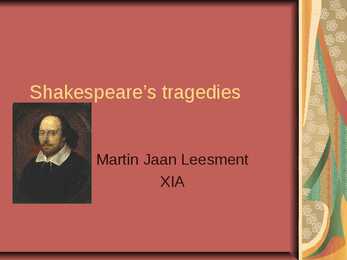
Timon of Athens - 1607-1608 first performance. It was first printed in 1623 (First Folio) Coriolanus - 1607-08 first performed. It was first printed in 1623 (First Folio) Macbeth - 1611-12 First recorded performance. It was first printed in 1623 (First Folio) Tragedies were poignant revelations of humanity's struggle between good and evil and search for moral order A flaw ultimately results in death or destruction Some inspired by Shakespeare's study of Lives by Greek historian and essayist Plutarch and Raphael Holinshed's Chronicles All of Shakespeare's tragic protagonists are capable of both good and evil Titus Andronicus is about a Roman king whose daughter is raped, is full of violence and comedy. The most foul of the tragedies. Romeo and Juliet is about teenage romance and how it can be stopped by feuding families Julius Caesar is an historical tragedy concerning the ethics and consequences of political assassination Hamlet is about a tortured young prince who is
Fay Weldon an English author, essayist and playwright Early life § Fay Weldon was supposed to be born in New Zealand, but instead was born in England in 1931. At 5 weeks old she and her mother returned to New Zealand. § Her father was a doctor and her mother was a writer of commercial fiction under the pen name "Pearl Bellairs", among others. Her parents divorced when she was five. She lived with her mother, sister and grandmother until she started college and, as a result, grew up believing "the world was peopled by females". This problably influenced her works too. § She returned to England with her mother and studied economics and psychology at the University of St Andrews in Scotland. § Her actual christened name was "Franklin Birkinshaw". which she feels contributed to her being accepted at St Andrews and permitted to study economics: the school assumed she was a male student applica...
· Poems (1881) · The Sphinx (1894) Vera; or, The Nihilists (1880) The Duchess of Padua (1883) The Canterville Ghost (1887) The Happy Prince and Other Stories (1888, fairy tales) The Decay Of Lying (First published in 1889, republished in Intentions 1891) Lord Arthur Savile's Crime and Other Stories Edward Morgan Forster Edward Morgan Forster (1 January 18797 June 1970), was an English novelist, short story writer, and essayist. He is known best for his ironic and well-plotted novels examining class difference and hypocrisy in early 20th-century British society. Forster's humanistic impulse toward understanding and sympathy may be aptly summed up in the epigraph to his 1910 novel Howards End: "Only connect". Forster was homosexual, but this fact was not widely made public during his lifetime. His posthumously-published novel Maurie tells of the coming of age of an explicitly homosexual male character.
If Dante had tried to touch one of them, his hand would have met no physical resistance since the shades would melt into the air. Tate stands in awe of Dante's abilities to express such a large concept or picture in so few words. He says, "I believe we all wish we had been able not only to write better poems, but poems that say much more than we have been able to say, while at the same time seeming to say less."(452) In 1953, Jacques Maritain, a French philosopher, theologian, educator, and essayist, wrote "The Three Epiphanies of Creative Intuition", in his book, Creative Intuition in Art and Poetry. He wrote about how Dante's Divine Comedy is at the same time poetry of the song, poetry of the theater, and poetry of the tale. They are the three epiphanies of poetic intuition. Maritain believes that the essence of the song appears everywhere in the Divine Comedy, but more so in Paradiso, while drama appears everywhere, especially in Purgatorio, and novel is found
of the time. Dickinson's poems are unique for the era in which she wrote; they contain short lines, typically lack titles, and often utilize slant rhyme as well as unconventional capitalization and punctuation. Many of her poems deal with themes of death and immortality, two subjects which infused her letters to friends. Walter Whitman Walter Whitman (May 31, 1819 March 26, 1892) was an American poet, essayist, journalist, and humanist. He was a part of the transition between Transcendentalism and realism, incorporating both views in his works. Whitman is among the most influential poets in the American canon, often called the father of free verse. His work was very controversial in its time, particularly his poetry collection Leaves of Grass, which was described as obscene for its overt sexuality. Born on Long Island, Whitman worked as a journalist, a teacher, a government clerk, and a
angesprochen wird, erinnert an die Lage in der DDR und die damalige anhaltende Debatte um die Rolle des Künstlers im Sozialismus im Umfeld der Ausbürgerung Biermanns 1976 80er Jahre: eine neue Autorengeneration: UWE KOLBE (ein deutscher Lyriker und Prosaautor; ,,Nicht wirklich platonisch", ,,Ortvoll", ,,Die Farben des Wassers" usw), BERT PAPENFUß-GOREK (ein deutscher Lyriker), RAINER SCHEDLINSKI (ein deutscher Lyriker und Essayist. In der DDR gehörte er in dern 1980er Jahren zu den führenden Autoren der oppositionellen Literatuszene und war in dieser Zeit Informeller Mitarbeiter im Ministerium für Staatssicherheit; ,,Die Männer der Frauen", ,,Die Rationen den Ja und des Nein" usw), LUTZ RATHENOW (ein deutscher Lyriker und Prosaautor), STEFAN DÖRING (ein deutscher Schrifftsteller und Übersetzer), DURS GRÜNBEIN (ein deutscher Lyriker, Essayist und Übersetzer; ,,Die Bars von Atlantis", ,,Lob des Taifuns";
The PowerBook (2000) – cyberspace vs. the meatspace (the real world) – language is a costume. The idea of the panopticon. Post-‐colonialism in feminist literature. Issues of ethnicity and culture. Zadie Smith (1975) is an English novelist, essayist and short story writer. Born in Britain to a Jamaican-‐born mother and British father. White Teeth (2000) – a portrait of the contemporary multicultural London and looks at the lives of three ethnically diverse families; the beauty myth.
Rooted in the transcendental philosophy of Immanuel Kant (and of German Idealism more generally), it developed as a reaction against 18th Century rationalism, John Locke's philosophy of Sensualism, and the predestinationism of New England Calvinism. Its fundamental a variety of diverse sources such as: Vedic thought, various religions, and German idealism. Ralph Waldo Emerson (May 25, 1803 April 27, 1882) was an American essayist, lecturer, and poet, who led the Transcendentalist movement of the mid19th century. He was seen as a champion of individualism and a prescient critic of the countervailing pressures of society, and he disseminated his thoughts through dozens of published essays and more than 1,500 public lectures across the United States. Emerson gradually moved away from the religious and social beliefs of his contemporaries, formulating and expressing the philosophy of Transcendentalism in his 1836
More often, however, Kantemir indirectly praised Peter's influence through his satiric criticism of Russia's "superficiality and obscurantism," which he saw as manifestations of the backwardness Peter attempted to correct through his reforms. Kantemir honored this tradition of reform not only through his support for Peter, but by initiating a decade-long debate on the proper syllabic versification using the Russian language. Vasily Kirillovich Trediakovsky, a poet, playwright, essayist, translator and contemporary to Antiokh Kantemir, also found himself deeply entrenched in Enlightenment conventions in his work with the Russian Academy of Sciences and his groundbreaking translations of French and classical works to the Russian language. A turning point in the course of Russian literature, his translation of Paul Tallemant's work Voyage to the Isle of Love, was the first to use the Russian vernacular as opposed the formal and outdated Church-Slavonic. This
Estonian Republic; Johan Kõpp (1874-1970), Bishop of the Estonian Lutheran Church; Arthur Võõbus (1909-1988), clergyman, church historian and Orientalist. Tartu University lost 190 of its lecturers and professors1 In literature, theatre and art: Gustav Suits; Marie Under; Henrik Visnapuu; Bernard Kangro (1910-1994); August Mälk, novelist; Albert Kivikas (1898-1978), writer, journalist and dramatist; Karl Ristikivi (1912-1977), writer, essayist and literary critic; Riina Reinik (1908-1989), actress and director; Liina Reiman (1891-1961), actress; Eduard Wiiralt, graphic artist; Jaan Grünberg and Eerik Haamer (1908-1994), painters. Composers and musicians: Juhan Aavik; Olav Roots, composer, pianist and chief conductor of State Broadcasting Symphony Orchestra; Verner Nerep (1895-1959), composer and chief conductor of the Estonia Theatre; Theodor Lemba (1876-1962),
 annaabi.ee