5th century AD When did the Vikings first raid Britain? The Vikings first invaded Britain in AD 793 (last invaded in 1066) . they come from the three countries of Scandinavia: Denmark, Norway and Sweden. Who were the Normans? The Normans were the people who gave their name to Normandy, a region in northern France When was the Battle of Hastings? in1066 The Bayeux Tapestry is a long embroidered cloth - not an actual tapestry - which depicts the events leading up to the Norman conquest of England as well as the events of the invasion itself. Who was William The Conquerer? duke of Normandy and, as William I, the first Norman king of England. He defeated and killed the last Anglo- Saxon king of England at the Battle of Hastings.
The Norman Conquest In the 11th century, Normans conquered England - The Battle of Hastings 14.10.1066 The Anglo-Saxon forces had more soldiers but the Normans had better military tactics and won in the end thanks to a clever strategy William I, also known as William the Conqueror, replaced King Harold on the throne The invasion was completed by 1071 - The Norman invasion is depicted on the Bayeux Tapestry a long embroidered cloth The death of King Harold embroidered on the Bayeux Tapestry The Norman England William I ensured his power by dividing the land into parts and making 1/7 of it a royal domain He made his nobles swear an oath of allegiance and become his vassals Died in 1087 while fighting in France, was succeeded by his third son, William II Rufus William II was very unpopular: - Problems with the church - Increased taxes and claimed the money of many
During the battle many Norwegian leaders were killed. Norwegians lost the battle, and it is very often taken to mark the end of the Viking Age. · Battle of Hastings 1066- Occurred on 14th October 1066 during the Norman conquest of England, between the Norman-French army of William the Conqueror and the English army under king Harold II. During the battle Harold was killed and the Normans won. It was the end of Anglo-Saxon era. · Bayeux Tapestry- Embroidered cloth nearly 70m long, which depicts the events leading up to the Norman conquest of England concerning William, Duke of Normandy and Harold, Earl of Wessex, later king of England and culminating in the battle of Hastings. · Debate poem- Essentially, a debate poem depicts a dialogue between two natural opposites (e.g sun vs. moon). Although the particulars can vary considerably, this can function as a general definition of the literary form.
Anglo-Saxon Britain was divided into many small kingdoms. King Alfred the Great of Wessex united most of them under his reign. England became the most powerful kingdom on the Island of Great Britain. Constant warfare with Wales and Scotland till 13th century. Edward the Confessor reigned 1042-1066. No male heir to the throne. William I, Duke of Normandy, later William the Conqueror reigned 1066-1087. Invaded Britain in 1066. The Battle of Hastings. The Bayeux Tapestry is a 50 cm by 70 m long embroidered cloth which depicts the events of the invasion itself. Importance of the Norman Conquest: 1) Norman influence to Anglo Saxon culture 2) New buildings and fortification of England 3) French influences to the English language. French as the language of the ruling classes for nearly 300 years. 4) Adoption of the European feudalism. King the most powerful man in the country; Barons
So if you are lucky enough to be invited when a wedding is hapenning make sure you attend, it really is an opportunity not to be missed. 6. Bedouin Handicafts Tradditionally Bedouin women would weave the family tent from goat or camel hair, and be responsible for the setting up and the packing of the tent when the family would move on to new lands. Today Bedouin women make beautiful handicrafts including woven rugs, necklaces, bracelets and burkas. These are usually embroidered or embellished with beads, sequins and coins using tradditonal designs passed down through the generations. Bedouin children are often found selling these beauitful crafts around Dahab town centre. Many shops also sell these locally made items on behalf of the Bedouin families. 7. What is a Tribe A tribe is a group made up by a number of clans, each clan made up of individual families who can trace their ancestry back to one original source
The descriptions are very vivid and economic. He pays attention to the pilgrims' clothes. E.g. the Knight has come back from some war, is high-minded, gentle-humoured and tries to live according to the ideals of courtly love, although he doesn't understand that this code of behaviour is slowly disappearing. The Squire is his young son who has curly hair, is high-spirited and wears a white-sleeved gown embroidered with red flowers who also thinks he is a typical courtly lover. Most of the clerics are ridiculed. E.g. the Monk doesn't pray, he hunts. He is fat, doesn't fast a lot, rides a good horse and is richly dressed. He is still presented in good nature. The Parson is poor but is rich of holy thought and work. The Student rides an extremely lean horse, is poor, dresses threadbare his clothes are shabby
A bookmark is a thin marker, commonly made of paper or card, used to keep one's place in a book. Bookmarks were used throughout the medieval period, consisting usually of a small parchment strip attached to the edge of folio (or a piece of cord attached to headband). Bookmarks in the 18th and 19th centuries were narrow silk ribbons bound into the book and become widespread in the 1850s. They were usually made from silk, embroidered fabrics or leather. Not until the 1880s did paper and other materials become more common. Some large reference books such as dictionaries may have a thumb index which is a round cutout in the pages with some printing, allowing the user to see approximately where the wanted entry may be, and open the book to the appropriate section, without looking at the table of context, or index. The process of physically assembling a book from a number of folded or unfolded sheets of paper is bookbinding.
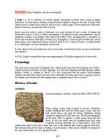
The battle was close and extremely bloody. At the end of it, most of the best warriors in England were dead , including their leader, King Harold. On Christmas day that year the Norman leader, Duke William of Normandy, was crowned king of England. He is known in popular history as 'William the Conqueror'. The date is remembered for being the last time that England was successfully invaded. The Bayeux Tapestry is technically not a tapestry, but a huge band of embroidered linen, which describes the Norman invasion of England and the events that led up to it. The Tapestry contains 2 hundreds of images divided into scenes each describing a particular event. The scenes are joined into a linear sequence allowing the viewer to "read" the entire story starting with the first scene and progressing to the last. 12.French influence on the English language
at first, fell. Ther Norman Conquest Started in 1066, risings against Norman rule every year from 1067 to 1070 The Normans had live like an occupation unit, build castles New ruling class, culture, language- French Higly developed feudals ystem, royal power Lasted till 1154, Henry II The House of Normandy William te Conqueror 11C William II Rufus 11C Henri I Beauclerc 12C Stephen 12C The Bayeux Tapestry Is 70 m of embroidered linen, describes how William the Conqueror invaded England In annotated in latin, made by either Queen Matilda of ordered by Bishop of Bayeux, William´s brother The most important pictural image of 11 C, priceless value The Domesday Book Historical record, based on the great survey of England which was drwan up on the orders of King William I Describes landholdings, resources of late 11 C Was written in latin, consisted of two books-
Henry I had scholarly interests. His reign is noted for its political opportunism. *The Bayeux Tapestry It is a 50 cm by 70 m long cloth which explains the events leading up to the Norman invasion of England as well as the events of the invasion itself. The Tapestry is annotated in Latin. It is presently exhibited in a special museum in France. According to the legend, the tapestry was created by Queen Matilda, William the Conqueror's wife. The Bayeux tapestry is embroidered in wool yarn using two differeent methods of stitching. The main yarn colours are terracotta, blue-green, dull gold, olive green, and blue. Later repairs are worked in light yellow, orange, and light greens. *The Domesday Book It is one of Medieval England's greatest treasures. The Domesday Book is closely linked with William the Conqueror's attempt to dominate Medieval England. That book was to give William huge authority in England. William I ordered that a book be
Artes de Sevilla muuseumis asuva teosega, mis on dateeritud aastaga 1570, v�ib sellelt pildilt leida samu inglite, deemonite ja inimeste figuure. Viimsep�evakohtu teemat on kunstnik k�sitlenud korduvalt, kuna see sobis katoliiklastest tellijatele, kandes vastureformatsiooni vaimsust p�rast Hollandi 1566. aasta revolutsiooni. ****** Selle Br�sselist p�rit andeka meistri elust on v�he teada. Ta kuulus n�ndanimetatud Tikitud Lehestiku Meistri (Master of the Embroidered Foliage) l�hikonda, kelle nime uusimad uurijad �igustatult Aert van den Bossche�iga samastavad. Kunstniku suurep�rased religioossed maalid on t�nap�eval hoiul sellistes paikades nagu Palais des Beaux-Arts, Lille, Prantsusmaa; Jumalaema kirik, Brugge, Belgia; Catedral de Burgos, Burgos, Hispaania; Museum Boijmans Van Beuningen, Rotterdam, Holland. Kujutatav motiiv ja teose formaat eeldavad, et k�esolev kolmikmaal oli loodud
the UNCRC Article 29 enabling children at Cadle to be the best they can be. 101 Moreover, the new school charter based on key articles of the UNCRC, children`s responsible actions and adult`s responsibilities was launched by the Cadle and displayed throughout the school. The Cadle also held recently a whole school competition to design a mascot for the Rights Respecting School. The winning mascot the Rio the Rhino has become the visual symbol of children`s rights in school which has also been embroidered on the schools uniform. The assessment demonstrated that every initiative taken by the Cadle reflects their commitment to the UNCRC.102 The school displays and message boards for instance, along with the embedment of the UNCRC in topic planning across the curriculum, children`s work about rights, school concerts, homework, Restorative Practice, Family Learning Signature, 97 UNICEF, Steps to the Award. 98 UNICEF, Steps to the Award. 99
He drove fast but not recklessly, weaving easily over the curves and straightaways of the scenic route back to the city. There was almost no traffic until we hit the gridlock of Manhattan. When we arrived at his apartment, we both went straight into the master bathroom and undressed for a shower. As if he couldn't stop touching me, Gideon washed me from head to toe; then he dried me with a towel and wrapped me in a new robe of embroidered teal silk with kimono sleeves. He finished by pulling a pair of similarly hued drawstring silk pants out of a drawer for himself. "Don't I get panties?" I asked, thinking about my drawer of sexy underwear. "No. There's a phone hanging on the wall in the kitchen. Hit speed dial one and tell the man who answers that I want him to pick up double my usual dinner order from Peter Luger." "All right
 annaabi.ee