Leidsid 33 sarnast õppematerjali, mis on seotud failiga "Education". Need materjalid aitavad sul teemat sügavamalt mõista.
year, yearschoolsecondary, prep, england, followubjects, degree, curriculum, children, primary, pupils, fivetudents, independent, complete, medicine, wales, established, compulsory, core, englishcience, foundation, technology, begin, divided, infant, move, nearly, cent, gcsi, certificate, board, followingtudy, required, university, knownSchool system in the USA Education in the United States is provided by government. Each of the 50 states has its own laws regulating education. Children start school at the age of 5 or 6 and continue until the age of 18. Primary or grade school starts from the first grade up to the sixth grade. Then students attend middle school also called junior high school for three years. After middle school, students attend secondary schools, which are called "high schools" from ninth to twelfth grades. The idea of secondary school is to get a high school diploma. Students should take on average 17 or over 20 units during their studies. Public schools are free of charge and available for everybody
Compulsory education in Britain starts at the age of 3-5. Primary (infancy) School and move to a secondary school at 11 or 12. Primary (infant) Years 1-2 Age 5-7 Primary(junior) 3-6 5-7 secondary 7-9 11-14 Secondary 10-11 14-16 Sixth form Lower sixth form 1 year 16-18 Upper sixth form 1 year A-level advanced level. Higher level academic exams that are taken mostly by people around the ae of 18 who wish to go on to higher education. GCSE general certifcate of Secondary Education. The exams taken by 15 to 16 year olds in England, Wales and Northern Ireland. Marks are iven for each subject separately. Grades are A-G. A, B and C are regarded as good Grandes.
Established church The Church of England is the established church, which means that: 1.)the Monarch is the Supreme Governor of the church, 2.)the Church performs a number of official functions, 3.)Church and State are linked. To disestablish Disestablishmentarianism refers to campaigns to sever links between church and state, particularly in relation to the Church of England as an established church. It was initially a movement in the United Kingdom in the 18th century. The established churches in Wales and Ireland could not count on even nominal adherence by a majority of the population of those countries. In Ireland, the predominantly Roman Catholic population campaigned against the position of the established Anglican Church of Ireland - eventually disestablished in Ireland from 1 January 1871.
Main Sights England is known for its many world-famous sightseeings and people all around the world come to see them. Some of them are even like symbols of England. The most famous ones are: Stonehenge is one of the greatest national icons of Britain. That prehistoric monument is located in the plain of Salisbury, in the county of Wiltshire in the south-west of England. It is built of 150 enormous stones which are set in a purposive circular pattern. Stonehenge was probably built to mark the longest and shortest day of the year because it lies on the line of the midsummer sunrise and the midsummer sunset. That would have enabled people to keep a record of changing of seasons. Although it is still unclear who built it. Hadrian’s Wall is an ancient wall which was built in 2nd century by Hadrian, the emperor of
2 Educational system in Croatia divided into: 1. Early childhood education 2. Primary education 3. Secondary education 4. Higher education 3 Early childhood education There are three stages of early childhood education: • from when the child is 6 months old to when they're one • from the ages of one to three • from the age of three until the child stars attending primary school
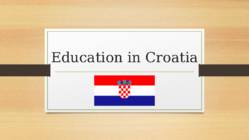
Education in Croatia Educational system in Croatia divided into: 1.Early childhood education 2.Primary education 3.Secondary education 4.Higher education Early childhood education There are three stages of early childhood education: · from when the child is 6 months old to when they're one · from the ages of one to three · from the age of three until the child stars attending primary school Even though these three stages are not compulsory, every child must attend kindergarten for a year prior to primary school. Primary education (Children begin school at the age of 6 or 7.) There are two stages: · 1st through 4th grade, being taught by one teacher per class that teaches every subject with the exception of foreign languages and Religion. The students stay in one classroom for the 4 years.
60.0 million people in mid-2009, it is the third most populous island in the world, after Java and Honsh. Great Britain is surrounded by over 1,000 smaller islands and islets. The island of Ireland lies to its west. Politically, Great Britain may also refer to the island itself together with a number of surrounding islands which comprise the territory of England, Scotland and Wales. All of the island is territory of the sovereign state of the United Kingdom of Great Britain and Northern Ireland, and most of the United Kingdom's territory is in Great Britain. Most of England, Scotland, and Wales are on the island of Great Britain, as are their respective capital cities: London, Edinburgh, and Cardiff. The Kingdom of Great Britain resulted from the political union of the kingdoms of England
Estonian and British Education System Estonian and British education system is not quite different. In Estonia, the education system is based on six levels which include the: kindergarten, primary school, basic school, secondary school and university or vocational school. In Britain, the education system is also based on six levels which include the: nursery school, infant school, junior school, secondary school, 6th form and university or college. What is similar for both systems is that the first level of education starts at age of three. While in Estonia this level is called Kindergarten, then in Britain it is called Nursery school.
States of America's education. Or maybe there is no difference at all, and our systems about school and education are more similar than they appear at first sight. After reading all the materials and all sorts of notes about USA's education systems and their school household. All at once I realized, that they are not so different at all. Like for example USA's kids have to go to school exactly the same amount of time as our Estonian children. And basically learn same amount of same things. Like everywhere there are always differences. Education in the United States is mainly provided by the public sector, with control and funding coming from three levels: federal, state, and local. Child education is compulsory. A sub-type of compulsory education is public education. Public education is universal at the primary and secondary levels (known inside the United States as the elementary and high school levels)
USA school system Most children enter the public education system around ages five or six. They may begin in preschoolpreschool, kindergartenkindergarten or first gradefirst grade. They normally attend 12 grades of study over 12 calendar years of primary and secondary education before graduating, earning a diploma that makes them eligible for admission to higher educationhigher education. Education is only mandatory until age 16, however. There are generally five years of primary (elementary) school, during which students customarily advance together from one grade to the next as a single cohort or "class", three years of middle school, which may have cohorts, and four years of high school. There is some variability in the arrangement of grades. In the U.S., ordinal numbersordinal numbers (e.g., first gradefirst grade) are used for identifying grades. Typical ages and grade groupings in contemporary, public and private schools may be found through the U.S
Education The education system is a little bit different in the UK than ours. For example they have go to school 2 years earlier than us. Primary school is for pupils aged 5-11. Though schooling is only compulsory from age 5 in the UK, children most commonly enter Reception Class aged 4 in the academic year in which they will reach their 5th birthday. When pupils are aged 7 they sit Key Stage 1 [SATs]. Key Stage 2 SATs are taken when pupils are aged 11. Secondary school is for pupils aged 11-16. 11-13 years old pupils study a broad range of 10–15 subjects. No public examinations are taken during this time. Traditionally, at the age of 14 students start a programme that lasts for 2 years and during which time they study up to 11 subjects of their choice. After this students take GCSE state examinations After 16 attending at school isn't compulsory but pupils can stay at school, go to college, or take up
Essay United States and Estonian education systems USA and Estonian school systems are very similar. But still there are some differences. How children attend school and when? How chlidren are divided by age in USA and Estonia? The American school year traditionally begins in August or September, after the traditional summer recess, which is three months long. As well in Estonia. School year usually ends in may or june. First difference between Estonian school system and USA's is that children attend school at the age of 5-6, but in Estonia children go to school at the age of 7-8. Before going to school american children attend preschool (selectively). Years 5-6 american children attend kindergarden, which is a preparation for the first grade. Most children enter the public education system around ages five or six.
The French education system is split into three stages: primary school (école), secondary school (collège) and high school (lycée). Primary and secondary education is free, neutral, secular and compulsory between the ages of 6 and 16. However, there are some private schools that are not subject to these obligations and particularities of the French education system. Nursery school classes accept toddlers at 2 or 3 years of age, starting in September. The children develop their basic faculties, improve their speaking skills and are introduced to the world of reading and writing, numbers and other key areas of learning. From age 6 to 11, the children attend elementary school which is mixed and freein the case of public (state) schools. The 'collège' accepts all pupils after elementary school without the need to pass an entrance exam. The teaching is structured by subject: French, mathematics, history-geography, 'civics' or
1) Eduactional charities - Hariduslikud heategevusasutused 2) Universal education - Üldkättesaadav haridus 3) Compulsory education - Kohustuslik haridus 4) Full-time education - Päevane õpe 5) Home schooling - Koduõpe 6) Maintained schools - Riigikoolid 7) National Curriculum - Rahvuslik õppekava 8) Independent schools - Erakoolid 9) Foundation subjects - Alusained 10) School hours - Koolitunnid 11) Terms - Semestrid 12) State schools - Riigikool 13) Primary (education) - Algharidus/algkool 14) Infant - Väikelastele 15) Junior - Algaste 16) Secondary - Põhikool 17) Single-sex - Ühesoolised 18) Co-educational - Segakoolid 19) Comprehensive schools - Üldhariduskool 20) Selective - Valiv 21) General certificate of secondary education - Põhikooli lõpueksam 22) Independent examination boards - Sõltumatud eksamikomisjonid 23) Vocational college - Kutsekool 24) Technical college - Tehnikumid 25) A-Level - Riigieksamid
The Estonian Education System The current Estonian education system consists of pre-school education, basic education, general secondary education, vocational education and higher education. Basic education is the compulsory education minimum, whics is provided by basic schools. Estonian law requires all children to be in full-time education from age of seven. In Estonia the National Curriculum is compulsory for all schools. The academic year begin on the first of September and is divided into four terms. So pupils have four holidays: a week in October, two weeks at Christmas, a week in March and three months in summer. Most Estonian children receive free education in state schools. School uniform is not compulsory. At the end of basic school pupils take three exams and at the end of twelfth form pupil take five exams. On completion of basic education, studies may be continue in a general secondary school or
Challenges of children`s “participation”: A Case Study of active citizenship in Cadle Primary School Gerli Orumaa – 662974 9th of May 2014 Word Count: 8,800 `Submitted in partial fulfilment of the requirements for the degree of B.A. International Relations` Table of Contents Abstract 3 Introduction 4 Chapter 1: Citizenship, Children`s Rights and Participation: from the UN to the UK 6 Chapter 2: Citizenship Education in Wales………………………………………………14 Active Citizenship in Cadle Primary School: A Case Study 20 Conclusion 29 Bibliography 32 Appendices Appendix 1: The United Convention of the Rights of the Child
Children go to school at age five in Great Britain, which is too early in my opinion. Most children in Estonia start school at age seven, only some of them at age six. I think starting with school and competition, rivalry, witch always associates with schooling, too young, shortens the childhood and may affect negatively self-esteem, success and coping in the future. Children´s job is to play, it develops child the best, so I think anyone shouldn't forbit humans inherent needs. Children don´t have to become too fast to an adult. The high school in Great Britain starts at age eleven, but in Estonia at about age fifteen. Biggest difference is that in Great Britain they prepare young people to get a job or continue studing, but in Estonia this is only first step of educational life. After primary school in Estonia you have two ways to walk: high school or industrial school, where they get profession.
laws to a new province of the Roman Empire and started to build good roads. Officials were appointed (governors, procurators to collect taxes, look after the estates and mines and se that the gold, silver, iron and lead were exported back to Rome). Introduced schools,a new language Latin, large farms (villas), baths. In AD 410 they had to leave . roman occupation lasted nearly 400 years. They left behind very little. Roman province of Britannia covered most of present-day England and Wales. 4. Latin influence on English *The influence of Latin is noticeable also in the names of European cities: the Latin noun colonia (settlement, colony) may be found in numerous place-names: Lincoln, Colchester, Cologne ; from Latin word castrum (military camp) were derived English affixes -chester and -castle: Manchester, Lancaster, Newcastle; Latin word portus (seaport) in Portsmouth *-tor - person, doer, masculine form
1. Match the term to heir definition A parish priest in the Church of England = vicar, rector A member of the highest order of ministry in the Anglican and Roman Catholic Churches who supervises a diocese = bishop A person authorized to conduct religious worship in the Church of Scotland= minister, deacons, “elders”, readers 2. Which of the following is considered ascribed status? Job Gender - yes Age - yes Position Race – yes 3. A member state of the Commonwealth of Nations which recognizes
The United Kingdom and London United Kingdom is a political name of the United Kingdom of Great Britain and Northern Ireland. These political names include the countries of England, Scotland and Wales. Every country has its own capital and language. The capital of England is London, the people there are english and the language spoken is English. In scotland live the scots, capital is Edingburg and the languages spoken are English and Scottish. The capital of Wales is Cardiff, the people tehre are welsh and the languages spoken are welsh and English. N. Ireland is the home for the Irish, the capital is Belfast and the language is Irish. The first inhabitants were Iberians and Celts who settled on the land and were often at war with each other
Advantage when applying for job- eelis kui taotled tööd Limited-limiteeritud,piiratud Account for-selgitama Neglet-hooletus Boarding school- No pupil is completed to attend lessons- Curriculum-õppekursus New methods of teaching-uued meetodi õpetamisel Continuum-hüpotees Primary school- algharidus Coprehended-tavaline Public school- riigikool Compulsory-kohustuslik Private nursery-eraalgkool Comprehensive school- tava-, üldkool Pre-school playgroups-algkooli lasteaed College-kolledz Preparatory schools- ülikool
Task 2. Complete each sentence with a word from the box. Use each word once only. cheat copy memorise pay revise concentrate divide pass punish underline a) Our teachers used to punish us by making us stay behind after school. b) If you…….twenty-seven by nine, the answer is three. c) Try to……. the most important rules. d) It is difficult to …….attention in a noisy classroom. e) Pauline tried her best to …….the end of year examinations. f) Your work is the same as Harry's. Did you……. his work? g) Your mind is wandering! You must …….more! h) Helen decided to……. all her work at the end of every week. i) It's a good idea to……. important parts of the book in red. j) The teacher saw Jerry trying to …….in the exam. Task 3. Match the words in the box with a suitable definition (a-j). Use each word once only.
male 78 years and female 84 years. Environmental problems: air pollution from vehicle emissions and open-air burning; acid rain; water pollution from increased use of agricultural fertilizers. Education: The education system in Switzerland is very diverse, because the constitution of Switzerland delegates the authority for the school system mainly to the cantons. The Swiss constitution sets the foundations, namely that primary school is obligatory for every child and is free in public schools. The minimum age for primary school is about six years in all cantons but Obwalden, where it is five years and three months. After primary schools, the pupils split up according their abilities and intentions of career paths. Roughly 20% of all students attend secondary schools leading, normally after 12 school years in total which grants access to all universities
fresh, are so full of flavour that British haven't had to invent sauces to disguise their natural taste. What can compare with fresh pees or new potatoes just boiled and served with butter? Why drown spring lamb in wine or cream and spices, when with just one or two herbs it is absolutely delicious? If you ask foreigners to name some typically English dishes, they will probably say "Fish and chips" then stop. It is disappointing, but true that, there is no tradition in England of eating in restaurants, because the food doesn't lend itself to such preparation. English cooking is found at home. So it is difficult to a good English restaurant with a reasonable prices. In most cities in Britain you'll find Indian, Chinese, French and Italian restaurants. In London you'll also find Indonesian, Mexican, Greek... Cynics will say that this is because English have no "cuisine" themselves, but this is not quite the true. Vocabulary: to criticize - tasteless overcooked -
Canada has equal rights with the United Kingdom; is loyal to Queen Elizabeth II; has membership in the United Nations; appoints her own ambassadors and other representatives abroad; makes her own treaties; draws up her own laws; imposes her own taxes, maintains her own army, navy and air forces. History The first inhabitants were the Native Indians, the Inuits. Around 1000 Vikings tried to arrive in Greenland but got lost and ended up in Canada. John Cabot from England, took back word that the sea was full of fish which could be taken not only with a net but in baskets let down into the water. Beaver fur brought Europeans to Canada. In 1608 the first permanent settlement was established, it was called Quebec by Champlain and after that Canada was called New France. During 1689-1763 there was constant fighting and wars between the british and the french. In 1774 the English parliament passed the Quebec Act. It gave the
Education Education is so multifaceted that it is difficult for me to know where to begin discussing it, or how to prioritize the many factors. Relaying my own experience is easy: I had a standard classroom approach, supplemented by inordinate reading. In only the briefest and least memorable instances did I receive any individual tutoring. Education is commonly thought of as the job of schools. Adults cry "educate our children!" Everyone has opinions about the best way to do the job. It is of urgent importance, and all the numerous factors are much studied, debated, and new (or old) ideas continually tested or retested. Some people say "it's as simple as . . . " and then name their pet peeve or passion. My view is not of an education specialist, but of one who loves sharing what I learn, and owes much to educators. Since I don't have an educational theory neatly worked-out, nor an outline
Germanic tribes- Anglo-Saxons. 6. Describe Wales.- Wales is a mountainous country on the western side of Great Britain. The national game of Wales is Rugby. Flag- Red dragon on a green and white field. They have their own language Cymraeg ( Welsh) . Anthem- Land Of My Fathers. Official animal- Dragon. There used to be a lot of coalmines. 7. What are the symbols of the 4 constituent countries? England- The three national symbols of England are St.George's cross; The red Rose and the Three Lions Crest; The oak is national tree; Northen Ireland- Shamrock; St.Patrick ;Scotland-thistle, St.Andrew 's cross . ; Wales-daffodil, leek, Prince of Wales's feathers; St.David, red dragon 8. How did the Romans influence Britain? The Romans built the first bridge(in London), the capital(London) is a Roman city, the street system(paved roads), benefits for the poor, public heated baths, art, architecture. They also
UK Conservation & Environment 1. What does AONB stand for? 2. What type of environment does the Ramsar Convention protect? 3. Which country has the greatest proportion of its land devoted to National Parks and other countryside conversation areas: England, Scotland, Wales or Northen Ireland? 4. Which is the main contributing gas to the greenhouse effect? 5. Which fortification in Britain dates from the Roman era and is listed in the World Heritage List? 1. Area of outstanding natural beauty 2. Wetlands 3. Northen Ireland 4. Carbon dioxide 5. Hadrian's Wall, in the north of England Physical geography 1. Which of the following countries is the nearest continental neighbour to Great Britain:
34. Are sports days held at your school? 35. What sports events do you watch on TV? 36. Do you read the sports page in a paper? Do you watch/listen to sports news? Could you tell us the latest sports news? 37. Who is the best athlete in your class? 38. Who is your favourite athlete? What do you know about him? 39. What sports events are popular in Estonia? How many Estonian Olympic gold medalists can you name? 40. Do you think it is necessary for children to play sport? Why? 41. Do you know any Estonian people who are known to everyone and liked by all? Are they politicians, writers, scientists, musicians? 42. Can you name some Estonian writers who are famous for their humour? Which of their books have you read? 43. What kind of books do you like to read? 44. When did you last read a poem? 45. Do you enjoy reading poems? http://www.abiks.pri.ee 46
5. Which 5 places attract visitors in Wales and Scotland? Edinburgh, Loch Ness, The Highlands, Snowdonia, Cardiff. 6. Name 6 islands, 5 rivers, 3 lakes, 3 mountains in UK. Isle of Man, Isle of Wight, Isle of Lewis, Island of Mull, Island of Arran, Anglesey Island Severn, Thames, Tweed, Avon, Trent, Dove Ben Nevis, Snowdon, Ben Macdui 7. Stonehenge. Stonehenge was produced by a culture that left no written records. Built on Salisbury Plain, in Wiltshire, England some time between 5,000-4,300 years ago. One of the most famous megaliths in the world, dating from prehistoric times. Stonehenge consists of circles of stone arranged in complex patterns, and their origin is still being explored. Some of the stones come from over 200 miles away in Wales. There is little or no direct evidence revealing the construction techniques used by the Stonehenge builders. It was probably associated with sun-worship and
There are different kinds of libraries to meet the needs of people: university, research, school, medical, government libraries and other libraries. Public libraries serve a wider range of people than other libraries. They may range from big city libraries to small village libraries. Big city libraries' materials are usually organized into subject areas, such as history, science, sports, fiction etc. There may be specials sections also for children. Almost every library has a special reading room with comfortable furniture for the readers and the students can work on independent study projects. School libraries. School libraries are part of the education system. It supports the curriculum as it helps the teachers and pupils to prepare for the lesson. Pupils can read extra materials there about the subjects they like. Everyone doesn't have a computer neither good encyclopedias at home so they can get the required
By 2006, the state had over 130 km2 of vineyards, a harvest of 109,000t of grapes and exports going to over 40 countries around the world from the 600 wineries located in the state. While there are some viticultural activities in the cooler, wetter western half of the state, the majority (99%) of wine grape production takes place in the desert-like eastern half. Education Elementary and secondary As of the 2008–2009 school year, 1,040,750 students were enrolled in elementary and secondary schools in Washington, with 59,562 teachers employed to educate them.[106] As of August 2009, there were 295 school districts in the state, serviced by nine Educational Service Districts.[107] Washington School Information Processing Cooperative provides information management systems for fiscal & human resources and student data. Higher education There are more than 40 institutions of higher education in Washington
was in orbit around the Earth. `Sputnik' was small, no bigger in fact than a football, and compared to today's technology, it was very primitive. All it could do was to bleep. But its impact was enormous. After its launch, things began to happen quickly. Less than a month later it was followed by `Sputnik 2' which carried a dog Laika into orbit. The USA sent its first satellite, `Explorer 1', into space early the next year. The next step, putting a man in space followed in 1961 when the Russian pilot called Yuri Gagarin orbited the Earth in `Vostok 1'. In 1961, President Kennedy announced that America would begin a programme to put a man on the Moon. Use the Internet to get answers to the following questions: 1 When did the first man take the first steps on the Moon? What was the name of the first man on the Moon and what did he say? Was he walking on the Moon alone?
 annaabi.ee