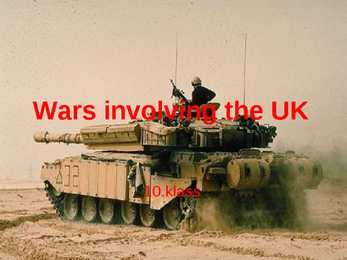
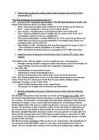
Wars involving the UK 10.klass Roman Invasion · 43 AD 410 AD · Aulus Platius · Archeological and epigraphic evidence The Lunt Fort near Coventry, · New developments a reconstructed Roman fort Aulus Platius Hadrian's Wall Norman conquest of England · 1066 AD · William the Conqueror · Battle of Hastings · Last succesful conquest of the UK Hundred Years' War · 1337 1453 · England France · Edward III · Joan of Arc · French victory English and Welsh longbow; the most Painting of Jeanne d'Arc at famous and efficient weapon during the war the Siege of Orléans The Wars of the Roses · 1455 1485 · Henry VI · Edward IV · Henry Tudor Red Rose of Lancaster The Tudor Rose of England White Rose of York ...
History of Great Britain Prehistory (55BC) no written records 6th 3rd c. BC the Celts came to British isles hill figures, hill forts, stone circles ( Stonehenge ) RomanBritain (55BC 400AD) Julius Caesar, named the country Albion Hadrian's Wall, villas, roads, the town of Bath The AngloSaxon, Danish and Norman invasions Germanic tribes settled and stayed Anglia Christianity was brought, religion became important, churches were built 8th century = raids by the Vikings and the Danes 1016 1042 : Under Danish rule ( York was the capital ) 1042 : local AngloSaxons regain their rule 1066 : Normans arrive ( the Norman conquest ) Medieval Britain (106615th c.) the Battle of Hastings William the Conqueror a new AngloNorman state the feudal system introduced the rule of the king and church strengthened centralised country, military rule Scotland, Wales and Ire...
Jonathan Dekel-Chen lectures, Jews in the USSR, 1917-2000 1937 census didn't get published. 1939, pretty accurate for Js. 3.1 mill Js in pre- Molotov-Ribbentrop area. 1939, 2.2 mill. Js not shy about declaring Jewishness. Inherits 1.3 mill in Poland. Similar # annexed by Germ. 250,000 in Lithuania. 330,000 Bessarabia. Back to pre-1917 #s of Sov Jewry. 5 ½ mill of pre-war levels. Pre-mature deaths during famine of '21-'22, '31-'33, 7 years of war, emigration up to 1924 (vast majority to West, 3rd and 4th aliyahs). J pop growth still significant, high birth rates, but pop static. Grows more in SU than anywhere else few leaving, pop growth significant. Vast majority in W borderlands. Very few emigrate during year and a half from annexed areas. Germans occupied Leningrad-Moscow-Stalingrad, all and more of former Pale. 1939, started evacuating. Stalin thought 43-44, war. Purges, Winter War, military needed improvement, military industrial ...
Britain History Pre-Norman Britain The Iberians brought their metal-working skills and the first real civilization to Britain in the third millennium B.C and were overrun by various Celtic invasions that began in the 8th century. The Celts introduced their tribal organization and an early form of agriculture before they were forced westward by the Roman invasion. Forms of Celtic language are still spoken in Britain. Romans (with Julius Caesar in the head of them) first tried to occupy Britain in 55 B.C., but there was a rebellion in Gaul so they had to leave to fight against it. Next time they came in 43 A.D. and their leader was Emperor Claudius. Romans brought a lot with them. Their brought paved roads, the sites of important cities, the seeds of Christianity, the Roman law, Roman baths, language and advanced civilization. They also built Hadrian's Wall in 122 A.D. Romans occupied...
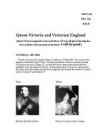
Kadri Laur PRG 11B. 26.05.07 Queen Victoria and Victorian England (Queen Victoria is supposed to have said this as a 10-year-old girl on learning that she was likely to become queen in the future: I will be good.) VICTORIA (r. 1837-1901) Victoria was born at Kensington Palace, London, on 24 May 1819. She was the only daughter of Edward, Duke of Kent. The Duke and Duchess of Kent selected the name Victoria but her uncle, George IV, insisted that she be named Alexandrina after her godfather, Tsar Alexander II of Russia. Edward died when Victoria was eight months old, upon which her mother enacted a strict regimen that shunned the courts of Victoria's uncles, George IV and William IV. Father ...
Joseph Rudyard Kipling was a British author and poet. He was born on 30 December 1865 in Bombay, in India which was part of the British Empire then. he is best known for his works of fiction The Jungle Book (1894) (a collection of stories which includes Rikki-Tikki-Tavi), Kim (1901) (a tale of adventure), many short stories, including The Man Who Would Be King (1888); and his poems, including Mandalay (1890), Gunga Din (1890), and If-- (1910).He is regarded as a major "innovator in the art of the short story"; his children's books are enduring classics of children's literature; and his best works speak to a versatile and luminous narrative gift. Kipling was one of the most popular writers in English, in both prose and verse, in the late 19th and early 20th centuries. In 1907, he was awarded the Nobel Prize in Literature, making him the first English language writer to receive the prize. Among other honours, he was sounded out for the Br...
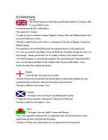
1) General facts The UK: * the United Kingdom of Great Britain and Northern Ireland was formed in 1801 * it covers 243,610 sq km * everybody from the UK is called British * the capital city is London * is made up of four constituent countries: England, Scotland, Wales and Northern Ireland which in turn are divided into counties * the flag is called the Union Jack which is a combination of the flags of England, Scotland and Northern Ireland * the population is about 60,000,000 people, the population density is 242 people/sq km * its coasts are washed by the Atlantic Ocean, the North Sea, the English Channel, the Celtic Sea, Saint George's Channel, and the Irish Sea. It is linked to France by the Channel Tunnel * the United Kingdom is a constitutional monarchy. The current monarch is Queen Elizabeth II, who is also the Queen and Head of State of fifteen other Commonwealth Realms, such as Can...
QUEEN VICTORIA & HER TIME Project Mari Murakas Class 11A 2011 Early life of Queen Victoria Victoria was born in London on 24 May 1819, the only child of Edward, Duke of Kent, and Victoria Maria Louisa of Saxe-Coburg. [1] The Duke of Kent was the fourth son of George III and Victoria Maria Louisa was the sister of King Leopold of Belgium. The Duke and Duchess of Kent selected the name Victoria but her uncle, George IV, insisted that she be named Alexandrina after her godfather, Tsar Alexander II of Russia. [2] Victoria's father died when she was eight months old. The Duchess of Kent developed a close relationship with Sir John Conroy, an ambitious I...
Stonehenge One of the best known ancient wonders of the world, 5000 years old Megalith monument, built by western mediterraneans during 3000-1600 BC Circular structure, large standing stones, aligned with rising sun at teh solstice Attlers and bones were sued to dig pits that hold the stones The Celts in Britain and their legacy 700-200 BC celts invade Britain Gaels or Goehls(Ireland and Scotland),Cymri(Wales) and Brythons(gave name to Brittany) Fierce fighters,superb horsemen.Most of them farmers, lived in thatched houses Good at art, craftmanship, used iron Divided into tribes, ruled by kings, only in face of danger would they choose a single leader Legacy- hill-forts, farms, churches, field system, woodland, pasture, weapons, iron objects, langugae, culture Caesar in Britain The great Roman Emperor Firts came 55 BC to gather information, celts ...
History exam *Stonehenge - is a monument located in England. It is one of the most famous prehistoric sites in the world and is composed of earthworks surrounding a circular setting of large standing stones. The surrounding circular, earth bank and ditch, have been dated to about 3100 BC. Stonehenge was produced by a culture with no written language. Many aspects of Stonehenge remain subject to debate. There is little or no direct evidence for the construction techniques used by the Stonehenge builders. *The Celts in Britain and their legacy The Cets lived in Britain in The Iron Age. They were warring tribes who were battleful amongst themselves as well as inter-tribal war. They were not centrally governed. The Celts brought iron working, iron ploughs and metal swords, horses, wheels and chariots - all these things gave them an instant superiority over the native tribes. The Celts built a number ...
1. What is known about the earliest settlers from Estonia to the territory of the present-day US? *The first immigrants from Estonia in the US = 1627 no trace of the "Estonians and Livonians" who left their homeland to settle at the mouth of the Delaware River (a Swedish colony) · 1654 at least one Estonian in the settlement of New Sweden on the Delaware River Johan Schalbrick, a drummer from Tallinn (Reval) · New Sweden Swedish colony on the Delaware River from 16381655 · 1657 Martinus Hoffman, born in Tallinn (Reval), came to New York (New Amsterdam), started to work as a saddlemaker. · His great-granddaughter Cornelia Hoffmann (b. 1734) married Isaac Roosevelt, which makes her the great-great-grandmother of Franklin Delano Roosevelt, president of the US from 193345. · Hans Rebane = 1897 founded the first Estonian-language newspaper in the US Eesti Ameerika Po...
Discuss the representation of the generation of fathers in Turgenev's novel "Fathers and Sons" Turgenev always had two tasks before him to depict the body and pressure of time, and to depict the rapidly changing face of cultured Russian society (Freeborn 1960:48). Kluchevsky (1993:40) defined one case of the generation gap in the beginning of the XIX century as "merry cosmopolitan sentimentality of the fathers now transformed in a patriotic grief of their children. The Fathers were Russians, who passionately wanted to become French; the sons were raised as French and passionately wanted to become Russians. Fathers and Sons situates this generational conflict within family relations. In this essay, the ways how Turgenev represents the generation of Fathers in Fathers and Sons is discussed. Fathers and Sons is set in between Russia's defeat in the Crimean War and the Emancipation of the Serfs a socially challenging area. Mid-19 th c...
Russian philology The meaning of the word "philology" is "love for word". This is love that unites teachers and researchers of modern and Classical languages and literature, interpreters and diplomats, journalists and publishers, writers and poets. Russian philologis are highly demanded in various spheres of scholarly research and education, in the mass media, in civil service at the Ministry of Foreign Affairs, in archives, libraries, museums, in travel agencies, as well as Russian and international companies. Curriculum within in philological faculty includes courses of Russian and European languages and literature, courses of Linguistics and Theory of Literature for students to familiarize themselves with various schools and trends of Russian and foreign philology. The core curriculum also includes a number of Liberal Arts courses (Philosophy, History, Psychology, Pedagogy), as well as courses of basic mathematics and compute...
1. Ancient Britain: the Celtic tribes. 2000 years ago there was an Iron Age Celtic culture throughout the Br Isles. It seems that the Celts, who had been arriving from Europe from the 8th cent BC onward, intermingled with the peoples who were already there. The Celts were extremely talented people, creative and artistic. More than 1 Celtic tribe invaded Br. The descendants of ancient Celts live in Wales, Scotland, Cornwall and Ireland. They lived in primitive society. Druids priests, more powerful than chiefs. Acted like prophets. 2. Stonehenge From prehistoric period. Was built on Salisbury plain between 2500 and 1500 bc. One of the most famous and mysterious archaeological sites in the world. One of the mysteries is how it was built at all with the technology of the time. Another is its purpose. It appears to function as a kind on astronomical clock and we know it was used by the Druids for ceremonies marking the passing ...
Some of the things you will learn in THE CODEBREAKERS • How secret Japanese messages were decoded in Washington hours before Pearl Harbor. • How German codebreakers helped usher in the Russian Revolution. • How John F. Kennedy escaped capture in the Pacific because the Japanese failed to solve a simple cipher. • How codebreaking determined a presidential election, convicted an underworld syndicate head, won the battle of Midway, led to cruel Allied defeats in North Africa, and broke up a vast Nazi spy ring. • How one American became the world's most famous codebreaker, and another became the world's greatest. • How codes and codebreakers operate today within the secret agencies of the U.S. and Russia. • And incredibly much more. "For many evenings of gripping reading, no better choice can be made than this book." —Christian Science Monitor THE ...
TRADERUN MOODUL TRADERUN MODULE BUSINESS PECULIARITIES IN THE EU, RUSSIA AND EASTERN PARTNERSHIP COUNTRIES ÄRI ERIPÄRAD EUROOPA LIIDUS, VENEMAAL JA IDAPARTNERLUSRIIKIDES Lecturers: Ryhor Nizhnikau (responsible) Giorgi Gaganidze, Sergei Proskura, Andres Assor P2EC.00.202 (UT code), RIE 7044 (TLU code) Reading materials: Business peculiarities in Ukraine and Belarus Lugemismatejal: Äri eripärad Ukrainas ja Valgenenes Created by Andres Assor Tartu 2013 TABLE OF CONTENTS INTRODUCTION ................................................................................................................... 4 1. UKRAINE ...................................................................................................................
 annaabi.ee