 50 punkti
Autor soovib selle materjali allalaadimise eest saada 50 punkti.
50 punkti
Autor soovib selle materjali allalaadimise eest saada 50 punkti.
 ~ 1 leht
Lehekülgede arv dokumendis
~ 1 leht
Lehekülgede arv dokumendis
 2010-04-22
Kuupäev, millal dokument üles laeti
2010-04-22
Kuupäev, millal dokument üles laeti
 12 laadimist
Kokku alla laetud
12 laadimist
Kokku alla laetud
 0 arvamust
Teiste kasutajate poolt lisatud kommentaarid
0 arvamust
Teiste kasutajate poolt lisatud kommentaarid
 andz31
Õppematerjali autor
andz31
Õppematerjali autor
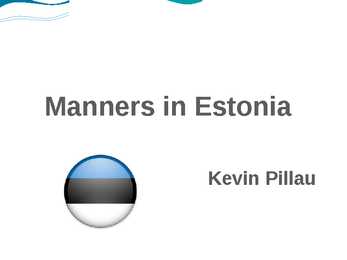
Manners in Estonia Kevin Pillau Hierarchy in Estonian Society Estonia is a hierarchical society. Age, experience and position earn respect. Older people are generally viewed as wiser and as a result revered and honoured. Elders are introduced first and in general are treated much like royalty. Those in senior positions bear the responsibility to make decisions in the interest of the group. Due to seniority titles are very important when addressing people. It is expected that you will use a person's title and their surname until invited to use their first name. Cultural Traditions Estonian culture as an identity is very strong. Oral traditions especially have played a key role in preserving traditions, stories and customs during Soviet administration. Singing is a very Estonian activity and the Estonians are known to have sung their way to freedom during the "Singing Revolution" of 1989-91. Manners Estonians on the whole are quiet and reserved. They tend to speak softly a
1. TELEPHONE ETIQUETTE · When answering the phone at your desk say..."Hello, this is Mr. or Ms. Smith". Do not say phrases such as... "Smith here!" or simply "Hello". · Many people think it is rude when you use call waiting to talk to someone else in the middle of the conversation you are having with them. · When using a cell phone, try to find a quiet spot to answer a call. It is considered particularly rude to leave a cell phone turned on in public places like: classrooms, libraries, movie theaters, churches, etc. 2. CLOTHES AND DRESS · Also, pay attention to how much of your body you are exposing (have uncovered) and whether it is appropriate for the situation. (Ex. shorts, sandals, a very short or very tight skirt, or low cut or too tight shirt, are really not appropriate for meetings, interviews, etc.) Wearing this type of clothing can also communicate the same negative things. · Men: socks should match their
educated, where we live and who we connect to When we hear word ,,tolerant" then mostly we connect it with homo sexuals, racism, religion and all kinds of different people(disabled people for example) and how we tolerate those things. Speaking of homo sexuals then for me they are same people as I am and I have nothing against them. I only would not like if homo sexuals would start effecting my future child and saying that being homo sexual is better and so on, that i would tolerate, of course. Also I would not like them to have babies because in my point of view children need usual, traditional family, because having for example 2 fathers may cause problems with other children and life would be harder and stranger. Nowadays attitude towars black people is changed but there were times when they were hated and treater evilly. This was not just race problem, it was also affected by cultural differences
g Miami, California etc. Education I went to school when I was 7 years old. Gruaduated Gümnaasiumi 9th grade. Then I went to ***** ***** Gümnaasium'isse, for one year, and I diden't like it there so I left. And I decided to go to Tallinna Industrial Educational Center(THK). The reason why I chose THK was becouse I like the speciality. When we talk about Estonians Educatinoal System, then I think that it could be better, becouse I don't like it. First of all, everyone dosen't have the opertunity and the money for a full lengh enducation. Global Problems I don't notice nature changes much. But what I have noticed is that there are a lot of cars that produce CO2 what are not good for nature. What troubles me is the over population. What it means is that more people born, and less die. The biggest risk is that there are not enough jobs and food. Most people don't care about the future of our planet.
Golden Grammar rules 1. Don't use an with own. Sue needs her own room. (NOT Sue needs an own room.) I'd like a phone line of my own. (NOT ... an own phone line.) 2. Use or rather to correct yourself. She's German or rather, Austrian. (NOT She's German or better, Austrian.) I'll see you on Friday or rather, Saturday. 3. Use the simple present play(s), rain(s) etc to talk about habits and repeated actions. I play tennis every Saturday. (NOT I am playing tennis every Saturday.) It usually rains a lot in November. 4. Use will ..., not the present, for offers and promises. I'll cook you supper this evening. (NOT I cook you supper this evening.) I promise I'll phone you tomorrow. (NOT I promise I phone you tomorrow.) 5
Heat Kuumus Icy Jäine Humid Niiske Humidity Niiskus Breeze Kerge tuul Gale Tormituul Hurricane/tornado Tornaado Thunderstorm Äike Thunder Kõu Lightning välk Do you agree? On a rainy day I feel bad. On a sunny day I feel much better. Some people complain too much about the weather. I don´t think it is so important. I don´t like our climate. I would like to have hotter summers and no snow in winter. NATURE 1. Have you ever had a pet? Would you like to have a pet? 2. What is difficult about having pet animals and what are the joys they give us? 3. What are the most common wild animals in Estonia? Which of them have you seen in the wild?
Tallinna Pedagoogiline Seminar Noorsootöö osakond Intercultural communication: Customs and behaviour patterns in Finland Andra Pant, NT 12 Tallinn 2011 Punctuality is very important to the Finns. Never be late for meetings, as this is considered very impolite in Finland. Be on time! Do not raise your voice when you talk to Finns, especially not in public! Speaking in a loud voice is considered rude, as Finns themselves are quiet. Remember to look Finns in the eye. Looking down or to the side is a sign of dishonesty in Finland. If you want to visit a Finnish frien
license online. Usability went mainstream.In 2000, not that many people understood the importance of usability. Now, thanks in large part to Steve Jobs (and Jonathan Ive), almost everyone understands that it’s important, even if they’re still not entirely sure what it is. Except now they usually call it User Experience Design (UXD or just UX), an umbrella term for any activity or profession that contributes to a better experience for the user. It’s great that there’s now so much more emphasis on designing for the user, but all the new job descriptions, subspecialties, and tools that have come along with this evolution have left a lot of people confused about what they should actuallydoabout it. I’ll be talking about all three of these changes throughout the book. Don’t get me wrong… This edition has new examples, some new principles, and a few things I’ve
 annaabi.ee







Kõik kommentaarid