The Great Guild Liisbeth Kallakmaa The Great Guild Medieval Tallinn's social institutions were guilds and brotherhoods, whose main function was to provide members with social interactions and ensure their rights, but also played an important political and economic role. Tallinn had three important guilds - The Great Guild, St. Canute's Guild and St. Olaf's guild. The Great Guild was the youngest among them, founded in the 14th century, but soon became the biggest and most important. It was founded as an organization of the wealthiest merchants and shipowners. The name of the Great Guild was introduced in the late 15th century. There were close ties between the guild and the town rules: only members of the Great Guild had the right to belong to the town council and could be elected for mayor. Tallinn's small coat of arms is also the Great Guild's coat of arms. Guild was led by Alderman, with the assistance of t...
Old Market square (Vanaturg) is the former market square in Tallinn old town. Five streets meet here: Vene, Viru, Suur Karja and Kuninga streets, and Vana Turu Kael sidestreet. The market location perfectly suited for trade: five trade routes started there. The square is connected to Town Hall Square by a short sidestreet. Town Hall Square Was used as marketing place, for festivities as well as for executions. In summer it is filled with outdoors cafes In winter it becames a magical christmas market The L-shaped sigh There has been a town hall in Tallinn since at least 1322. Town Hall Built in 13th century The management of the city worked in the Town Hall until the year 1970 The only gothic town hall on Northern Europe Weathervane Old Thomas The height of the towe is 64 metres Town Hall pharmacy Is one of the oldest working pharmacies in Europe and...
2 Towns (Upper & Lower Town) Tallinn used to be divided into 2 parts - Upper Town where lived the aristocracy, gentry and the clergy; and Lower Town with traders, craftsmen and merchants. Legend says the Toompea Hill is actually the tumulus mound of the great Kalev. Linda carried rocks to his grave. It is a naturally- formed limestone hill. Lower Town was a merchantile centre, Tallinn also belonged to the Hansaetic League (1285). It is often referred to as the town of citizens. Any grown-up, married and economically independent person, born in a legal marriage between two free people and having lived in the town for at least 3 months, could apply to the Magistracy for citizenship. Serfs could escape from serdom after having successfully hidden in town for a year and a day. Two parts remained separated until the end of the 19th century. Four Names Lyndanise - mentioned by Henricus de Lettis in his Chronicle; derives from the name Lind...
The square in front of Tallinn's Town Hall functioned as a marketplace for centuries, dating back to times even before the Town Hall itself was built. Through the years this served as a place of celebrations as well as executions. Today the square remains a cultural focal point for the city. In summer, it's filled with outdoor cafés and is home to countless openair concerts, handicraft fairs and medieval markets. In winter, an annual Christmas Market enchants the crowds on the square, as does the town's Christmas tree (a tradition whose roots stretch back to 1441), which stays up for a month or more. Town Hall Square has also become the traditional centre of the Old Town Days festival, a modern version of a medieval carnival. Traditions from the Middle Ages are kept alive here, including parades, a knights' tournament, a parrotshooting contest and the election of the May Count. Tallinn`s late Gothic Town Hall building is one of...
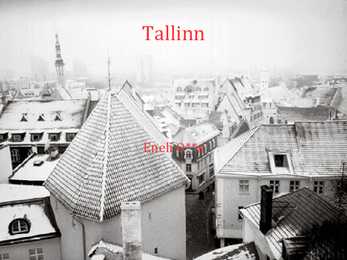
Tallinn Eneli O**a History City rights were given to Tallinn on May 15, 1248 Independent since 1991 Covers the area of 159.2 km2 Old Town of Tallinn Tallinn's Old Town is one of the most well- preserved old towns in northern Europe The golden era in lies in the period between the early 15th and mid 16th centuries It has three parts: Lower Town, Upper Town + Town Wall, Towers and the Gates Lower Town/Upper Town Town Hall Square Toompea Castle & Tall Tallinn Town Hall Hermann's Tower Town Hall Pharmacy Cathedral of Saint Mary the Virgin Great Guild Hall Danish King's Garden House of the Brotherhood of Black Heads Other Attractions Ka...
Old Tallinn Old Town, a medieval walled city filled with old buildings and fortifications. The sheltered bay and the easily defended Toompea Hill made it a natural place to settle. Sometime about 1050 A.D. a fortress was built atop the hill, the first of many. In 1219 the Danes showed up as part of the Northern Crusade to subjugate the Baltics and convert the local pagans to Christianity whether they wanted to or not. The Danes improved the fortifications and expanded the town, which became part of the Hanseatic League, a trading organization of a hundred northern cities. The Danes sold Tallinn to the Livonan Order, a branch of the Teutonic Knights, in 1346. The Swedes came next in 1561. Tallinn weathered plague and the Great Northern War and became part of Russia in 1710. In 1918, Estonia declared independence from Russia and fought a bitter war against Bolshevik Russia. Independence didn’t last long, ...
THE DOMINICAN St. CATHERINE`S MONASTERY One of the best-kept secrets of Tallinn is to be found in the very center of the city. Located near Viru Street, between Müürivahe and Vene Streets, is a medieval Dominican monastery which reveals a fascinating dimension of the city's history. The Dominican Order was founded by a Spaniard, Saint Dominic Gusman, in 1216. Up to that moment only bishops were permitted to preach, but their performance was inadequate beause of the time they had to devote to the administrstion of their dioceses. The result was that many Christians heard the Word of God rarely if at all . Dominic envisioned the creation of a body of trained theologians who would scatter throughout Europe and proclaim the gospel in the most remote areas. The nordic countries appear very early on the Dominic anagenda. To reach Tallinn the friars followed the trade route along the southern coast of the Baltic Sea, and reached Estonia some 7...
Fay Weldon an English author, essayist and playwright Early life § Fay Weldon was supposed to be born in New Zealand, but instead was born in England in 1931. At 5 weeks old she and her mother returned to New Zealand. § Her father was a doctor and her mother was a writer of commercial fiction under the pen name "Pearl Bellairs", among others. Her parents divorced when she was five. She lived with her mother, sister and grandmother until she started college and, as a result, grew up believing "the world was peopled by females". This problably influenced her works too. § She returned to England with her mother and studied economics and psychology at the University of St Andrews in Scotland. § Her actual christened name was "Franklin Birkinshaw". which she feels contributed to her being accepted at St Andrews and permitted to study economics: the school assumed she was a male student applica...
Moulin Rouge It is a movie about two lovers who fall in love but their love is not possible. Woman, Satine is a courtesan who works in Moulin Rouge and the man, Christian is a poor writer who writes a play ,,Spectacular Spectacular" for Moulin Rougle and Harold Zidler who is the owner of Moulin Rouge. At the beginning Christian presents himself as the Duke to win Satine's favour. The reason was not that he wanted to trick her but to present his work to Satine. Satine believed that Christian was the right Duke and tried to seduce Christian eventhough the man recisted. They fell in love after Christian reads her one of his poems. But Zidler had planned Satine to spend the night with the right Duke because he wanted him to become the investor of the Moulin Rouge because Zidler wanted Moulin Rouge to be a real theatre. He used Satine to do that. After Christian had read poetry to Satine the real Duke a...
Hilisgootika (keskaeg) 1400-1530 Lübecki linnaõigus- iga majavaldus moodustas naabritest kindla müüriga eraldatud kinnistu. Aknad avanesid vaid tänavale ning olid võrestatud, liikudega. Ehitada tohtis vaid kivist elumaju(tulekahju)-nõuded ranged. Peahoonega liitusid hoovis väiksemad majapidamishooned. Hooned olid paekivist. Seest: Eeskoda diele, suured aknad. Ühe akna all peremehe kontor mis oli eraldatud vahe või kappseinaga. Diele(eesruum) tagumises osas matelkorstna all köök, riiulid seinaavades. Üks kitsas seina... trepp viis keldri, teine ülemisele korrusele aidaruumi. Mantelkorstna korral oli uks köetavasse elutuppa-dornsi-kus oli suur õule avanev aken, kätepesukoht e lavatoorium. Köeti kerisahjuga, mööbel asetses seite ääres, levinud olid laekad ja kirstud, kesel söögilaud ja pingid. Ülejäänud ruume kasutati laona. (KAUBAÕITSENG) Sisseehitatud mööbel, mööbel vastavalt rikkusele. Renessanss 1530-1640 -Reformatsiooni ja sõdade ...
Introduction Tallinn, the capital city of the Republic of Estonia and of the Harju county, is a town in North Estonia on the coast of the Gulf of Finland. It has nearly half a million inhabitants and covers an area of almost 160 sqkm. It is also an important economic and cultural centre and one of the main ports in the Baltic States. Tallinn is one of the oldest cities on the Baltic Sea. It is unique for its well-preserved architecture from the 13-15 centuries. In contrast to the ancient town-walls and towers, Tallinn of today offers modern hotels, restaurants, sport and cultural centres. Every five years national song and folk dance festivals take place in Tallinn. The yachting regatta of the 1980 Moscow Olympic Games was held at Pirita. History Tallinn means in English "Danish town". The place is believed to have been settled by Finno-Ugric people about 2500 BC. It was first marked on a map of the world by the Arab geographer al-I...
Tallinn Mustamäe College G2K Jaana-Kristiina Jõgevest The Four oldest churches of Tallinn Report Supervisor: Ingrid Teigar Tallinn 2009 The Dome Church The Danes began fortification of Toompea after the conquest of Tallinn in 1219 and probably also built the first church there. It was presumably a wooden building located at the site of the present cathedral. However, a serious conflict with the Order of the Brothers of the Sword broke out soon as the latter wanted to gain control of the entire Estonia. The order succeeded in subordinating Tallinn and the whole of North Estonia to its rule in 1227. The monks of the Dominican Order began the construction of a stone church in Toompea in 1229. The first written data on the cathedral date back to 1233, the date of a battle...
kool Research work Styles in interior design nimi TALLINN2010 Interior design is a multifaceted profession in which creative and technical solutions are applied within a structure to achieve a built interior environment. The interior design process follows a systematic and coordinated methodology, including research, analysis, and integration of knowledge into the creative process, whereby the needs and resources of the client are satisfied to produce an interior space that fulfills the project goals. Baroque Baroque (pronounced /brok/ b-ROHK in American English or /brk/ in British English) is an artistic style prevalent from the late 16th century to the early 18th century in Europe.[1] It is most o...
The Renaissance In the history the Middle Ages were followed by the Renassance period. During this period a new class called bourgeoeisie came into being. This is the period when monarchies based on nationality were estabilished. The Renaessance started in Italy In the 14th century. Then it spread all over Europe, reached England in 16th century. The struggle for power culminated in a war called The War of Roses. It was a civil war between two dynasties, families. They had different emblems on one side the Yorks (white rose) other Lancasters (red). They couldn't decide who gets the throne. War ended 1485. A new dynasty came to throne, Tudor, the first king in this dynasty was Henry Vll. When he came to throne a period of stability followed because he built a nation based state. He was good at diplomacy.He could avoid quarrels and wars with neigbouring countries. France, Spain - greatest enemies.So he ...
Years 1154-1485 Henry I was the first unquestioned ruler. One of the most important kings in the Middle Ages. He had lands in Britain & France. Then the government was the monarch, a person, not a place. He had more land than any pervious king. After his marriage to Eleanor of Aquitaine, he also ruled the lands south of Anjou. His empire stretched from the Scottish border to the Pyrenees. England provided most of its wealth, but the heart was Anjou. Henry II began to regain royal control. During the war some barons had become very powerful. He pulled down some of their castles. He tried to restore law & order. He wanted the same kind of justice to be used everywhere. He appointed his own judges to travel around the country. They dealt with crimes & disagreements over poverty. Serious offences were tried in the king's court. At first they had no special knowledge or training. They were trusted to use common se...
Art Museum of Estonia Art Museum of Estonia was founded on November 17th, 1919, but it was not until 1921 that it got its first permanent building the Kadriorg Palace, built in the 18th century. In 1929 the palace was expropriated from the Art Museum in order to rebuild it as the residence of the President of Estonia. The Art Museum of Estonia was housed in several different temporary spaces, until it moved back to the palace in 1946. In September, 1991 the Kadriorg Palace was closed, because it had totally deteriorated by then. At the end of the year the Supreme Council of the Republic of Estonia decided to guarantee the construction of a new building for the Art Museum of Estonia in Kadriorg. Untill then the Knighthood House at Toompea Hill served as the temporary main building of the Art Museum of Estonia. The exhibition there was opened on April 1, 1993. Art Museum of Estonia premanently closed down the exhibitions in that buildi...
Ameerika Kirjandus 30.01.13 Naturalism · France, Emile Zola · Put down his theory in 1879: Le Roman Experimental, attempt to explain the development of human society throuch biological laws · Outlook is deterministic, pessimistic, fatalistic (fate or biology) · Man as an animal-clever than other beasts, still explainable within the framework · Man is not a free agent, is govern by something · Unable to determine his own faith · Hereditary · Naturalists tried to apply in fiction the processes of natural sciences · Writers task is to record facts, systems of behaviour, living conditions, never revealing any natural unbiased (completely natural) · Point of view: amoral-outside the category of morality, neither good or bad · Naturalist find it absurd to blame the wicked. These criminals are doing what nature, environment, their unconscious tells them to do. Naturalists do not ...
LOENGUD MAASTIKUARHITEKTUURI AJALOOST 2010 Õppematerjal maastikuarhitektuuri ning maastikukaitse ja hoolduse üliõpilastele Koostanud Kadi Karro AEGADE ALGUS NING VARAJANE MAASTIKUKUJUNDUS. Esimesed maastikud, nende areng. Varajased tsivilisatsioonid: Egiptuse ning Mesopotaamia (Babüloonia, Assüüria ja Pärsia) kultuurid ja maastikukujundus. VANA-KREEKAST KESKAJANI: Antiik-Kreeka linnaplaneerimine ja aiad. Antiik-Rooma linnaplaneerimine ja aiad. Vitruvius "De Architectura". Islami aiad. Euroopa läbi keskaja: kloostriaiad, religioosne sümboolika; botaanikaaiad, linnakodanike aiad. RENESSANSS: Vararenessanss Itaalias 14. saj. Renessanss Itaalias 15.- 16. saj. Manerism ja barokk Itaalias 16.-18. saj. Linnaruum Itaalias: piazzad keskajast barokini. BAROKK: Barokk Prantsusmaal 17. saj. Prantsusmaa naabermaad 16.-18. saj: regulaarstiil Inglismaal, Hispaanias, Austrias, Saksamaal, Madalmaades, Venemaal, Rootsis, Taanis. EESTI VANEMAD MÕIS...
 annaabi.ee