http://doi.org/10.3797/scipharm.1111-13 Tartes, U. jt. (2008). Eesti Punane Raamat. (Red Data Book of Estonia), 150. Taylor, L., & Roberts, D. L. (1992). Biological Flora of the British Isles: Epipogium aphyllum Sw. List Vasc. Pl. Br. Isles, 4(162). http://doi.org/10.1111/j.1365- 2745.2011.01839.x Wang, G., Wang, M., Yuan, Y., Lu, X., & Jiang, M. (2014). Effects of sediment load on the seed bank and vegetation of Calamagrostis angustifolia wetland community in the National Natural Wetland Reserve of Lake Xingkai, China. Ecological Engineering, 63, 2733. http://doi.org/10.1016/j.ecoleng.2013.12.004 16 Veldkornet, D. A., Potts, A. J., & Adams, J. B. (2016). The distribution of salt marsh macrophyte species in relation to physicochemical variables. South African Journal of Botany. http://doi.org/10.1016/j.sajb.2016.08.008 17
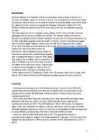
Landscape. Estonia's landscape is quite even. The last Ice Age made a big impact on the current relief and also the sea that covered the country once. The southern and central part of Estonia is hillier than the northern and western part. The northern and western parts are quite low. 50% of Estonia is covered with forests and 30% is covered with wetlands. Estonian landscape features numerous meteorite craters. The Endla Nature Reserve in Central Estonia is an uninhabited wetland covered in a variety of vegetation and fauna. It covers seven ancient bogs, zix slow- flowing rivers, five shallow lakes and over 30 springs. Pärnumaa means sun, sean and holidays. Pärnu is the summer capital of Estonia. It is rich in sandy beaches, forests, bogs and marshes. It is in the South-West of Estonia. Its area is about 32 square kilometres. About 45000 people live in Pärnu, 80% of them are Estonians. Pärnu is the 5th biggest city in Estonia. It's an important harbour-city.
the flora of Britain and only small parts of those forests remain today. Although about 10 percent of Britain is still forested, most of this area consists of commercially planted coniferous forests in Wales. Before they were affected by the people, the oak forests spread over the best soils of Britain. Forests were unable to establish themselves in the poorer soils of the mountains, wetlands and heath. The plants common to these wilder areas are heather, peat moss, rowan and bilberry. Some wetland areas have drained and are now covered by towns and farmland. Animal life An estimated 30,000 animal species live in Britain, although many of them are on the endangered list. Britain has many small mammals and the large ones tend to be gentle. The only surviving large mammals are red deer and roe deer. Semi wild ponies also inhabit the Shetland Islands. Once wild boars and wolves roamed Britain but they were hunted to extinction.
Before they were affected by centuries of clearing and human use, the great oak forests spread over the best soils in Britain. Forests were unable to establish themselves in the poorer soils of the mountains, wetlands, heath, and moorlands. The plants common to these areas are heather, gorse (astelhernes), peat moss (sammal), rowan (pihlakas) and bilberry (mustikas). These regions have been altered by heavy grazing of livestock and by controlled burning. Some wetland areas have been subjected to massive draining efforts for hundreds of years and are now covered by towns and farmland. 8. Agriculture, natural resources The open fields with their tiny strips of land worked by farmers were quickly replaced by compact farms, with large farms surrounded by hedges and ditches to prevent stray animals from ruining the crops or mixing with the new, improved breeds of sheep and cattle
avakesed liiva osakeste vahel ning muuta süsteemi mittefunktsionaalseks. Ka liiva kvaliteet mõjutab tulemust. Liivaterade suurus(ning sellest tulenev pooride suurus) on oluline näitaja. Liiv tuleks hankida kvalifitseeritud töövõtjalt, kellele on riiklikud regulatsioonid teada. Vallisüsteemide rajamine ning remont on kallid. Materjalide valik on väga oluline ning kõpptulemusel määrav. Süsteemi tuleb hooldada. MÄRGALADE SÜSTEEM(Wetland Systems) Võrreldes teiste alternatiividega, saab märgalade süsteeme ehiada odavamalt. Samas on märgala süsteemi tulemuslikkus võrreldes teiste alternatiividega väike. Märgalade süsteemid saavad üldiselt eelselitusega hakkama, kuigi mõnel juhul on nad ehitatud ka biopuhastuseks ehitatud. Märg süsteem töötab kõige efektiivsemalt siis, kui süsteemile eelneb heitvee kogumismahuti ning taimerile sätestatud pump, mis toimetab kontrollitud doosidega.
The best place to see marshes is in the Soomaa National Park in Western Estonia. Soomaa indeed means "Bogland" in Estonian and impressive bogs cover the majority of the park with the thickness of the peat layer reaching up to 7 metres in some places. At least 10 per cent of the Estonian territory is subject to the environment protection. The most important protection areas are resting and recreation areas for migratory birds. Mainly seashore wetlands and chaste woodland and wetland areas. The preservation of traditional cultural landscapes is important as well. 5 History To the Nineteenth Century The Estonians settled in their present territory before the Christian era. They were mentioned by Tacitus 1st century A.D., who called them Aesti. In the 13th cent. the Danes and the German order of the Livonian Brothers of the Sword formed an alliance to conquer the pagan Estonian tribes
ringed seal are relatively common as well. Of the 333 recorded bird species, 222 breed in Estonia, including the capercaillie, black stork, and all together at least 400 pairs of eagles. At least 10 per cent of the Estonian territory is subject to the environment protection. The most important protection areas are resting and recreation areas for migratory birds, mainly seashore wetlands, and chaste woodland and wetland areas. The preservation of traditional cultural landscapes is important as well. Political structure With the proclamation of Estonia's national independence in 1918, a parliamentary republic was formed. The constitution of 1920 was clearly one of the most democratic for that time. The Parliament elected a Riigivanem (president) who acted as the leader of the government and head of state. In 1991 the Republic of Estonia was restored on the basis of
koostööd Bird Life'iga, mõlemad riigid on osalevad ka Save the Tiger fund'is. 3 Indoneesia on seotud ka IUCN-iga (Rahvusvahelise looduskaitseliiduga) läbi oma riikliku Keskse Metsakaitse ja Looduse Säilitamise Direktoraadi, Malaisia aga suisa läbi kaheksa valitsusvälise ja riikliku organisatsiooni. Indoneesia programm on olemas ka Wetland International'il (Rahvusvaheline märgalade kaiste organisatsioon) sama mittetulundusühinguga on seotud ka Malaisia. Ramsari alasid on Indoneesias kolm ning Malaisias 5. Indoneesias asub ka Green peace'i osakond. Nii Brunei, Malaisia kui ka Indoneesia on ÜRO liikmed ja seeläbi seotud UNEP-i tegevustega. UNEP teeb aga tihedat koostööd IPCC-ga (rahvusvaheline kliimamuutuste alane ekspertide kogu).
51. Tamm, L. 1967. Süstaga Halliste jõel. Eesti Loodus 6: 383-386. 52. Taylor, D. R., Aarssen, L. W. & Loehle, C. 1990. The species-pool hypothesis and plant community diversity. Oikos 68: 371-374. 53. Talvi, T., 2001. Pool-looduslikud kooslused. Ökoloogiliste Tehnoloogiate keskus. 54. Tilman, D. 1982. Resource competition and community structure. Princeton University Press, Princeton. 55. Touzard B., Clément B., Lavorel S. 2002. Successional patterns in an eutrophic alluvial wetland of western France. Wetlands 22 (1): 111-125. 56. Truus L., Tõnisson, A. 1998. The ecology of floodplain grasslands in Estonia. In: Joyce CB, Wade PM (eds) European Wet Grasslands: Biodiversity, Management and Restoration. Wiley, Chichester, 49-60. 57. van der Maarel, E. 1998. Species diversity in plant communities in relation to structure and dynamics. In: During H. J., Werger, M.J.A. & Willems, J. H. (eds.). Diversity and
 annaabi.ee