easily. An unstable soil structure could spell disaster for the larger trees. Epiphytes An epiphyte is a plant that grows upon another plant (such as a tree) non-parasitically or sometimes upon some other object (such as a building or a telegraph wire), derives its moisture and nutrients from the air and rain and sometimes from debris accumulating around it, and is found in the temperate zone (as many mosses, liverworts, lichens and algae) and in the tropics (as many ferns, cacti, orchids, and bromeliads). Lianas A liana is any of various long-stemmed, woody vines that are rooted in the soil at ground level and use trees, as well as other means of vertical support, to climb up to the canopy to get access to well-lit areas of the forest. Lianas are especially characteristic of tropical moist deciduous forests and rainforests. Fig trees Ficus is a genus of about 850 species of woody trees, shrubs, vines, epiphytes, and
Koala The Koala is another recognised symbol of Australia. It's difficult to take koala pictures because they sleep 20 hours a day. (They are permanently sleepy because of the chemicals in the Gum leaves). Emu It is quite common to see emu's in Australia.They are the second largest flightless bird in the world (just smaller than the Ostrich), but the emu is unchallenged as the stupidest of all creatures. In the tropics you can meet emus cousin cassowary. National symbols Flag of Australia National anthem-Advance Australia fair National colors-green and gold National flora emblem-golden wattle National gemstone-Opal Coast of arms-Coast of arms of Australia National animal-Red Kangoroo National bird-Emu Australian icons Sydney opera house Uluru Akubra Hat Vegemite Sport in Australia Rugby Cricket Golf Rowing Sailing Cycling Bowls Martial arts
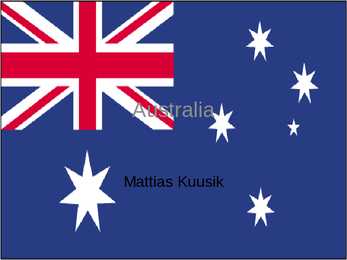
About 91% of the population is from Europe, 6% from Asia, only 2,2% are indigene. 85% of the whites are British or Irish, a lot of immigrants are from Yugoslavia lands, like Croatia (800 000), Greek (600 000), Italy (600 000) and Polish (200 000) . Government: Federal parliamentary democracy and constitutional monarchy, monarch is Queen Elizabeth II, Governor General is Quentin Bryce and Prime Minister is Kevin Rudd. Climate: Most part of Australia is located in tropics zone. Equatorial climate rules in Queenslands north, and tropical monsoonclimate rules West-Australia and north territory, and queenlands north-western. Subtropical climate remains South- Australia south and New-South-Wales. Temperate zone rules in South-Victoria and in Tasmanite. Midland, west- and south are very dry. Moderate climate is only in east and south-east 400 km coastline and in south-west. Sightseen: Sydney Tower tallest independent tower in sydney
1 slajd Today I will talking about Spices and Herbs 2 slajd Spices Spices are dried roots, stems, and seeds of plants that are usually grown in the tropics. Aromatic substances of vegetable origin used as a preservative Used to add flavor and zest to foods Not all spices are hot like many may think, but most do add flavor. Spices are sold in whole and ground forms, with ground being the most popular. 3 slajd On the picture you can see some example of spices: Caraway, cayenne, cloves, chili powder 4 slajd On this picture are also spices Peppercorn , paprika , poppy seed, saffron, nutmeg , ginger, coriander, cumin 5 slajd
Ameerika looderannikust pärineva vee tõusu ehk upwelling’ut (vt 2.2). Ka need samad tuuled lükkavad pinnakihi vett läände, mille tulemusena vesi koguneb Vaikse ookeani lääneosas. Indoneesia ranniku keskmine merepinna kõrgus on umbes 0,5 meetrit kõrgem kui on Peruus. [12,14] Joonis 6. Vaikse ookeani tüüpiline seisund. (Allikas: Effects of ENSO in the Pacific. National Weather Service. http://oceanservice.noaa.gov/education/yos/resource/JetStream/tropics/enso_ patterns.htm) Vaikse ookeani lääneosas kuhjuva vee piirkonnas tekitavad passaadid 150 meetrilise paksusega sooja veekihi lääne osas, mis surub termokliini alla, samal ajal kui see tõuseb veepinnale idas. Pinnapealne 30 meetriline ida termokliin võimaldab tuultele tõmmata vett alt, mis on tavalselt palju toitainete rikkam kui pealisvee kiht. [12] 10
Lauryl Lactylate/Sulphate, Hyrated Palm Glycerides, Etyl Palmitate, Octyl Palmitate, Palmityl Alcohol Impacts on health • Contains no trans fats but contains same amount of saturated fats as butter • Increases the level of cholesterol in body which can lead to heart diseases • How to avoid palm oil in your diet – avoid packaged and processed foods. Cook your own meals from natural whole foods Impacts on environment • Oil palms are grown in tropics – Asia, Africa, Latin America • Large areas of tropical forests and other ecosystems with high conservation values have been cleared to make room for vast monoculture of oil palm plantations. This clearing has destroyed critical habitat for many endangered species—including rhinos, elephants, tigers and orang-utans – the biggest victims • Burning forests to make room for the crop is a major source of greenhouse gas emissions.
oceans, it is separated from Asia by the Arafura and Timor seas. It the sixth largest country in area after Russia, Canada, China, the United States and Brazil. It is the flattest and (after Antarctica) the driest of continents, yet it has extremes of There are rainforests and vast plains in the north, snowfields in the south east, desert in the center and fertile croplands in the east, south and south west. About one third of the country lies in the tropics. Mountain ranges run from north to south along the east coast, reaching their highest point in Mount Kosciusko (2,228 m). The western half of the continent is occupied by a desert plateau that rises into barren, rolling hills near the west coast. Mount Kosciusko Climate Australia is warm and dry
wide, 130km long) was dry for a hundred years until 1950. Lake Eyre is the lowest place in Australia. It is 16 meters below sea level. Other bigger lakes are Lake Disappointment, Lake Mackay, and Lake Carnegie in the western part. Lake Torrens, Lake Gairdner and Lake Eyre in the southern part. Rivers The biggest river is the Murray. The other biggest rivers are the Mitchel and the Flinders. Other rivers are short and have water only after rains. The Climate Australia stretches from the tropics to the temperature region. It is a hot and dry country. The northern part has a hot tropical climate with heavy rainfall. It has two seasons - wet summer and dry winter. The south and the east of Australia have warm summers and winters. The southeastern coast gets rains all year around. The southwest area has hot, dry summers and mild moist winters. In the west and in the outback the temperature is often 35 degrees in the summer months. The outback receives almost no rainfall
There are many temporary rivers called creeks. The biggest rivers are in the east. All the rivers in Australia are short. Murray River is Australia's principal river. The Murray River and its tributaries run approximately 3,370km in length and form most of the border between New South Wales and Victoria. Climate Because of its size, Australia has many climates. The Tropic Capricorn cuts across the northern part of Australia so about 40per cent of the country lies in tropics. In the south, the island state of Tasmania lies in the cool roaring forties. In the north the climate is tropical. Monsoon winds bring moist air from the northwest during summer. This time of high rainfall, between December and March is known as "the wet". In the southern the climate ranges from warm temperate to cool temperate. Winter temperatures can be low but rarely freezing in the southern states. Australia is a land of droughts and floods. The droughts are caused by the EL Nino, a
7 It's very _____________________ for her to be out. I wonder where she's gone? USUAL 8 She takes her job very _____________________. SERIOUS 9 _____________________ warming is a serious problem nowadays. GLOBE 10 We must stop cutting down _____________________ forests. TROPICS Marks: /10 36 Macmillan Publishers Limited 2001. This sheet may be photocopied for use in class. 7 Complete these sentences using an appropriate word in each space. 1 I prefer to go on a __________________ holiday, where everything is already organized and paid for.
ofcommercial agricultu re to be natio ns In the regIOn rely pr imarily highlyproductive. Despite a rid co n o n su bs iste nce ag nculture a nd ditions,vastareas of the mr eri o r tounsm . Australia's climate IS pr edominately wa rm an d dr y. The northern half of the co untry lies within th e tr opi cs and has very warm condit ion s year ro un d. The so uthern half of th e country lies below th e tropics and expe ne nces a warm su m m er and a cool winter. Ashmore and Climat e · Cartier/so ·
The Malay cat, like the British domestic cat, is of varied colours, ginger, black, black and white, tabby and tortoiseshell. Some having Persian forbears, are long haired. Practically all have kinks, and I had one, a beloved ginger, called Peter, who was considered a cat of particularly good omen, as he had two kinks quite close together. They were very tender, and he hated them being touched. He lived to the age of seventeen - very old indeed for an animal in the tropics. He died a few months before the Japanese invaded Borneo." The first Siamese fanciers club was founded in Britain in 1902 at which time they were apparently variable in type. Possibly the conformation depended on which cats the early Siamese had been out-crossed to, there being few pure Siamese in the country at the time, or to the variability of imported cats and inbreeding from a limited gene pool. Early photos show differences between the "compact" cats and the "lithe" cats, but the
Jonestowner looked to the actions of surrounding individuals to assess the situa- tion and-finding calmness because everyone else, too, was surreptitiously assess- DEFENSE _ _ ing rather than reacting-"learned" that patient turntaking was the correct behav- ior. Such misinterpreted, but nonetheless convincing, social evidence would be ex- pected to result precisely in the ghastly composure of the assemblage that waited in the tropics of Guyana for businesslike death. From my own perspective, most attempts to analyze the Jonestown incident have focused too much on the personal qualities of Jim Jones. Although he was without question a man of rare dynamism, the power he wielded strikes me as coming less from his remarkable personal style than from his understanding of fundamental psychological principles. His real genius as a leader was his realiza- tion of the limitations of individual leadership
Impressive, yes. But these stunts didn't satisfy him. Looking for bigger and bolder challenges, he set his sights on the breath-holding world record. How hard could it be to fake? He tried having a breathing tube the size of a vacuum hose pushed down his throat under sedation. It failed. All of his attempts failed. Then it occurred to him that he could simply bite the bullet and take the craziest approach of all: actually holding his breath. Traveling from Navy SEAL training to the tropics, he gured it out. Then, for four months, David held the Guinness world record for oxygen-assisted static apnea (holding your breath after breathing pure oxygen): 17 minutes and 4.4 seconds. His record was surpassed by Tom Sietas on September 19, 2008, but this wasn't surprising. Tom is a professional free diver and built for it. David was an anomaly, a product of pure conditioning. This is why, when I bumped into him at the medical conference TEDMED, I begged him to train me
always lower than in the rest of the container have a shelf life up to 1 year at 40°C; in this Canned Products and Pâté 343 case, F must be between 12 and 15. This type maximum for bacterial growth destroy all of preserves is intended for regions with viable cells; however, spores may survive in extreme heat and humid weather, such as the this condition. humid tropics, with no other preservation In food-processing operations, the term facility. Total F-value for the heating phase “sterilization” is incorrect, as sterility is not is 9.4589, and for the cooling is 5.1602; the fully achieved. This means that, although all overall value is F = 14.6191. pathogens are destroyed, some nonpathogens can survive, although environmental condi-
 annaabi.ee