Consists: Methane Ethane Butane Propane What is LNG? Cooled natural gas 160 0C 1/600th the volume of the same amount of natural gas LNG is: Clear Colourless Nontoxic liquid Liquefaction and regasification terminals Liquefaction terminal Export Receive gas by pipeline Cleans gas Liquefies Regasification terminal Import Receive gas by ships Regasifies Storage and transport 50 years and 128 million miles Doublehulled tankers Atmospheric pressure Doublewalled tanks 1 meter thick concrete wall Sophisticated monitoring system Heating it to regasify Questions?
Marine dumping garbage-> the oxygen in the water could be depleted bottles, plastics, bags-> can suffocate or choke sea animals TREATMENT cleaning water Do not throw anything into water! Industrial waste toxic chemicals causes also air pollution TREATMENT fit filters to chimneys treatment plants Oil pollution spilled oil spoil drinking water Birds' feathers-> stuck with oil-> drown can blind an animal TREATMENT cleaning water with skimmers Being more careful when tankers trantsport oil! How to prevent water pollution? use water wisely; be careful about what you throw down your sink; environmentally household products; don't throw rubbish anyhow Used literature http:// www.explainthatstuff.com/waterpollution.html http://www.water-pollution.org.uk/ http:// eschooltoday.com/pollution/water-pollution/what-is -water-pollution.html
PROBLEMS OF THE PLANET Problems Cause - Effect 1. Destruction of the rainforests Trees are cut down to make room for cattle or to get paper and land Less clean air, Loss of natural habitat = die 2. Water pollution Factories, oil tankers, farmers use pesticities that get into our drinking water Sea life close to extinction, No clean drinking water, Beaches polluted 3. Air pollution Cars and factories give off fumes Cities will become impossible to live in, Breathing problems, Allergies 4. Famine Crops failing (saak ikaldub), Overpopulation = lack of food People die of hunger 5. Flooding Climate changes cause excessive raining, Polar icecaps
Many transport companies provide scheduled delivery days and next day delivery services, depending upon your needs. Goods can be packet/grouped in box or in containers which are also used for sea transportation. 4.Waterways Sea transportation is used by businesses to deliver goods from distant suppliers. The type of sea transport is dependable on which size and what kind of goods are being shipped. Goods can be stored in a cargo container, and stacked on the deck. Sea tankers are used for large shipments of liquid or granular goods such as oil, grain and coal. 5.Rail Businesses use rail transportation for delivery of a wide range of goods including post, coal, steel and other heavy goods. 6.Pipelines Pipeline is a method of transportation in which liquid, gaseous or solid products are moved over long distances throught pipelines. It is used mainly for conveying natural gas, petroleum and solid materials 7
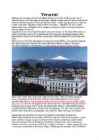
manufacturing.Mexico is the leading oil producer in Latin Ametica, with the world's eighth largest reserves.Yet even the gargantuan oil industry has been vulnerable during the country's economic crisis.To raise cash to service the national debt, Mexico's stateowned petroleum company,Petroleos Mexicanos, or Pemex, has been hanging `'For sale" signs on plants that produce petrochemicals for photographic film,antifreeze, nylon stockings, nd fertilizers. Sharing the Gulf with Pemex oil tankers in Veracruz's fishing fleet, the largest in Mexico.Each day before sunrise some 11,600 boats pull out to harvest shrimp,clams, oysters, crabs, and fish- enough to supply 12 percent of the country's commercial seafood needs. The grit and grime of the oil industry and the frantic sorting of fish this is what many outsiders think of as the essence of Veracruc Yet there is an other a calmer, quieter Vera cruz down any country road
transit in the Estonian economy has been consistently decreasing. Slightly more than 70% of the freight flow of the ports and 57% of the rail freight is connected with transit. Such shares are constantly diminishing as Russian oil flow goes through her own ports on an increasing scale. Presently about one third of the freight flow may be related to transit. The principal part thereof is constituted by the export of petroleum products from Russia -- first by rail, then by sea with tankers. Other Russian goods that have been transported through Estonia are grain and fertilizers, sometimes other goods as well. The transit from the West to Russia has gradually grown, mostly in the form of containerised freight. The Estonian national air company Estonian Air has also proven successful as it has managed to increase both cargo volumes and the number of passengers in spite of the hard times in the world's aviation business. In 2004 the number of passengers in Estonia
robustness is required. Each ship's hull has its own characteristics. In order to achieve the highest possible total efficiency of the vessel, the propeller must be a perfect match with the engine and the hull. A fixed pitch propeller is the choice when optimum efficiency, reliability and robustness are required. Fixed pitch propellers are usually installed for ocean sailing vessels, for example Container vessels Tankers Bulk carriers Dry cargo vessels 1.3) The Rolls-Royce gearbox range is based on the single-input single-output design with built- in clutch and thrustblock - and a wide variety of power-take-offs that enable large-shaft generators to be driven - and electric motors to feed power for get-you-home propulsion or as part of a hybrid propulsion system. The input shaft is provided with keyway for mounting of the flexible coupling and the output shaft with a cylindrical shaft or flange.
lading on the date of departure for release to shipper. Bill of Lading Module 4. Maritime & Intermodal Transport What changed shipping in size after the second World War? Economies of scale. The biggest trade lane nowadays is Asia-Europe&Asia-North America. The international shipping industry is the life blood of the global economy. General cargo ships: 39% Tankers: 25% Bulk carriers: 13% Passanger ships: 12% Container ships: 7% SOLAS – Safety of life at sea. MARPOL ensures that we do not cause marine pollution. There are 2 types of general cargo vessels: Conventional cargo vessel: is employed in the carrying of traditional general cargo and ( a part of) bulk cargo.
militarily. They don’t have factories that manufacture telephone equipments or telephone receivers; they don’t have factories that manufacture the cables used in laying the telephone lines or the fibre- optic technologically-advanced cables now being utilized. They don’t have factories that build jet- fighters or bombers. They don’t have the capability to build platforms to extract Africa’s oil. They don’t have the tankers to ply to Africa’s wharves and lift the crude oil. They don’t have the capability to refine the oil and return it to Africa for consumption. They don’t have oil refineries. They don’t have the expertise needed to extract Africa’s gold and diamonds and refine them, get the best price and pay a good price to the owners. They don’t have factories to manufacture clothing for Africa’s teeming millions. They don’t have
While the reference price may be for West Texas Intermediate delivered at Cushing, the actual oil being traded may be a discounted Canadian heavy oil delivered at Hardisty, Alberta, and for a Brent Blend delivered at Shetland, it may be a Russian Export Blend delivered at the port of Primorsk. Petroleum industry The petroleum industry is involved in the global processes of exploration, extraction, refining, transporting (often with oil tankers and pipelines), and marketing petroleum products. The largest volume products of the industry are fuel oil and petrol. Petroleum is also the raw material for many chemical products, including pharmaceuticals, solvents, fertilizers, pesticides, and plastics. The industry is usually divided into three major components: upstream, midstream and downstream. Midstream operations are usually included in the downstream category.
storage systems, such as old oil and gas wells or caverns formed in old salt beds. The gas remains there until it is added back into the pipeline when people begin to use more gas, such as in the winter to heat homes. When chilled to very cold temperatures, approximately -260 degrees Fahrenheit, natural gas changes into a liquid and can be stored in this form. Because it takes up only 1/600 th of the space that it would in its gaseous state, Liquefied natural gas (LNG) can be loaded onto tankers (large ships with several domed tanks) and moved across the ocean to deliver gas to other countries. When this LNG is received in the United States, it can be shipped by truck to be held in large chilled tanks close to users or turned back into gas to add to pipelines. When the gas gets to the communities where it will be used(usually through large pipelines), the gas is measured as it flows into smaller pipelines called "mains".
Kui lastitav või lossitav kaup, sõltuvalt selle omadustest, jääb vette ujuma (ei lahustu ega aurustu täielikult), peab laadimisoperatsioonide eest vastutav isik tagama sobivate boontõkete kiire paigaldamise reostuse lokaliseerimiseks. 6.1.2 Terminali ja tankeri vastastikuste kohustuste määratlemise aluseks on "Rahvusvaheline ohutuse juhend naftatankeritele ja terminalidele'' (International Safety Guide for Oil Tankers & Terminals I.S.G.O.T.T). 6.1.3 Terminalis peavad olema välja töötatud organisatsioonilised ja tehnilised meetmed, mis tagavad töötajate ohutuse, tulekahjude vältimise, merereostuse ärahoidmise ning nende tagajärgede lokaliseerimise ja likvideerimise. Terminali ja tankeri ühistegevust käsitlevad ohutuse reeglid kooskõlastavad ja allkirjastavad mõlema poole vastutavad isikud kohe pärast tankeri saabumist. 6.1
picked up, apparently on a blanket broadcast, an electrifying open-code message intended for it: NIITAKA-YAMA NOBORE ("Climb Mount Niitaka"). It informed the strike force that the decision for war had been made and directed it to proceed with attack. Niitaka-yama, also known as Mount Morrison, is a peak on Formosa whose 12,956-foot elevation made it the highest point of what was then the Japanese empire. The symbolism could not have been lost on the officers. The force refueled from its tankers. Earlier that day, the Japanese consulate in Honolulu had received Circular #2445 in J19, relayed by Washington from Tokyo: Take great pains that this does not leak out. You are to take the following measures immediately: 1. With the exception of one copy each of the O [PA-K2] and the L [LA] codes, you are to burn all telegraph codes (this includes the codebooks for communication between the three departments
 annaabi.ee