were the one who wanted to remain loyal to Britain (United Empire Loyalists). Britain created two new colonies: New Brunswick and Upper Canada. New Brunswick was created in 1784. Upper Canada became part of Quebec in 1791. Upper Canada was the English-speaking colony and Lower Canada was the French-speaking colony. They were reunited in 1841, called Canada West and Canada East and the capital of them was Montreal. They become provinces of Ontario and Quebec in 1867. Uniting all the Canadian provinces soon became a necessity. There were five reasons why it was good to unite the provinces: they wanted to be protected from the USA, they wanted to defend themselves against the Fenians, trading would be much easier, they wanted to build a railway from east to west and Britain didn't want to support Canadian provinces anymore likewise Canadian provinces wanted to break away from Britain. 1st July 1867 the Dominion of Canada was formed of Quebec, Ontario, New Brunswick and Nova Scotia
Alberta's past when dinosaurs roamed the then lush landscape. Agriculture Agriculture has a significant position in the province's economy. The province has over three million head of cattle and Alberta beef has a healthy worldwide market. Nearly one half of all Canadian beef is produced in Alberta. Alberta is one of the prime producers of plains buffalo (bison) for the consumer market. Sheep for wool and mutton are also raised. Wheat is primary farm crop, with Alberta leading the provinces in spring wheat production; other grains are also prominent. Much of the farming is dryland farming, often with fallow seasons interspersed with cultivation. Continuous cropping (in which there is no fallow season) is gradually becoming a more common mode of production because of increased profits and a reduction of soil erosion. Across the province, the once common grain elevator is slowly being lost as rail lines are decreasing; farmers typically truck the grain to central points.
It was so because of the American Revolution. Americans were fighting for their independence from Britain. So the British people fled from America to the north were was Canada. With so many new settlers Britain had to create two new colonies: New Brunswick nad Upper Canada. There was also an act in 1791 that divided Quebec into Upper and Lower Canada. They were reunited in 1841. Upper Canada became Canada West and Lower Canada became Canada East. They would eventually become the provinces of Ontario and Quebec in 1867. Regions in Canada Canada is divided into five major regions. The Pacific Region The Pacific Region consists of only one province - British Columbia. It is known for its mild coastal climate, forests and the Rocky Mountains. The Rocky Mountains are the youngest and the highest mountains in Canada. Largest cities are Vancouver and Victoria. Only 5% of The Pacific Region is inhabitable. The Prairie Provinces
what are `territorial politics' The multi-level politics of federal, regionalised, devolved states Distribution of power between central and regional government Party competition across levels of government `Regions' as spheres for autonomous action South Africa Mexico Germany · 9 provinces · 31 states plus federal district · Developed democracy · `Cooperative' federalism · Predominant role for federal 16 Laender German influence, ANC government · Cooperative federalism
Canada Canada is a country occupying most of northern North America, extending from the Atlantic Ocean in the east to the Pacific Ocean in the west and northward into the Arctic Ocean. It is the world's second largest country by total area, and shares land borders with the United States to the south and northwest. Canada is a federation composed of ten provinces and three territories; in turn, these may be grouped into regions. Western Canada consists of British Columbia and the three Prairie provinces (Alberta, Saskatchewan, and Manitoba). Central Canada consists of Quebec and Ontario. Atlantic Canada consists of the three Maritime provinces (New Brunswick, Prince Edward Island, and Nova Scotia), along with Newfoundland and Labrador. Eastern Canada refers to Central Canada and Atlantic Canada together
language, with the original word meaning `to trade'. Due to the country's huge size and position, it is very diverse. It is bordered by the Pacific Ocean to the west, the Atlantic to the east, and the Arctic to the north. The landscapes differ greatly from rolling plains and mountains to the cold tundra in the northern part of the country. Geographically, the country's split into 5 major regions the Pacific, the Prairie Provinces, Central Canada, the Atlantic Provinces and the North. The Pacific Region is known for its mild coastal climate, its forests and its spectacular mountains. The three Prairie Provinces are known for their rolling plains and their extreme climate with long, cold winters and hot, dry summers. Part of the Rocky Mountains are in the there. A lot of the Prairie Provinces' area is covered with farms producing wheat and other grains. The region is rich in oil and natural gas. In fact, Canada is the second largest oil
the north. Most of the largest towns and industrial areas lie near the Great Lakes and the St Lawrence River in central Canada. In the east, fishing villages and sandy beaches dot the Atlantic coast. Across the country, Canadians experience many different landscapes from rolling plains and mountains to the cold tundra of the north. Geographically, Canada can be divided into five major regions : the Pacific Region, the Prairie Provinces, Central Canada, the Atlantic Provinces, and the North. The Pacific Region includes Canada's westernmost province, British Columbia. The region is known for its mild coastal climate, its forests, and its spectacular mountains, including the famous Rockies. The Rocky Mountains are the youngest and highest mountains in Canada. British Columbia is in the landform region called the Western Cordillera. ('Cordillera' means a system of mountain ranges). Between the mountain ranges are areas of high plateaus and deep trenches.
the coasts. Spring is generally pleasant across the country. Autumns are often crisp and cool, but brightened by rich orange and red leaves on trees. Winters are generally cold with periods of snow, although southern Alberta enjoys the occasional "Chinook", a warm dry wind from the Rocky Mountains that gusts through and melts the snow. Winters are mild and wet on the west coast, in cities such as Vancouver and Victoria. Territories and provinces Canada consists of 3 territories and 10 provinces. Very few people live in the territories, but it has more power on deciding important questions. Newest territoy is Nunawut, it became a territory in 1999. It was created from the eastern part od North- West territories. Quebec and Ontario are the biggest provinces. In the central part of Canada there are prairies and agriculture is very common. Alberta is rich in natural resources such as oil and natural gas
because the country has rugged terrain and a severe climate. Canada's people are varied. About 38% of all Canadian's are of British descent and 32% are of French descent. About 15% of Canada's people speak both English and French, the two official languages. There are also people of German, Italian, and descent. Eskimos and American Indians together make up about 2% of the population. Over three-quarters of Canada's people live in cities or towns. Provinces/territories Canada is divided into provinces and territories. There are 10 provinces and 3 territories. The provinces are Newfoundland, New Brunswick, Prince Edward Island, Nova Scotia, Quebec, Ontario, Alberta, Saskatchewan, Manitoba and British Columbia. Quebec Quebec differs greatly from the rest of Canada because of its French language and culture. About 80% of Quebec's people are of French descent. The official language is French. Quebec is the largest province in area and the second largest in population. Ontario
would not try to break away from Britain. After the American War of Independence immigrants from Britain began to arrive, among them there were also poor Irishmen and Scotsmen. Indeed, all the Canadians except the Indians and Eskimos, are really immigrants or their descendants. Canada is politically a young country. In 1967 the people celebrated its first century of independence. It was on the first of July, 1967, that four provinces of British North America joined together and formed the Dominion of Canada. Geographical facts. Canada occupies the northern portion of North America. It shares land borders with the United States to the south and with Alaska to the northwest. It shares territorial water boundaries with the United States, Greenland to the northeast, and Saint-Pierre and Miquelon (an overseas community of France) to the southeast. Canada stretches from the Atlantic Ocean in the east to the Pacific
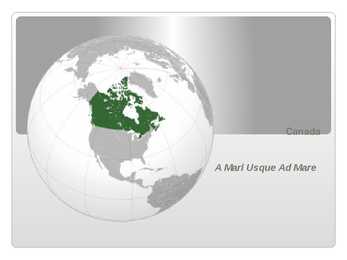
Canada A Mari Usque Ad Mare Official language(s) English, French Inuktitut, Inuinnaqtun, Cree, Recognised regional languages Dëne Sliné, Gwich'in, Inuvialuktun, Slavey, Tlch Yatiì Languages in Canada North American country consisting of ten provinces and three territories located in the northern part of the continent, it extends from the Atlantic Ocean in the east to the Pacific Ocean in the west, and northward into the Arctic Ocean spanning over 9.9 million square kilometers, Canada is the world's second largest country by total area its common border with the United States is the longest land border in the world. Some facts
Parts of Canada were first settled by the French, part of it by the English. Picturesque Quebec is the most French, of Canada's big cities. Canada's largest city, Montreal, is also largely French. Next to Paris in France it is the largest French- speaking city in the world. Canada belongs to British Commonwealth of Nations. It rules itself in very much the way the United States. Its capital is Ottawa. The country is divided into provinces and territories. Both the provinces of Ontario and British Columbia are much bigger than the states of Texas. Furs, farms, forests and fisheries make up much of Canada's wealth. The country is also rich in minerals. Canada has copper, lead, silver, gold and other metals. The discovery of rich oil fields in Alberta in 1947 has made oil production one of Canada's leading industries. South of Newfoundland is one of the greatest fishing regions in the world. Much of Canada is covered with forests
The Prime Minister is the leader of the party that holds a majority in the Parlament. Every Province has it's own Parlament and Government. The monarchy is represented by the leutenantgovernor. The Frenchspeaking province of Canada (Quebec) is very different culturally. Since the 1960s there has been a strong movement to became an independent country (separatist movement). 80 % of Canada's French speaking people lives in Quebec. Canada has ten provinces and two territories (the capital of each is shown in parentheses): Alberta (Edmonton), British Columbia (Victoria), Prince Edwars Island (Charlottetown), Manitoba (Winnipeg), New Brunswick (Fredericton), Nova Scotia (Halifax), Nunavut (Iqaluit), Ontario (Toronto), Quebec (Quebec City), Saskatchewan (Regina), Newfoundland and Labrador (St. John's), Northwest Territories (Yellowknife) and Yukon Territory (Whitehorse). Geographically, Canada can be divided into five major regions:
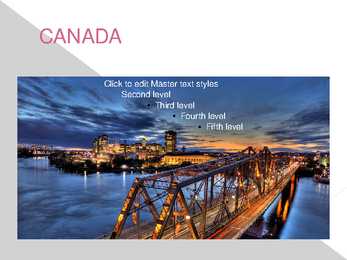
n economy is dominated by the o servive inudustry , which employs about m threequarters of the country's y workforce. Ottawa Ottawa is the capital of Canada. The city is located on the south bank of the Ottawa River. The 2011 census had the city's population as 883,391. The name "Ottawa" is derived from the Algonquin wor adawe, meaning "to trade". Canada is a federation composed of ten provinces and Click to edit Master text styles three territories. Second level Pro These may be grouped into Third level Fourth level vin regions: Western Canada, Central Fifth level ces Canada, Atlantic Canada, and an Northern Canada. Provinces have d more autonomy terr than territories. itor ies
1670 Hudson's Bay Company is formed 1755 Expulsion of the Acadians 1759 Battle of the Plains of Abraham: Québec City is captured 1763 New France is formally ceded to Britain; Pontiac Rebellion erupts 1783 Loyalist refugees begin arriving after the American Revolution 181214 War of 1812: U.S. invades Canada 183738 Rebellions against British rule in Upper and Lower Canada 1848 Responsible government is won, first in Nova Scotia, then in Canada 1867 Confederation (first four provinces: Québec, Ontario, N.S., and N.B.) 1870 Red River Resistance; province of Manitoba is created 1871, 1873 B.C. and P.E.I. join Canada 1885 North-West Rebellion; the Canadian Pacific Railway is completed 1905 The provinces of Alberta and Saskatchewan are created 191418 World War I 1916 Women win the vote in Manitoba, Saskatchewan, and Alberta 1919 The Winnipeg General Strike 192939 The Great Depression 193945 World War II 1949 Newfoundland joins Canada 195053 Korean War
There are only 1,000 windmills left in Holland, one-tenth the original number. The Aalsmeer flower auction sells approximately 14 million flowers a day from all over the world. 5 There are approximately 14 million bicycles in Holland. 20 percent of Holland has been reclaimed from the sea. In the previous centuries, one of the methods to protect Holland was to reflood the drained lands. Rotterdam has the largest port in the world. Twelve provinces make up the Netherlands: Groningen, Friesland, Flevopolder, Drenthe, Overijssel, Gelderland, Utrecht, North and South Holland, Zeeland, North Brabant and Limburg. The Netherlands is known as Holland because the North and South Holland provinces are the most internationally influential. Holland means hollow or soaked land. Ice skating is one of the most popular sports in Holland. Each year approximately 45,000 people go to the Waddenzee to be "mud-walkers". The people
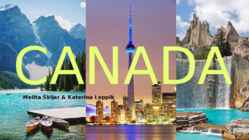
CANADA Melita Skljar & Katerina Leppik CANADA is a country, consisting of ten provinces CAPITAL CITY - O T T A W A Population is 883 391 FLAG- Maple Leaf Largest city: Toronto Athem: "O Canada" Official languges: English and French Area: 9,984,670 km2 (2nd after Russia) Population: 34,319,000 SPORTS Canada's official national sports are hockey in the winter Hockey is the sport most played by Canadians, with 1.65 million participants Lacrosse Best summer game Other popular spectator sports include curling and football, that is played professionally in
Head of state is the Monarch of the UK. In Canada there are three levels of government: federal, provincial and local or munucipal. These governments are elected and, therefore, are directly responsible for their actions to the electorate. Population of Canada is about 35 million and territory about 10 million square kilometers, about one-thirteenth of the entire land area of the world. So the population density is 3.5 persons per sq.km. There are 10 provinces and 3 territories. The biggest provinces are Alberta, British Columbia and Manitoba. The biggest city is Montreal with 3.8 million people. The capital Ottowa has only 1.2 million people and is listed fourth biggest city. 32% of population is Canadian, 21% is English and 15.8% is French. First Nationist are only 4%. 80% of Canadians live in 3 urban areas concentrated in the Quebec City- Windsor Corridor, the British Columbia Lower Mainland, and the Calgary-Edmonton Corridor. 80% of
There are such plants as: white oak, white birch, pecan, lady fern, common lime and carpet moss. Typical animals are: eagles, black bears, coyotes, deers and chipmunks. Land. Across the country Canadians experience many different landscapes from rolling plains and mountains to the cold tundra of the north. Geographically, Canada can be divided into five major regions: the Pacific Region, the Prairie Provinces, Central Canada, the Atlantic Provinces and the North. The Pacific Region includes Canada's westernmost province British Columbia. The region is known for its mild coastal climate, its forests and its spectacular mountains, including the famous Rockies which are also the youngest and highest mountains in Canada. British Columbia is in the landform region called the Western Cordillera (system of mountain ranges). Between the mountain ranges are areas of high plateaus and deep trenches
Table of contents 1. Introduction 2. Geographical position 3. Mountains, lowlands 4. Rivers, lakes 5. The territories and provinces 6. Towns, economy, agriculture 7. Climate 8. Animals, plantlife 9. Population 10. Sports 11. Culture 12. History 13. Political system, symbols 14. Conclusion 15. Materials 1. Introduction If you had to use two words to describe Canada, they might be large and diverse. Canada is the second largest country in the world, bordered by three oceans, and across the country, Canadians experience many different landscapes from rolling plains and mountains to the cold tundra of the north
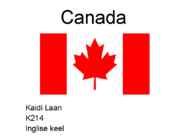
Canada Kaidi Laan K214 Inglise keel Canada ● population 35,344,962 ● area 9,984,670 km2 ● languages English and French ● capital Ottawa ● money dollar ● Canada is a country in North America consisting of ten provinces and three territories. ● Canada is the world's second-largest country by land area and the fourth-largest country by land area. ● Canada is a federal parliamentary democracy and a constituational monarchy. ● Canada is a memberof the Commonwealth of Nations. Thanks for watching
Tallinn English College Report of Canada 8a Teacher: Merike Sisask Composer: Kärt Kalvet 2010 Canada, Kärt Kalvet 8a Canada General Information Canada is in North America. It's area is 9220970 sq km. Canada's population is 313.612.000 people. Canada is divided into 10 provinces and 3 territories. The capital of Canada is Ottawa. Canada has constitutional monarchy. The head of state in Canada's government is the Queen of England. There are two main languages in Canada: English and French. Canada's curreny is Canadian dollar (1 dollar=100 cents[Can$]). The highest peak of Canada is Mount Logan, 5959 metres. The lowest point is sea level. The longest river is the Mackenzie. The climate and
western regions, where bleak desolation is unrelieved by any vegetation beyond the size of low bushes, and where wind sweeps unchecked across vast expanses of arid plain. The Indian monsoon exerts some influence on eastern Tibet. Northern Tibet is subject to high temperatures in the summer and intense cold in the winter. Cultural Tibet consists of several regions. These include Amdo (A mdo) in the northeast, which is under the administration as part of the provinces of Qinghai, Gansu and Sichuan. Kham (Khams) in the southeast, is divided among western Sichuan, northern Yunnan, southern Qinghai and the eastern part of the Tibet Autonomous Region. Ü-Tsang (dBus gTsang) (Ü in the center, Tsang in the center-west, and Ngari (mNga' ris) in the far west) covered the central and western portion of Tibet Autonomous Region. The distribution of Amdo and eastern Kham into surrounding provinces was initiated by the Yongzheng Emperor
The Prarie Provinces Main Facts The Prairies comprise the states of Alberta, Saskatchewan and Manitoba Covers about 2,1 million square kilometers. About 5,7 million people live in that region. What is a Prarie? Prarie (aslo known as a temperate grassland) is a treeless ecozone in North America. Different names in different countries. Only about 400 mm per year. Hot summers and cold winters. Humans and the Prairies Almost 95 % of the Prairies are converted into farmland. The biggest towns are Calgary, Saskatoon and Winnipeg. The main argiculture industries are wheat, barely and canola. Rich in oil and natural gas. Fauna The most common carnivores are the Black Bear, Coyote and Badger. The most common herbivores are the Mule Deer, Pronghorne Antil...
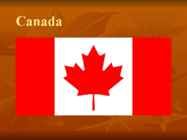
The first city founded by the french was Quebec. New France was generally the name given to the french colonies of Canada and Acadia. British settlements appeared along the Atlantic coast. As the colonies grew, a struggle for control over North America started between England and France. For almost a century Canada was caught up in the struggle for power, until in 1763 England finally gained control over almost all of Canada. Gradually the British started to move westward and new provinces and territories appeared. During this settlement process the native Canadians were treated with more respect than the natives of the USA. Canada's real birthdate is July 1, 1867 when the British created the Dominion of Canada under British rule. In 1931 Canada peacefully broke away from direct British rule. In 1965 a new flag with a red maple leaf on a white background was adopted. The name Canada is believed to come from the Huron-Iroquois word Kanata, which means "village" or "settlement"
Bloemfontain, Cape town - to the North lie Botswana, Namibia and Zimbabwe Cultures and languages - diversity in cultures and languages (11 official) - Ethnic groups 79.4% black 9.2% white 8.8% coloured 2.6% asian - two of them are European origin : Afrikaans and South- African English Constitutional democracy (parliamentary republic) The president is Jacob Zuma - National Assembly and National Council of Provinces ( must ensure that provincial interests are taken into account in the national sphere of government ) Economy GDP 22 730,725 US $ per capita, 20,858 billion US $ total The Nelson Mandela Bridge in Johannesburg. Gauteng produces 33% of South Africa's GDP and 10% of the African continent's GDP GDP 10,136 US $ per capita, 277,4 billion US $ total Living standards Living standards are different from region to region Natural resources
The land occupied by Canada was inhabited for millennia by various groups of Aboriginal people. Beginning in the late 15th century, British and French expeditions explored, and later settled along, the Atlantic coast. France ceded nearly all of its colonies in North America in 1763 after the Seven Years' War. In 1867, with the union of three British North American colonies through Confederation, Canada was formed as a federal dominion of four provinces. It is a bilingual and multicultural country, with both English and French as official languages. Geography: Covering most of the northern part of the North American continent and with an area larger than that of the United States, Canada has an extremely varied topography. In the east, the mountainous maritime provinces have an irregular coastline on the Gulf of St. Lawrence and the Atlantic. The St. Lawrence plain, covering most of southern
Territory and landscape Canada is one of the largest countries in the world. It covers nearly 4 million square miles. It is dividend into ten provinces( British Columbia, Manitoba, New Brunswick, Alberta, Nova Scotia, Ontario, Prince Edward Island, Quebec, Saskatchewan, Newfoundland ) along with two territories( the Yukon, the Northwest territories ). The capital city is Ottawa. Canada is a country rich in forests. It borders in the south with The United States and it's surrounded in the west by the Pacific Ocean, in the east by the Atlantic Ocean and above by many smaller bays, but is also borderedd with Alaska in the north-west
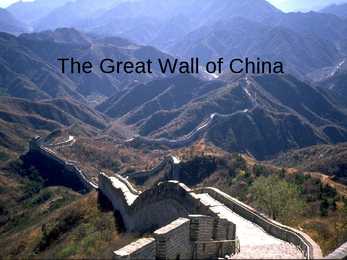
died · that's over 300 men per mile · Qin made 70% of population build the wall Importance of the Wall · at first it was ment to keep enemies away, later to keep away semi- nomadic thiefs · nowadays a very popular tourist attraction · Simatai - wall in original state · Beijing reconstructed part · Thousands of tourists every day Parts of the Wall · from Gulf of Bohai to Jiayugan Pass · divided into 101 sections in 9 provinces · well preserved in Hebei and Beijing · most popular is Badaling section in Beijing Interesting facts · Only 30% of the Wall in good condition · It's visible from space · "longest cemetery on earth" · UNESCO World Heritage since 1987 · Great Wall marathons · Some parts of the Wall are gone because villagers take the bricks to build their houses
The first inhabitants of Canada were native Indian peoples, primarily the Inuits. Starting from the late 15th century both British and French expeditions explored and later settled the Atlantic coast. French ceded nearly all of its colonies in North-America in 1763 after the Seven Years War. Canada is a parlamentary democracy and a constitutional Monarch with Queen Elizabeth the Second as a head of state. The federal comprises ten provinces and three territoties. Canada is a bilingueal and multicultural country. Both English and French are official languages at federal level. Canadas economy is heavily reliant upon its abuntant natural resources and upon trade with the USA. Canada is one of the world`s wealthiest nations with a high per capita income. It is a free market economy with much less government intervention than European nations. Canada is one of the few developed countries that is a net exporter of energy
to a multicultural federation. Info http://static.open.salon.com/files/beaver1231206221.jpg · Population: 33,212,696 · Capital city: Ottawa · Second largest country in the world after Russia. · Ranks 9th in the least densely populated countries (3 people per sqkm). · Its motto is "from sea to sea". · National animal: the beaver · There are 6 time zones. · Ten provinces and three territories. http://www.travelandtransitions.com/interviews/images/ottawa-panorama1.jpg The Flag · The National Flag, also know as the Maple Leaf was adopted in 1965 to replace the Union Flag. http://en.wikipedia.org/wiki/File:Flag_of_the_United_Kingdom.svg http://en.wikipedia.org/wiki/File:Flag_of_the_United_Kingdom.svg
Some of their cultures had collapsed by the time European explorers arrived in the late 15th and early 16th centuries The first known attempt at European colonization began when Norsemen settled briefly at L'Anse aux Meadows in Newfoundland around 1000 AD Goverment Canada has a parliamentary system within the context of a constitutional monarchy The sovereign is Queen Elizabeth II, who also serves as head of state of 15 other Commonwealth countries and each of Canada's ten provinces People Justin Bieber is a singer from Canada Jim Carry, Ellen Page, Ryan Gosling and Myke Myers are some of the famous movie acters from Canada Deadmau5 is a famous DJ from Canada Nature Canada has a very various landscape Canada has around 31,700 large lakes Canada is geologically active, having many earthquakes and potentially active volcanoes The national animals in Canada are beaver and canadian horse Culutre and traditions Historically, Canada has been influenced by
Kaia Teder K112 About One of the southern provinces of Thailand The island is connected to mainland Thailand by two bridges Country : Thailand Capital : Phuket City Area : 576.0 km2 Population : 600,000 (2013) The relatively recent name "Phuket" is apparently derived from the word bukit which means "hill", as this is what the island appears like from a distance. The symbol is a picture of Thao thep kasatri and Thao sri sunthon Heroines Monument. The reason for the use of the pictures of these heroines is because they protected the province from the Burmese in 1785 AD. Attractions Hat Patong is Phuket's most developed beach and is 3 kilometres long. Daytime activities are primarily centered around the beach with many watersport activities. Patong is equally well known for its nightlife. Patong is also a shopping option in Phuket. The northern end of Patong Bay is called Kalim and is a popular place for viewing the sunset and be...
· The major radio and television stations are state-run, and other communications, such as land-based telephones and telegraphs, are largely under government control Religion · The Christian community, makes up 40 percent of the population. There is also 40 percent of the population who maintain Indigenous beliefs, and Islam is practiced by 20 percent of the country's population. · Christians are concentrated chiefly in the southern and western provinces and Muslims reside in large numbers in every province. There is significant internal migration. Large cities have significant populations of both groups, with mosques and churches often located near each other. Religion ·The Christian community, makes up 40 percent of the population. There is also 40 percent of the population who maintain Indigenous beliefs, and Islam is practiced by 20 percent of the country's population · Christians are concentrated chiefly in
compromise was found with english to make this flag. III flag The new flag was chosen for Nelson Mandela to become president. It was made 31 May 2004. The flags design was made by Frederick Brownell. Politics South Africa has three capital cities: Cape Town, the largest of the three, is the legislative capital; Pretoria is the administrative capital; and Bloemfontein is the judicial capital. South Africa has a bicameral(kahekojaline) parliament: the National Council of Provinces (the upper house) has 90 members, while the National Assembly (the lower house) has 400 members. Members of the lower house are elected on a population basis by proportional representation Province Capital Area (km²) Population (2007) Eastern Cape Bhisho 169,580 6,527,747 Free State Bloemfontein 129,480 2,773,059 Gauteng Johannesburg 17,010 10,451,713 KwaZulu-Natal Pietermaritzburg 92,100 10,259,230
CANADA Pavel Zubarev 8.a Geographical position Canada is the second largest country in the world. Only Russia has a greater land area. Canada is situated in North America. Canada is a federation of 10 provinces and 2 territories. The population Canada is slightly larger than the United States, but has only about a tenth as many people. About 28 million of people live in Canada. About 80% of the population live within 320 km of the southern border. Much of the rest of Canada is uninhabited or thinly populated because of severe natural conditions. Canada's people are varied. About 57% of all Canadians have some English ancestry
Canada Mary-Liis Kull KiNG 10.klass Basic information Area is about 10 million sq km Popluation is estimately 35 million people The country is bilingual (English and French) The National Holiday is Independence Day on July 1'st The capital is Ottawa and the largest city is Toronto Basic information Consists of 10 provinces and 3 territories Extends from the Atlantic to the Pacific and northward into the Arctic Ocean Shares land borders with the U.S Is a federal state, governed as a parliamentary democracy and a constitutional monarchy Canada comes from the word kanata, meaning village or settlement History The first inhabitants were the Inuits (Eskimo) First white man in the country John Cabot The French and British colonies settled the Atlantic coast in the late 15th century
political and cultural undercurrents were also active, preparing the ground for the industrial society and the national-democratic movement in the second half of the 19th century. The 1710 of the corporations of knights and towns, until Alexander II (18551881), established the relationships between Estonia, Livonia and the Russian Empire. The Baltic Landesstaat reached its full development. The freedom of action in the new provinces was naturally granted to one of the most firm ideological pillars of the tsarist empire -- the Russian orthodox church; though as the Landeskirche in the Estonian and Livonian territories, the Lutheran church long maintained a de facto predominance. The most important organ of Baltic German local government was the Diet, consisting of all the noble families who had been `selected' in a list of the eligible. Although jealously
Aboriginal people, First Nations and Inuit Eneli Maltsar Form 9 8th December 2017 Canada Canada is a country in the nothern part of North America The capital of Canada is Ottawa The population of Canada is 36 million Total area is 9,984,670 square kilometres (3,855,100 square miles) The largest city is Toronto Canada Canada is a bilingual country : they speak both English and French The monarch is the Queen of England It's ten provinces and three territories extend Canada's national anthem is `' O Canada '' How Canada got it's name? Canada's name comes from `' kanata, '' the Iroquois-Huron word for `' village '' or `' settlement '' Aboriginal people, First Nations and Inuit Aboriginal Canadians, also known as Indigenous Canadians, are the indigenous people within the boundaries of present - day Canada. The first largest group were the Indians. Nowadays the term `' First Nations `' is used instead of `' Indian ''
Canada Canada is the second largest country in the world, only Russia has a greater land area. It covers nearly 4 million square kilometers. Canada is a country that is occupying most of northern America and it shares land borders with the United States to the south and northwest. Canada has the longest coast line and has about one fourth of all the fresh water available in the world. Canada has six time zones and it consists of ten provinces and three territories. Canada's birthday is on the first of July and its motto is: "From sea to sea". The first inhabitants were the ancestors of the Aborigines. Today Canada is the home of over a million Aboriginal people. They came to Canada about 25 000 years ago. First Europeans came to Canada about 1000 years ago. The first Europeans in Canada were the Vikings. The population of Canada is about 33 million. Canada has two official languages: English and French
Cities of Canada Ottawa is the capital of Canada and a municipality within the Province of Ontario. Located in the Ottawa Valley in the eastern portion of Southern Ontario, the city lies on the southern banks of the Ottawa River, a major waterway forming the local boundary between the Provinces of Ontario and Quebec. Connected by several bridges to its Quebec neighbour, the City of Gatineau on the northern shores of the Ottawa River, the two cities had a combined 2009 population of 1,220,674, making it the country's fourth largest metropolitan area. Although a recent StatsCan estimate in February 2010 surmises that the Ottawa metropolitan area has recently been surpassed by the Calgary metropolitan area as the Canada's fourth largest metropolitan area
It is also larger than the combined area of the 22 smallest U.S. states. 3 Natural features With its myriad islands, Alaska has nearly 54,720 km of shoreline. Many active volcanoes are found in the Aleutians and in coastal regions. The chain of volcanoes extends to Mount Spurr, west of Anchorage on the mainland. Geologists have identified Alaska as part of Wrangellia, a large region consisting of multiple states and Canadian provinces in the Pacific Northwest which is actively undergoing continent building. One of the world's largest tides occurs in Turnagain Arm, just south of Anchorage tidal differences can be more than 35 feet. Alaska has more than three million lakes. With over 100,000 Alaska has half of the world's glaciers. Alaska highest mountain is Mount Mckinley which is 6198 metres above the sea level. 4 Climate
Ottawa Ottawa is the capital of Canada and a municipality within the Province of Ontario. Located in the Ottawa Valley in the eastern portion of Southern Ontario, the city lies on the southern banks of the Ottawa River, a major waterway forming the local boundary between the Provinces of Ontario and Quebec. The 2006 Census recorded the population at 812,129, making it the fourth largest municipality in the country and second largest in Ontario. Connected by several bridges to its Quebec neighbour , the City of Gatineau on the northern shores of the Ottawa River, the two cities had a combined 2006 population of over 1,130,000, making it the country's fourth largest metropolitan area. On December 31, 1857, Queen Victoria was asked to choose a common capital for the
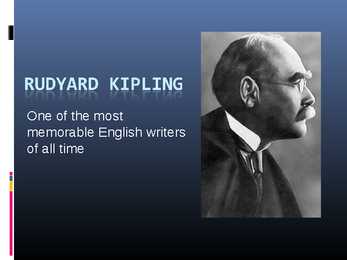
Father John Lockwood Kipling Sister Alice Kipling Fleming Early Life 30 December 1865 in Bombay, in British India Captain and Mrs. Holloway - Lorne Lodge Paradise at Aunt Georgie's and her husband 1878 - admitted to the United Services College Bombay in 1865 Travels & First writings 1883 - visited Simla thirty-nine stories appeared in the Gazette included in Plain Tales from the Hills Kipling's first prose collection 1887 Allahabad in the United Provinces published six collections of short stories 1889 sold the rights to his six volumes of stories Life London published a novel - The Light that Failed and on the 18 January 1892 Carrie Balestier (29) and Rudyard Kipling (26) were married in London United States didn't find a country that lived up to his expectations the Boer war increasing harshness of his views John Josephine Peak of his career Nobel Prize in 1907
The car over there is fast. The teacher is very good, isn't he? · The first time you speak of something use "a or an", the next time you repeat that object use "the". I live in a house. The house is quite old and has four bedrooms. I ate in a Chinese restaurant. The restaurant was very good. · DO NOT use an article with countries, states, counties or provinces, lakes and mountains except when the country is a collection of states such as "The United States". He lives in Washington near Mount Rainier. They live in northern British Columbia. · Use an article with bodies of water, oceans and seas - My country borders on the Pacific Ocean · DO NOT use an article when you are speaking about things in general I like Russian tea. She likes reading books.
, Smirnov, G., 2016). Rahavahetaja Chan Wah Shun oli WT'd õpetanud 36 aastat ja tal 16 õpilast. Õpilaste hulgas oli ka ta enda poeg Chan Yu Min, kes sattus sageli kaklustesse. Sellest tulenevalt otsustas rahavahetaja vältida pojale kõrgemate tehnikate õpetamist. Küll aga õpetas ta oma poja naisele, kes oli väga andekas selles vallas. Mida Chan Yu Min ei õppinud oma isalt, õppis ta oma naiselt. Rahavahetaja poeg Chan Yu Min omandas tiitli ,,King of the Pole of Seven Provinces", mis anti talle ,,Martial Arts Tournamets of Seven Provinces" üritusel (Lehiste, K., Miitel, M., Smirnov, G., 2016). Rahavahetaja Chan Wah Shuni teine õpilane Ng Chung So oli väga andekas ning omandades kõik teadmised. Ta assisteeris Chan Wah Shun'i kuni tema surmani. Rahavahetaja Chan Wah Shun'i viimane õpilane oli 13-aastane Yip, kelle ta jättis oma assistendi Ng Chung So õpetada (Lehiste, K., Miitel, M., Smirnov, G., 2016).
Vesuuviga PEJI VÄLJA- KAE- VATUD Photo R. Decker 2. LIP large igneous provinces laialdased basaltplatood Lõhevulkaanid: (klassikaline geoloogia: trapikatted) magma tõuseb piki lõhet - tekivad laialdased laavakatted basaltide platood Vulkaanikoonused piki 1783a avanenud Laki lõhet Islandil Kolumbia platoobasaldid Kolumbia Platoo basaldid 17 14 (kuni 6) Ma >200 000 km3 >300 laavavoolu
War. "Farewell to Nova Scotia" brings the listener back to an age when Nova Scotia was renowned for "wooden ships and iron men". Wooden Ships and Iron Men, now-classic 1924 book about the last days of the Age of Sail in Maritime Canada. Written by Frederick William Wallace. · The Age of Sail was the period in which international trade and naval warfare were dominated by sailing ships. · The Maritime provinces, also called the Maritimes or the Canadian Maritimes, is a region of Eastern Canada. "God Save the Queen", (alternatively "God Save the King") is the national anthem of the United Kingdom and its territories and dependencies. As "God Save the Queen" is the Royal Anthem of Canada, the first verse has been translated into French for use in that country. Land of the Silver Birch is a traditional Canadian folk song. It is sometimes sung to
They also brought new diseases with them. In parts of Australia, not one Aborigine survived. Today aborigines continue to live in Australia but there culture in under threat. In 1770, there were about 300,000 Aborigines. Now, there are 120,000. It is becoming harder and harder for them to continue their traditional way to live. Today Australia is a modern, industrial country, independent from Britain since 1931. The Commonwealth of Australia consists of 6 states and two provinces. It is the world's biggest producer of wool, bauxite and important producer of wheat, meat, sugar and fruit. What do these numbers and dates refer to? For example: 12,000 years ago: first people arrived in Australia 120,000 1970 300.000 7,700,000 - What is the capital of Australia? a. Sydney b. Melbourne c. Canberra - Which city is the oldest and largest? a. Canberra b. Sydney c. Darwin
to keep dingoes away from the sheep. 9. The wine cask, the ubiquitous plastic bag full of wine contained in a cardboard box, was invented in Australia in 1967. 10. The world's longest golf course, measuring more than 850 miles long is located in Australia. Canada 1. Canada is one of the only countries that confederating without war. 2. Canada, the 2nd largest country in the entire world has less than 35 million people. 3. Canada has 10 provinces and 3 territories. Nunavut is the 4th largest subdivision of a country in the world. 4. Toronto, Canada is home to the largest tower in the world, the C.N. Tower. 5. Canada's Great Lakes compose of 20% of the world fresh water! 6. The Canadian flag consists of 2 colours, red and white. The white represents peace and honesty and the red represents bravery and strength. The maple leaf in the centre celebrates the environment of Canada. 7
 annaabi.ee