Leidsid 33 sarnast õppematerjali, mis on seotud failiga "Jaanipäev". Need materjalid aitavad sul teemat sügavamalt mõista.
jaanipäev, fire, night, summer, estonians, during, light, lovers, jaaniõhtu, important, dayselebration, became, year, soviet, tradition, brief, between, june, võidupüha, traditional, lightinghange, work, midsummer, ritual, away, there, tale, once, flower, occupationountry, holiday, again, official, liisa, reigo, jaanilaupäevalendar, apartModern customs of the holiday include gift-giving, Church celebrations, and the display of various decorations--including the Christmas tree, lights, mistletoe, nativity scenes, and holly. In many countries there are many different types of decorations used depending on the traditions and available resources. However , in Estonia people bring Christmas tree in and decorate it with straw ,glass balls and candles. Estonians eat sauerkraut and black pudding. On the 24th December people leave work early, families gather, Santa Clouse comes , everybody gives gifts. People are very calm at Christmas time and they support each other. New Year's Eve New Year's Eve is on December 31, the final day of the Gregorian year, and the day before New Year's Day. New Year' s Eve is celebrated all around world because it's final day of the Gregorian year.
Holidays, Festivals, Cultural events TALLINN - If you're looking for entertainment in Estonia this summer, you are really spoiled for choice. Festivals and events dedicated to the consumption of beer are a lot of fun, but if you want to get the true feel of the country, you need something a little more ethnic. Like a town fair. Just as July becomes August, the seaside town of Haapsalu will host a grand spectacle of rural Estonian entertainment. The White Lady Days is a summer celebration filled with amusement for all the family. Held in and around the remains of the Teutonic-knights-era castles, the fair combines enchanting medieval legends with modern countryside charm to create a comprehensive experience of Estonia beyond the big cities. But the legend of the White Lady of Haapsalu, which is at the heart of the festival, is perhaps the most famous tall tale of the many that are so abundant in Estonia's folklore.
anniversary of a nation's assumption of independent statehood, usually after ceasing to be a colony or part of another state, more rarely after the end of a military occupation. In Estonia it's celebrated on February 24.Estonia got independence from the Bolshevist Russia in 1918.Estonia regain independence in 1991 from NSVL when it fall a part. St John`s Day (jaanipäev) In Estonia, aside from Christmas, St John's Day is the most important days in the calendar. The short summer seasons with long days and brief nights hold special significance for the people of Estonia. St John's Day is celebrated in the night between 23rd and 24th of June, a few days after the summer solstice, when night seems to be non-existent. For Estonians, Jaanipäev celebrations were merged with the celebration of Victory Day during the War of Independence when Estonian forces defeated the German troops on 23 June 1919. After this battle against Estonia's traditional
Independence day 24 February. Estonian people often have a day-off from school and work, to celebrate this day. People often make big dinners and sit around in the circle of family. They often light a few candles on the window and all houses have an Estonian flag out. This is by law the most important holiday, commemorating the declaration of independence in 1918. New Year's Eve 31December The New Year's Eve is an event that happens when Estonians celebrates the end of one year and the beginning of the next year. Estonians launch a big amount of fireworks up to the sky at midnight. It's a celebration with family and friends. After launcing the fireworks people watch and toast and wich a happy new year to each other. Christmas Eve 24 December Most of the traditions, such as Christmas dinner and gift giving are observed in Estonia on this day. Santa Claus visits homes in person, played by an older family member or a rent-a-Santa
region. The battle was part of the 1918-1920 Estonian War of Independence, where the main adversary of the newly independent Estonia was Communist Russia. Today, Võidupüha also marks the contributions of all Estonian nations in their fight to regain and retain their independence. Estonian celebration of June 23 is ceremonially tied to the following Midsummer Day celebrations on June 24. According to Estonian laws, the state flags are not to be lowered during the night between the days. Christmas Eve December 24 Christmas Eve is the evening or entire day before Christmas Day, the widely celebrated annual festival commemorating the birth of Jesus Christ. It occurs on December 24 in the Western Christian Church, and is considered one of the most culturally significant celebrations in Christendom and the Western world, where it is widely observed as a full or partial holiday in anticipation of Christmas Day. St
The biggest ones are located to the west. The four biggest islands are Saaremaa, Hiiumaa, Vormsi and Muhu. The highest point in Estonia and also in the Baltic region is Suur Munamägi. It is 318. above sea level. Estonia is a country of a thousand lakes. The Largest one is Lake Peipsi which is also the fourth biggest freshwater lake in Europe. Lake Peipsi and Lake Võrtsjärv are rich in fish. Estonia has many rivers but only nine of them are longer than 100km. The most important ones are Pärnu River and Emajõgi River Climate Estonia lies in the northern part of the temperate climate zone and in the transition zone between maritime and continental climate. Because Estonia is continuously warmed by the Gulf Stream it has a milder climate despite its northern latitude. Northern latitude means long summer daylight hours (the longest summer day stretches to 19 hours), and dark winters when daylight lasts sometimes only six hours.
More than 200 of them breed in Estonia. Due to the vast preserved natural landscapes, large raptorial birds, such as the golden eagle and eagle owl have made Estonia their home. It is the small islets, however, that can really be called bird paradise. Undisturbed by man and protected from most smaller predators by the sea, they are real nesting sanctuaries for a diversity of birds. The first inhabitants came to the area that now forms present-day Estonia some 11 000 years ago. Estonians were one of the last pagan people in Europe. Estonia was incorporated into Christendom at the beginning of the 13th century, under the pressure of crusaders from Denmark and Northern Germany. Estonians were reduced to the status of peasantry until the 19th century. From 1558 onwards, Estonia became the battleground for the Livonian War involving Denmark, Sweden, Russia and Poland. Sweden emerged as the winner and Estonia remained under its influence until the beginning of the 18th century
Saaremaa and Muhumaa are connected to each other with a bridge. The best- known smalles islands are Naissaar, Aegna, Ruhnu, Kihnu, Väike-Pakri, Suur-Pakri etc. 3. Relief Lying in the north-western part of the East-European Plain, Estonia is mostly flat with an average elevation of about 50 metres above sea level. South-eastern and eastern parts of Estonia are higher than the western parts. The relief of the present-day landscape was shaped during the Ice Age. Ice sheet has carried large boulders and limestone blocks here, not to mention that the hilly terrain in Estonia was also shaped by the continental ice and the melting water. The land is rising 25 cm every one hundred years. In folklore, many features of the relief are explained by the activities of giants such as the legendary national hero Kalevipoeg. The Haanja and Otepää Uplands are particularly rich in Hills. It is here
Introduction Estonia, officially the Republic of Estonia (Estonian: Eesti or Eesti Vabariik) is a country in the Baltic region of Northern Europe. It is bordered to the north by Finland across the Gulf of Finland, to the west by Sweden across the Baltic Sea, to the south by Latvia (343 km), and to the east by the Russian Federation (338,6 km). The territory of Estonia covers 45,227 km² and is influenced by a temperate seasonal climate. The Estonians are a Finnic people closely related to the Finns, with the Estonian language sharing many similarities to Finnish. The modern name of Estonia is thought to originate from the Roman historian Tacitus, who in his book Germania (ca. AD 98) described a people called the Aestii. Similarly, ancient Scandinavian sagas refer to a land called Eistland, close to the German term Estland for the country. Early Latin and other ancient versions of the name are Estia and Hestia. Until the late
The people here are mostly engaged in industry- mainly the food industry (23%), trade (16%) and transport and communication (14%). History. Tallinn has a great history. It was first marked on a map of the world by the Arab geographer al-Idrisi in 1154, its name then being Kolyvan. In the 13 th- century chronicle of Henricus de Lettis the town was called Lyndanise. Then it was called Reval for some time and finally Estonians started to call the town Tallinn from Taanilinn (Danish town) after the Danish conquest in the 13th century. The Knights of the Sword took Tallinn from the Danes in 1227 and made Toompea their fortress. In the middle of the 14th century Denmark sold its possessions in Estonia to the German Teutonic Order; Toompea became the seat of German-born gentry. A fortified wall was built between the Toompea (the Upper Town) and the
..................................................................................................... 9 Conclusions........................................................................................................................10 References..........................................................................................................................11 3 Introduction English is considered to be one of most important languages in the world. It is one of the official languages of the United Nations. According to research by the British Council, around 375 million people in the world speak English as their native language and English has official or special status in at least seventy-five countries. The British Council has also noted that English is the main language of newspapers, airports and air-traffic control, international business and academic conferences, science, technology, diplomacy and sport
Midsummer Day Kadi Jürisson Midsummer Day June 23 and 24, a few days after the summer solstice Click to edit Master text styles Second level Midsummer Day Third level celebrations were merged Fourth level Fifth level with the celebration of Victory Day Most important day in the Estonian calendar
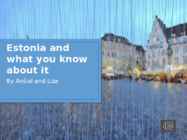
Estonia and what you know about it By Anšiel and Liza National symbols • The flag is blue, black and white horisontal lines, It represents the blue sky, the dirt, purity or snow. • The national bird is a swallow. • The national flower is a cornflower. History • The first settelments in Estonia came by supposedly about 11 000 years ago. • In the past most Estonians worshipped spirits of nature and their beliefs were seen as unholy by christian crusaders. Taara is believed to have been the name of the old Estonian god. • Starting with the Northern Crusades in the Middle Ages, Estonia became a battleground for centuries where many countries fought their wars over controlling the important geographical position of the country as a gateway between East and West, despite this the country has survived.
country's proximity to the sea, the skies are often cloudy, and rain often falls in the spring and autumn, in the winter the rain turns to snow. The highest point in Estonia is Suur Munamäg It is in fact the highest point in the Baltic region Forest cover over one half of Estonia. The most common types of tree are pine, spruce and birch. Estonia, along with Finland and Sweden are the countries with the greatest percentage of forested land. Forest management and wood production are particularly important for the Estonian economy. One third of Estonian forests are protected areas. In these protected forests you can come across types of primeval forest cover, which have long ago disappeared from other parts of Europe. Examples of such primeval forests are the Järvselja forest in Tartumaa County and Poruni in Ida- Virumaa County. Meadows in Estonia are rich in different species much more so than in Western Europe. Estonia is a country of thousand of lakes
Kunda Ühisgümnaasium Tallin Old Town Report Student: Kristin Karu Teacher: Kristi Aron Kunda 2012 The Alexander Nevsky Cathedral The Alexander Nevsky Cathedral is an orthodox cathedral in the Tallinn Old Town,Estonia. It was built to a design by Mikhail Preobrazhensky in a typical Russian Revivalstyle between 1894 and 1900, during the period when the country was part of theRussian Empire. The Alexander Nevsky Cathedral is Tallinn's largest and grandest orthodox cupola cathedral. It is dedicated to Saint Alexander Nevsky who in 1242 won the Battle of the Ice on Lake Peipus, in the territorial waters of present-day Estonia. The late Russian patriarch, Alexis II, started his priestly ministry in the church. Interior of the Cathedral. The Alexander Nevsky Cathedral crowns the hill of Toompea where the Estonian folk hero
the republic is celebrated on February 20. The national flower is cornflower, national bird is barn swallow and national stone is limestone. It is a land of great natural beauty with a long and varied history and rich culture. It has served as a junction of international trade routes for centuries. History. The oldest marks of habitation on the territory of Estonia date from the 8th millennium BC. Fortified settlements were established in the 1 st century BC. The ancestors of Estonians formed several independent states headed by elected elders. Until the beginning of the 13th century Estonia was politically independent. Then began a long chain of occupation and control by foreign powers. In the 1200s the German crusaders converted Estonia into a Christianity by force and took control over South Estonia. In 1219 Denmark conquered Northern Estonia. About a century later, in 1346 Denmark sold its territory to Germany. By the 1500s German nobles owned much of
EISTLAND; to modern Scandinavians it is known as ESTLAND. Most contemporary languages use the Latin name ESTONIA. FLAG The Estonian blueblackandwhite national flag was originally the flag of the Estonian Student's Society, consecrated in Otepää Church in 1884. today there is a memorial plaque on the church wall commemorating the event. The Flag Museum attracts tourists who take an interest in the history of the flag. After about half a century, during which it was prohibited by the Soviet authorities, the flag was sen again in public for the first time in Tartu. Many elderly people were carrying the flags they had kept in secret hiding places durin the Soviet years; tears were rolling down their cheeks. On 24 February 1989, Estonia, still part of the Soviet Union, hoisted its tricolour on the tower of Pikk Hermann in Tallinn. Since then the flag has always been hoisted with
established the relationships between Estonia, Livonia and the Russian Empire. The Baltic Landesstaat reached its full development. The freedom of action in the new provinces was naturally granted to one of the most firm ideological pillars of the tsarist empire -- the Russian orthodox church; though as the Landeskirche in the Estonian and Livonian territories, the Lutheran church long maintained a de facto predominance. The most important organ of Baltic German local government was the Diet, consisting of all the noble families who had been `selected' in a list of the eligible. Although jealously guarding their privileges, the knighthoods still never became entirely closed. Between sessions of a Diet, the legislative power of the knighthoods belonged to the Council of the Diet. The towns were governed by the Town Councils, which supplemented their ranks from among the representatives of merchants and lawyers. The
Tallinn was first marked on a map of the world by the Arab geographer al-Idrisi in 1154, its name then being Kolyvan (probably derived from the name Kalev). In the 13th-century Chronicle of Henricus de Lettis the town was called Lyndanise. Later came Reval (presumably after the old county of Rävala), the name used by the Germans who ruled the country for seven centuries. Russians then modified Reval to Revel. For Estonians, the town came to be called Tallinn from Taanilinn (Danish town) after Danish conquest in the 13th century. Over the course of time, Taanilinn was shortened to Tallinn The place is believed to have been settled by Finno-Ugric peoples about 2500 BC. The Danes, led by King Valdemar II, conquered northern Estonia in 1219. Legend has it that one day, when the Danes were about to lose a bloody battle, the sky suddenly opened and a red flag with a
and "towns". More than 70% of the population lives in towns. History • Estonia was settled near the end of the last glacial era, beginning from around 8500 BC. Before the German invasions in the 13th century proto-Estonians of the Ancient Estonia worshipped the spirits of nature. Since the Northern Crusades Estonia became a battleground for centuries where Denmark, Germany, Russia, Sweden and Poland fought their many wars over controlling the important geographical position of the country as a gateway between East and West. Being conquered by Danes and Germans in 1227, Estonia was ruled initially by Denmark in the north, by the Livonian Order, an autonomous part of the Monastic state of the Teutonic Knights and Baltic German ecclesiastical states of the Holy Roman Empire. From 1418–1562 the whole of Estonia was part of the Livonian Confederation. After the Livonian War, Estonia became part of the Swedish
Topic Sports Tallinn English College 8b form 2007 1. Introduction For some people sport plays a very important part in their lives. And to some, it is even a way of life. There are different kinds of sports. For instance, there are sports meant for playing indoors, some can be practised only at a certain time of year. There are winter and summer sports also. Skiing, figure-skating, sledding and snowboarding these four most popular are practised during winter. Good examples of summer sports are: swimming, badminton, roller skating and golf. 2. The ancient Olympic Games The first recorded Olympic Games took place in 776. B.C. at Olympia but the city may have functioned as a meeting place for worship and other political practices many years earlier. The city is located in western Greece. The games were held every four years
Windsor Castle, which is one of the official residents of British monarch, is located in the English country of Berkshire. It is the largest in habited castle in the world and the oldest in continuous occupation, since it dates back to the time of William the Conqueror. The castle’s area is approximately 484,000 square feet (44, 955 square metres). The castle has been garrison fortress, home, official palace and sometimes prison for most of the Kings and Queens of England/Great Britain. During the war, the castle has been heavily fortified but when country has been in peace, it has been expanded with large and grand apartments and this pattern has continued nowadays. The White Cliffs of Dover is one of England’s most famous natural landmarks. The cliffs were formed over 80 million years ago. They are a part of British coastline facing France and the Strait of Dover. The cliffs owe its impressive façade to its composition of chalk
Estonian Economy Estonians earn about half of the average European income, despite the fact that the economic growth during the recent years has been very fast and the differences have been diminishing. Although the extremely vigorous period of economic reforms is now over, the changes that Estonia is presently going through are far more extensive than those in the developed countries. The Estonian economy is diverse industry and transport, as well as commerce and different branches of services are all equally important. Due to the available natural
The American Rock Art Research Association protects rock-art sites. 2) THE FAVOURITE SPORT IN BRITAIN The most popular sport is probably football. Two kinds of football is played in Great Britain. One of them, which is called association football, is played all over Europe. The other kind: rugby football is also very popular in New Zealand, France, and some other European countries. English boys play it at school, and in public parks. When they grow up, they play as members of important amateur teams or as a professional in teams competing in football ,,leagues". Professional football is as much a business as a sport. Rugby football was first played in 1823. In rugby every player is allowed to carry the ball. The ball is oval, not round. Each team contains 15 players. The oldest game of football in England is probably the football match which takes place at Ashburn on Shrove Tuesday every year. The game starts in the centre of the town,
The wealthy mulk were the first of Estonian farmers to build manses, until then the farmers all over Estonia lived in farmhouses that included a barn so that people and animals lived under one roof. The old farmhouses and mansions can still be seen in many places in Southern Viljandimaa. As a result of the hard work and the tenacity of the local inhabitants, Mulgimaa developed into an area known as prosperous and rich by its cultural heritage. The masters working in the villages played an important role in the development. The local foods such as sauerkraut stew, curd cake and ,,kama" (a meal made with sour milk and a mixture of ground grains) are popular even nowadays. There is even a song that says: "It is good to live in Mulgimaa / The nature is beautiful and the land is fructuous/ There are glorious groves and large wealthy Estonian farms". As for now, the large-scale industry has become more and more dominating in agriculture. After
In the 18th century Russian Tsar Peter the Great joined Estonia to his empire. The first true political parties emerged(Where established) at the turn of the century, demanding autonomy for Estonia. Following the Russian Revolution of 1917, Estonia declared independence from Russia on Feb. 24, 1918. Independent Estonia made large strides between wars. World War II ended Estonia's independence. The country was occupied by the Soviet Army in June 1940.Thousands of Estonians were killed or deported to Siberia. In 1944, Estonia became part of the Soviet Union. Proindependence guerrilla forces continued to fight against the Soviets into the 1950s. In the "Singing Revolution" of the 1980s, Estonians showed their desire for independence in peaceful mass meetings. In 1989, 2 million people from the three Baltic countries linked hands in a human chain stretching from Tallinn to Vilnius in Lithuania. Independence was proclaimed(declared) on Aug. 20, 1991
Economy of Estonia The economic growth during the recent years has been very fast. The Estonian economy is diverse industry and transport, as well as commerce and different branches of services are all equally important. Due to the available natural resources Estonian economy largely relies on the branches related to the forest; Estonian energy sector is based on oil shale. Finland and Sweden are the most important trade partners. The Estonian economy profits significantly from the business generated by more than 2 million tourists a year. The important sectors of the Estonian economy are the processing, transport, warehousing and communications, commerce and estate, rental and letting, as well as business services, agriculture, construction and government, education and health care. In order to be able to import all the products and services, something must be exported, that's
HISTORY OF ESTONIA Estonians are one of the longest-settled European peoples, whose forebears, known as the "comb pottery" people, lived on the southeastern shores of the Baltic Sea over 5,000 years ago. Like other early agricultural societies, Estonians were organized into economically self-sufficient, male-dominated clans with few differences in wealth or social power. By the early Middle Ages most Estonians were small landholders, with farmsteads primarily organized by village. With the collapse of the Russian empire in World War I, Russia's provisional government granted national autonomy to Estonia. A popularly elected assembly (Maapaev) was formed but was quickly forced underground by opposing extremist political forces. The Committee of Elders of the underground Maapaev announced the Republic of Estonia on February 24, 1918, 1 day before German troops invaded
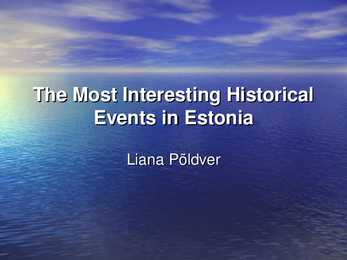
The Most Interesting Historical Events in Estonia Liana Põldver · The nationwide Song Festival tradition began with the first Song Festival in Tartu, June 18 20, 1869. · 1860 marks the beginning of the period of the National Awakening. A singing society led by Johann Voldemar Jannsen started and carried through the nationwide idea of Song Festival. · During 1879 1910 six Song Festivals were held that played an important part in the nation's cultural and economical awakening and growth. In the independent Estonian Republic the Song Festivals were held in every five years (1923 1938). After World War II, the Song Festival tradition began again in 1947. Since 1950 General Song Festivals were held in every five years again. 1969 was an exception though when 100th anniversary of the Song Festival was celebrated. · The foreign authorities have tried to use the Song
*Estonians conquered by the crusaders 1208 *Reformation 16th century establishments of new school, Estonians first book appeared in 1525 *Tartu University 1632 founded by King Gustavus II Adolphus, classical university, member of the Coimbra group *Abolition of serfdom 1816 *Song festival 1869 in Tartu, an organiser was J.V.Jannsen, 822 singers, men only *Declaration of independence 24th February 1918 *War of independence 1918-1920 during the Russian Civil War, resulted in a victory for Estonia *Deportation 1949 *Estonia becomes independent 20th August 1991 *Joining EU 1st May 2004 Language: Estonian language, belongs to the Balti-Finnic group of the Finno-Ugric languages, closely realted to Finnish and rather remotely to Hungarian; Latin alphabet with 32 letters , 5 of which occur only in foreign words, the phenomes include 9 vowels and 18 consonants; words are borrowed from Latin, Greek, English etc
Introduction Tallinn, the capital city of the Republic of Estonia and of the Harju county, is a town in North Estonia on the coast of the Gulf of Finland. It has nearly half a million inhabitants and covers an area of almost 160 sqkm. It is also an important economic and cultural centre and one of the main ports in the Baltic States. Tallinn is one of the oldest cities on the Baltic Sea. It is unique for its well-preserved architecture from the 13-15 centuries. In contrast to the ancient town-walls and towers, Tallinn of today offers modern hotels, restaurants, sport and cultural centres. Every five years national song and folk dance festivals take place in Tallinn. The yachting regatta of the 1980 Moscow Olympic Games was held at Pirita. History
According to the tradition, the Olympic Games began in 776 B.C. when Ifitos made a treaty with Lycourgos the king and famous legislator of Sparta and Cleisthenes the king of Pissa. In this treaty that was the decisive event for the development of the sanctuary as a Panhellenic centre, the "sacred truce" was agreed. That is to say ceasing of fighting in all of the Freek world for as long as the Olympic Games were on. The Olympic Games were held, after the completion of four years during the month of July or August. The time between two competitions was called the Olympiad. In the beginning the games lasted for only one day and comprised only one event, the running of one Stadion, but gradually more events were added resulting, towards the 5th century B.C., in the games lasting for 5 days. In total the Olympic Games consisted of 10 events: running, the pentathlon (viievõistlus), jumping, discus, "ekebolon" javelin, wrestling, boxing, the pancration,
UNO SOOMERE ESTONIAN SYMPHONIC MUSIC. THE FIRST CENTURY 1896-1996. AN OVERVIEW With a Historical and Cultural Summary IN MEMORY OF THE GREAT ESTONIAN COMPOSERS CONTENTS ESTONIA AND THE ESTONIANS FOREWORD IN THE FOLD OF TSARIST RUSSIA. EMERGENCE AND FIRST STEPS ON THE CLASSICAL-ROMANTIC PATH. HISTORICAL INTRODUCTION I. MUSICAL LIFE IN TARTU AT THE TURN OF THE CENTURY. TRAILBLAZERS: ALEKSANDER LÄTE, RUDOLF TOBIAS, ARTUR KAPP. II. THE FIRST DECADE OF THE 20TH CENTURY. ARTUR LEMBA: THE BEGINNING OF ESTONIAN SYMPHONY AND OPERA. III. NEW DEVELOPMENTS IN CULTURAL AND MUSICAL LIFE: THE END OF THE TSARIST PERIOD. THE INDEPENDENT REPUBLIC OF ESTONIA: THE INTRODUCTION OF
 annaabi.ee