 50 punkti
Autor soovib selle materjali allalaadimise eest saada 50 punkti.
50 punkti
Autor soovib selle materjali allalaadimise eest saada 50 punkti.
 ~ 6 lehte
Lehekülgede arv dokumendis
~ 6 lehte
Lehekülgede arv dokumendis
 2012-11-08
Kuupäev, millal dokument üles laeti
2012-11-08
Kuupäev, millal dokument üles laeti
 4 laadimist
Kokku alla laetud
4 laadimist
Kokku alla laetud
 0 arvamust
Teiste kasutajate poolt lisatud kommentaarid
0 arvamust
Teiste kasutajate poolt lisatud kommentaarid
 mastermalts
Õppematerjali autor
mastermalts
Õppematerjali autor
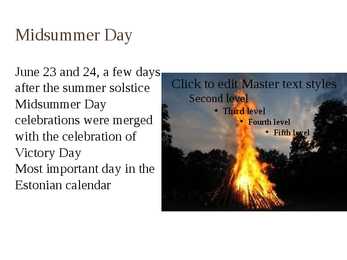
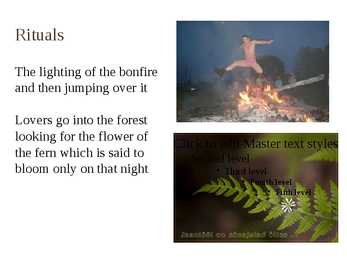
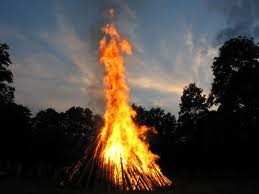
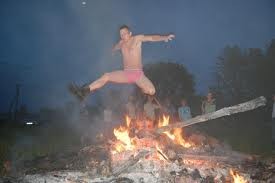
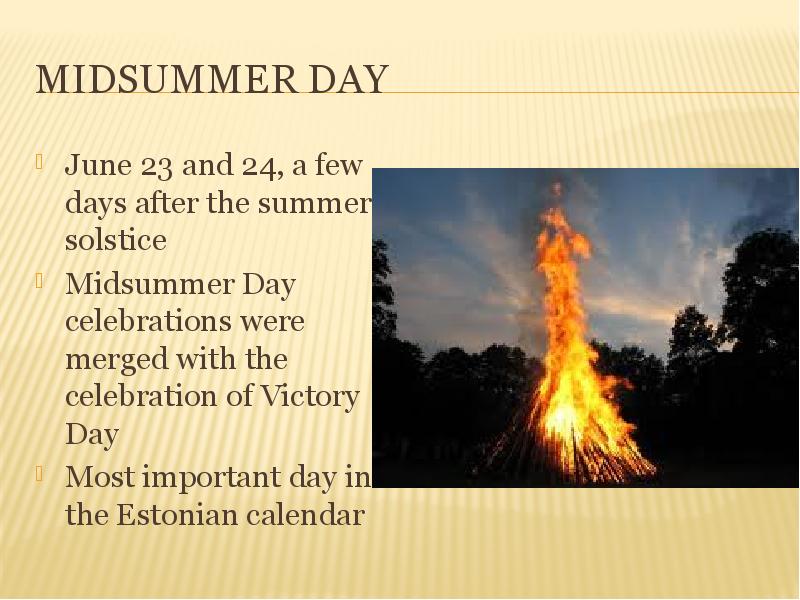
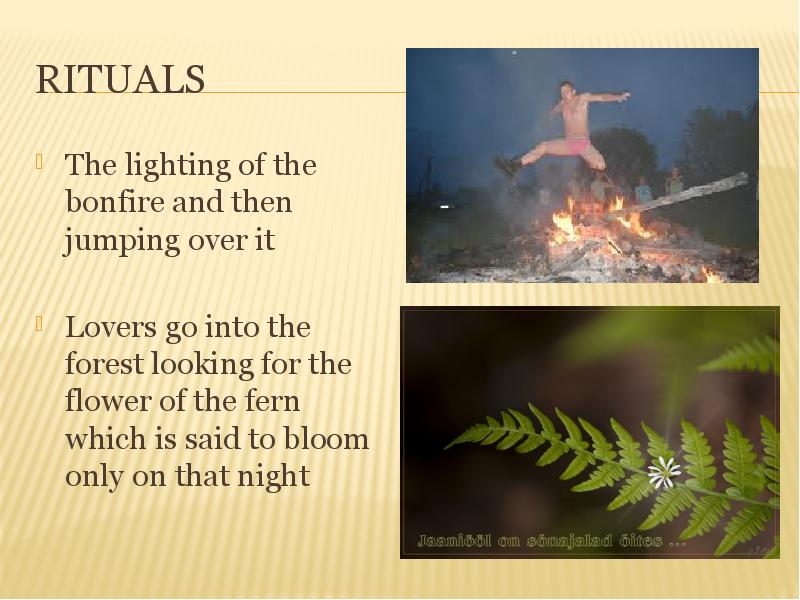
Mari-Liisa Reigo Jaanipäev Jaaniõhtu, also called Jaanilaupäev and Jaanipäev are the most important days in the Estonian calendar, apart from Christmas. The short summer seasons with long days and brief nights hold special significance for the people of Estonia. Jaanipäev is celebrated in the night between 23rd and 24th of June, a few days after the summer solstice, when night seems to be non-existent. For Estonians, Jaanipäev celebrations were merged with the celebration of Võidupüha during the War of Independence when Estonian forces defeated the German troops on 23 June 1919. After this battle against Estonia's traditional oppressors, Jaaniõhtu and the lighting of the traditional bonfires became linked with the ideals of independence and freedom.
Holidays, Festivals, Cultural events TALLINN - If you're looking for entertainment in Estonia this summer, you are really spoiled for choice. Festivals and events dedicated to the consumption of beer are a lot of fun, but if you want to get the true feel of the country, you need something a little more ethnic. Like a town fair. Just as July becomes August, the seaside town of Haapsalu will host a grand spectacle of rural Estonian entertainment. The White Lady Days is a summer celebration filled with amusement for all the family. Held in and around the remains of the Teutonic-knights-era castles, the fair combines enchanting medieval legends with modern countryside charm to create a comprehensive experience of Estonia beyond the big cities. But the legend of the White Lady of Haapsalu, which is at the heart of the festival, is perhaps the most famous tall tale of the many that are so abundant in Estonia's folklore.
Independence Day is celebrated with victory parade, flag raising and speeches , but some famililies have a lavish feast and parents talk to their children that how and when Estonia got independence.Many of people just watch victory parade from TV. On this day people are very calm and they enjoy to be Estonians. St. John's Day In Estonia, aside from Christmas, St John's Day is the most important days in the calendar. The short summer seasons with long days and brief nights hold special significance for the people of Estonia. St John's Day is celebrated in the night between 23rd and 24th of June, a few days after the summer solstice, when night seems to be nonexistent. For Estonians, Jaanipäev celebrations were merged with the celebration of Victory Day during the War of Independence when Estonian forces defeated the German troops on 23 June 1919. After this battle
A single nation. A million voices. The fall of and empire. Main events in Estonian history NIMI Ancient Estonia · Begins from around 8500 BC. · Worshipped the spirits of nature. · Own gods. · 5 periods: mesolithic, neolithic, bronze age, iron age, early middle ages. Click icon to add picture Click icon to add picture Estonian crusade · One of the last corners of medieval Europe to be christianized. · Against pagans in Estonia. ·
FORMATION OF MEDIEVAL kARELIA · WHAT WAS BEFORE MIDDLE AGES · WHAT CHANGES OCCURRED WITH IT HOW KARELIA LOOKED LIKE WHEN NEW · ERA DAWNED IN 16th CENTURY GEOGRAPHY OF KARELIA AND ITS RELEVANCE Click to edit Master text styles Major changes in prehistoric times in Second level Karelia Third level Transgression of Ladoga Birth of Vuoksi 3700 BCE Fourth level Birth of Neva 1300 BCE Fifth level Land rise during entire period from Ice Age till today, leading most notably to changes in Vuoksi river's flow Crossroads of trading routes White Sea/Arctic Ocean Upper Volga / Caspian basin Baltic Sea basin Dnepr / Black Sea basin Daugava Waterways: Gulf of Finland, Ladoga, Onega, White Sea, Neva, Vuoksi, Svir, Volkhov, Vytegra, Uiku/Vyg. Network of waterways like Saim
James Joyce James Augustine Aloysius Joyce Irish novelist and poet Click to edit Master text styles one of the most Second level Third level influential writers in the Fourth level modernist avant-garde Fifth level of the early 20th century Early life born on 2 February Click to edit Master text styles 1882 Second level Third level eldest of ten surviving Fourth level children Fifth level Slide into poverty Educaation Clongowes Wood College Christian Brothers Click to edit Master te
England Halloween Table of contents 1. Introduction 2.Threats 3.Halloween pranks 4.Picture 56.History of Halloween 7.Luther's celebration 89. Turnips and Halloween 10.New elements 11.Druids in Britain 12.Picture Halloween is a holiday in many English speaking countries that is celebrated on the night of October 31st. Children wear costumes and they go to peoples' homes saying "Trick or treat!" to ask for candy, sweets in the United Kingdom, or lollies in Australia, and then people give it to them. This practice originally involved a threat. A threat is when someone says that they will do something bad if they do not get what they want. In this case the threat could be explained as: "Give me a treat or I will play a trick on you." Children today usually do not play tricks if they do not get treats. However, some children still get up to mischief (pranks or things to make fun of people; like putting toilet paper in trees; writing on windows with soap or thro
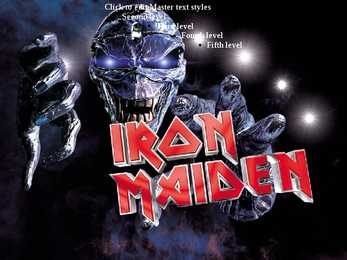
Click to edit Master text styles Second level Third level Fourth level Fifth level Iron Maiden § English heavy metal band from Leyton in east London, formed in 1975 by Steve Harris & Dave Murrey § Named after a torture device. § 15 studio albums. § 11 live albums. § 4 extended plays. § 7 compilations. § Iron Maiden have sold over 85 million records worldwide § Over 2000 live peformances. § Their music has influenced dozens of famous bands, most notably Metallica and the Red Hot Chili Peppers § Most famous lead vocals: Paul Di'anno , Bruce Dickinson; Blaze Bayley. § They have been active since 1975 present . Click to edit Master text styles Second level Third level Fourth level Fifth level
 annaabi.ee










Kõik kommentaarid