 5 punkti
Autor soovib selle materjali allalaadimise eest saada 5 punkti.
5 punkti
Autor soovib selle materjali allalaadimise eest saada 5 punkti.
 ~ 1 leht
Lehekülgede arv dokumendis
~ 1 leht
Lehekülgede arv dokumendis
 2010-10-11
Kuupäev, millal dokument üles laeti
2010-10-11
Kuupäev, millal dokument üles laeti
 19 laadimist
Kokku alla laetud
19 laadimist
Kokku alla laetud
 0 arvamust
Teiste kasutajate poolt lisatud kommentaarid
0 arvamust
Teiste kasutajate poolt lisatud kommentaarid
 TiniStaar
Õppematerjali autor
TiniStaar
Õppematerjali autor
CANADA Pavel Zubarev 8.a Geographical position Canada is the second largest country in the world. Only Russia has a greater land area. Canada is situated in North America. Canada is a federation of 10 provinces and 2 territories. The population Canada is slightly larger than the United States, but has only about a tenth as many people. About 28 million of people live in Canada. About 80% of the population live within 320 km of the southern border. Much of the rest of Canada is uninhabited or thinly populated because of severe natural conditions. Canada's people are varied. About 57% of all Canadians have some English ancestry and about 32% have some French ancestry. Native people American Indians and Eskimos make up about 2% of the country's population. 77% of Canada's people live in cites or towns. The Capital of Canada Ottawa is the capital of Canada. One third of its peop
Canada Geography The geography of Canada is vast and diverse. Occupying most of the northern portion of North America, Canada is the world's second largest country in total area. The highest point in Canada is Mount Logan 6,050 m, which is in the Yukon. The two principal river systems are the Mackenzie and the St. Lawrence. The St. Lawrence, with its tributaries, is navigable for over 3,058 km. The largest lake situated entirely in Canada is Great Bear Lake at 31,328 km2 in the Northwest Territories. The largest lake which is at least partly in Canadian territory is Lake Superior Climate Canada's climate is as diverse as its landscape. Generally, Canadians enjoy four very distinct seasons, particularly in the more populated regions along the US border. Daytime summer temperatures can rise to 35°C and higher, while lows of -25°C are not uncommon in winter. More moderate temperatures are the norm in spring and fall.
CANADIAN PATRIOTIC SONGS "Ca-na-da", or "The Centennial Song" (French version: "Une chanson du centenaire") was written by Bobby Gimby in 1967 to celebrate Canada's centennial and Expo 67. The Canadian Centennial was a year long celebration held in 1967 when Canada celebrated the 100th anniversary of the Canadian Confederation. The 1967 International and Universal Exposition, or Expo 67 as it was commonly known, was the general exhibition, category one World's Fair held in Montreal, Quebec, Canada from April 27 to October 29 The "Canadian Railroad Trilogy" is a song by Gordon Lightfoot that describes the building of the Canadian Pacific Railway. "Farewell to Nova Scotia" is a popular folk song from Nova Scotia of unknown authorship. It is believed to have been written just prior to or during the First World War. "Farewell to Nova Scotia" brings the listener back to an age when Nova Scotia was renowned for "woo
Gleistunud leostunud, leetjad ja nõrgalt leetunud mullad optimaalsete niiskustingimustega on sellele kasvukohale tüüpilised. The humus horizon is thick (15...30 centimetres) and rich in humus. Huumushorisont on (15...30 sentimeetrit) tüse ja huumuse poolest rikas. The predominant type of forests are those where the majority of trees are of deciduous species; birch forests occupy 44% and aspen forests 8% of the area. Domineerivad metsatüübid on need, kus enamus- puud on lehtpuuliigid: kasemetsad hõlmavad 44% ja haavametsad 8% kogupindalast (alast). In 40% of this site type spruce is the dominant species. 40% selles kasvukohatüübist on kuusk enamus puuliigiks. Because of the high fertility of soil even the most demanding tree species can grow there (oak, ash, maple, lime, elm) but the number of nemoral forests preserved until our days where these species constitute the majority is small (ash forests make up the largest part 1%)
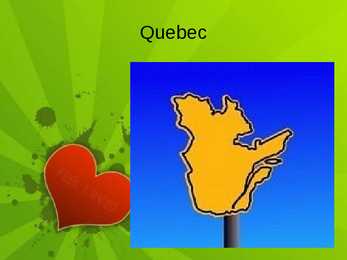
Quebec Quebec Province in east-central Canada. The only Canadian province with a predominantly French- speaking population. Largest province by area. second-largest administrative division. Bordes West by the province of Ontario, James Bay and Hudson Bay. North by Hudson Strait and Ungava Bay. East by the Gulf of Saint Lawrence, Newfoundland and Labrador and New Brunswick. South the U.S.A. Geography 90% of Quebec's territory lies within the Canadian Shield The Eastern Canadian forests cover the Appalachian Mountains Climate Most of central Quebec has a subarctic climate. Winters are long, very cold, and snowy. Summers are warm but very short. History At the time of first European contact and later colonization, Algonquian, Iroquoian and Inuit tribes were th
CANADA Canada is a vast country, second largest country of the world after Russia. It stretches from the Atlantic Ocean in the east to the Pacific Ocean in the west and to the Arctic Ocean in the North. Canada Covers most of the northern part of North America and its geography is very diverse. Canada's area is about 10 million square kilometers and its population is 31 000 000. Its capital is Ottowa and other main cities are Toronto, Montreal and Vancouver. Almost 75 % of canadians lives within 300 kilometer of the USA border, because the climate is softer in the South. 89 % of Canada is almost unhabited. Its official languages are English and French, but many other languages are spoken too. Like Italian, Chinese, German, Polish, Ukrainian, Dutch and Creek. There are also many native languages such as Algonquian. Most of the canadian's speak English (67 %), but French is very largely spoken too (26 % of the canadians).
Tallinna Inglise Kolledz Canada. The land of diversity. Tallinn 2006 Canada. If you had to use two words to describe Canada, they might be large and diverse. Canada is the second largest country in the world with a territory of about 10 million square kilometers and it is bordered by three oceans: the Arctic, the Pacific and the Atlantic Oceans. The population of Canada is about 31 million people. About 77% of the people live in cities which lie in a band about 100 miles wide above the border of the United States. The capital of Canada is Ottawa. Other large cities are Montreal, Toronto, Vancouver, Winnipeg and Quebec. Canada has two official languages English and French. It's interesting to know that about 61% of Canadians name English and 24% French their mother tongue. There are also many other languages spoken in Canada such as: Italian, Chinese, German, Polish, Ukrainian, Greek and Dutch. There are also many
Temperate deciduous forests, woodlands and shrub Tartu 2008 Location: Temperate forests are typical of all European continent, the Eastern region of Asia (in special, Chinese and Japan) and North America. Also are finded in tempered areas of South America. Climate: The average temperature in temperate forests is 50° F. Summers are mild, and average about 70° F, while winter temperatures are often well blow freezing. The average yearly precipitation is 30-60 inches. This precipitation falls throughout the year, but in the winter it falls as snow. There are four seasons in this biome, with warm summers and cold winters, often snowy. In autumn, the leaves change color and fall from the trees. The leaves decay on the forest floor, so the soil is very rich. Because of this, and because of the long growing season, many deciduous forests have been cut down for farming purposes. Plants: Trees of this biome include hardwoods such as maple, oak, hickory, and beech. There
 annaabi.ee






Kõik kommentaarid