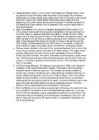
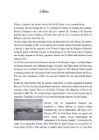
Tartu Hanseatic Days Tartu Hanseatic Days are celebrated every year from 17th to 19th July. For three days the Old Town of Tartu is filled with Hanseatic merchants and different workshops. People dress up in different medieval clothes and have a great time. The Hanseatic days are held so people could test their skills, learn more about their history and just have fun. Before the festival can start people set up tents and workshops in the Old Town. Some stalls are set up on the streets while others are located in the courtyards of historical buildings. People also make or buy costumes for the festival. Some dress up as simple peasants while others prefer to play merchants, soldiers and knights.
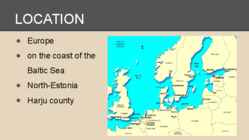
LOCATION ● Europe ● on the coast of the Baltic Sea ● North-Estonia ● Harju county FACTS ● capital city of Estonia ● largest city in Estonia ● population 435,000 ● area 156 km² ● previous name - Reval HISTORY ● first marked on the map in 1154 ● Danish rule started in 1219 ● 1285 - member of the Hanseatic League ● 1345 - Danes sold Tallinn to the Teutonic Order ATTRACTIONS ● Toompea Castle ● Old Town ● Town Hall ● Kadriorg - beautiful park ● City Centre - medieval churches, modern towers OLD TOWN ● listed in the UNESCO world heritage list ● built up from the 13th to 16th centuries ● old Hanseatic town ● surrounded by huge walls ● many towers, narrow streets TOWN HALL ● on the Town Hall Square ● built in 1402-1404 ● oldest in the Baltic region and Scandinavia
stayed here permanently. It is known that in 1154 the Arabian traveller and geographer Abu Abdallah Muhammed al-Idrisi serving the King of Sicily mentioned a river named Bernu. Embecke ("Emajõgi" in Estonian) is the same River Bernu referred to by al- Idrisi and later renamed as the River Pärnu. Pärnu's first period of prosperity was the time from the beginning of the 14th century up to the end of the 15th century while it was a port on the route to the Hanseatic City of Novgorod. 2. Attractions Places to visit: ● Rannapark (Beach Park) & Vallikäär ● Eliisabet Church was built 1747 and is now a popular location for concerts. It’s organ has a distinct, beautiful sound. ● Jekateriina Church is one of the most beautiful apostolic baroque churches in Estonia ● Tallinna Gates, also called as Kuningavärav (King’s Gates) is a part of former medieval
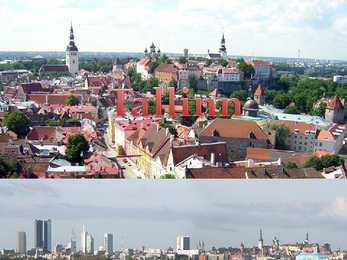
The Historic Centre (Old Town) of Tallinn is an exceptionally complete and well-preserved medieval northern European trading city on the coast of the Baltic Sea. The city developed as a significant centre of the Hanseatic League during the major period of activity of this great trading organization in the 13th-16th centuries. The combination of the upper town on the high limestone hill and the lower town at its foot with many church spires forms an expressive skyline that is visible from a great distance both from land and sea. The upper town (Toompea) with the castle and the cathedral has always been the administrative centre of the country, whereas the lower town preserves to a remarkable
Tallinn Old Town It was built up from the 13th to 16th centuries, when Tallinn was a thriving member of the Hanseatic trade league. It is built on a big hill and is surrounded with big walls. There is a lot of medieval style houses and inns, courtyards, churches and museums and a lot more. Many have described Tallinn Old Town as mystic and addictive. Unlike other capital cities in Europe, Tallinn has managed to preserve the completeness and structure of it's medieval and Hanseatic origin. Even after 7 centuries, Town Hall Square still remains as the social heart of the city and is hosting many concerts and fairs. Town Hall on Town Hall square is the only intact Gothic town hall in Northern Europe, now operates as a museum and concert hall.On top of the Town Hall tower, you will see a beloved guard of Tallinn Old Town Vana Toomas.One of the most impressive churches in Old Town is 15th and 16th century, St. Olaf's Church (Oleviste) with it's 159m high tower,
Mailis Kokla MT-09A Pärnu is a West-Estonian resort with well-established traditions that has held the title of summer capital and heart-warming town for over ten years. Pärnu is also a former Hanseatic town and it host the 30th International Hanseatic Days medieval festival in 2010. During the sunny summer period, the beautiful, sandy beaches invite people to come to Pärnu. Amazing nature, as attractive as the beach, can also be found throughout Pärnu County, which boasts a 242 km coastline. Tallinn Gate The so called Tallinn Gate used to mark the beginning of the postal road from Pärnu to Tallinn and was built during the Swedish period in the 17th century. The medieval fortification system of Pärnu was almost
TALLINN History Tallinn is one of the oldest cities in the Baltic Sea region. Tallinn was first mentioned in written sources of the 1154th, when the Arabian geographer Al Idris took a world map the city 'Kaleveny "/ Kolõvan. Through the years, the city of Tallinn had several names: Lindanisa, Kolõvan, Reval and eventually Tallinn. Tallinn was granted the Lübeck law in 1248 and became the member of the Hanseatic League in 1285. General Data l Country - Estonia l County - Harju County l First appeared on map - 1154 l Town rights - 1248 l Mayor - Edgar Savisaar l Aera - Total 159.2 km2 (61.5 sq mi) l Population - (1 Mar 2012) Total - 416,470 Denisty - 2,614.0/km2(6,766.6/sq mi) Tallinn Coat of arms Flag Top 5 Attractions 1. Kiek in de Kök Visitors to the museum will see examples of Medieval firepower,
OLDE HANSA OVERVIEW • OLDE HANSA WAS ESTABLISHED TO HONOUR THE HANSEATIC LEAGUE AND OUR FOREFATHERS AND FOREMOTHERS. • THEY HAVE DEDICATED THEMSELVES TO THIS TASK IN ORDER TO TAKE US - THE CUSTOMERS - ON A JOURNEY TO TALLINN'S GOLDEN AGE. • OLDE HANSA IS THE HOME OF A RICH MERCHANT. • HIS HOUSE IS BUILT IN A MANNER TO INCREASE THE ENJOYMENT OF THE HAPPY MOMENTS IN THE LIFE OF A HANSEATIC MERCHANT. LOCATION • OLDE HANSA IS LOCATED IN TALLINN'S OLD TOWN, ON THE ADDRESS VANA TURG 1, WHICH WOULD TRANSLATE TO "OLD MARKET". • THIS IS NEAR THE TALLINN'S OLD TOWN CENTRE, RAEKOJA PLATS (OR CENTRE). • IT'S A GREAT LOCATION, SINCE THE CENTRE IS A HUGE TOURIST ATTRACTION AND CONSECUTIVELY THE OLDE HANSA IS MORE THAN OFTEN VISITED BY PEOPLE WHO WOULD LIKE TO TRY ESTONIAN NATIONAL (OR JUST INTERESTING) CUISINES. SWEET ALMONDS OLDE HANSA IS ALSO FAMOUS FOR THEIR
Places to visit in Estonia Sten Maileht Otepää Adventure Park · Established in 2005 · 8 tracks 58 obstacles · Night adventure head torches Tallinn's Medieval Old Town · 1997 Unesco · Authentic hanseatic architecture · Town Hall Square · Outdoor cafes Piusa sand caves · 1922-1970 Cause of manual mining of class-sand · 1999 3000 · 1922-1970 under protection · potential falls Kaali field of meteorite craters · In Saaremaa · 7500-7600 years ago atomic bomm · Big crater diameter of 110 m and depth of 22 m and 8 smaller craters · World's giant craters Kaali crater is on 8th place Lahemaa National Park · oldest and largest national park
N U Pärnu is a seaside town. It is situated on the south-west coast of Estonia. It is a very popular holiday destination in summer. It's also situated between the sea and the Pärnu river. Pärnu was first mentioned in the 12th century, so it is older 700 years old. In the middle ages Pärnu was a very important trading centre. It was a member of the Hanseatic League. Pärnu became a resort town in the 1830s when a group of businessmen founded the first bathing establishment. Before that today's Beach Park's area was just wet pasture. In the 1930s Pärnu cecame especially popular with Finns, Swedes, Latvians and Lithuanians. In Soviet times, however, people from the west were not allowed to stay in Pärnu for the night. Pärnu's sanatoria were full of holiday-makers from the s.u.
Largest towns in Estonia Tallinn Tallinn is located at the coast of Gulf of Finland. Tallinn is the capital of Estonia. It is one of the best retained medieval European towns. The ,,Old Town" is located at the middle of the city and the Town Hall is the best-preserved Medieval town hall in Northern Europe. Tartu The university town, museum-rich and Hanseatic city of Tartu lies on the banks of the River Emajõgi. The capital of sothern Estonia is the second largest city in the country and the oldest in the Baltic States. Tartu is a modern city with a rich historical heritage and culture. One of Tartu ´s most important historical monuments is the St. John´s Church with it´s thousand terracotta sculptures. Narva As In the past, Narva remains a melting pot for nations, periods and cultures, old and new. This is what makes the town so special
Kiek in de Kök is an old German language nickname for towers, mainly those that formed parts of town fortifications. They gained the name from the ability of tower occupants to see into kitchens of nearby houses. Due to the history of the Hanseatic League and the Teutonic Order, also towers far outside modern Germany bear this name, like in Gdask and Tallinn. The tower in Tallinn is an artillery tower built in 1475.The walls are 4 m thick but the tower was then lower than today. The waterproof upper floor made of cobblestones was open and had 22 embrasures in its parapet. The parapet must have been covered by some kind of a roof but the middle part of the floor was uncovered to get the mortars and catapults in place better.
Tallinn The first traces of human settlement found in Tallinn's city center by archeologists are about 5000 years old. In 1050 the first fortress was built on Tallinn Toompea.[3] In 1285 the city became the northernmost member of the Hanseatic League. Medieval Tallinn enjoyed a strategic position at the crossroads of trade between Western and Northern Europe and Russia. On 24 February 1918, the Independence Manifesto was proclaimed in Tallinn, followed by Imperial German occupation and a war of independence with Russia. On 2 February 1920, the Tartu Peace Treaty was signed with Soviet Russia, wherein Russia acknowledged the independence of the Estonian Republic. Tallinn became the capital of an independent Estonia.
Tartumaa Tartumaa People began to live in Tartumaa about 5000 years ago. At the end of the first millennium in place Toomemäe in Tartu was Estonians castle. From 13 century, Tartu belonged to the Hanseatic League. Tartumaa´s flag. Tartu Tartu is the capital of Tartumaa. At first Tartu is associated with knowledge and studing. There`s about 103,284 peoples live in Tartu. Area of Tartu is about 38.8 km2. Mayor of Tartu is Urmas Kruuse. There`s 80% estonians, 15%
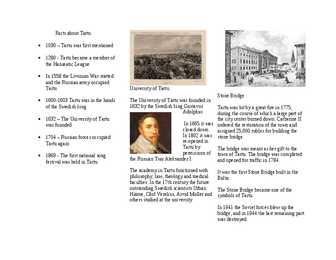
Facts about Tartu · 1030 Tartu was first mentioned · 1280 - Tartu became a member of the Hanseatic League · In 1558 the Livonian War started and the Russian army occupied Tartu University of Tartu Stone Bridge · 1600-1603 Tartu was in the hands The University of Tartu was founded in of the Swedish king 1632 by the Swedish king Gustavus Tartu was hit by a great fire in 1775,
What kind of city is Tallinn? What is it famous for? Old own The old City, city of Hanseatic sellers, was not an administrative part of a city (the Cathedral Hill) till the end of a XIX-th century. It was the centre of medieval marketing that has provided him well- being. Now it is the most popular place among tourists with shops and big variety of restaurants. It was opened 22 july 1718 year.Kadriorg it is the largest park in Tallinn.Kadriorg`s founder was the Peter I. He named the park in honour of his wife Ekaterine I. Y ou can walk around this beautiful park and
Europe. At the moment Supilinn is being rapidly renovated, undergoing a slow transformation from the historic slum into a prestigious highclass neighborhood. The active community embodied by the Supilinn Society is committed to preserving the heritage. Tartu's large student population means that it has a comparatively thriving nightlife, with many bars, restaurants, and nightclubs. Annually, in the summer, Tartu hosts the Hansa Days Festival (Estonian: Hansapäevad) to celebrate the Hanseatic heritage under the motto "History lives" when the old town bustles with activity from handicraft markets and historic workshops to a jousting tournament.
In the former dwelling house there is an exhibition reflecting the life and creative work of the writer. In summer different events take place; the openair theatre performances are especially popular. From the Museum hiking tracks lead into the countryside of Kõrvemaa. · Kõpu lighthouse is the most famous tourist sight of Hiiumaa, one could even say it is a symbol of the island; it is the third oldest working lighthouse. It is known that in 1490 the Hanseatic League requested the erection of a signal light. The completion date of the building of the lighthouse is considered to be 1531. The light of Kõpu can be seen for 35 nautical miles. It is possible to ascend to the top of the lighthouse.
music and the song became the unofficial Estonian national anthem that miraculously slipped by the Soviet censors. In 1969, more than a hundred thousand participants gathered for the century anniversary of a national song festival and, in a spontaneous act of nonviolent resistance, sang this song. For fifty years, it was a musical statement of every Estonian's desire for freedom. http://www.blogto.com/events/3626 Pärnu Hanseatic Days 2008 June 27th 28th Pärnu prepares for the International Hanseatic Days of 2010 by holding handicraft fairs every summer. Traditionally, the Hanseatic Days are declared open by the Mayor who leads the colourful procession from the City Hall to the field of Vallikäär. Among the traders there shall be a stage in the site of the fair, where both singers and actors shall perform. A knights' tournament and several dance shows shall take place. http://www.visitparnu.com/index.php
Old Town, a medieval walled city filled with old buildings and fortifications. The sheltered bay and the easily defended Toompea Hill made it a natural place to settle. Sometime about 1050 A.D. a fortress was built atop the hill, the first of many. In 1219 the Danes showed up as part of the Northern Crusade to subjugate the Baltics and convert the local pagans to Christianity whether they wanted to or not. The Danes improved the fortifications and expanded the town, which became part of the Hanseatic League, a trading organization of a hundred northern cities. The Danes sold Tallinn to the Livonan Order, a branch of the Teutonic Knights, in 1346. The Swedes came next in 1561. Tallinn weathered plague and the Great Northern War and became part of Russia in 1710. In 1918, Estonia declared independence from Russia and fought a bitter war against Bolshevik Russia. Independence didn’t last long, however, and the fledgling nation fell first to the Nazis and then the Soviets during World War II
Milestones in Estonian History The Estonians are a Finno-Ugric people who came from the area near the Urals and the Volga and Oka rivers. They migrated westward to the Baltic shores some 5, 000 years ago. In the ninth century A.D. Viking ships invaded Estonia and the country became a vital link in the sea-trade between East and West. By the 12th century, the Arabian geographer al-Idrisi had placed the city on his maps. In the 13th century, Tallinn joined the Hanseatic League, the union of European commercial towns that stretched from London to Novgorod. Pärnu, Viljandi and Tartu were also members. Estonia became a vital link in the sea-trade between East and West. The oldest preserved book written in Estonian, a catechism, dates from 1535. Tartu University was established in 1632, on orders from Sweden's King Gustav II Adolf. Literacy spread. The Bible was translated into Estonian in 1739(pole vaja teada).
Archaeological evidence of the first human settlement in Hiiumaa dates to as early as the 4th century BC. The first documented record of the island of Dageida was made by contemporary chroniclers in 1228, at the time when Hiiumaa, along with the rest of Estonia, had been conquered by Germanic Crusaders. In 1254, Hiiumaa was divided between the Bishoprick of Ösel-Wiek and the Livonian branch of the Teutonic order who were also partly acting on behalf of the Hanseatic league The island was part of Swedish Estonia from 15631720, after which it passed to the Russian as part of the Governorate of Estonia, although Dagö's Swedish population kept most of their privileges. Most of the island's previously numerous Swedish speaking population emigrated or were "Estonia" during the period of Imperial Russian rule, although a small minority remains to this day. Estonian Swedes are also known as "aibofolke"
In the middle of the 14th century Denmark sold its possessions in Estonia to the German Teutonic Order; Toompea became the seat of German-born gentry. A fortified wall was built between the Toompea (the Upper Town) and the Lower Town (inhabited by people of a lower social standing), as there were conflicts between the two. The doors and the gates of the wall were locked at night, a procedure which carried on until the end of the 19th century. Tallinn joined the German-dominated Hanseatic League in 1285 and became a junction of trade between East and West: furs, honey, leather and seal fat moved west, while salt, cloth, herring and wine moved 'in the opposite direction. As salt was an important trading commodity, Tallinn is said to have been built on it. Its geographical position was very favourable, with its wide bay protected by the two outlying islands of Aegna and Naissaar; it proved a suitable place for a large port. By the 12th century
(consistorium) and, considering the times, a huge warehouse (cellarium civitatis). Three walls and seven windows representing Tallinn's oldest secular architecture have come down to our days from that building. In the first quarter of the 14th century the existing building was extended and the basement enlarged. The so-called diele-dornse (front-back room) system was established. In 1346 the King of Denmark handed over his supremacy over Estonia to the Teutonic Order. As a member of the Hanseatic League, Tallinn gained control of trade with the East by the so-called goods yard right. Fast development of trade and economic prosperity led to the need for new utility rooms in the Town Hall and its more dignified appearance. In 137174 the Town Hall acquired its full present-day length and ground floor volume. From that time the Town Hall has its oldest and rarest pieces of medieval woodcarving: benches in the Gothic style
Tallinn`s first fortress was built in Toompea, in 1050. As an important port for trade between Russia and Scandinavia, it became a target for the expansion of the Teutonic Knights and the Kingdom of Denmark during the period of Northern Crusades in the beginning of the 13th century when Christianity was forcibly imposed on the local population. Danish rule of Tallinn and Northern Estonia started in 1219. In 1285 the city became the northernmost member of the Hanseatic League - a military alliance of German-dominated cities inNorthern Europe. The Danes sold Tallinn along with their other land possessions in northern Estonia to the Teutonic Knights in 1346. Medieval Tallinn enjoyed a strategic position at the crossroads of trade between Western and Northern Europe and Russia. The city, with a population of 8,000, was very well fortified with city walls and 66 defence towers.
town and the lake, start right from beside the Town Hall. There are five flights and 158 steps. Water Tower The old water-tower of Viljandi between the museum and Town Hall has been reconstructed now into an observation tower. Church spires and the Old Water Tower form a silhouette on the lake surface. The Water Tower offers a magnificent view of the whole town. Hanseatic merchants settled here as long ago as the 14th century. Due to its good location, varied nature and good connecting roads, Viljandi is an excellent place for trade, stopovers and living. Bridge When you walking along a footpath you will soon get to the famous suspension bridge. The first bridge in 1931 was a contribution to the town by the landlord of Tarvastu, Karl von Mensenkampff. The bridge is over 50 m long
today Tallinn is home for almost a third of Estonian's population. It covers an area of almost 160 sqkm. It is also an important economic and cultural centre and one of the main ports in the Baltic States. Tallinn was first mentioned in 1154 and the first inhabitants are believed to have come here 3500 years ago. They lived on the banks of the river Härjapea present-day Keldrimäe. Tallinn is one of the oldest cities on the Baltic Sea. In the 13th century Tallinn joined the Hanseatic League. It is unique for its well-preserved architecture from the 13-15 centuries. In 1980 Tallinn was awarded the European Gold Medal for preserving several architectural monuments. Old Tallinn is also famous for its cosy, romantic bars and cafes. Tallinn of today offers modern hotels, restaurants, sport and cultural centres. The town is also a well-known sailing centre. The yachting regatta of the 1980 Moscow Olympic games was held at Pirita.
a third of Estonian’s population. It covers an area of almost 160 sq kilometers. It is also an important economic and cultural centre and one of the main ports in the Baltic States. Tallinn was first mentioned in 1154 and the first inhabitants are believed to have come here 3500 years ago. They lived on the banks of the river Härjapea present- day Keldrimäe. Tallinn is one of the oldest cities on the Baltic Sea. In the 13 th century Tallinn joined the Hanseatic League. It is unique for its well-preserved architecture from the 13-15 centuries. In 1980 Tallinn was awarded the European Gold Medal for preserving several architectural monuments. Old Tallinn is also famous for its cosy, romantic bars and cafes. Tallinn of today offers modern hotels, restaurants, sport and cultural centres. The town is also a well-known sailing centre. The yachting regatta of the 1980 Moscow Olympic games was held at Pirita.
wikipedia.org/wiki/Tallinn Old Tallinn The Old Town can historically be divided into two distinct areas: Toompea Hill and the Lower Old Town, which were separated by a dividing wall since medieval times. The elevated area of Toompea Hill with its castle was occupied by the residences of Tallinn's rulers and gentry. The Lower Old Town meanwhile developed as an autonomous merchantile centre, flourishing during the 13th-16th centuries, when the city enjoyed membership of the powerful Hanseatic Trading League. Generally speaking these two districts are now collectively referred as the Old Town. The Town wall and towers Medieval fortresses, which emerged during the development of the medieval town at the end of the 13th century, surrounded the city centre as a closed defence zone. By the 16th century, Tallinn's defence system was one of the most powerful in Northern Europe. The city wall was three meters thick, sixteen meters high, and four kilometres long, completely
resold them to the Livonian Order. The Germans renamed Tallinn and called it Reval. Toompea became the seat of the German-born gentry. A fortified wall was built between Toompea (the Upper Town) and the Lower Town, as there were conflicts between the two. The Lower Town was the home of simple people, the artisans and the merchants. The doors and gates in the wall were locked at night. Tallinn joined the German-dominated Hanseatic League in 1285 and became a junction of trade between East and West: furs, honey, leather and seal fat moved west, while salt, cloth, herring and wine moved east. Its geographical position was very favourable, with its wide bay protected by the two outlying islands of Aegna and Naissaar for a large port. Tallinn developed along three lines: fortress, port and market town. Tallinn grew rapidly and had developed into a well-known trading centre by the 15th century. Unfortunately,
tourism.tallinn.ee/eng/fpage/explore/churches#!p_307 Old Town Twisting cobblestone lanes and iron street lamps. Gothic spires and medieval markets. Cappuccino and Wi-Fi. This is the city's famous Old Town. If you're looking for that mix of historic ambience and cutting-edge culture that defines Tallinn, you'll find it here. Built up from the 13th to 16th centuries, when Tallinn or Reval as it was known then was a thriving member of the Hanseatic trade league, this enclosed neighbourhood of colourful, gabled houses, half-hidden courtyards and grandiose churches is, quite rightly, the city's biggest tourist draw. And the fact that it's all neatly packaged within a mostly-intact city wall and dotted with guard towers gives it an extra dose of fairytale charm. http://www.tourism.tallinn.ee/eng/fpage/explore/attractions/old_town Kiek in de Kök
from various parts of northwest Germany (Saxons, Angles). Estonian in comparison is a language that has been spoken in the area of present day Estonia for more than 4000 years, Meri (1976). 4 First links Although written evidence of regular links between Estonia and England date back only into the beginning of the 20 th century, it is clear that there have been links also earlier. These contacts might be very old. During Hanseatic times the trade on the Baltic Sea was quite active. The links might be even older. Historians have claimed that already during the second Punic war in 218 BC a northern nation called Esths controlled the north south trade of furs. It is most likely that some furs also reached the area of present day England. Even more likely contacts between Estonia and England date back to the beginning of the second millennium AD. It has been widely acknowledged, that Estonians and
Estonia was christianised when the German "Livonian Brothers of the Sword" invaded southern Estonia as part of the Northern Crusades in the early 13th century. At the same time, Denmark attempted to take possession of northern Estonia. Estonia was consolidated under the two forces by 1227. Northern Estonia remained a possession of Denmark until 1346. Tallinn (known as Reval at the time) was given its Lübeck Rights in 1248 and joined the Hanseatic League at the end of the 13th century. In 1343, the people of northern Estonia and Saaremaa rebelled against the rule of the Germans in the St. George's Night Uprising, which was put down by 1344. There were unsuccessful Russian invasions in 1481 and 1558. After 1524, during the Protestant Reformation, Estonia converted to Lutheranism. Estonia regained its independence on August 20, 1991, with the Singing Revolution
the Danes and the German order of the Livonian Brothers of the Sword formed an alliance to conquer the pagan Estonian tribes. The Danes founded Reval (now Tallinn) in 1219 and introduced Christianity and Western European culture to Estonia. While Denmark took the northern part of Estonia, the knights occupied the southern portion. In 1346 the Danes sold their territory to the order, and Estonia remained under the rule of the knights and the Hanseatic merchants until the order's dissolution in 1561. Northern Estonia was then passed to Sweden, the rest was briefly held by Poland but was transferred to the Swedes by the Treaty of Altmark in1629. It ended the first Polish-Swedish war. German nobles--the Baltic barons--kept their sway over the Estonian peasantry until the eve of the 1917 Russian Revolution. Industrialization proceeded during the 19th century. The republic became heavily
white cross on it dropped down upon them from the heavens. This is allegedly how the Danes obtained their national flag, the Dannebrog in a battle against the Estonians. In the middle of the 14th century Denmark sold its possessions in Estonia to the German Teutonic Order. Toompea became the seat of the German-born gentry. A wall was built to separate the Upper Town and the Lower Town. In 1285 Tallinn joined the Hanseatic league and became a junction of trade between East and West. Tallinn is said to be built on salt, as it was an important trading commodity. In the 16th century Tallinn had a population of about 7,000 8,000 making it one of the biggest cities in northern Europe. In 1629 Sweden took control of the whole of Estonia. Though hard times continued, the period that followed is known as the "good old Swedish era": foundations were laid for
of Germany, who already possessed Livonia (southern Estonia and northern Latvia). The Teutonic Knights reduced the Estonians to serfdom. The Estonian capital city of Tallinn was founded by Danish and German crusaders and merchants. In the mid-fourteenth century the Danes sold their possessions in North Estonia to the Livonian Order a religious fraternity of German crusaders. In 1523 Tallinn became a member of the mercantile Hanseatic League. As a result of the long period of wars between Old Livonia, Russia, Sweden, Denmark and Poland, Sweden gained control of Estonia. The times under the Swedish crown between the Livonian War and the Northern War are remembered in Estonian folklore as the Good Old Swedish Times. Russia conquered Estonia in the Great Northern War (1700-1721). The Russians ruled for two centuries and after WW I, in 1918, Estonia declared its independence
altacapital.ee/ · BaltCap Management Ltd http://www.baltcap.com/ Kinnisvarainvestorid · Arco Balti Kinnisvarafond AS http://www.kinnisvarafond.ee/ · AS Eastern Europe Real Estate Investment Trust http://www.eereit.ee/ · Metro Capital Management AS http://www.metrocapital.eu/ · IPC Real Estate AS http://www.ipcinvestment.com/ Mezzanine Financing · BaltiAmeerika Ettevõtlusfond http://www.balaef.ee/ · Hanseatic Capital http://www.hanseaticcapital.net/ Muud investeerimisettevõtted · Worldwide Invest AS http://www.wwi.ee · Pakri Marine Investments AS http://www.pmigroup.ee/ · Kobe Investments AS http://www.kobeinvest.com
 annaabi.ee