 100 punkti
Autor soovib selle materjali allalaadimise eest saada 100 punkti.
100 punkti
Autor soovib selle materjali allalaadimise eest saada 100 punkti.
 ~ 4 lehte
Lehekülgede arv dokumendis
~ 4 lehte
Lehekülgede arv dokumendis
 2014-04-06
Kuupäev, millal dokument üles laeti
2014-04-06
Kuupäev, millal dokument üles laeti
 1 laadimist
Kokku alla laetud
1 laadimist
Kokku alla laetud
 0 arvamust
Teiste kasutajate poolt lisatud kommentaarid
0 arvamust
Teiste kasutajate poolt lisatud kommentaarid
 posike
Õppematerjali autor
posike
Õppematerjali autor
1. Ancient Britain: the Celtic tribes. 2000 years ago there was an Iron Age Celtic culture throughout the Br Isles. It seems that the Celts, who had been arriving from Europe from the 8th cent BC onward, intermingled with the peoples who were already there. The Celts were extremely talented people, creative and artistic. More than 1 Celtic tribe invaded Br. The descendants of ancient Celts live in Wales, Scotland, Cornwall and Ireland. They lived in primitive society. Druids priests, more powerful than chiefs. Acted like prophets. 2. Stonehenge From prehistoric period. Was built on Salisbury plain between 2500 and 1500 bc. One of the most famous and mysterious archaeological sites in the world. One of the mysteries is how it was built at all with the technology of the time
REVISION QUESTIONS 1. What do you know about Margaret Thatcher? Winston Churchill? Margaret Thatcher was the first female Prime Minister in Europe. She was a member of the conservative party. She died recently. Winston Churchill was the Prime Minister during WW II. He was excellent in making speeches, but he was a heavy drinker and also smoker. 2. What are the main countries of the UK and their capitals? There are 4: England with London as the capital; Wales with Cardiff as the capital; Scotland with Edinburgh as the capital; and Northern Ireland with Belfast as the capital. 3. What is Remembrance Day all about and why is it celebrated at that time? It is about the men (and women) who lost their lives fighting in the World Wars. It's celebrated then, because that's the day WWI was ended with a treaty. 4. Which powers does the Queen of the UK have? The Queen has to sign all the bills for them to pass
History exam *Stonehenge - is a monument located in England. It is one of the most famous prehistoric sites in the world and is composed of earthworks surrounding a circular setting of large standing stones. The surrounding circular, earth bank and ditch, have been dated to about 3100 BC. Stonehenge was produced by a culture with no written language. Many aspects of Stonehenge remain subject to debate. There is little or no direct evidence for the construction techniques used by the Stonehenge builders.
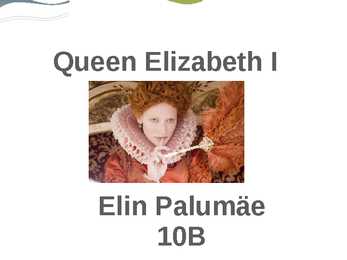
Queen Elizabeth I Elin Palumäe 10B Elizabeth I Reign - 17 Nov. 1558 24 March 1603 (44 years) Coronation - 15 January 1559(25 years) Predecessor - Mary I Successor - James I House - House of Tudor Father - Henry VIII Mother - Anne Boleyn Born - 7 September 1533 Greenwich, England Died - 24 March 1603 (aged 69) Burial - Westminster Abbey Anne Boleyn Queen consort of England Mother of Elizabeth I Tenure - 28 May 1533 17 May 1536 Coronation 1 June 1533 Anne Boleyn was Queen of England from 1533 to 1536 as the second wife of Henry VIII of England and the 1st Marquess of Pembroke in her own right for herself and her descendants. House - House of Tudor Father - Thomas Boleyn, 1st Earl of Wiltshire Mother - Lady Elizabeth Howard Born c.1501/1507 Blickling Hall/ Hever Castle, England Died 19 May 1536 (aged 29-35)Tower of London
lying. That means that the south and east on the whole have better agricultural conditions, and it is possible to harvest crops much earlier than in the north. So it is not surprising that south-east Britain has always been the most populated part of the island. For this reason it has always had the most political power. Protected by the Sea Britain is an island, and the sea has helped shape the character and history of the British people. More than once it has helped protect the island from invasion, and it has given the people a feeling of security. Since 1066, no enemy has crossed the Channel and invaded the country. 8 The Age of the Island Britain has not always been an island. It became one only after the end of the last ice age, by about 5000 BC. The temperature rose and the ice sheet melted, flooding the lower-lying land that is now under the North Sea and the English Channel
Outstanding figures in British literature Eva Martina Põder 11.b British literature Refers to all literature produced by British authors from the United Kingdom, which includes England, Scotland, Northern Ireland, Wales, the Channel Islands, and Isle of Man Includes early works written in Gaelic, Welsh, and Latin, works in Old, Middle, and Modern English, each of which represents a different period Full of great works British works in Latin Venerable Bede He lived between 673 and 735 AD The greatest of all the AngloSaxon scholars He's the earliest English historian, whose work has shed light on a period of English history that would have otherwise been unknown
The book includes maps of the house, the murder scene, and a drawing of a fragment of a will. The Mysterious Affair at Styles was adapted as a 103-minute drama and transmitted on ITV in the UK on Sunday September 16, 1990 as a special episode in their series AgathaChristie'sPoirotto celebrate the centenary of the author's birth. AGATHA CHRISTIE Agatha Christie was born Agatha May Clarissa Miller in Devon, in England in 1890, the youngest of three children. Her father died, when she was a child. At sixteen she was sent to school in Paris where she studied singing and piano. Christie was an accomplished pianist but her stage fright and shyness prevented her from pursuing a career in music. She never attended school. Dame Agatha Christie was an English crime writer of novels, short stories and plays. She also wrote romances under the name Mary Westmacott, but is best remembered for her 80 detective
four trips to the Caribbean and South America during the years 1492-1504. He discovered America in 1492. I Indian sun, they pray for fan. J we hate Jews, they are fools. K Bush is okey, because he is not gay. L Americans are large, they eat much. M Mc`Donalds is good, there is a lot of food. N is for Nigga who pulled the trigger. O is for Osama who wears pyjamas. P is for Pamela who likes camera. Puritans The Puritans were a group of people who grew discontent in the Church of England and worked towards religious, moral and societal reforms. The writings and ideas of John Calvin, a leader in the Reformation, gave rise to Protestantism and were pivotal to the Christian revolt. They contended that The Church of England had become a product of political struggles and man-made doctrines. The Puritans were one branch of dissenters who decided that the Church of England was beyond reform. Escaping persecution from church leadership
 annaabi.ee







Kõik kommentaarid