Leidsid 33 sarnast õppematerjali, mis on seotud failiga "Estonia". Need materjalid aitavad sul teemat sügavamalt mõista.
country, four, snow, known, thousand, forth, wall, president, eastern, europe, beside, baltic, finland, russia, latvia, sweden, surface, square, wide, around, rains, quite, often, spring, autumn, usually, sometimes, haven, even, summers, mostly, warm, amazing, countryside, mountains, islands, lakes, seeing, almost, parks, than, nature, best, thereEstonians have two personalities-a summer one and a winter one Estonia is a country in Eastern Europe. It's a small country beside the Baltic Sea. Our neighbours are Finland, Russia, Latvia and Sweden. Estonia's surface area is 45,227 square kilometres. The population of Estonia is around 1,3 million. We have four seasons in Estonia. The air is very humid and it rains quite often, especially in spring and autumn. We usually have long winters and plenty of snow, but sometimes we haven't even had snow. Summers are mostly warm and beautiful in Estonia. In winter our nation is mostly very passive, becouse it is quite cold in outside, we are like bears who sleep in winter, but we still go to school and work even if we are like so tired and don't wanna go out. Our winter is like too long and people are starting to miss summer,sun, beach and ice cream what you will eat in a hot summerday. It is quite sad becouse our summer is very short and winter is so long
Tallinn English College Topic Estonia Tallinn 2008 1. Introduction Estonia is a small country about the size of Switzerland, or New Hampshire and Massachussetts combined. Estonia is named after the people called "Ests" who lived in the region in the 1 st century AD. The Republic of Estonia is one of the three countries commonly known as the "Baltic States". The other Baltic States are Latvia and Lithuania. 2. Geographical position Estonia is situated in northeastern Europe. Estonia is bounded on the north by the Gulf of Finland, on the east by Russia, on the south by Latvia and on the west by the Baltic Sea. In the north it borders on Finland. The coastline of the Baltic Sea in Estonia is characterized by numerous gulfs and bays, the biggest of them being the Gulf of Finland, the Gulf of Riga and the Gulf of Pärnu
Estonia. Estonia, officially the Republic of Estonia is a country in Northern Europe. It is the smallest of the three Baltic countries. Estonia has land borders with Latvia (339 km) to the south and Russia (229 km) to the east. It is separated from Finland in the north by the narrow Gulf of Finland and from Sweden in the west by the Baltic Sea. Estonia has been a member of the European Union since May 1, 2004 and of the NATO since March 29, 2004. The area of Estonia is about 45000 square kilometres and the population is about 1.4 million people
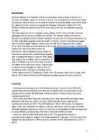
Estonia Topic Tallinn 2007 2 List of Contents page Facts and figures 3 Geography 3 Climate 3 Nature 4 History 5 Economy 6 Culture 6 Biggest towns 7 Language 8 3 Facts and figures The Republic of Estonia is a small country. Covering only 45, 228 sq km it is slightly bigger than Denmark, Belgium or Switzerland. Estonia's population is under 1.4 million. The official language is Estonian but since very many Russians live here Russian is also wide spread. The capital of Estonia is Tallinn. The currency used in Estonia is Eesti kroon. The Estonian national flag is blue-black-white. It was originally the flag of the Estonian Students' Society. The flag was first consecrated in Otepää Church in 1884. For a while,
ESTONIA ·Republic of Estonia is a country in Norhern Europe. Our president is Toomas Hendrik Ilves ·Territory of Estonia is 45,227 ( square kilometer) km² ·Population is 1.4 million. Estonia is one of the least-populous members of the European Union. ·The capital and largest city is Tallinn wich is in North-Estonia ·We are special because we have own language estonian ·Estonia is bordered to the north by the Gulf on Finland, to the west by the Baltic Sea, to the south by Latvia and to the east by Russian Federation
Tallinn 2007 FACTFILE Area: 45 228 sq km Poplulation: under 1.4 million Capital: Tallinn Language: Estonian Currency: Eesti kroon (EEK) Main religion: Lutheran National holiday: 24 February (anniversary of the republic) National flower: Cornflower National bird: Barn Swallow National stone: Limestone LOCATION The Republic of Estonia is the northernmost and smallest of the three Baltic States. It is located on the eastern shores of the Baltic Sea in the north east of Europe. To the east the country borders Russia. Latvia is the countries neighbour to the south. From the west the coast of Estonia is washed by the Baltic Sea and from the north by the Gulf of Finland. The length of the coastline is approximately 3 800 km. The longest distance from east to west is 350 km, while north to south Estonia stretches 240 km. THE NAME The name EESTI was apparently derived from the word AISTI, the
Võnnu Keskkool ESTONIA Referaat Autor: Klass : 9 Juhendaja: Võnnu 2013 Estonia officially the Republic of Estonia, is a state in the Baltic region of Northern Europe It is bordered to the north by the Gulf of Finland, to the west by the Baltic Sea, to the south by Latvia and to the east by Lake Peipus and Russia.Across the Baltic Sealies Sweden in the west and Finland in the north. The territory of Estonia covers 45,227km2 The Estonian climate resembles that of other countries on the Baltic littoral. On account of the country's proximity to the sea, the skies are often cloudy, and rain often falls in the spring and
Estonia lies on the eastern shores of the Baltic Sea on the level northwestern part of the rising east European platform. Estonia is a flat country covering 46 226 square kilometers.Estonian's neighbours are Finland, Sweden, Latvia and Russia. Estonia is rich in islands. The two largest are Saaremaa and Hiiumaa . Saaremaa is famous for its big meteorite crater called Kaali and Hiiumaa is famous for its nature and plants. The countries highest point Big Egg hill ( Suur- Munamägi) reaches 318 meters above sea level. Estonia has many uplands too. The uplands are: Pandivere upland, Otepää upland, Vooremaa upland, Karula
Latvia and in the east there lies Russian Federation. The territory of Estonia is 45,227 km 2 and it is divided into 15 counties. The capital and also the largest city in Estonia is Tallinn. The population is not large only 1.3 million people. The official language is Estonian. Although we have only few speakers in word terms, we are proud of our language which is considered to be one of the world's most beautiful ones. Estonia is an independent country, the government is parliamentary republic and the president of Estonia is Toomas-Hendrik Ilves. In Estonia, there are many places worth visiting. For example, the ruins of the Order Castle in Viljandi, national parks in Soomaa and definitely Old Tallinn and the University of Tartu. There is a spectacular landscape in Estonia, which offers outstanding natural beauty and tranquillity for forigners. There are many pastures and forests but there isn't much untouched and wild landscape
Holidays, Festivals, Cultural events TALLINN - If you're looking for entertainment in Estonia this summer, you are really spoiled for choice. Festivals and events dedicated to the consumption of beer are a lot of fun, but if you want to get the true feel of the country, you need something a little more ethnic. Like a town fair. Just as July becomes August, the seaside town of Haapsalu will host a grand spectacle of rural Estonian entertainment. The White Lady Days is a summer celebration filled with amusement for all the family. Held in and around the remains of the Teutonic-knights-era castles, the fair combines enchanting medieval legends with modern countryside charm to create a comprehensive experience of Estonia beyond the big cities.
Introduction Estonia, officially the Republic of Estonia (Estonian: Eesti or Eesti Vabariik) is a country in the Baltic region of Northern Europe. It is bordered to the north by Finland across the Gulf of Finland, to the west by Sweden across the Baltic Sea, to the south by Latvia (343 km), and to the east by the Russian Federation (338,6 km). The territory of Estonia covers 45,227 km² and is influenced by a temperate seasonal climate. The Estonians are a Finnic people closely related to the Finns, with the Estonian language sharing many similarities to Finnish. The modern name of Estonia is
The Republic of Estonia Estonia lies on the shores of the Baltic Sea. Its nearest neighbours are Finland, Sweden, Latvia and Russia. The total are of Estonia is 45,215 square kilometres. Estonia is one of the most sparsely populated countries in Europe. It has population neraly 1.4 million. There are lot of bays and peninsulas along the coast of Estonia.It has about 1,200 islands, the largest of which are Saaremaa and Hiiumaa. Nort-estonia is relatively flat and low-lying. There is a nice coastline here. Sout- estonia is hilly, but there are no high mountains in Estonia. The highest point is Suur-Munamägi, is only 318 meters above sea level. The largest industrial urban areas are in East-Estonia and there are
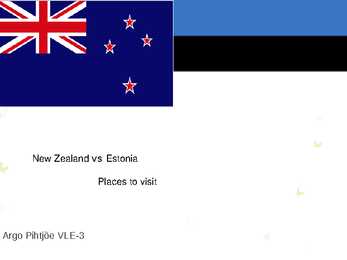
Zealands premier tourist destinations. The home of bungee jumping and jet boating. Queenstown is also one of the southern hemispheres premier skiing destinations Rotorua Famous for its volcanic activity. Every reserve has spectacular examples of geysers, boiling pools, hot springs, boiling mud, volcanic terraces, and craters. Mt Tarawera nearby volcano offers spectacular scenery including superb views inside the rim of the volcano Best area in the country to experience and learn about Maori Culture. Top ten places to visit in New Zealand Bay of Islands Bay of Islands is the finest maritime park in New Zealand. There are about 150 islands. The park has an abundance of marine life, including marlin, whales, penguins and dolphins. Mt Cook National Park Mt Cook and surrounding area is an alpine park within the South Westland World Heritage area. Mt Cook, Mt Tasman and Mt Sefton.
Estonia is a pretty small country in northern Europe. Estonia has land borders in the south with Latvia and in the east with Russia, it's oversea neighbours are Finland and Sweden. Estonia divided into fifteen counties. Estonia has been an independent country since 1991. Tallinn is the capital city of Estonia. It's not very large, there lives about 400 000 pedestrians. Estonia is a member of European Union and NATO. Estonia is a democratic republic and it's president is Toomas Hendrik Ilves. The territory of Estonia covers 45,227 km² and is influenced by a temperate seasonal climate. The surface there is mainly flat, but in the southern parts of Estonia it gets little bumpy. The official language of Estonia is Estonian, which is Finno-Ugric language and has many similarities with Finnish. The population of Estonia contains mainly Estonians but some Russians and other ethnicities too.
Then it was called Reval for some time and finally Estonians started to call the town Tallinn from Taanilinn (Danish town) after the Danish conquest in the 13th century. The Knights of the Sword took Tallinn from the Danes in 1227 and made Toompea their fortress. In the middle of the 14th century Denmark sold its possessions in Estonia to the German Teutonic Order; Toompea became the seat of German-born gentry. A fortified wall was built between the Toompea (the Upper Town) and the Lower Town (inhabited by people of a lower social standing), as there were conflicts between the two. The doors and the gates of the wall were locked at night, a procedure which carried on until the end of the 19th century. Tallinn joined the German-dominated Hanseatic League in 1285 and became a junction of trade between East and West: furs, honey, leather and seal fat moved west,
Estonia is located in the Northern Europe and is a state in the Baltic region It is bordered to the north by the Gulf of Finland, to the west by the Baltic Sea, to the south by Latvia, and to the east by Lake Peipus(Peipsi) and the Russian Federation.Estonia also has a number of islands: Saaremaa and Hiiumaa, which are the most known are also the two biggest ones.The territory of Estonia covers 45,227 km2. There is 3,794 kilometers of coastline marked by numerous bays, straits, and inlets. The Republic of Estonia is divided into fifteen counties: Hiiumaa, Saaremaa, Läänemaa, Harjumaa, Lääne-Virumaa, Ida-Virumaa, Tartumaa, Jõgevamaa, Järvamaa, Raplamaa, Viljandimaa, Pärnumaa, Valgamaa, Põlvamaa and Võrumaa. The capital city of estonia is Tallinn. Estonia is influenced by a temperate seasonal climate
Kunda Ühisgümnaasium Tallin Old Town Report Student: Kristin Karu Teacher: Kristi Aron Kunda 2012 The Alexander Nevsky Cathedral The Alexander Nevsky Cathedral is an orthodox cathedral in the Tallinn Old Town,Estonia. It was built to a design by Mikhail Preobrazhensky in a typical Russian Revivalstyle between 1894 and 1900, during the period when the country was part of theRussian Empire. The Alexander Nevsky Cathedral is Tallinn's largest and grandest orthodox cupola cathedral. It is dedicated to Saint Alexander Nevsky who in 1242 won the Battle of the Ice on Lake Peipus, in the territorial waters of present-day Estonia. The late Russian patriarch, Alexis II, started his priestly ministry in the church. Interior of the Cathedral. The Alexander Nevsky Cathedral crowns the hill of Toompea where the Estonian folk hero
even so much money that for the first time in history Estonian farmers became owners of mansions. The wealthy mulk were the first of Estonian farmers to build manses, until then the farmers all over Estonia lived in farmhouses that included a barn so that people and animals lived under one roof. The old farmhouses and mansions can still be seen in many places in Southern Viljandimaa. As a result of the hard work and the tenacity of the local inhabitants, Mulgimaa developed into an area known as prosperous and rich by its cultural heritage. The masters working in the villages played an important role in the development. The local foods such as sauerkraut stew, curd cake and ,,kama" (a meal made with sour milk and a mixture of ground grains) are popular even nowadays. There is even a song that says: "It is good to live in Mulgimaa / The nature is beautiful and the land is fructuous/ There are glorious groves and large wealthy Estonian farms". As for
Tallinna Inglise Kolledz Canada. The land of diversity. Tallinn 2006 Canada. If you had to use two words to describe Canada, they might be large and diverse. Canada is the second largest country in the world with a territory of about 10 million square kilometers and it is bordered by three oceans: the Arctic, the Pacific and the Atlantic Oceans. The population of Canada is about 31 million people. About 77% of the people live in cities which lie in a band about 100 miles wide above the border of the United States. The capital of Canada is Ottawa. Other large cities are Montreal, Toronto, Vancouver, Winnipeg and Quebec. Canada has two official languages English and French
One can't become an independent person without it. When time comes to enter a college a young Englishman chooses one far away from home. It is a necessary part of becoming adult. During the last 30 years there were a lot of different trends in youth movements. All of them were characterized by their own philosophy, way of life, style of dressing. Each tendency was born by the influence of economic and political changes in the society. Those trends are known as the "hippies" the "punks" the "rockers". But certainly there are different traditional youth organizations in Great Britain. Among them -- the Scout Association, the Girl Guides Association, the National Union of Students, the Youth Club. The latter offers, for example, a wide range of sporting and social activities. The National Union of Students was founded in 1922. It operates through local branches in colleges and universities. It promotes the educational, social and general
It is bordered to the north by the Finland, to the west by the Baltic Sea, to the south by Latvia (343 km), and to the east by lake Peipus and Russia (338.6 km). Across the Baltic Sea lies Sweden in the west and Finland in the north. Towns Tallinn is the capital and the largest city of Estonia. It lies on the northern coast of Estonia, along the Gulf of Finland. There are 33 cities and several town-parish towns in the country. In total, there are 47 linna, with "linn" in English meaning both "cities" and "towns". More than 70% of the population lives in towns. History • Estonia was settled near the end of the last glacial era, beginning from around 8500 BC. Before the German invasions in the 13th century proto-Estonians of the Ancient Estonia worshipped the spirits of nature. Since the Northern Crusades Estonia became a battleground for centuries where Denmark,
Introduction of Estonia The Republic of Estonia is beautiful country which is located in northeastern Europe, bordering the Baltic Sea on the west, the Gulf of Finland on the north, Latvia on the south, and Russia on the east. Estonia is the smallest of the Baltic countries. Administrative division: Estonia has an area of 45,226 square kilometers and Estonia is administratively divided into counties. There are 15 counties in Estonia. The capital is Tallinn which is located in Harjumaa. Counties are divided into 194 rural municipalities.
Estonia Estonia, officially the Republic of Estonia, is a state in the Baltic region of Northern Europe. It is bordered to the north by the Gulf of Finland, to the west by the Baltic Sea, to the south by Latvia, and to the east by Lake Peipus and Russia. Across the Baltic Sea lies Sweden in the west and Finland in the north. The territory of Estonia covers 45,227 km 2, and is influenced by a humid continental climate. The Estonians are a Finnic people, and the official language, Estonian, is a Finno-Ugric language closely related to Finnish, and distantly to Hungarian and to the Sami languages
..................................................................................................10 Introduction I chose finland because there are friendly people and beautiful nature. Finland is bigger than Estonia. There lives over 5 milj. people. Finland capital is Helsingi and there lives about 2 milj. people. Highest top is 1328m. Finland is bordersed with Sweden to the west, Russia to the east and Norway to the north. It is the eight largest city in Europe. Most Finns speak Finnish. The second language is Swedish. Finland is rated the sixth most peaceful country in the World. In Finland there are more than 60000 lakes. Capital: Helsinki Area: 338145km2 Population: 5200000 Language: Finnish, Swedish Currency: Euro (EUR) Goverment: Parliamentary republic
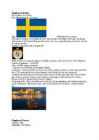
of Sweden of 1442. Symbols blackbird,male European elk Three Crowns is a national emblem of Sweden, present in the Coat of Arms of the Realm of Sweden. Population - 9,415,295 Size - 449,964 square kilometres Sweden is a world leader in a number of fields. Landscape - Traveling north, you'll pass by endless numbers of lakes, streams, pine and birch trees. The landscape becomes more dramatic, and rolling hills rise into mountains. Southern and central parts of the country have warm summers and cold winters, the northern part of the country has shorter, cooler summers and longer, colder and snowier winters. Famous for Pipi Longstocking by Astrid Lindgren Interesting facts - When you travel to Sweden you will see traditional red wooden farmhouses in the countryside. The famous colour, also known and loved in Estonia, is called Swedish red. Kingdom of Norway Capital Oslo Language Norwegian
Economic Country Review: Finland, Estonia and Hungary Girli Vasiljev Report Business Economics, RB1X 06.05.2012 Abstract 06.05.2012 Experience and Wellness management Author Group Girli Vasiljev RB1X Title of report Number of pages Economic Country Review: Finland, Estonia 20 and Hungary Teacher Kalevi Torunen The goal of this paper is to compare the economic performance of Finland, Estonia and Hungary. First, a general overview on the countries will be given. After, economic indicators (real GDP growth rate, inflation, unemployment, household consumption, investment, current account, government budget and deficit) of the three countries will be compared to draw a conclusion. Keywords
the north of Estonia in 1219. Legend has it that one day, when the Danes were about to lose a bloody battle, the sky suddenly opened and a red flag with a white cross on it dropped down upon them from the heaven. This is how the Danes obtained their national flag. In 1346 the Danish king sold his Estonian lands to the Teutonic Order, who a year later resold them to the Livonian Order. The Germans renamed Tallinn and called it Reval. Toompea became the seat of the German-born gentry. A fortified wall was built between Toompea (the Upper Town) and the Lower Town, as there were conflicts between the two. The Lower Town was the home of simple people, the artisans and the merchants. The doors and gates in the wall were locked at night. Tallinn joined the German-dominated Hanseatic League in 1285 and became a junction of trade between East and West: furs, honey, leather and seal fat moved west, while salt, cloth, herring and wine moved east. Its geographical position was very favourable, with
It is on almost the same latitude east St. Petersburg in Russia, Stockholm in Sweden and Stavanger in Norway, and covers 158 sq km. Tallinn was first marked on a map of the world by the Arab geographer al-Idrisi in 1154, its name then being Kolyvan (probably derived from the name Kalev). In the 13th-century Chronicle of Henricus de Lettis the town was called Lyndanise. Later came Reval (presumably after the old county of Rävala), the name used by the Germans who ruled the country for seven centuries. Russians then modified Reval to Revel. For Estonians, the town came to be called Tallinn from Taanilinn (Danish town) after Danish conquest in the 13th century. Over the course of time, Taanilinn was shortened to Tallinn The place is believed to have been settled by Finno-Ugric peoples about 2500 BC. The Danes, led by King Valdemar II, conquered northern Estonia in 1219. Legend has it that one
All EU members are devoted to peace, democracy, human rights respecting and working together to spread these values all the world. History The beginning of EU might consider the year 1951, when European Coal and Steel Community (ECSC) was constitute. Six countries joined with it for peace: Belgium, Netherlands, Luxembourg, Italy, France and Germany. With that move, coal and steel industry were put under one organisation, so war was almost impossible between these six country. Cooperation in different areas improved, when in 25. March 1957 Treaties of Rom , European Economic Community and European Atomic Energy Community memorandum of association were signed. These were sundry organisations. But they had one name- European Community. As the authorisations broaden, it become European Union in 1993. The European Union was formally established when the Maastricht Treaty came into force. In
Estonia Estonia is a small country in Northern Europe with an area of about 45 000 sq km. As a part of the East-European Plain, the country has a rather flat surface. The highest and most diverse region in Estonia is in the south-eastern part of the country. At 318 metres, Suur Munamägi is not only the highest point in Estonia, but of all the Baltic countries. There are about 1500 islands in Estonia, the biggest of which being Saaremaa and Hiiumaa. Sixty-four species of mammals have been recorded in Estonia, three of them have been introduced: the racoon dog, the American mink and the muskrat. A couple of species have been re-introduced The European beaver, who was hunted to extinction by the end of the 19th century
Poliitiliselt on Eesti demokraatlik vabariik. Eesti parlamenti kutsutakse riigikoguks ning presidendi valib rahvas. Eesti rahaühikuks on eesti kroon. Estonia is located on the east coast of Baltic Sea. The territory of Estonia covers 45,227 km² with a population of only 1,34 million, Estonia is one of the leastpopulous member of the European Union. Estonia is one of the more sparsely populated countries in Europe, only 35 people per square kilometers. Nearly the third of the population live in Tallinn, the capital of Estonia. There are many bays and islands located along the coastline of Estonia. There are great number of islands away from the west and north shore. The biggest of these are Saaremaa and Hiiumaa islands. Geagraphically Estonia can be devided into four: North, South, Western and Eastern Estonia. North Estonia is quite flat and low
Topic Australia Introduction Many people know Australia as the land down under because it is the only continent except for Antarctica that is all on the southern hemisphere. Its name means ,,Southland". The official name of the country is the Commonwealth of Australia. It's capital is Canberra. Australia is the sixth largest country in the world but the smallest continent. Australia has 6 states and 2 territories (New South Wales, Victoria, Tasmania, Queensland, Western Australia , South Australia, The Australian Capital Territory and the Northern Territory). The Australian people are culturally the same as the Anglo Americans. There also live aborigines. Aborigines are the ancestors of the people. Like the US and Canada, Australia was an English speaking colony of Great Britain. Today
Baltic Sea. The area features large bogs, extensive forests, coastal plains, warm and peaceful beaches, the lake Kaali with its mystical meteorite flight and a number of offshore islands. The islanders have their own customs, national costumes and speak their own local dialects. Thousands of birds visit Straitland areas during their spring and autumn migrations. Sights and Tourism Pärnu is the summer capital of Estonia. In summer, the population of forty-four thousand grows tenfold. Its beach, seaside parks, squirrels hopping in the trees, sanatoriums and rest homes, curative sea-mud and holidaymakers are its characteristic features. Pärnu as a summer resort dates back to the 19th century. The first bathing institution started operations in Pärnu in 1838. Pärnu also offers great year-round opportunities for organizing meetings and conferences in addition to relaxation and treatments for restoring one's health.
 annaabi.ee