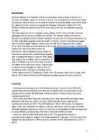
The Republic of Estonia is a country in Northern Europe. The territory of Estonia covers 45,227 km2 . Tallinn is the capital and largest city of Estonia.The city is an important industrial, political and cultural center, and seaport Estonia is a democratic parliamentary republic and is divided into fifteen counties. Estonia is one of the least-populous members of the European Union. Estonia lies in the northern part of the temperate climate zone Estonia has four seasons of near-equal length. The official language is Estonian.Võro and Seto in southern counties are spoken along with Estonian. The Estonian national flag is a tri-color- blue, black and white. The national currency is the Eestonian kroon. Estonia has over 1,400 lakes. Most are very small, with the largest, Lake Peipsi being 3,555 km² .There are many rivers in the country. The longest of them are Võhandu (162 km), Pärnu (144 km), and Põltsamaa (135 km).Estonia has numerous f...
The Republic of Estonia Estonia officially the Republic of Estonia is a country in the Baltic region of Northern Europe. It is bordered to the north by Finland across the Gulf of Finland, to the west by Sweden across the Baltic Sea, to the south by Latvia and to the east by the Russian Federation. The territory of Estonia covers 45,227 km² and is influenced by a temperate seasonal climate. Estonia is a democratic parliamentary republic and is divided into fifteen counties. The capital and largest city is Tallinn. With a population of only 1.4 million, it is one of the least- populous members of the European Union. Estonia was a member of the League of Nations from 22 September 1921, has been a member of the United Nations since 17 September 1991, of the European Union since 1 May 2004 and of NATO since 29 March 2004. Estonia has also signed the Kyoto protocol. Estonia regained its ind...
Estonian state system The Resolution of the National Independence of Estonia was adopted on August 20, 1991. The Constitution of Estonia is the fundamental law of the Republic of Estonia and it was adopted in June 1992. Estonia is a Democratic Parliamentary Republic where the supreme power is vested in the people. The head of State of Estonia is the President of the Republic who can be elected for two five-year terms. The Legislature. The Parliament of Estonia is called Riigikogu and it is elected by people for a four year term. The election is universal, uniform and direct. Voting is secret. The Riigikogu is comprised of one hundred and one members. The Riigikogu has three main functions: legislation, reviewing the activities of the executive power, representation. The members of the Riigikogu have the rights to form factions. The Executive. The Executive of Estonia consists of the body of the Prime Minister and cabinet of ministers. ...
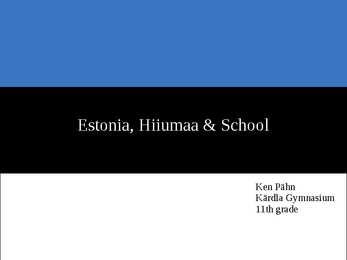
Estonia, Hiiumaa & School Ken Pähn Kärdla Gymnasium 11th grade Estonia Officialy the republic of Estonia Territory: 45 000 sq km Population: 1,3 million Capital: Tallinn 15 counties Language:Estonian Estonian Flag Coat of Arms Blue the blue sky above the native land. Black - the attachment to our black soil. White - hard work and purity. National emblems Barn swallow Corn flower National emblems limestone Estonia President: Toomas Hendrik European Union since 2004 Ilves Nato since 2004 Prime minster: Andrus Ansip United Nation since 1991 Democratic parliamentary republic Andrus Ansip Toomas Hendrik Il...
Estonia is a state in the Baltic region of Northern Europe. It is bordered to the north by the Gulf of Finland, to the west by the Baltic Sea, to the south by Latvia (343 km), and to the east by Lake Peipus and Russia (338.6 km). Across the Baltic Sea lies Sweden in the west and Finland in the north. The territory of Estonia covers 45,227 km2 (17,462 sq mi), and is influenced by a humid continental climate. The Estonians are a Finnic people, and the official language, Estonian, is a Finno-Ugric language closely related to Finnish, and distantly to Hungarian and to the Sami languages. Estonia is a democratic parliamentary republic divided into fifteen counties, with its capital and largest city being Tallinn. Estonia's population of 1.3 million makes it one of the least-populous member states of the European Union, Eurozone and the North Atlantic Treaty Organization. A developed country with an advanced, high-income economy, Estonia has ...
France République française facts Capital-Paris Language- french Area- 674,843 square km Population-65,447,375 President-Nicolas Sarkosy Location- Western Europe, bordered by the Mediterranean Sea (Vahemeri), Bay of Biscay and English Channel National symbol- Gallic Rooster(bird),Stylised Lily(flower) Motto-Liberté, égalité, fraternité(Liberty, Equality, Fratenity) Main Religions- Roman Catholicism Government Democratic parliamentary republic Other largest sities- Lyon, Marseille, and Lille National sport- soccer (jalgpall) France is special because... There is a lots of........ v Restaurants, brasseries or bistros v Variety food- (sheese- around 400 varieties, wines, chocolate mousse, crêpes, snails, croissants, creme brule) v Tourist attractions (Eiffel tower, Notre Dame, Disneyland, 3900 museums, 4400 cinemas, 38 879 historic monuments...
Estonia officially the Republic of Estonia, is a country in the Baltic region of Northern Europe. It is bordered to the north by the Gulf of Finland, to the west by the Baltic Sea, to the south by Latvia and to the east by Russia. Across the Baltic Sea lies Sweden in the west and Finland in the north. The territory of Estonia covers 45,227 km2, and is influenced by a humid continental climate. Estonia is a democratic parliamentary republic divided into fifteen counties, with its capital and largest city beingTallinn. With a population of 1.3 million, it is one of the least-populous member states of the European Union. The Estonians are a Finnic people, and the official language, Estonian, is a Finno-Ugric language closely related to Finnish The history of Estonia is a part of the history of Europe. Estonia was settled near the end of the last glacial era, beginning from around 8500 BC. Before the Germans invaded in the 13th century pro...
Kerli Uue 10.r The Republic of Estonia Estonia is a democratic parliamentary republic divided into 15 counties. The capital and largest city is Tallinn. Estonia's neighbours are Latvia, Russia and Finland. The parliment is named ,,The Riigikogu." The Estonian parliament has 101 members and influences the governing of the state primarily by determining the income and the expenses of the state. The Riigikogu elects and appoints several high officials of the state, including the President of the Republic. The Parliament of Estonia is elected by people for a four year term by proportional representation. The Government of Estonia is formed by the Prime Minister of Estonia, nominated by the president and approved by the parliament. The government exercises executive power pursuant to the Constitution of Estonia and the laws ...
Ireland is an island in the eastern part of the North Artic, directly west of the United Kingdom. Ireland is a sovereign, independent, democratic state with a parliamentary system of government. The President of Ireland is Mary Patricia McAleese. The total are of Ireland is about 81 squarekm and population is about 4 million, from children consive is 22%, workforce 67% and elder peole 11%. Religions are Roman Catholic, Church of Ireland, Presbyterian, methodist, Muslim, Jewish and the others. Ireland is a small, modern, trade-dependent economy with growth averaging 6%. Agriculture is one the most important sektor, is now dwarfed by undusrty and services. Ireland in the decade up to 2006 than any ohter developed world economy. Ireland jooned in circulating the euro in 1. January 2002 along with 11 other EU nations. The Irish Transport System Provides a nationwide coordianted road and rail system of publik transport for go...
Eesti Eesti laiub Läänemere idakaldal. Eesti kogupindala on ligikaudu 45 000 ruutkilomeetrit ja tema elanike arv on umbes 1,5 miljonit. Eesti on üks hõredamini asustatud riike Euroopas, ainult 35 inimest ruutkilomeetri kohta. Ligi kolmandik rahvastikust elab pealinnas Tallinnas. Piki Eesti rannajoont paikneb mitmeid lahtesid ja poolsaari. Lääne ja põhjakaldast eemal asuvad arvukad saared. Suurimad neist on Saaremaa ja Hiiumaa. Geograafiliselt saab Eestijagada neljaks : Põhja, lõuna, lääneja idaeestiks. PõhjaEesti on suhteliselt tasane ja madal. Siin on kena rannajoon abajate, neemede ja pankrannikuga. LõunaEesti on künklikum, kuid siin pole ühtegi mäge ega mäeahelikku. Eesti kõrgeim punkt SuurMunamägi on 318 m üle merepinna. Suurimad tööstuslinnakud asuvad IdaEestis. LääneEestis asuvad kaunid looduskaitsealad. Sisemaa on p...
Introduction Estonia, officially the Republic of Estonia (Estonian: Eesti or Eesti Vabariik) is a country in the Baltic region of Northern Europe. It is bordered to the north by Finland across the Gulf of Finland, to the west by Sweden across the Baltic Sea, to the south by Latvia (343 km), and to the east by the Russian Federation (338,6 km). The territory of Estonia covers 45,227 km² and is influenced by a temperate seasonal climate. The Estonians are a Finnic people closely related to the Finns, with the Estonian language sharing many similarities to Finnish. The modern name of Estonia is thought to originate from the Roman historian Tacitus, who in his book Germania (ca. AD 98) described a people called the Aestii. Similarly, ancient Scandinavian sagas refer to a land called Eistland, close to the German term Estland for the country. Early Latin and other ancient versions of the name are Estia and Hestia. Until the late 1930s, the ...
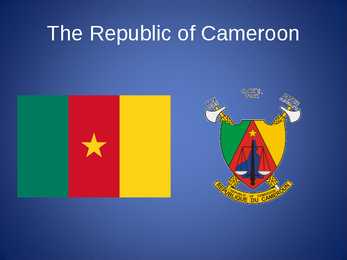
The Republic of Cameroon Cameroon · A unitary republic of central and western Africa · Bordered by Nigeria to the west; Chad to the northeast; the Central African Republic to the east; and Equatorial Guinea, Gabon, and the Republic of the Congo to the south. · Cameroon's coastline lies on the Bight of Bonny, part of the Gulf of Guinea and the Atlantic Ocean. · The country is called "Africa in miniature" for its geological and cultural diversity. History · The territory of present day Cameroon was first settled during the Neolithic · Portuguese sailors reached the coast in 1472 · The German Empire claimed the territory as the colony of Kamerun in 1884 and began a steady push inland. · An economic crisis took effect in the mid-1980s to late 1990s as a result of international economic conditions, drought, falling petroleum prices, and years of corruption, mismanagement, and ...
Tartu Kivilinna Grammar School Netherlands Report Composer: Reino Urbanovits Supervisors: Tiia Krass Erika Hunt Tartu, 2003 Table of contents Table of contents............................................................................................................................2 Introduction....................................................................................................................................3 Chapter 1........................................................................................................................................4 The Netherlands.............................................................................................................................4 Chapter 2.......
ESTONIAN BUSINESS ENVIRONMENT Estonia is a country with the population of just a little over 1.3 million people. It has been estimated though, that by the year of 2040 the number will have decreased by 125,000 people. It means that the population of Estonia is decreasing. As young Estonians often like to go study or live abroad, the population is aging as well – young people move away, while older stay there. Many different nationalities live there: besides Estonians there are Russians, Ukrainians, Belarussians, Finnish, Tatars, Latvians, Poles, Lithuanians, Jews, Germans and others. Due to this fact, the most popular languages spoken as a mother language are Estonian, Russian and Ukrainian. Nevertheless, there is still just one official language of Estonia, which is Estonian. Most of the people, approximately 900,000 live in the cities, such as Tallinn, Tartu, Narva. The most common sector that ...
HISTORY TEST 5 invasions to Britain until 1066 1) The Celts o Gaels in 600BC; Cymry(Britons) in 300BC o From present-day Austria, Switzerland o The Celtic language survives in the names of many places in England- Dover, Kent, Thames o The Celts are best known for their art- many bronze objects with elaborate designs; brooches; pins; mirrors; Celtic stone crosses o The Celts had 3 social orders: warriors, druids(priests) ordinary people 2) The Romans o (55 BC-Caesar) 43 AD- 410 AD- Claudius o From present-day Italy o Southern Britain became Britannia and was ruled by a roman governor o The Romans built over 20 towns: Colchester, Londinium, Winchester etc. They were good engineers and built roads and villas that had central heating, glass windows and mosaic floors ...
ERLE MAIDO TAAB11 Report Purpose The purpose of this report is to give an overview of Estonian population, political factors, technological factors, economic factors and the trends in Estonian economy compared to Germany and to briefly discuss Estonian business environment. Estonian population The total population of Estonia is 1 313 271 according to Statistics Estonia, of which 69.1% are Estonians, 25.1% Russians, 4.9% of which are of different nationalities for example Ukrainians, Belarusians and Finns. Rest are of unknown nationality. 68.5% of population speaks Estonian as a mother language, 29.6% speaks Russian as a mother language and 0.6% Ukrainian. Estonia has only one official language which is Estonian. Ac...
Fiji covers a total area of some 194,000 square kilometres (75,000 sq mi) of which around 10% is land. Fiji is the hub of the South West Pacific, midway between Vanuatu and the Kingdom of Tonga. The archipelago is located between 176° 53 east and 178° 12 west. The 180° meridian runs through Taveuni but the International Dateline is bent to give uniform time to all of the Fiji group. With the exception of Rotuma, the Fiji group lies between 15° 42 and 20° 02 south. Rotuma is located 400 kilometres north of the group, 670 km from Suva, 12° 30 south of the equator. Fiji consists of 322 islands (of which 106 are inhabited) and 522 smaller islets. The two most important islands are Viti Levu and Vanua Levu. The islands are mountainous, with peaks up to 1,300 metres (4,250 ft), and covered with thick tropical forests. Viti Levu hosts the capital city of Suva, and is home to nearly three quarters of the population. Other important towns incl...
khTallinn English College The United Kingdom Topic Mari-Liis Pakats Tallinn 2008 2 Table of Contents Introduction..................................................................................................................4 Geographical Position .................................................................................................4 History .........................................................................................................................4 Government..................................................................................................................5 Queen Victoria.............................................................................................................5 Relief...............................................................................................................................
European Union Exam 1949 France, UK and the Benelux countries decide to set in place a Council of Europe. 1951 Treaty of Paris signed by the Six (Belgium, France, Germany, Italy, Luxembourg, Netherlands), establishing the European Coal and Steel Community (ECSC). 1957 Treaties of Rome establish the European Economic Community (EEC) and the European Atomic Energy Community (Euratom). 1959 July, seven countries of the Organisation for European Economic Co- operation (OEEC) – Austria, Denmark, Norway, Portugal, Sweden, Switzerland and the UK – decide to establish a European Free Trade Association (EFTA). 1960 Creation of European Free Trade Association 1961 UK applies to join the Community. 1962 The Parliamentary Assembly changes its name to the European Parliament. 1965 The Treaty merging the executives of the three Communities (ECSC, EEC, Euratom) is signed in Brussels; enters into force on July 1, 1967. Empty chair crisis 1966 Luxembou...
Tallinn English College Topic Great Britain 2007 1. Introduction The official name of Great Britain is `the United Kingdom of Great Britain and Northern Ireland (or short United Kingdom)' The population is about 60.4 million. The capital is London. Other biggest cities include Birmingham, Bristol, Portsmouth, Glasgow and Swansea. English is the main language of Great Britain, but Welsh is officially recognized in Wales and Gaelic in Scotland. 2. Geographical position The British Isles is the geographical term for a group of about 5000 islands off the coast of mainland Europe. The largest island is Great Britain, which is also the largest island in Europe. It consists of England, Wales and Scotland. The next largest island is Ireland, which is made up of Northern Ireland and the Irish Republic. Britain and Northern Island together form the United Kingdom. When referring to Britain ...
1. Ancient Britain: the Celtic tribes. 2000 years ago there was an Iron Age Celtic culture throughout the Br Isles. It seems that the Celts, who had been arriving from Europe from the 8th cent BC onward, intermingled with the peoples who were already there. The Celts were extremely talented people, creative and artistic. More than 1 Celtic tribe invaded Br. The descendants of ancient Celts live in Wales, Scotland, Cornwall and Ireland. They lived in primitive society. Druids priests, more powerful than chiefs. Acted like prophets. 2. Stonehenge From prehistoric period. Was built on Salisbury plain between 2500 and 1500 bc. One of the most famous and mysterious archaeological sites in the world. One of the mysteries is how it was built at all with the technology of the time. Another is its purpose. It appears to function as a kind on astronomical clock and we know it was used by the Druids for ceremonies marking the passing ...
UNO SOOMERE ESTONIAN SYMPHONIC MUSIC. THE FIRST CENTURY 1896-1996. AN OVERVIEW With a Historical and Cultural Summary IN MEMORY OF THE GREAT ESTONIAN COMPOSERS CONTENTS ESTONIA AND THE ESTONIANS FOREWORD IN THE FOLD OF TSARIST RUSSIA. EMERGENCE AND FIRST STEPS ON THE CLASSICAL-ROMANTIC PATH. HISTORICAL INTRODUCTION I. MUSICAL LIFE IN TARTU AT THE TURN OF THE CENTURY. TRAILBLAZERS: ALEKSANDER LÄTE, RUDOLF TOBIAS, ARTUR KAPP. II. THE FIRST DECADE OF THE 20TH CENTURY. ARTUR LEMBA: THE BEGINNING OF ESTONIAN SYMPHONY AND OPERA. III. NEW DEVELOPMENTS IN CULTURAL AND MUSICAL LIFE: THE END OF THE TSARIST PERIOD. THE INDEPENDENT REPUBLIC OF ESTONIA: THE INTRODUCTION OF INNOVATIONS FROM WESTERN ART AND THE EVOLUTION OF NATIONALLY ORIENTED MUSICAL TRENDS. IV. THE TWENTIES. ARTUR KAPP: ROMANTICIST AND DRAMATIST. V. THE INFLUENCE OF NEW WESTERN MUSIC...
1 Mis on tarbimissotsioloogia? 1. Sissejuhatus Meie väike Eesti asub Lääne kultuuriruumis ja siin elades puutume me kokku meeletu hulga tarbekaupade ja äriteenustega ja tekstide või siis peenemalt öeldes diskursustega, mida identifitseeritakse kui tarbimiskultuuri või tarbimisühiskonda. Asjad ümbritsevad meid sünnist surmani: sünni puhul kingitakse meie vanematele igasuguseid asju, et oma rõõmu näidata, tihti on need asjad pehmed ja roosad. Kui me sureme, siis kingitakse meie lastele igasuguseid asju, et oma kurbust näidata, tihti on need asjad mustad, valged ning teravad - kaardid ja pärjad. Selles mõttes ei ole ju eriti suurt vahet, kui me võrdleme ennast ükskõik millise lääne kultuuri eelkäija-kultuuriga või traditsioonilise kultuuriga: avalikud ja eratseremooniatel kasutati ka väga palju erinevaid objekte, millel oli erinev tähendus. Sellele vaatamata on enamus tarbimiskultu...
 annaabi.ee