The Republic of South Africa History The Republic of South Africa is a country located at the southern tip of Africa, with a 2,798 kilometres coastline on the Atlantic and Indian Oceans. Modern humans have inhabited Southern Africa for more than 100,000 years. In 1652 the Dutch East India Company founded a refreshment station at what would become Cape Town. The discovery of diamonds and later gold triggered the conflict known as the Anglo-Boer War, as the Boers and the British fought for the control of the South African mineral wealth. Although the Boers were defeated, the British gave limited independence to South Africa in 1910 as a British dominion. South Africa contains some of the oldest archaeological sites in the world. Flag I flag After the Anglo-Boer War the English people desided to make British Union Flag a national flag of South Africa II flag The second flag was designed in 31 May 1928, becau...
Winston Churchill (1874 - 1965) Winston Leonard Spencer Churchill was born on 30 November 1874 at Blenheim Palace in Oxfordshire. His father was the prominent Tory politician, Lord Randolph Churchill. Churchill attended the Royal Military College, Sandhurst, before embarking on an army career. He saw action on the North West Frontier of India and in the Sudan. While working as a journalist during the Boer War he was captured and made a prisoner-of-war before escaping. In 1900, Churchill became Conservative member of parliament for Oldham. But he became disaffected with his party and in 1904 joined the Liberal Party. When the Liberals won the 1905 election, Churchill was appointed undersecretary at the Colonial Office. In 1908 he entered the Cabinet as president of the Board of Trade, becoming home secretary in 1910. The following year he became first lord of the Admiralty. He held this post in the first months of Worl...
Arthur Conan Doyle Life Arthur Conan Doyle was born on 22 May 1859, in Edinburgh, Scotland, to an English father, Charles Altamont Doyle, and an Irish mother, Mary Foley, who had married in 1855.] Although he is now referred to as "Conan Doyle", the origin of this compound surname is uncertain. Conan Doyle's father was an artist, as were his paternal uncles (one of whom was Richard Doyle), and his paternal grandfather John Doyle. Conan Doyle was sent to the Roman Catholic Jesuit preparatory school St. Mary's Hall, Stonyhurst, at the age of eight. He then went on to Stonyhurst College, but by the time he left the school in 1875, he had rejected Christianity to become an agnostic. From 1876 to 1881 he studied medicine at the University of Edinburgh, including a period working in the town of Aston (now a district of Birmingham). While studying, he also began writing short stories; his first published ...
RUDYARD KIPLING 1965-1936 * Was born in India, in Bombay * Father - an artist , a professor at Bobay art school * In 1871 - sent to England to school * He and his sister lived with family friends, often beaten * Found solace in books, literature, poetry * Suffered from a bad eyesight * Collection of poems "Schoolboy lyrics", at the age of 16 * 1881- after finishing school returned to India * 1882- 1889- a journalist in India and the USA * Collections stories, essays, articles . Department ditties (poetry) ; Barrack room ballads (poetry); The seven seas , The five nations * 1892- got married, travelled in America, Canada, Japan * 1896- came back to England and settled down in Sussex * 1894 - The Jungle Book * 1895 - The second jungle book * 1898 ...
Data of New Zealand. · Capital - Wellington. · Largest city - Aucland. · Official languages - English, Maori, NZ Sign Language. · Government - Constitutional monarchy . · - Head of State Queen Elizabeth II . · - Governor-General Anand Satyanand . · - Prime Minister Helen Clark . · Independence from the UK in September 26, 1907. · Area- 268 680 km². Water (%)2.1. · Population - 4,143,279 . · Currency New Zealand dollar. New Zealand geography. · New Zealand is a country in the southwestern Pacific Ocean. · New Zealand comprises two main islands . · NZ has got many smaller islands. · NZ is mountanious country. The highest peak is Aoraki/Mount Cook at 3754 meters. · NZ have an active volcano Mount Ruapehu. · The climate throughout the country is mild, mostly cool temperate to warm temperate, with temperatures rarely falling below 0°C (32°F) or rising above 30°C (86°F) · The climate in West is different from...
History of Great Britain Prehistory (55BC) no written records 6th 3rd c. BC the Celts came to British isles hill figures, hill forts, stone circles ( Stonehenge ) RomanBritain (55BC 400AD) Julius Caesar, named the country Albion Hadrian's Wall, villas, roads, the town of Bath The AngloSaxon, Danish and Norman invasions Germanic tribes settled and stayed Anglia Christianity was brought, religion became important, churches were built 8th century = raids by the Vikings and the Danes 1016 1042 : Under Danish rule ( York was the capital ) 1042 : local AngloSaxons regain their rule 1066 : Normans arrive ( the Norman conquest ) Medieval Britain (106615th c.) the Battle of Hastings William the Conqueror a new AngloNorman state the feudal system introduced the rule of the king and church strengthened centralised country, military rule Scotland, Wales and Ire...
History exam *Stonehenge - is a monument located in England. It is one of the most famous prehistoric sites in the world and is composed of earthworks surrounding a circular setting of large standing stones. The surrounding circular, earth bank and ditch, have been dated to about 3100 BC. Stonehenge was produced by a culture with no written language. Many aspects of Stonehenge remain subject to debate. There is little or no direct evidence for the construction techniques used by the Stonehenge builders. *The Celts in Britain and their legacy The Cets lived in Britain in The Iron Age. They were warring tribes who were battleful amongst themselves as well as inter-tribal war. They were not centrally governed. The Celts brought iron working, iron ploughs and metal swords, horses, wheels and chariots - all these things gave them an instant superiority over the native tribes. The Celts built a number ...
1) General facts The UK: * the United Kingdom of Great Britain and Northern Ireland was formed in 1801 * it covers 243,610 sq km * everybody from the UK is called British * the capital city is London * is made up of four constituent countries: England, Scotland, Wales and Northern Ireland which in turn are divided into counties * the flag is called the Union Jack which is a combination of the flags of England, Scotland and Northern Ireland * the population is about 60,000,000 people, the population density is 242 people/sq km * its coasts are washed by the Atlantic Ocean, the North Sea, the English Channel, the Celtic Sea, Saint George's Channel, and the Irish Sea. It is linked to France by the Channel Tunnel * the United Kingdom is a constitutional monarchy. The current monarch is Queen Elizabeth II, who is also the Queen and Head of State of fifteen other Commonwealth Realms, such as Can...
Britain History Pre-Norman Britain The Iberians brought their metal-working skills and the first real civilization to Britain in the third millennium B.C and were overrun by various Celtic invasions that began in the 8th century. The Celts introduced their tribal organization and an early form of agriculture before they were forced westward by the Roman invasion. Forms of Celtic language are still spoken in Britain. Romans (with Julius Caesar in the head of them) first tried to occupy Britain in 55 B.C., but there was a rebellion in Gaul so they had to leave to fight against it. Next time they came in 43 A.D. and their leader was Emperor Claudius. Romans brought a lot with them. Their brought paved roads, the sites of important cities, the seeds of Christianity, the Roman law, Roman baths, language and advanced civilization. They also built Hadrian's Wall in 122 A.D. Romans occupied...
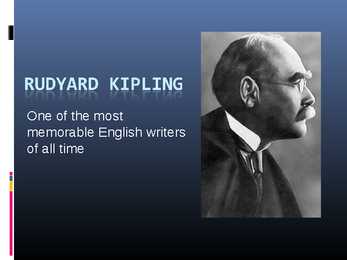
One of the most memorable English writers of all time Family of Joseph Rudyard Kipling Mother Alice MacDonald Kipling Father John Lockwood Kipling Sister Alice Kipling Fleming Early Life 30 December 1865 in Bombay, in British India Captain and Mrs. Holloway - Lorne Lodge Paradise at Aunt Georgie's and her husband 1878 - admitted to the United Services College Bombay in 1865 Travels & First writings 1883 - visited Simla thirty-nine stories appeared in the Gazette included in Plain Tales from the Hills Kipling's first prose collection 1887 Allahabad in the United Provinces published six collections of short stories 1889 sold the rights to his six volumes of stories Life London published a novel - The Light that Failed and on the 18 January 1892 Carrie Balestier (29) and Rudyard Kipling (26) were married in London United States didn't find a country that lived up to his expecta...
Stonehenge One of the best known ancient wonders of the world, 5000 years old Megalith monument, built by western mediterraneans during 3000-1600 BC Circular structure, large standing stones, aligned with rising sun at teh solstice Attlers and bones were sued to dig pits that hold the stones The Celts in Britain and their legacy 700-200 BC celts invade Britain Gaels or Goehls(Ireland and Scotland),Cymri(Wales) and Brythons(gave name to Brittany) Fierce fighters,superb horsemen.Most of them farmers, lived in thatched houses Good at art, craftmanship, used iron Divided into tribes, ruled by kings, only in face of danger would they choose a single leader Legacy- hill-forts, farms, churches, field system, woodland, pasture, weapons, iron objects, langugae, culture Caesar in Britain The great Roman Emperor Firts came 55 BC to gather information, celts ...
The Adventures of Sherlock Holmes By Arthur Conan Doyle Sveta Kostina Arthur Conan Doyle was born in Edinburgh on 22nd May 1859. he studied medicine at the University of Edinburgh medical practice at Bush Villas in Elm Grove, Southsea good at sport two wives: Louisa (or Louise) Hawkins and Jean Elizabeth Leckie five childrens: two with his first wife and three with his second wife studied the eye in Vienna; practice as an ophthalmologist died of his heart attack, aged 71, on 7th July 1930 Arthur Conan Doyle Bibliography A Study in Scarlet (1887) The Sign of Four (1890) The Adventures of Sherlock Holmes (1892) The Memoirs of Sherlock Holmes (1894) The Hound of the Baskervilles (1902) The Return of Sherlock Holmes (1904) The Valley of Fear (1915) His Last Bow (1917) The Case-Book of Sherlock Holmes (19...
Kadri Laur PRG 11B. 26.05.07 Queen Victoria and Victorian England (Queen Victoria is supposed to have said this as a 10-year-old girl on learning that she was likely to become queen in the future: I will be good.) VICTORIA (r. 1837-1901) Victoria was born at Kensington Palace, London, on 24 May 1819. She was the only daughter of Edward, Duke of Kent. The Duke and Duchess of Kent selected the name Victoria but her uncle, George IV, insisted that she be named Alexandrina after her godfather, Tsar Alexander II of Russia. Edward died when Victoria was eight months old, upon which her mother enacted a strict regimen that shunned the courts of Victoria's uncles, George IV and William IV. Father ...
hot.ee/zolki/Churchill/Churchill.html · http://www.miksike.ee/documents/main/referaadid/winston_churchill.htm · http://www.raamatukoi.ee/cgi-bin/raamat?61209 · http://en.wikipedia.org/wiki/Blood,_toil,_tears,_and_sweat · http://en.wikipedia.org/wiki/Lord_Randolph_Churchill · et.wikiquote.org/wiki/Winston_Churchill · Google.com pildiotsing · http://www.dailymail.co.uk/news/article-2094822/Photo-Winston-Churchill- horseback-daring-Boer-War-prison-camp-escape-auction.html · http://www.world-war-2-diaries.com/winston-churchill-photos.html · http://www.world-war-2-diaries.com/winston-churchill-timeline.html (Sealt on osa materjali inglise keelest tõlgitud) 11
Rudyard Kipling - One of the most memorable English writers of all time Family of Joseph Rudyard Kipling Mother- Alice MacDonald Kipling. Alice Kipling (one of four remarkable Victorian sisters) was a vivacious woman about whom a future Viceroy of India would say, "Dullness and Mrs. Kipling cannot exist in the same room."[3] Father - John Lockwood Kipling. Lockwood Kipling, a sculptor, an illustrator, museum curator and pottery designer, was the principal and professor of architectural sculpture at the newly- founded Sir Jamsetjee Jeejeebhoy School of Art and Industry in Bombay. Later in life Kipling illustrated many of Rudyard Kipling's books, and other works. Kipling also remained editor of the Journal of Indian Art and Industry, which carried drawing works from the students of the Mayo School. COUPLE named their son after the place they had first met Rudyard Lake. Alice Kipling Fleming - Sister of British author Rudyard Kipling w...
Outstanding figures in British literature Eva Martina Põder 11.b British literature Refers to all literature produced by British authors from the United Kingdom, which includes England, Scotland, Northern Ireland, Wales, the Channel Islands, and Isle of Man Includes early works written in Gaelic, Welsh, and Latin, works in Old, Middle, and Modern English, each of which represents a different period Full of great works British works in Latin Venerable Bede He lived between 673 and 735 AD The greatest of all the AngloSaxon scholars He's the earliest English historian, whose work has shed light on a period of English history that would have otherwise been unknown ,,The Father of English History" Wrote / translated about 40 books on almost every area of knowledge, i.e. nature, astronomy, and poetry His best known work is "The Ecclesiastical History of the English People" Starting with the Roman invasion in the 5th century, he...
Kordamisküsimused. 1. Tööstuslik revolutsioon ja tööstusühiskond. Tekke põhjused, olemus, mõju ühiskonna arengule. Tähtsaimad 19. s leiutised ja nende tähtsus. Tööstusliku revolutsiooni olemus 18. sajandil leidsid aset põhjalikud muutused tehnoloogilises arengus. 1 põhjus: Uute kaupade toomisel hakati inimese töö asemel senisest enam kasutama masinaid. 2. põhjus: Seni tootmise veduriks olnud manufaktuurid hakkasid järg-järgult asenduma vabrikutega. See murranguline pööre tootmises kujuneski tööstusrevolutsiooni aluseks. Lisaks masinatele oli tootmise uuendamiseks vaja raha ning inimesi, kes masinatega tööle hakkaksid. Tootmise uuendamiseks oli vaja ka raha ning inimesi. Ühtlasi hakkasid vabrikute- ettevõtete omanikud järjest enam huvi tundma ka uute tehniliste leiutiste vastu ning nende väljatöötamist vähemalt osaliselt rahastama. Üleminek vabrikutootmisele nõudis hulgaliselt tööjõudu, mida saadi enamasti maalt. Ühiskonna tehn...
Some of the things you will learn in THE CODEBREAKERS • How secret Japanese messages were decoded in Washington hours before Pearl Harbor. • How German codebreakers helped usher in the Russian Revolution. • How John F. Kennedy escaped capture in the Pacific because the Japanese failed to solve a simple cipher. • How codebreaking determined a presidential election, convicted an underworld syndicate head, won the battle of Midway, led to cruel Allied defeats in North Africa, and broke up a vast Nazi spy ring. • How one American became the world's most famous codebreaker, and another became the world's greatest. • How codes and codebreakers operate today within the secret agencies of the U.S. and Russia. • And incredibly much more. "For many evenings of gripping reading, no better choice can be made than this book." —Christian Science Monitor THE ...
 annaabi.ee