[2] Rosewarne argued that it may eventually replace RP (Received Pronunciation) in the south-east. Studies have indicated that Estuary English is not a single coherent form of English; rather, the reality behind the construct consists of some (but not all) phonetic features of working-class London speech spreading at various rates socially into middle-class speech and geographically into other accents of south-eastern England.[3][4] Rosewarne (1984) states that "the heartland of this variety lies by the banks of the Thames and its estuary". However, in the name itself the Thames is not mentioned. This seems to have irritated some of the academics, who willingly displayed their reluctance to the term. In his posting to the Linguist List, for instance, Battarbee (1996) talks of "... regional arrogance of the SouthEast within the UK: it takes for granted that 'Estuary' means the Thames Estuary
Pray, free Swiss, Gott im hehren Vaterland! Au ciel montent in favor del Mia olma senta Pray, Gott, den Herrn, im hehren plus joyeux patrio suol, ferm, For you feel and Vaterland! Au ciel montent in favor del Mia olma senta understand, plus joyeux patrio suol, ferm, For you feel and Les accents cittadino Dio Dieu en tschiel, understand, d'un coeur lo vuol, il bab etern. That he dwelleth pieux, cittadino Dio, Dieu en tschiel, in this land. Les accents si Dio lo il bab etern. That he dwelleth émus d'un coeur vuol. in this land. pieux. 2
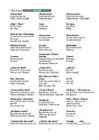
parisien soir sei tout rate asser ser souar trouver trouaer dégoter trobar trobar se capito garçon gâs coco/garchon dròlle/gojat gojat garcoun boire liquaer tuter/baller béver/beure/ Pintar/béve béure béguer r L'accent parisien domine aujourd'hui les autres accents. Le France ont eu beaucoup de colonies. L'époque coloniale a commencé sous Roi-Soleil, au 17 siècle au Canada. Les pluparts des colonies étaient en Afrique. Encore les colonies étaient en Asie. Dernière colonie de France, Algérie gagné son indépendance en 1962 DOP: La Guadeloupe, La Martinique, La Guyane (dite française), La Réunion Les quatre départements d'outre-mer sont d'anciennes colonies. Les personnes originaires des DOM ou y habitant sont dits les Domien.
These cars just radiate AUTHORITY. In fact, workers spend 5 hours polishing the front grille alone to make it stand out. One of the most beautiful features is The Spirit of Ecstasy. It is shaped in form of a woman leaning forward with her arms outstretched behind and above her. Billowing cloth runs from her arms to her back, resembling wings. It can even be covered in gold. All Rolls Royce automobiles have leather interiors with wood or metal accents. Their model Phantom, for instance, takes 9 Bavarian bull hides to cover the whole interior. Because of its long history, Rolls Royce has produced many different models. Currently it has 2 models, Phantom and Ghost in production with different variations. Most mentionable variations are the extended wheelbase version, which is meant for people, who need even more space to feel more comfortable and isolated from the road. It is preferred car by celebrities
and a smile are appropriate. * English is the spoken language at business meetings. However, stick with standard terms; do not experiment with Australian terms. * Popular welcome topics include the weather, sports, anything related to Australia in a positive way is a good conversation starter. * Topics to avoid –religion and politics - unless the Australian counterpart brings it up. Do not get into immigration and aboriginal issues no matter how curious you are. Also, comments on accents will not be welcome, as they often distinguish social classes. Business meetings and meals *Regarding dress code, men should wear a dark coloured, conservative business suit. *Similarly, women should wear a smart dress or a business suit. *Punctuality is important, it better to arrive a few minutes early. *Offering gifts is not part of Australian business etiquette, but it is acceptable to bring a small gift from your country. *Table manners are same as in Europe.
Used natively by only 3-5% of the population of England. RP has a large number of diphthongs and not a particularly close relationship to English orthography. RP is a social accent, rather than regional, and is associated particularly with the upper-middle and upper classes. Some features: · The /i:/ of bee, rather than the // of be, occurs in the final syllable of very, many, etc. · The vowel // in unstressed syllables (in RP) often corresponds to // (in near-RP accents). · The consonant /t/ may be realized as a glottal stop [?]. · Most EngEng accents have lost the original contrast. · Some English accents are ,,rhotic" or ,,r-ful" and others are ,,non-rhotic" or ,,r-less". 3. Estuary English - a dialect of English widely spoken in South East England. IT is commong among young Londoners. Something between RP and Cockney. Some features: · Non-rhotic · They use intrusive / r / · They use the broad / a: / sound
A.S.L.A. National Honour auhind (Ta on võitnud rahvusvahelise tunnustuse oma disainiga, ta on olnud õpetaja ja autor. Seda antakse maastikuarhitektile, kelle elu saavutused ja panused on olnud ainulaadsed ning neil on kauakestev mõju elanikkonnale ja keskkonnale.[3] ) Interiors 13th Annual Awards Gold Medal, Second Biennial of Mexican Architecture Award for Design Excellence, Print Casebooks 9 Southern Accents Award A.S.L.A. Merit Award Solana Arrivals Garden and Village Centre Eleventh North American Prairie Conference Landscape Design Award[2] 5 [11] [12] 6 [13] [14] [15] 7 Kasutatud kirjandus [1] http://en.wikipedia.org/wiki/Peter_Walker_(architect) [2] http://www.archidude
people say they don't approve of class divisions. An interesting part of the class system is that it has little to do with wealth. Of course wealth is part of it but it's not always possible to look at the people and say in which class the person belongs. The first sign is the way a person talks. People from different social classes eat different food at different times of day, they like to talk about different topics using different styles and accents of English, they enjoy different sports, they have different values about what things are most important in life and different ideas about the correct way to behave. 10. Standard English is used `naturally' in everyday speech by between 15% and 30% of the population in Britain. Received Pronunciation (RP) is used in everyday speech by only 3% to 12% of the population. So why is Standard English with an RP accent the usual
Gaelic. Less than a quarter of all Welsh people speak Welsh. Scottish Gaelic and Irish Gaelic are still spoken, although they have suffered more than Welsh from the spread of English. However, all three languages are now officially encouraged and taught in schools. Nowadays all Welsh, Scottish and Irish people speak English (even if they speak their own language as well), but all the countries have their own special accents and dialects, and their people are easily recognizable as soon as they speak. A southern English accent is usually taught to foreigners as it is the most easily understood. Regional movements of people For over a century there has been a drift of people from the north and west to the south-east of England. Some of the major reasons for this movement are listed here. 48. A decline in the farming workforce and rural population (rural depopulation). 49
In addition, for effective speechmaking, avoid the monotone voice (particularly Estonians!). · When we want to convey something very important and serious, we all tend to talk in a lower tone (and, inciden tally, at a slower pace.) · In ordinary conversation, we speak in the midrange between bass and treble. · And when we are excited or a little silly, our voices creep up to the higher range. Accents Do Southerners or "New Yorkers" have an advantage or disadvantage? Rush's rule for answering that question is as follows: " . . . I don't mess with it unless the accent will hurt another person's credibility or render him unintelligible. For example, when someone with a downhome accent tries to sell stocks in a metropolitan area, the accent might not help." Laughter This may surprise you, but as a speaker don't be afraid to laugh, where and when appropriate. Laughter is a wonderful sound
perpendicular to the thrust lines of the arch. Though built on soft alluvial soils, the bridge continues to support a street of jewellery shops enjoyed by tourists four centuries later. The end of the Italian Renaissance witnessed a new vision of bridge construction. More than merely utilitarian, bridges were designed as elegant, grand passage-ways that were part of the visual perspective of the idealized cityscape - major accents to the totally redesigned merchant and capital cities. No country attempted to advance this concept more than France at the end of the 16th century, where a national transportation department of architects and engineers was set up, responsible for designing bridges and roads (Ponts et Chaussées). This corps of specialists gave the Neo-Classical period a range of monumental and elegant bridges on rivers as the Loire (Blois, Orléans, Saumur) and the Seine in Paris
Stress: Just as in English, Spanish stresses a certain syllable in a word. If a word ends in a consonant, except s or n, the stress is on the last syllable. If a word ends in a vowel, or s or n, the stress is on the second-to-last syllable. For words that do no follow these rules, an accent is written over the vowel so that you will know to stress that syllable, as in el pájaro (bird). Please keep in mind that because Spanish is spoken in many countries, there are several regional dialects and accents so pronunciation rules may not apply to all countries. This tutorial is mostly concerned with the language that is spoken in Mexico and Spain. 3. Alphabet a ah j hoh-tah r air-ay b bay k kah rr airr-ay c say l ay-lay s ay-say ch chay ll ay-yay t tay
now I still felt like a fraudulent New Yorker. I had the address and the job, but I was still wary of the subway and had trouble hailing cabs. I tried not to walk around wide-eyed and distracted, but it was hard. There was just so much to see and experience. The sensory input was astonishing-the smell of vehicle exhaust mixed with food from vendor carts, the shouts of hawkers blended with music from street entertainers, the awe-inspiring range of faces and styles and accents, the gorgeous architectural wonders...And the cars. Jesus Christ. The frenetic flow of tightly packed cars was unlike anything I'd ever seen anywhere. There was always an ambulance, patrol car, or fire engine trying to part the flood of yellow taxis with the electronic wail of ear-splitting sirens. I was in awe of the lumbering garbage trucks that navigated tiny one-way streets and the package delivery drivers who braved the bumper-to-bumper traffic while facing rigid deadlines.
The annihilation of the African languages can be traced directly to the stupid notion on the part of older Africans who had come in contact with the British and French that it was more of an honor for them to speak English or French with their accent, than to learn these two languages as a secondary language as other cultures have done. Africans delight in talking about how their children can speak with either French or English accents with no trace of the heavy African accent. Most of us cannot converse with our children in our own languages because we had been taught to avoid our own languages. One of the first languages to become extinct is the Igbo language, spoken by more tha 40 million people in Nigeria. The Igbo are a group which has become an embodiment of a race without culture, history or language. This race embraced English so “wholeheartedly” that brothers, sisters, children, parents,
him listen with an apprehensive and anxious attention, while she added: "When I said that he improved on acquaintance, I did not mean that his mind or his manners were in a state of improvement, but that, from knowing him better, his disposition was better understood." Wickham's alarm now appeared in a heightened complexion and agitated look; for a few minutes he was silent, till, shaking off his embarrassment, he turned to her again, and said in the gentlest of accents: "You, who so well know my feeling towards Mr. Darcy, will readily comprehend how sincerely I must rejoice that he is wise enough to assume even the appearance of what is right. His pride, in that direction, may be of service, if not to himself, to many others, for it must only deter him from such foul misconduct as I have suffered by. I only fear that the sort of cautiousness to which you, I imagine, have been alluding, is merely adopted on his
PREFACE CULTURAL IMPERIALISM Another of the clangers of standardized language and methods is that local differ ences, the very things that add zest and spice to journeys to faraway places, will get hammered into blandness by the machinery of mass production. Artists around the world are on guard against "cultural imperialism," the aggressive export of Hollywood storytelling techniques and the squeezing out of local accents. American values and the cultural assumptions of Western society threaten to smother the unique flavors of other cultures. M a n y observers have remarked that American culture is becoming world culture, and what a loss it would be if the only flavorings available were sugar, salt, mustard, and ketchup. T h i s problem is much on the minds of European storytellers as many coun tries with distinct cultures are drawn into a union. T h e y are striving to create sto
Era of Estonian Republic. Pp. 150-188. Stockholm 1969, the Estonian Singers’ League in Sweden. of the plays of William Shakespeare (Othello, Romeo and Juliet among them). The Scandinavian playwrights, by their character, seem to have been closer to the taste of the theatre-goers (Ibsen, Aleksis Kivi and Strindberg), the dramas of Friedrich Schiller (Marie Stuart, Wilhelm Tell), French and Russian classics (Molière, Beaumarchais, Gogol) production with its colourful types and social accents received a warm welcome. The Republic was a time for the establishment and rise of professionalism. Eesti Näitlejate Liit (The Estonian Actors’ League) was reconstituted in 1934, and began publishing the monthly Teater (Theatre), an up to date forum discussing cultural and specific professional problems, which became very popular. In 1938 the State Theatre School was opened. There were several strong theatre companies, and some of
The second male hovered unobtrusively behind them, slighter than the leader, his light brown hair and regular features both nondescript. His eyes, though completely still, somehow seemed the most vigilant. Their eyes were different, too. Not the gold or black I had come to expect, but a deep burgundy color that was disturbing and sinister. The dark-haired man, still smiling, stepped toward Carlisle. "We thought we heard a game," he said in a relaxed voice with the slightest of French accents. "I'm Laurent, these are Victoria and James." He gestured to the vampires beside him. "I'm Carlisle. This is my family, Emmett and Jasper, Rosalie, Esme and Alice, Edward and Bella." He pointed us out in groups, deliberately not calling attention to individuals. I felt a shock when he said my name. "Do you have room for a few more players?" Laurent asked sociably. Carlisle matched Laurent's friendly tone. "Actually, we were just finishing up. But we'd certainly be interested another time
 annaabi.ee