Leidsid 33 sarnast õppematerjali, mis on seotud failiga "Tallinn Town wall". Need materjalid aitavad sul teemat sügavamalt mõista.
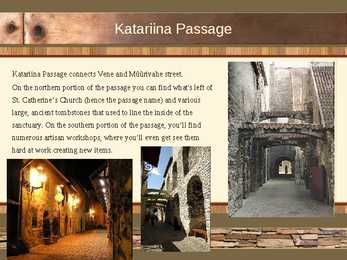
wall, gate, introduction, walls, margaret, grand, monasteryKatariina Passage connects Vene and Müürivahe street. On the northern portion of the passage you can find what's left of St. Catherine's Church (hence the passage name) and various large, ancient tombstones that used to line the inside of the sanctuary. On the southern portion of the passage, you'll find numerous artisan workshops, where you'll even get see them hard at work creating new items. City wall Tallinn's medieval city wall is a sub-facility that was built to protect the lower Tallinn and upper Tallinn (Toompea). The building of the city wall began in 1310th years, and by improving over time it formed the city wall with defensive buildings (towers). It was finished by the end of the 1561. Then it was 2.35-kilometer-long circular wall, which had 27 wall gate, 8 tower gate and 21 other stone fortifications. Many parts of the town wall have survived until today
Great Coastal Gate & Fat Margaret's Tower Good morning ladies and gentlemens, and welcome to Great Coastal Gate and Fat Margaret's Tower. Before we begin the tour, I`d like to tell you a little about their history. The Great Coastal Gate (Suur Rannavärav) was the most important gate in Tallinn. It was built as a defence on the seaward side of Tallinn, but also to impress visitors coming in from the sea. In the Middle Ages the Great Coastal Gate was about 300 footsteps from the harbour. Legends say, that during storms, the waves reached the gate. . In the 16th century, a powerful cannon tower was built next to the Great Coastal Gate. It had 155 loopholes, diameter of 25 meters, and a height of about 20 meters. The tower was named Roosikrantsi, but as it was the stoutest tower in the Wall, people started to call it "Fat Margaret". Through history, the cannon tower has also served as a
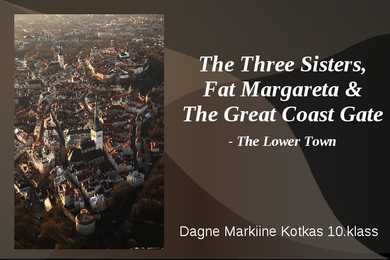
The Three Sisters, Fat Margareta & The Great Coast Gate - The Lower Town Dagne Markiine Kotkas 10.klass The Three Sisters Three Sisters is a group of 15th century houses at 71 Pikk Street with many decorative elements. The first record of The Three Sisters merchant houses comes from the year 1362. This is a typical of the Tallinn school of Gothic architecture. Recently a hotel was opened in this medieval complex. The Three Sister's Hotel Big sister's suite
If you're looking for that mix of historic ambience and cutting-edge culture that defines Tallinn, you'll find it here. Built up from the 13th to 16th centuries, when Tallinn or Reval as it was known then was a thriving member of the Hanseatic trade league, this enclosed neighbourhood of colourful, gabled houses, half-hidden courtyards and grandiose churches is, quite rightly, the city's biggest tourist draw. And the fact that it's all neatly packaged within a mostly-intact city wall and dotted with guard towers gives it an extra dose of fairytale charm. http://www.tourism.tallinn.ee/eng/fpage/explore/attractions/old_town Kiek in de Kök Those interested in walls, towers, cannons and the like should drop into this museum of the town's defences. Visitors of this museum will see examples of Medieval fire power, displays detailing how the city's system of fortification walls and towers developed through the
the north of Estonia in 1219. Legend has it that one day, when the Danes were about to lose a bloody battle, the sky suddenly opened and a red flag with a white cross on it dropped down upon them from the heaven. This is how the Danes obtained their national flag. In 1346 the Danish king sold his Estonian lands to the Teutonic Order, who a year later resold them to the Livonian Order. The Germans renamed Tallinn and called it Reval. Toompea became the seat of the German-born gentry. A fortified wall was built between Toompea (the Upper Town) and the Lower Town, as there were conflicts between the two. The Lower Town was the home of simple people, the artisans and the merchants. The doors and gates in the wall were locked at night. Tallinn joined the German-dominated Hanseatic League in 1285 and became a junction of trade between East and West: furs, honey, leather and seal fat moved west, while salt, cloth, herring and wine moved east. Its geographical position was very favourable, with
in 1346. The Swedes came next in 1561. Tallinn weathered plague and the Great Northern War and became part of Russia in 1710. In 1918, Estonia declared independence from Russia and fought a bitter war against Bolshevik Russia. Independence didn’t last long, however, and the fledgling nation fell first to the Nazis and then the Soviets during World War II. Despite all this conquering, Tallinn’s historic core has survived remarkably intact. Much of the 14th century city wall still stands, including a couple of stretches where you can climb the narrow spiral staircases of the towers and end up on the medieval catwalk. The Viru Gates, flanked by thin pointed towers from the 14th century, makes a nice entrance into Old Town. Dominating the town atop Toompea Hill is Toompea Castle and Pikk Hermann Tower. It was used as the center of government since 1229 and is now the site of Estonia’s parliament. Nearby stands the inappropriately named Maiden’s Tower
1. Fat Margareta - 16. Cent. Tallinn's most impressive defensive structures, the Great Coastal Gate (Suur Rannavärav) and Fat Margaret's Tower. They were built not only to defend the city from the seaward side of town, but also to impress any visitors arriving via the harbour. Fat Margareta used to be a prison. It is a town wall's building. Now it's home to the Estonian Maritime Museum, which provides a detailed look at the nation's seafaring past. 2. The Great Coastal Gate - with the Viru Gates, are the last of six gates that controlled access to the
Also were a weighing house, well, pillory- Magistracy - consisted of 24 burghermaster and something, selected from the members of the great guild Guilds The Great Guild - the association of hansaetic merchants, married persons, Brotherhood of blackheads - association of local unmarried blackheads, when married went into the great guild. active from the 14th century til 1930. founded a military organisation, but became social one. Estonians were never accepted into guilds. Town Wall Fat margaret and great coastal gate They were built not only to defend the city from the seaward side of town, but also to impress any visitors arriving via the harbour.The Great Coastal Gate, along with the Viru Gates, are the last of six gates that controlled access to the town in Medieval times. The gate system here on Pikk street originated in the 1300s, but it was during reconstruction in the early 16th century that the Fat Margaret cannon tower was added
It is ranked as a global city and has been listed among the top 10 digital cities in the world.The city was a European Capital of Culture for 2011, along with urku, Finland.Tallinn is the oldest capital inNorthern Europe. The city was known as Reval from the 13th century until the 1920s. http://en.wikipedia.org/wiki/Tallinn Old Tallinn The Old Town can historically be divided into two distinct areas: Toompea Hill and the Lower Old Town, which were separated by a dividing wall since medieval times. The elevated area of Toompea Hill with its castle was occupied by the residences of Tallinn's rulers and gentry. The Lower Old Town meanwhile developed as an autonomous merchantile centre, flourishing during the 13th-16th centuries, when the city enjoyed membership of the powerful Hanseatic Trading League. Generally speaking these two districts are now collectively referred as the Old Town. The Town wall and towers
The result was that many Christians heard the Word of God rarely if at all . Dominic envisioned the creation of a body of trained theologians who would scatter throughout Europe and proclaim the gospel in the most remote areas. The nordic countries appear very early on the Dominic anagenda. To reach Tallinn the friars followed the trade route along the southern coast of the Baltic Sea, and reached Estonia some 750 years ago. The monastery in Tallinn was certainly in existence by1246.Constructed in the gothic style, it exhibits a number of Interesting architectural features,and contains the largest collection of carved stones in Estonia. The site of the monastery in the Old City was carefully chosen in order to facilitate both the ministry of the friars and their business interests.They traded in fish in order to support themselves,but their reason for existing was preaching the word of God. The seal
(therefore the oldest street in Tallinn) and the only public road connecting the upper and lower town. It was paved with cobblestones already in the 14th century and was considered quite a dangerous place in the old times. It was certainly not recommended to walk along it after dark and it was not an easy road to be taken on a carriage, as the steep rise often proved too difficult for the horses and going down usually required excellent coachman´s skills. The present day 5-storeyed gate tower dates from 1380. Lühike Jalg (Short Leg) was first mentioned in 1353. This street belonged to the lower town and was used by pedestrians only because it is and was only a stairway street. The relations between the Upper and Lower towns were tense at the best of times as both the rich merchants of the Lower Town and the noblemen and knights of the Upper Town wanted to obtain more power. Due to the conflicts between the two towns the merchants in the Lower Town were afraid
1644. Following Victorian trends, the grounds and adjoining Loch Fyvie were landscaped in the 19th century. The American industrialist Alexander Leith bought the castle in 1885. It was sold to the National Trust for Scotland in 1984 by his descendants.The castle (like many Scottish castles) is said to be haunted. A story is told that in 1920 during renovation work the skeleton of a woman was discovered behind a bedroom wall. On the day the remains were laid to rest in Fyvie cemetery, the castle residents started to be plagued by strange noises and unexplained happenings. Fearing he had offended the dead woman, the Laird of the castle had the skeleton exhumed and replaced behind the bedroom wall, at which the haunting ceased.Today, the castle is open to tourists during the summer months. Crookston Castle is located in the Crookston area of south-west Glasgow, Scotland
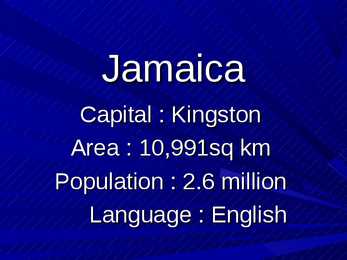
Jamaica Capital : Kingston Area : 10,991sq km Population : 2.6 million Language : English People Tourism Growing: Bananas Sugar cane Cocunats Oranges Coffe Kingston (town) Capital and the largest city Locaiton :Southeastern coast of island natural harbour Port Royal / N. M. International Airport English-speaking city Big city Culture Christian faith Most loved music: Reggae (Bob Marley) Dance to reggae music Writers (Dereck Walcott,Mikey Smith Films (Shottas,The Harder They Come) Sports (football,dominos,gymnastics) Thank You for watching By Manfred-M. Tikenberg
From the time of the Reformation church has been part of the Lutherian tradition St Olaf's became a Baptist church in 1950 From 1944 until 1991, the Soviet KGB used Oleviste's spire as a radio tower and surveillance point Horse mill Only preserved horse mill in the Baltic States Used if the city was surrounded with enemies; winter frost Worked until 1757, later as a warehouse Houses limestone museum The Great Coastal Gate Built during 14th century... Sadly has not been preserved. It was important to secure it. It was only 100 meters from the gate to the sea. Fat Margareta Initially called Rosary Thickness of the tower is 2.5-5.5m Height 16-22m Originally a cannon tower 155 portholes Was also used as a prison Estonian Maritime Museum
● Reval - used after 1219; comes from two german words ‘reh’ and ‘fall’, meaning the falling of the deer - as they fall down the Toompea hill, probably when escaping from the Danish occupation or just the hunters. ● Tallinn - used after Estonia gained its independence in 1918, origin is definitely estonian; meaning Taani-linn, tali- linn. Liberty Square ● The central square of Tallinn, it was renovated in 2008. There used to be Harju gate, which can now be seen through glass. ● The statue of Liberty, 2009; represents freedom, Estonia has been under many foreign powers, starting with Danes, Sweden, German and Russia. The clock of liberty, 2004. Kiek in de Kök ● The cannon tower, founded in 1475-1483. Kiika kööki, peek into the kitchen, from up there it was possible to peek into the enemy’s kitchen. The walls are 4 m thick, can see the cannons stuck in there. Tallinn City Museum.
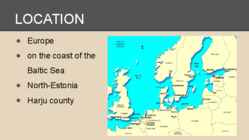
Tallinn English College English Sergo Vainumäe 9A TALLINN Report Supervisor: Inge Välja Tallinn 2006 Order of contents: 1.Introduction 2.Toompea 3.Lower Town 4.Kadriorg and Pirita 5.Museums 1. Introduction Tallinn, the capital of Estonia, lies on the Baltic Sea. It is on almost the same latitude east St. Petersburg in Russia, Stockholm in Sweden and Stavanger in Norway, and covers 158 sq km. Tallinn was first marked on a map of the world by the Arab geographer al-Idrisi in 1154, its name then being Kolyvan (probably derived from the name Kalev). In the 13th-century Chronicle of Henricus de Lettis the town was called Lyndanise. Later came Reval (presumably after the old county
Cities and towns of Estonia Facts 47 cities/towns Almost 50% forest In 2011 Tallinn was the European Capital of Culture Has over 1,500 islands Tallinn Capital of Estonia Old town Businesses Park Kadriorg TV tower Open-air museum Zoo Estonia Theatre Tartu University Old town AHHAA science centre Aura water park & SPA Art and history museums Vanemuine Theatre Pärnu Captial of summer Beach SPA hotels Tallinn gate Endla Theatre Viljandi Sild Viljandi Lake Ruins of the Viljandi Order Castle Ugala Theatre Rakvere Rakvere Castle Modern central square Aqua SPA hotel Rakvere Theatre Haapsalu Episcopal Castle Legend of the White Lady Estonian Railway Museum Beaches Thanks for watching!
THE CITY OF LONDON History The City of London occupies one square mile in the middle of the capital. It once made up entire town of London, surrounded by the wall first built by Romans. The Romans also built a bridge over the Thames and there has been one in the same area ever since. The Roman Londinium grew up on the northern side of the bridge. In AD 61 the native Celtic tribe, led by Queen Boudicca, rose up against the Romans. They burnt down Londinium to the ground and killed most of its inhabitants. Roman armies eventually defeated Boudicca and Londinium was rebuilt.
general and the origin of the name "Lai". 3 Lai Street in general Lai Street is 520 m long and begins at a small green patch below the Toompea slope, where a graceful bronze statue of a Roe Deer by Jaan Koort (1883-1935), one of the best-known Estonian sculptors, has been standing for several decades. Lai Street stretches from Nunne Street to Pikk Street. Parallel with Pikk Street, Lai Street, too, ends at the Great Coast Gate (first mentioned 1359). Lai Street is very wide considering that it was laid out in the Middle Ages. This is because it sprang up on both sides of former city wall. Lai is quite a peaceful street with few shops. However, it has three museums and two theatres. The main entrance into St Olaf´s Church also faces the street. Several Lai Street houses have kept their Gothic appearance and even interiors, although we can also notice moderate Nordic
members of Parliament hold most of their debates there at one end of the Chamber is the Speaker's Chair HOUSE OF LORDS CHAMBER Located in the southern part the benches in the Chamber, as well as other furnishings, are coloured red the Lords Chamber, like the Commons, has benches on either side and galleries above. at one end of the Chamber is the Throne from which Queen Elizabeth II gives her speech WESTMINSTER HALL The oldest part of Parliament the walls were built in 1097 it was extensively rebuilt during the 14th century today the hall is often used for important State occasions THE MAIN FUNCTIONS TODAY To examine proposals for new laws provide, by voting for taxation the means of carrying on the work of government scrutinise government policy and administration debate the major issues of the day VISITING PARLIAMENT You can attend debates watch judicial hearings and committees take a tour of Parliament
.................7 Conclusion.................................................................................................................................. 8 References...................................................................................................................................9 2 Introduction I did this choice, because I thought, I could find a lot of materials for this subject. I hope, this is not hard subject for me and I can do this report finely. 3 Beginning of 20th century Estonian literates participated in the fight for local power mainly with the help of the newspaper "Teataja" created in 1901. The 1904 elections were won by an Estonian-Russian
When the kids saw the snake in the as they were driving through the grass, they started outback of Australia. running around screaming hysterically. They walked around the building twice The train passed through nine tunnels looking for the entrance. on the way to Denver. The cruise ship passed under the Golden Gate Bridge as it was leaving They strolled along the beach San Francisco. watching the sunset. His dog is always trying to escape from The plane flew over the Grand Canyon the backyard. Sometimes he manages on the way to Los Angeles. to jump over the fence, and sometimes
koolinimi Report Legends of Tallinn Student: nimi Supervisor: nimi Tallinn 2010 Table Of Contents Table of Contents..................................................................................................................................2 Introduction......................................................................................................................................3 Legend of St. Olav's Church.......................................................................................................4 True story of St. Olav's Church..............................................................................................5 Legend of Old Thomas...........................................................
it is Lühike jalg. Pikk jalg (lit. long leg/foot), One of the oldest streets in Tallinn, previously known as Strantstrasse (beach road) (1362); Pikk jalg (long-leg) is a steep narrow road which was once the only way into the fortress. It runs from Pikk in the lower town right up to Lossi plats and the Nevsky cathedral. A couple of cafes in the old houses along Pikk jalg offer excellent views and genuine ambience, as well as plenty of caffeine to help you up the hill. The gate tower at the end dates from around 1380. Because of the names short and long Tallinn is sometimes called a limping city. Short Leg is also sometimes called street-stairs, because it is made completely out of stairs. The Upper and Lower Towns were connected by the Long Leg street (Pikk jalg) during the Middle Ages. The Short Leg street (Lühike jalg) could only be used by pedestrians, because it is and was only a stairway-street. The relations between the
the Hanseatic League in 1285. General Data l Country - Estonia l County - Harju County l First appeared on map - 1154 l Town rights - 1248 l Mayor - Edgar Savisaar l Aera - Total 159.2 km2 (61.5 sq mi) l Population - (1 Mar 2012) Total - 416,470 Denisty - 2,614.0/km2(6,766.6/sq mi) Tallinn Coat of arms Flag Top 5 Attractions 1. Kiek in de Kök Visitors to the museum will see examples of Medieval firepower, displays detailing how the city's system of walls and towers developed through the centuries and an exhibit on crime and punishment in Old Tallinn. 2. Kadriorg Palace - Kadriorg Art Museum A trip to Tallinn isn't a trip to Tallinn without a visit to this magnificent northern baroque palace, built by Peter the Great for his wife, Catherine I, in 1718. The grandiose palace with its surrounding manicured gardens is home to the foreign art collection of the Art Museum of Estonia.
Fat Margaret was built in 16th century. Author of the first design was Clemens Pale, but the building was finished by Gert Konigk. 2nd March 1917 the convicts were liberated and the tower was set in fire by the mob of workers and sailors In 1930ties part of the complex buildings were used by the Tallinn City museum In 1978 to 1980 the tower were renovate First architect Clemens Pale was start building the canon tower in 15101529 to protect the harbour against the invaders. Building was finished by master Gert Konigk from Münster in 1531. The tower was reconstructed by Polish renovators from 1978 to 1980 The tower was originally used the canon tower, later it was taken into use as an arsenal and magazine . 1830 1917 it served as a prison since the convicts were liberated and the tower was set in fire Fat Margaret's Tower are now used by houses the Estonian Maritime Museum Exhibit on Estonian maritime
later on several forms of the same name were used, such as Kik (Kyk) in de Kok, Kiek in die Küche, Pulffer-Thurm Giecken Köck. In 1696 the present name Kiek in de Kök was also mentioned, meaning "peek into the kitchen" in Low German. And true enough, it was possible to watch what the enemy was doing in their "kitchen" i.e. on position lower down from the about 38m-high tower. Already in the late 15th century the tower was somewhat reconstructed. The outer walls were made thicker and the tower got a diameter of 17.3 m. The walls are 4 m thick but the tower was then lower than today. The waterproof upper floor made of cobblestones was open and had 22 embrasures in its parapet. The parapet must have been covered by some kind of a roof but the middle part of the floor was uncovered to get the mortars and catapults in place better. Compared to the other Tallinn towers Kiek in de Kök was predominant in its fire power,
Hello my name is. And for introduction i will give you some clues for my following presentation. I would like you to think guess the object im describing. Golden Gate Bridge connects the city of San Francisco on the northern tip of the San Francisco Peninsula to Marin County as part of US Highway 101 and California State Highway 1 • Total length of Bridge (including approaches): 1.7 miles = 8,981 ft = 2,737 m • Width of Bridge: 90 ft = 27 m • Clearance above water: 220 ft = 67 m • Height of tower above water: 746 ft = 227 m • Height of tower above roadway: 500 ft = 152 m Main reason of building this bridge
Multiple Choice Exercise Correct! Well done. Your score is 43%. 1. While they were hiking through the forest, Laurelle and Frank saw a mountain lion. 2. We walked along the river looking for a way to get across it, but there was no bridge. 3. When the kids saw the snake in the grass, they started running around screaming hysterically. 4. The train passed through nine tunnels on the way to Denver. 5. They strolled along the beach watching the sunset. 6. The plane flew over the Grand Canyon on the way to Los Angeles. 7. Several animals, including emus, ran across the road in front of the car as they were driving through the outback of Australia. 8. They walked around the building twice looking for the entrance. 9. The cruise ship passed under the Golden Gate Bridge as it was leaving San Francisco. 10. His dog is always trying to escape from the backyard. Sometimes he manages to jump over the fence, and sometimes he digs a hole and crawls under it. Ermo Altmäe 011PK
Kiek in de Kök is an old German language nickname for towers, mainly those that formed parts of town fortifications. They gained the name from the ability of tower occupants to see into kitchens of nearby houses. Due to the history of the Hanseatic League and the Teutonic Order, also towers far outside modern Germany bear this name, like in Gdask and Tallinn. The tower in Tallinn is an artillery tower built in 1475.The walls are 4 m thick but the tower was then lower than today. The waterproof upper floor made of cobblestones was open and had 22 embrasures in its parapet. The parapet must have been covered by some kind of a roof but the middle part of the floor was uncovered to get the mortars and catapults in place better. Compared to the other Tallinn towers Kiek in de Kök was predominant in its fire power, due to its 27 embrasures for cannons and 30 for handguns
-The Raekoja Square The Raekoja Square is used for senturies like market and fair square, here took place many festivals, and criminals were executed. In summer on Raekoja Square many open air conserts and fairs of handicraftsmen were arranged, at the same time old traditions are remembered, took place many different party parades, knight tournaments and shooting competitions. In winter Christmas tree is placed and christmas fair is spent -Defensive Towers Tallinns Town Wall, reinforced with defensive towers, is one of the strongest defensive structures in Northern Europe by the XVI sentury. It is 3m wide, 16m high and its lenght is about 4km -Modern Tallinn Tallinns business center, with the hotel skyscrapers, banks and business centers, is already a habitual part of the harisont,which people see when the come from over the sea to Tallinn -Old Town Harbour & The Old Town Old City Harbour is one of the biggest and busiest passenger harbour in the Baltic region
the Hanseatic City of Novgorod. 2. Attractions Places to visit: ● Rannapark (Beach Park) & Vallikäär ● Eliisabet Church was built 1747 and is now a popular location for concerts. It’s organ has a distinct, beautiful sound. ● Jekateriina Church is one of the most beautiful apostolic baroque churches in Estonia ● Tallinna Gates, also called as Kuningavärav (King’s Gates) is a part of former medieval fortification system: once, this beautiful baroque gate used to mark the beginning of a postal road and now leads visitors to Pärnu beach district. ● Red Tower (Punane Torn) was the corner tower of Pärnu’s medieval defence wall. Serving as a “hot spot” for handicraft, the former court yard is a popular place for art fairs. In Pärnu there is plenty of sand, sun and water. And History is all around Pärnu. 3. About Pärnu Pärnu is a West-Estonian resort with well-established traditions that has held
● area 156 km² ● previous name - Reval HISTORY ● first marked on the map in 1154 ● Danish rule started in 1219 ● 1285 - member of the Hanseatic League ● 1345 - Danes sold Tallinn to the Teutonic Order ATTRACTIONS ● Toompea Castle ● Old Town ● Town Hall ● Kadriorg - beautiful park ● City Centre - medieval churches, modern towers OLD TOWN ● listed in the UNESCO world heritage list ● built up from the 13th to 16th centuries ● old Hanseatic town ● surrounded by huge walls ● many towers, narrow streets TOWN HALL ● on the Town Hall Square ● built in 1402-1404 ● oldest in the Baltic region and Scandinavia ● tower height is 64 m ATTRACTIONS Old Town Town Hall ATTRACTIONS Park Kadriorg City Centre Thank you for listening!
 annaabi.ee