Leidsid 33 sarnast õppematerjali, mis on seotud failiga "School system in the USA". Need materjalid aitavad sul teemat sügavamalt mõista.
student, students, degree, year, grade, schools, boarding, attend, complete, first, secondary, university, primary, child, course, children, years, offer, study, graduate, even, states, continue, middle, usually, universities, select, these, four, specific, major, required, field, pursue, there, option, cost, sixth, grades, available, five, commonlyDifferences between Estonian and USA school and education systems. Juhendaja: Koostanud: 2009 Differences between Estonian and USA school and education systems. Question is, how different are our own and this big country they call United States of America's education. Or maybe there is no difference at all, and our systems about school and education are more similar than they appear at first sight. After reading all the materials and all sorts of notes about USA's education systems and their school household. All at once I realized, that they are not so different at all. Like for example USA's kids have to go to school exactly the same amount of time as our Estonian children. And basically learn same amount of same things. Like everywhere there are always differences. Education in the United States is mainly provided by the public sector, with control and funding coming from
come to see them. Some of them are even like symbols of England. The most famous ones are: Stonehenge is one of the greatest national icons of Britain. That prehistoric monument is located in the plain of Salisbury, in the county of Wiltshire in the south-west of England. It is built of 150 enormous stones which are set in a purposive circular pattern. Stonehenge was probably built to mark the longest and shortest day of the year because it lies on the line of the midsummer sunrise and the midsummer sunset. That would have enabled people to keep a record of changing of seasons. Although it is still unclear who built it. Hadrian’s Wall is an ancient wall which was built in 2nd century by Hadrian, the emperor of Rome from AD 117 to 138, and it marked the northern border of the Roman Empire in Britain. The wall was 80 Roman miles (117 kilometres) long and it is situated in northern
Essay United States and Estonian education systems USA and Estonian school systems are very similar. But still there are some differences. How children attend school and when? How chlidren are divided by age in USA and Estonia? The American school year traditionally begins in August or September, after the traditional summer recess, which is three months long. As well in Estonia. School year usually ends in may or june. First difference between Estonian school system and USA's is that children attend school at the age of 5-6, but in Estonia children go to school at the age of 7-8. Before going to school american children attend preschool (selectively). Years 5-6 american children attend kindergarden, which is a preparation for the first grade. Most children enter the public education system around ages five or six.
church) and ministers. Evangelical = low church The Low Church movement can trace its roots back to the early 18th century but is primarily associated with the opposition to the Anglo-Catholic movement of the later 19th century. Low Church placed great emphasis on preaching, personal piety and the authority of scripture and gave much less importance to the orders of priesthood and episcopacy. Anglo-Catholic = high church High Church is the older of the two terms and was first applied in the late 17th century to those individuals who were opposed to the Puritan wing of the Church of England. It is first and foremost associated with the Anglo-Catholic movement of the later 19th century (from 1833 onwards). High Churchmen placed great emphasis on liturgy and the sacraments, especially the weekly or daily celebration of the Eucharist as well as on the three orders of ministry (deacon, priest and bishop).
3. Secondary education 4. Higher education 3 Early childhood education There are three stages of early childhood education: • from when the child is 6 months old to when they're one • from the ages of one to three • from the age of three until the child stars attending primary school Even though these three stages are not compulsory, every child must attend kindergarten for a year prior to primary school. 4 Primary education (Children begin school at the age of 6 or 7.) There are two stages: • 1st through 4th grade, being taught by one teacher per class that teaches every subject with the exception of foreign languages and Religion, with subjects such as Croatian, mathematics, visual
Northern Ireland. The relatively limited variety of fauna and flora on the island is due to its size and the fact that wildlife has had little time to develop since the last glacial period. The high level of urbanisation on the island has contributed to a species extinction rate that is about 100 times greater than the background species extinction rate. 2 The History of the Great Britain The island was first inhabited by people who crossed over the land bridge from the European mainland. Traces of early humans have been found (at Boxgrove Quarry, Sussex) from some 500,000 years ago and modern humans from about 30,000 years ago. Until about 10,000 years ago, Great Britain was joined to Ireland, and as recently as 8,000 years ago it was joined to the continent by a strip of low marsh to what is now Denmark and the Netherlands. Britain in the reign of Elizabeth
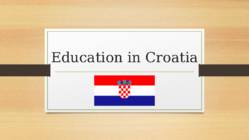
Education in Croatia Educational system in Croatia divided into: 1.Early childhood education 2.Primary education 3.Secondary education 4.Higher education Early childhood education There are three stages of early childhood education: · from when the child is 6 months old to when they're one · from the ages of one to three · from the age of three until the child stars attending primary school Even though these three stages are not compulsory, every child must attend kindergarten for a year prior to primary school. Primary education (Children begin school at the age of 6 or 7.) There are two stages: · 1st through 4th grade, being taught by one teacher per class that teaches every subject with the exception of foreign languages and Religion. The students stay in one classroom for the 4 years. · 5th through 8th grades, where different teachers teach different subjects
USA school system Most children enter the public education system around ages five or six. They may begin in preschoolpreschool, kindergartenkindergarten or first gradefirst grade. They normally attend 12 grades of study over 12 calendar years of primary and secondary education before graduating, earning a diploma that makes them eligible for admission to higher educationhigher education. Education is only mandatory until age 16, however. There are generally five years of primary (elementary) school, during which students customarily advance together from one grade to the next as a single cohort or "class", three years of middle school, which may have cohorts, and four years of high school.
In England and Wales most school were established by private benefactors and operated as educational carities. Compulsory education was introduced in 1888. Maintained schools follow National Curriculum. National Curriculum core subjects are English, matematics and science. Foundation subjects are design and technology, history, music, art. Children in Englan begin with primary education and it may be divided into Infant and Junior school. After primary school they move secondary school. Nearly 88 pre cent of secondary school pupils in England go to comperhensive schools. After five years of secondary education students take examination in a range of subjects at
Education Education is so multifaceted that it is difficult for me to know where to begin discussing it, or how to prioritize the many factors. Relaying my own experience is easy: I had a standard classroom approach, supplemented by inordinate reading. In only the briefest and least memorable instances did I receive any individual tutoring. Education is commonly thought of as the job of schools. Adults cry "educate our children!" Everyone has opinions about the best way to do the job. It is of urgent importance, and all the numerous factors are much studied, debated, and new (or old) ideas continually tested or retested. Some people say "it's as simple as . . . " and then name their pet peeve or passion. My view is not of an education specialist, but of one who loves sharing what I learn, and owes much to educators
Education The education system is a little bit different in the UK than ours. For example they have go to school 2 years earlier than us. Primary school is for pupils aged 5-11. Though schooling is only compulsory from age 5 in the UK, children most commonly enter Reception Class aged 4 in the academic year in which they will reach their 5th birthday. When pupils are aged 7 they sit Key Stage 1 [SATs]. Key Stage 2 SATs are taken when pupils are aged 11. Secondary school is for pupils aged 11-16. 11-13 years old pupils study a broad range of 10–15 subjects. No public examinations are taken during this time. Traditionally, at the age of 14 students start a programme that lasts for 2 years and during which time they study up to 11 subjects of their choice
Education Estonian Style Until the age of 7 you usually go to kindergarten, which means that you obtain preschool education. In grades 1-9 you obtain basic education. In grades 7-9 in addition to obtaining basic education, it is possible for you to get prevocational training in basic school. For persons without basic education who have passed the minimum school-leaving age (17 years) it is possible to continue their education in vocational schools on vocational training programmes (within 0,52,5 years one obtains vocational skills) or in upper-secondary schools for adults. If you have basic education, then you have choices to continue your studies: Upper-secondary school for general upper-secondary education (3 years). Vocational school for vocational secondary education (at least 3 years). If you have (general or vocational) secondary education, then you have three choices to continue your studies.
shortens the childhood and may affect negatively self-esteem, success and coping in the future. Children´s job is to play, it develops child the best, so I think anyone shouldn't forbit humans inherent needs. Children don´t have to become too fast to an adult. The high school in Great Britain starts at age eleven, but in Estonia at about age fifteen. Biggest difference is that in Great Britain they prepare young people to get a job or continue studing, but in Estonia this is only first step of educational life. After primary school in Estonia you have two ways to walk: high school or industrial school, where they get profession. Youngsters in United States of America and Great Britain have easier to make choice choosing a profession, because there they start to prepare people to get a job very early. High schools in Estonia teaches every subject almost equally, so everyone have to study everything,
Estonian and British education system is not quite different. In Estonia, the education system is based on six levels which include the: kindergarten, primary school, basic school, secondary school and university or vocational school. In Britain, the education system is also based on six levels which include the: nursery school, infant school, junior school, secondary school, 6th form and university or college. What is similar for both systems is that the first level of education starts at age of three. While in Estonia this level is called Kindergarten, then in Britain it is called Nursery school. Kindergarten is for children´s from age three to six, but Nursery school is for children´s three to four. Differently from Estonian system, at age of five to seven, British children ´s go to Infant school. This is called year one, year two and year three and all these three years are called key one
c) After leaving school, Ann studied/trained as a teacher. d) Peter decided not to go in/enter for the examination. e) My sister learned/taught me how to draw. f) I can't come to the cinema. I have to read/study for a test. g) In history we had to learn a lot of dates by hand/heart. h) I hope your work will improve by the end of course/term. i) Martin failed/missed his maths exam and had to sit it again. j) If you have any questions, raise/rise your hand. Task 2. Complete each sentence with a word from the box. Use each word once only. cheat copy memorise pay revise concentrate divide pass punish underline a) Our teachers used to punish us by making us stay behind after school. b) If you…….twenty-seven by nine, the answer is three. c) Try to……. the most important rules. d) It is difficult to …….attention in a noisy classroom. e) Pauline tried her best to …….the end of year examinations.
Each tendency was born by the influence of economic and political changes in the society. Those trends are known as the "hippies" the "punks" the "rockers". But certainly there are different traditional youth organizations in Great Britain. Among them -- the Scout Association, the Girl Guides Association, the National Union of Students, the Youth Club. The latter offers, for example, a wide range of sporting and social activities. The National Union of Students was founded in 1922. It operates through local branches in colleges and universities. It promotes the educational, social and general interests of students. But certainly the most numerous is the Scout Association, founded in 1908 for boys and in 1910 for girls by Lord Baden-Powel. The Scout movement is to encourage a sense of adventure and of responsibility for others among young people. The programme of training
Her father worked on oil rigs during the Depression. After the Japanese attack on Pearl Harbor, he signed up for service in World War II and marched across Europe in Patton's army. Dunham's mother went to work on a bomber assembly line. After the war, they bought a house through the Federal Housing Program, and moved to Hawaii. Meantime, Barack's father had won a scholarship that allowed him to leave Kenya pursue his dreams in Hawaii. At the time of his birth, Obama's parents were students at the EastWest Center of the University of Hawaii at Manoa. Obama's parents separated when he was two years old and later divorced. Obama's father went to Harvard to pursue studies and then returned to Kenya. His mother married Lolo Soetoro, another EastWest Center student from Indonesia. In 1967, the family moved to Jakarta, where Obama's half-sister Maya SoetoroNg was born. Obama attended schools in Jakarta, where classes were taught in the Indonesian language.
Canada, a member of Commonwealth of Nations, is an independent, self-governing democracy, equal in rank to Great Britain and all other nations. Canada has equal rights with the United Kingdom; is loyal to Queen Elizabeth II; has membership in the United Nations; appoints her own ambassadors and other representatives abroad; makes her own treaties; draws up her own laws; imposes her own taxes, maintains her own army, navy and air forces. History The first inhabitants were the Native Indians, the Inuits. Around 1000 Vikings tried to arrive in Greenland but got lost and ended up in Canada. John Cabot from England, took back word that the sea was full of fish which could be taken not only with a net but in baskets let down into the water. Beaver fur brought Europeans to Canada. In 1608 the first permanent settlement was established, it was called Quebec by Champlain and after that Canada was called New France
I really wanted to see the world! The only question was how, because my financial resources were limited. Nevertheless, I think, it is the perfect situation in life. If you are eager to get something you have to think how it is possible to fulfill your dreams. I knew I was interested in writing and photography . Then came the question, how could I combine them. I examined the theme thoroughly and to my suprise there have always been many nationwide competitions for students and the prize sometimes has been a journey to somewhere. I rememember clearly that the first prize that I got for an essay was a backpack and the first journey that I won was to Brussels. To this day, thanks to these competitions, I have had the chance to visit about ten foreign countries and many of them even twice. Herewith I just want to say that nothing is impossible. The main thing is the desire to gain something. When you have found a goal, then you just have to start working for it!
Compulsory education in Britain starts at the age of 3-5. Primary (infancy) School and move to a secondary school at 11 or 12. Primary (infant) Years 1-2 Age 5-7 Primary(junior) 3-6 5-7 secondary 7-9 11-14 Secondary 10-11 14-16 Sixth form Lower sixth form 1 year 16-18 Upper sixth form 1 year A-level advanced level. Higher level academic exams that are taken mostly by people around the ae of 18 who wish to go on to higher education. GCSE general certifcate of Secondary Education. The exams taken by 15 to 16 year olds in England, Wales and Northern Ireland. Marks are iven for each subject separately. Grades are A-G. A, B and C are regarded as good Grandes.
Truancy in school individual responsibility Hello ladies and gentlemen, today I am here to talk to you about truancy in school and why is it an individual responsibility. Truancy in school is a very serious problem nowadays. Unfortunately many students have lost their motivation to study. According to the BBC 400,000 children were persistently absent from England's schools in the past year and missed about one month of school each. The effect that poor attendance at school can have on a child's education can be permanent and damaging but skipping should be child's own responsibility and it is not right to punish the parents for it. Students have many reasons why they are skipping school, mostly they do not like the teachers or the subjects that they are taught. They tend think that they won't need those subjects in their future life. Some children are just lazy and irresponsible
items of government legislation. Discusses domestic matters with the Master of the Household. Towards the end of the day, there is always another pile of official papers and reports waiting to be read or acted upon. The business on constitutional monarchy never ends. 3. Who is the present heir to the throne? Speak about his education. Who are the 2nd and 3rd in line? Present heir is Prince Charles, The Prince of Wales. Has been an exchange student in Australia. Graduated from the university of Cambridge with BA (honors). 2nd and 3rd in line are Prince William of Wales and Prince Henry of Wales, respectively. 4. Make up your list of 5 top British people. Give your motivation. The Queen, Adele, Elton John, Shakespeare, JK Rowling. 5. Which 5 places attract visitors in Wales and Scotland? Edinburgh, Loch Ness, The Highlands, Snowdonia, Cardiff. 6. Name 6 islands, 5 rivers, 3 lakes, 3 mountains in UK.
Challenges of children`s “participation”: A Case Study of active citizenship in Cadle Primary School Gerli Orumaa – 662974 9th of May 2014 Word Count: 8,800 `Submitted in partial fulfilment of the requirements for the degree of B.A. International Relations` Table of Contents Abstract 3 Introduction 4 Chapter 1: Citizenship, Children`s Rights and Participation: from the UN to the UK 6 Chapter 2: Citizenship Education in Wales………………………………………………14 Active Citizenship in Cadle Primary School: A Case Study 20 Conclusion 29 Bibliography 32 Appendices Appendix 1: The United Convention of the Rights of the Child
of running it. So I bought it, took on the existing staff and I haven't looked back. I think a lot of people are creative. Once they find an outlet for it, they find they want to do it all the time. But it's not just the creative side of my new career that I love. I also enjoy the contact with people and the business side. Some days I don't make as much money as others, but generally it's going well. Then there's the complete lack of stress. These days, I go home feeling relaxed. I haven't given up pharmacy altogether. One day a week I still work for Boots, who I locum for. I like keeping a toe in the water of pharmacy because it was never something I hated just something I found I didn't want to do all the time." The 10 most popular second careers Plumber Many organisations offer short, intensive training courses. To make sure these are
In this essay I am going to point out some of the most distinguish features in the education of both countries. Firstly, there are dissimilarities in the age at which children go to school. In Estonia the age is 7 whereas in Britain children start their educational journey already as young as 5 years old. Primary school lasts 6 years just like in Estonia but the pupils in Britain are 2 years younger when they finish primary school than the pupils in Estonia. However, students in Britain and Estonia finish secondary school at the same age because secondary school lasts 5 years in Britain instead of 3 like it is in Estonia. Altogether, compulsory school in Britain lasts 11 years which is 2 years more than in Estonia. Moreover, there are slight differences as for the compulsory subjects taught in the first three years of secondary school in Britain and Estonia. In Britain, more emphasis is placed on
However, there are some private schools that are not subject to these obligations and particularities of the French education system. Nursery school classes accept toddlers at 2 or 3 years of age, starting in September. The children develop their basic faculties, improve their speaking skills and are introduced to the world of reading and writing, numbers and other key areas of learning. From age 6 to 11, the children attend elementary school which is mixed and freein the case of public (state) schools. The 'collège' accepts all pupils after elementary school without the need to pass an entrance exam. The teaching is structured by subject: French, mathematics, history-geography, 'civics' or civil education, biology and earth sciences, technology, art, music, PE, physics-chemistry. The objectives are fixed by national programmes. After the 'collège', pupils continue their education in a general and technological 'lycée' or a professional 'lycée'
Partner schools in Comenius project Targo Timak Form 7a Tartu Veeriku School Sehit Millis Nuri Ilkogretim Okulu l There are 1300 students and 43 staffs. l Students are aged 6-14. l Even though their school takes place in the urban part of the city, most of the families still have their old traditional ways of life which belong to rural areas. l Their school needs this kind of projects because pupils around the school have really low economic standards and they may not be able to find another chance to attend a high standard intercultural activity in the rest of their lives. Fichtenberg Oberschule
male 78 years and female 84 years. Environmental problems: air pollution from vehicle emissions and open-air burning; acid rain; water pollution from increased use of agricultural fertilizers. Education: The education system in Switzerland is very diverse, because the constitution of Switzerland delegates the authority for the school system mainly to the cantons. The Swiss constitution sets the foundations, namely that primary school is obligatory for every child and is free in public schools. The minimum age for primary school is about six years in all cantons but Obwalden, where it is five years and three months. After primary schools, the pupils split up according their abilities and intentions of career paths. Roughly 20% of all students attend secondary schools leading, normally after 12 school years in total which grants access to all universities. The other students split in two or more school-types (depends on the canton)
enter the state school system by attending primary school until they are 11 years old. Then they go on to a secondary school, which they can leave when they reach 16. Before leaving, students sit their GCSE examinations in 8 or 9 subjects. If they want to go on to study at university, they stay at school for 2 more years and then do A-level examinations in 3 or 4 subjects. Some parents decide to pay for their children's education and send them to a private school. At university a student studies for his degree for 3 or 4 years and, if successful, he will graduate with either a Bachelor of Arts or a Bachelor of Science degree. Finally, a student can choose to do a post-graduate course and study for a Masters degree or a Ph. D. (doctorate). V Exercise 1. telephone circuits 2. to have access to sth 3. regulated by laws 4. to charge a fee 5. on an international scale 6. communication system 7. to create inconvenience 8. to cause offence 9. to lack the funds 10
A member state of the Commonwealth of Nations which recognizes Queen Elizabeth II as their head of state is called A Crown dependency A constituent country A Commonwealth realm - see 4. The principle that an individual human’s beliefs and activities should be understood bu other in terms of that individual’s own culture is known as Chauvinism Ethnocentrism Racism Cultural relativism- see 5. Math the examinations to their explanations An examination taken to complete the first stage of secondary education – a-level An examination in a particular subject that pupils have to pass if they want to go to university – CGSE 6. A school financially supported by the state is known in the UK as An independent school A public school A maintained school - see 7. The Sixth Form is the last stage of compulsory education in England True False - see 8. Which of the following Christian churches used to be referred to as non- conformists
university play a role in contributing to a succesful outcome? Kaisa Kamenik In Mike Nichols 1967 cult film „The Graduate“, Dustin Hoffman character Benjamin Braddock, who has just graduated from college, is facing basically same questions as posed in the title of this essay. Everyone is asking what is he going to do with his life now, but he is very uncomfortable aswering them and at that point he doesn’t care as well. Being a third year history student in University of Tartu, I am wondering over the same questions and find myself often thinking what is expected of me after graduating and how has university played a role in my development for almost three years now. When asked what is the main purpose of university, most people would say that it is preparing students for different proffessions, which would later be the driving force of the country. But I think it is more complicated than that
Words that ADD information · also · and · another · besides first, second, third, ... · furthermore · in addition · moreover The little girl put on her yellow shirt and brown overalls. Chris is on the basketball team this semester at Indiana School for the Deaf. In addition, he is on the soccer team. We will be here for one more week so we can finish up our work. Another reason we are staying longer is because we do not want to miss the Deaf Way conference.
The Estonian Education System The current Estonian education system consists of pre-school education, basic education, general secondary education, vocational education and higher education. Basic education is the compulsory education minimum, whics is provided by basic schools. Estonian law requires all children to be in full-time education from age of seven. In Estonia the National Curriculum is compulsory for all schools. The academic year begin on the first of September and is divided into four terms. So pupils have four holidays: a week in October, two weeks at Christmas, a week in March and three months in summer. Most Estonian children receive free education in state schools. School uniform is not compulsory. At the end of basic school pupils take three exams and at the end of twelfth form pupil take five exams. On completion of basic education, studies may be continue in a general secondary school or in a vocational institution.
 annaabi.ee