Made by: Siim Reimand Crusades Holy wars. The purpose -to retake the Holy Land. Christ -would come when the Christians control Jerusalem. For almost 200 years. Nine crusades! 1 Crusade st 2 Crusade nd (1096-1099) (1145-1149) Urban II called a Launched in 1147. council Was a complete Thousands of warriors failure. attacked Muslims and Christians took no Jews to gain the land new territory. for Christians. 3rd Crusade (1189-1192) o Richard I, Philip II, Frederick Barbarossa set out. o Along the way Frederick drowned. o Phillip went back home. o Richard won several victories but couldn't retake Jerusalem. o The English had to give up and head home. o Richard was taken prisoner ....
British kings and queens Kings King Henry VIII King Henry VIII is arguably the most well-known king of England. Famous for beheading his wives, of which he had six, King Henry VIII also had several children. King James I King James I was already King of Scotland when he got the English crown. King James I was the first ruler to call himself King of Great Britain, as he ruled England, Scotland and Wales. King James was the first King of Great Britain. King William I, the Conqueror King William I, otherwise known as William the Conqueror was born in France on 1028. He became friendly with the current English King, Edward the Confessor. He invaded and attacked England on Edward's death, as he was promised the English crown, but then denied it by the Saxon Harold. King George VI King George VI did not expect to become king, he was the shy brother of Edward VIII who only took the thrown when Edward...
Richard Lõvisüda 10A Juhendaja õp. Tallinn 2011 SISUKORD...................................................................................................................2 1.SISSEJUHATUS.......................................................................................................3 2.RICHARD LÕVISÜDA...............................................................................................4 2.1.Varajane Elu................................................................................................4 2.2.Ristisõda ja vangipõlv..................................................................
Medieval England 1066-1485 Eva Asper Anna Pohlak 11.c The Norman Dynasty The Norman Conquest In the 11th century, Normans conquered England - The Battle of Hastings 14.10.1066 The Anglo-Saxon forces had more soldiers but the Normans had better military tactics and won in the end thanks to a clever strategy William I, also known as William the Conqueror, replaced King Harold on the throne The invasion was completed by 1071 - The Norman invasion is depicted on the Bayeux Tapestry a long embroidered cloth The death of King Harold embroidered on the Bayeux Tapestry The Norman England William I ensured his power by dividing the land into parts and making 1/7 of it a royal domain He made his nobles swear an oath of allegiance and become his vassals Died in 1087 while fighting in France, was succeeded by his third son, William...
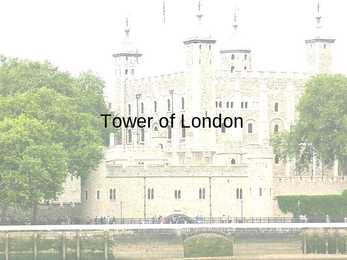
Tower of London Location The Tower of London is located at the eastern boundary of London, next to Tower Bridge on the northern bank of the Thames river. Description At the centre of the Tower of London stands the White Tower. The White Tower is defended by a massive curtain wall, which has thirteen towers. The first curtain wall is defended by a second massive curtain wall, which has five towers. The tower is manned by the Yeomen Warders (known as Beefeaters), who act as tour guides, provide security, and are a tourist attraction in their own right. Every evening, the warders participate in the Ceremony of the Keys as the Tower is secured for the night. History The Tower of London was founded in 1078 by William the Conqueror. In the 12th century, King Richard the Lionheart enclosed the White Tower with a ...
Richard Sildveer „ Astrid Lindgren“ Astrid Lindgren is a Swedish born author. She was born as Astrid Anna Emilia Ericsson on 1907 in Vimmerby in the province of Smaland, in Southern Sweden where she grew up on a farm. Her early childhood was spent with cows and discovering hidden forest paths. Astrid was born to liberal parents, the second of four children of Samuel August, a tenant farmer, and Hanna Jonsson Ericsson. During their childhood years, they were nurtured into storytelling; and were taught how to use their imagination and creativity in the world of Literature. Her childhood years were full of love and laughter, which came from her parents. The laughter extended more in the games that Astrid played with her three siblings, Gunnar, Stina and Ingegerd. Many of the settings and characters in Astrid’s books can be traced back to her own childhood. As an author, she...
The early middle ages The Norman Conquest Since William was crowned king, there were many rebellions against the Normans. A small Norman army marched from village to village and destroyed the ones it couldn't control. The Normans took away the Saxon lords' land. Only a few Saxons who supported William could keep their land. Feudalism William gave parts of his conquered land to his captains around the country to avoid rebellions and uprisings. He also kept some land to himself to make sure his was much stronger than his nobles. Of all the farmland half went to his nobles, quarter to church and fifth he kept to himself. William organised the English kingdom according to feudal system. The main purpose of using that system was economic. King gave the land to "vassals" in return of army services and goods. When a noble dies, his son took over the estate. When there was no family, the land went back to king who could give it to another n...
Anglo-norman period (1066-1300) The normans · The name derives from "the Northmen" · Descendants of the Vikings · Seized the north-western part of France · The area known as Normandy · Adopted French customs and Christianity · Norman-French (their version of French). 1066 · Edward the Confessor dies in January · Harold Godwinson crowned as king in Westminster Abbey on the same day · Another candidate for the throne William, Duke of Normandy · Gathered an army · Invasion delayed (bad weather) · Harald, king of Norway, invades England from the North · A battle at Stamford Bridge · Harald's army defeated, leaders killed · The end of the Viking Age · The Normans land in Britain (a few days after Stamford Bridge) · The Battle of Hastings · Harold defeated ...
Literature of the 14th century The highpoint of medieval literature, the best writer of late medieval lived then. William Langland 1332-1376 the last important poet of alliterative verse. His masterpiece "The Vision of Piers Ploughman" how important working hard is, the labour of peasants is the base of the welfare of the people. A passionate protest against social injustice. A time when peasants were slowly rising against their feudal lords. Descriptions of different social classes. Religious mysticism. Two great principles: 1) all men are equal before God; 2) honest labour is dignified. It is a dream allegory. A young maiden named Youth, Greed is an old witch. The greatest writer of this period and the whole of medieval times Geoffrey Chaucer (1340?-1400): · The father of English poetry · The creator of English versification · The first poet to use various metres · Laid the foundation of the new literary English ...
Stonehenge One of the best known ancient wonders of the world, 5000 years old Megalith monument, built by western mediterraneans during 3000-1600 BC Circular structure, large standing stones, aligned with rising sun at teh solstice Attlers and bones were sued to dig pits that hold the stones The Celts in Britain and their legacy 700-200 BC celts invade Britain Gaels or Goehls(Ireland and Scotland),Cymri(Wales) and Brythons(gave name to Brittany) Fierce fighters,superb horsemen.Most of them farmers, lived in thatched houses Good at art, craftmanship, used iron Divided into tribes, ruled by kings, only in face of danger would they choose a single leader Legacy- hill-forts, farms, churches, field system, woodland, pasture, weapons, iron objects, langugae, culture Caesar in Britain The great Roman Emperor Firts came 55 BC to gather information, celts ...
History exam *Stonehenge - is a monument located in England. It is one of the most famous prehistoric sites in the world and is composed of earthworks surrounding a circular setting of large standing stones. The surrounding circular, earth bank and ditch, have been dated to about 3100 BC. Stonehenge was produced by a culture with no written language. Many aspects of Stonehenge remain subject to debate. There is little or no direct evidence for the construction techniques used by the Stonehenge builders. *The Celts in Britain and their legacy The Cets lived in Britain in The Iron Age. They were warring tribes who were battleful amongst themselves as well as inter-tribal war. They were not centrally governed. The Celts brought iron working, iron ploughs and metal swords, horses, wheels and chariots - all these things gave them an instant superiority over the native tribes. The Celts built a number ...
 annaabi.ee