were accused of having a connection to them or providing them with support or were perceived, or presented as posing a threat to the US and its allies in general. It was typically used with a particular focus on militant Islamists and al-Qaeda. The ideology of violent extremists has been discussed frequently since the tragic events of Septenber 11, 2001. It is clear thet an ideology of Islamist or Islamic political opposition and radicalism has been key to understanding various events and movements that go back even further, to the Islamic Revolution in Iran, for example. The "war on terror" has created a culture of fear in America. The Bush administration's elevation of these three words into a national mantra since the horrific events of 9/11 has had a pernicious impact on American democracy, on America's psyche and on U.S. standing in the world. Using this phrase has actually
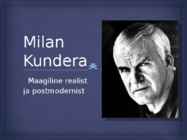
Plays: * The Owner of the Keys, 1962. * Two Ears, Two Weddings (Slowness), 1968 * The Blunder, 1969 * Jaques and His Master, 1971 (Hommage to Diderot in 3 acts) Fiction: * The Joke, 1965 * Laughable Loves, 3 parts: 1963-1965- 1968, complete 1969 * Life is Elsewhere, 1969/70 * The Farewell Waltz (earlier translation: Party), 1970/71 * The Book of Laughter and * Forgetting, 1978 Essays: * About the Disputes of Inheritance, 1955 * Art of the Novel, 1960 * The Czech Deal, 1968 * Radicalism and Exhibitionism, 1969 * The Stolen West or the Tragedy of Central Europe, 1983 * The Art of the Novel, 1985 * Testaments Betrayed, 1992 “Teadmatus” “Art of Fugue” “Elu on mujal” Romaanis «Elu on mujal» pilab Milan Kundera romantilist luuletajanatuuri, kirjeldades poeedihingega noormehe Jaromili lapsepõlve ja noorust, tema püüdlusi vabaneda ema mõjuvõimu alt, leida kohta täiskasvanute maailmas ja pälvida luuletajana üldsuse tunnustust.
unconditionally worshiped beauty, and strongly believed in a hierarchy of moral values that were not human conventions." Indeed, this characterisation is mainly brought forward by typical Turgenev's literary tools; he presents his `fathers' with a radically different generation of `nihilists' and from this contrast, the main critique and description of the very generation of Turgenev himself arises. Freeborn (1960:99) comments that radicalism/nihilism (Turgenev used radicalism) aimed to "to present as objectively as possible the ideological and class antagonisms existing between the fathers and the sons in that crucial year on 1859 when the two wings of the intelligentsia were in open disagreement". 1 From the beginning of the novel, Turgenev allows the reader to unveil the similarities and differences between the generations by portraying their interactions, moods, thoughts and eby their manners of speaking
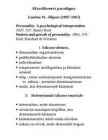
kahtlustav usaldav kade kergeuslik M Autia Praxernia ekstsentriline konventsionaalne fantaasiarikas kaalutlev N Shrewdness Artlessness sots. kalkuleeriv tahumatu sotsiaalselt tundlik sotsiaalselt abitu O Guilt Proclivity Guilt Rejection depressiivne enesekindel tujukas rõõmsameelne Q(1) Radicalism Conservatism uuendaja traditsiooniline vabameelne vanameelne Q(2) Self-Sufficiency Group-Adherence endale lootev heakskiitu ootev sõltumatu sõltuv Q(3) High self-sentiment Low self-sentiment strenght strenght ennast kontrolliv muretu sõnapidaja muutlike huvidega Q(4) High ergic tension Low ergic tension
kahtlustav usaldav kade kergeuslik M Autia Praxernia ekstsentriline konventsionaalne fantaasiarikas kaalutlev N Shrewdness Artlessness sots. kalkuleeriv tahumatu sotsiaalselt tundlik sotsiaalselt abitu O Guilt Proclivity Guilt Rejection depressiivne enesekindel tujukas rõõmsameelne Q(1) Radicalism Conservatism uuendaja traditsiooniline vabameelne vanameelne Q(2) Self-Sufficiency Group-Adherence endale lootev heakskiitu ootev sõltumatu sõltuv Q(3) High self-sentiment Low self-sentiment strenght strenght ennast kontrolliv muretu sõnapidaja muutlike huvidega Q(4) High ergic tension Low ergic tension
The Age of Reason The Age of Reason: Being an Investigation of True and Fabulous Theology , a deistic treatise written by eighteenth-century British radical and American revolutionary Thomas Paine, critiques institutionalized religion and challenges the inerrancy of the Bible. Published in three parts in 1794, 1795, and 1807, it was a bestseller in America, where it caused a short- lived deistic revival. British audiences, however, fearing increased political radicalism as a result of the French revolution, received it with more hostility. The Age of Reason presents common deistic arguments; for example, it highlights the corruption of the Christian Church and criticizes its efforts to acquire political power. Paine advocates reason in the place of revelation, leading him to reject miracles and to view the Bible as an ordinary piece of literature rather than as a divinely inspired text. The Age of Reason is not atheistic, but deistic:
5) revision of the cultural canon; 6) images of women in classical texts and mythology, fairy-‐tales revisited (Ophelia; Sleeping Beauty, Red Riding Hood); 7) wrote in the new genres of fantasy and dystopia. The feminist literature of the 1960s and 70s often resorted to radicalism and the previous female victim was turned into a terrorist; by the 1980s and onward this changed and feminist literature became more imaginative and complex; a return to common values can also be viewed, though there are few new ideas, instead mostly old ideas revisited.
Partly a reaction to the Industrial Revolution, it was also a revolt against aristocratic social and political norms of the Age of Enlightenment and a reaction against the scientific rationalization of nature. It was embodied most strongly in the visual arts, music, and literature, but had a major impact on historiography, education and the natural sciences. Its effect on politics was considerable and complex; while for much of the peak Romantic period it was associated with liberalism and radicalism, in the long term its effect on the growth of nationalism was probably more significant. In the U.S, romantic Gothic literature made an early appearance with Washington Irving's The Legend of Sleepy Hollow (1820) and Rip Van Winkle (1819), followed from 1823 onwards by the Leatherstocking Tales of James Fenimore Cooper, with their emphasis on heroic simplicity and their fervent landscape descriptions of an alreadyexotic mythicized frontier
Feminist Sex Wars over issues such as sexuality and pornography, which ushered in the era of third-wave feminism. Hélène Cixous is a professor, French feminist writer, poet, playwright, philosopher, literary critic and rhetorician S. de Beauvoir `Second Sex' to describe women because she believes them to be an oppressed and marginalized group dominated in every aspect of society. 16. Angela Carter. The evolution of the writer's career 1960s-1990s: from radicalism to magic realist metafiction. Femininity as a constructed notion in A. Carter's short stories, novels and non-fiction. New Woman changing old rules in Nights at the Circus and The Loves of Lady Purple. Angela Carter (7 May 1940 16 February 1992) was an English novelist and journalist, known for her feminist, magical realism, and picaresque works. Born Angela Olive Stalker in Eastbourne, in 1940, Carter was evacuated as a child to live in
ekstsentriline konventsionaalne fantaasiarikas kaalutlev N Shrewdness Artlessness sots. kalkuleeriv tahumatu sotsiaalselt tundlik sotsiaalselt abitu O Guilt Proclivity Guilt Rejection depressiivne enesekindel tujukas rõõmsameelne Q(1) Radicalism Conservatism uuendaja traditsiooniline vabameelne vanameelne Q(2) Self-Sufficiency Group-Adherence endale lootev heakskiitu ootev sõltumatu sõltuv Q(3) High self-sentiment Low self-sentiment strenght strenght ennast kontrolliv muretu
The era was distinctive for its architecture, literature, fashions, and politics. It was a period of excess for the aristocracy: for example, it was during this time that the Prince Regent built the Brighton Pavilion. However, it was also an era of uncertainty caused by the Napoleonic wars. *The Peterloo Massacre 1819 occurred at St Peter's Field, England. The end of the Napoleonic Wars had resulted in periods of famine and unemployment. It had enhanced the appeal of political Radicalism. In response, a group agitating for parliamentary reform, organised a demonstration to be addressed by Henry Hunt. Shortly after the meeting began, local magistrates called on the military authorities to arrest Hunt and to disperse the crowd. Cavalry charged into the crowd and 15 people were killed, 400700 were injured. Peterloo's immediate effect was to cause the government to crack down on reform, with the passing of what became known as the Six Acts.
 annaabi.ee