 10 punkti
Autor soovib selle materjali allalaadimise eest saada 10 punkti.
10 punkti
Autor soovib selle materjali allalaadimise eest saada 10 punkti.
 ~ 2 lehte
Lehekülgede arv dokumendis
~ 2 lehte
Lehekülgede arv dokumendis
 2015-08-29
Kuupäev, millal dokument üles laeti
2015-08-29
Kuupäev, millal dokument üles laeti
 1 laadimist
Kokku alla laetud
1 laadimist
Kokku alla laetud
 0 arvamust
Teiste kasutajate poolt lisatud kommentaarid
0 arvamust
Teiste kasutajate poolt lisatud kommentaarid
 lisqnna
Õppematerjali autor
lisqnna
Õppematerjali autor
Phrasal verbs 1. Hang around- ringi jõlkuma 2. Hang on- ootama 3. Hang on to- hoidma 4. Hang out- välja panema 5. Hang out with- Kellegagi koos aega veetma 6. Hang over- painama 7. Hang up- telefoni kõnet lõpetama 8. Commit a crime- kuritegu sooritama 9. Crime prevention- kuriteo ennetamine 10. Crime rate- kuritegude sagedus/määr 11. Crime scene- kuriteopaik 12. Juvenile/youth crime- noorsoo kuriteod 13. Petty crime- väärtegu 14. Serious crime- tõsine kuritegu 15. Street crime- tänaval juhtunud kuritegu 16. Turn to crime- kurjale teele minema 17. Violent crime- vägivaldne kuritegu 18. Au pair- lapsehoidja 19. Bon appetit- head isu 20. Bon voyage- head reisi 21. Critique- kriitik 22. Cuisine- köök 23. En suite- magamistuba koos privaatvannitoaga 24. Faux pas- piinlik apsakas 25. Fiance- kihlatu 26. Blizzard- lumetorm 27. Breeze- tuul 28. Downpour- paduvihm 29. Drizzle- tibutama 30. Flood- üleujutus 31. Hea
" (the evening) at "I go to bed at night." (night) in "It usually snows in the (a season) winter." Viljandi 2009 Viljandi County Gymnasium 4. Phrasal verbs Many verbs in English are followed by an adverb or a preposition (also called a particle), and these two-part verbs, also called phrasal verbs, are different from verbs with helpers. The particle that follows the verb changes the meaning of the phrasal verb in idiomatic ways: · drop off - decline gradually The hill dropped off near the river · drop off(2) - fall asleep While doing his homework, he dropped off. · drop off(3) - stop and give something to someone
ÜHENDVERBID (NB! Ühendverbe on tegelikult väga palju. Siin on toodud vaid mõned valitud näited nende kohta.) BLOW UP (explode): The factory was blown up yesterday. (Tehas lasti eile õhku.) BREAK DOWN (stop functioning): My car broke down yesterday. (Mu auto lakkas eile töötamast.) BREAK IN ON (interrupt): He broke in on my conversation with mom. (Ta segas vahele mu vestlusele emaga.) BRING UP (mention a topic): Jenny brought up that song again. (Jenny võttis jälle selle laulu kõne alla.) BRING UP (raise children): Deborah has to bring up four children. (Deborah'l peab nelja last kasvatama.) CALL OFF (cancel): The meeting was called off. (Koosolek jäeti ära.) CALL ON (visit): The doctor called on Helen. (Arst käis Heleni juures.) CATCH ON (become popular): Meg caught on in her class. (Meg sai oma klassis populaarseks.) CATCH UP WITH (keep abreast): You should catch up with the the class. (Sa peaks klassiga sammu pidama.) CHECK UP ON (examine): She promised to check up on
Pay back- to punish or reward Pay for- to make payment pay for- to suffer or be punished pay off- to pay a full amount (a debt) pay off- produce a profitable or successful result pay off- to get revenge pay off- to birbe (pistist maksma) pay out-a sum of money to sb (large amount) pay out- to let out (a line or rope) by slackening (lõdvaks laskma) pay up- to give over the full monetary amount demanded carry off- to die of a disease carry on- to continue carry on- have an affair carry on- behave badly carry out- to perform a task carry out- to follow or obey carry out- complete or accomplish st carry over- to continue to another time or situation carry through- to survive carry through- to accomplish, complete successfully pull ahead- overtake, move into the lead or in front pull apart- top from fighting pull apart- weaken an argument or theory pull out- bus or train leaving station pull out- move into traffic pull out- withdraw pull back- score a goal or point when behind pull back-
One is the imperfective, the other is the perfective. Often these two words are closely related, but this is not always the case. (Often the perfective is simply prefixed with “По”). ) Жить, Прожить – live Любить, Полюбить – love Делать, Сделать - do, make Говорить, Сказать - talk, speak, say. Работать, Поработать - work Aspects in the negative Using the negative with perfective verbs indicates the person failed to do that action. Using the imperfective will normally simply mean that it didn’t happen. Я не позвонила - I failed to phone (perfective) (but I was expected to) Я не звонила - I didn’t phone. (imperfective) Rank Russian verb English translation Aspectual pair (imp/perf) 1. быть to be, have imperfective, no pair
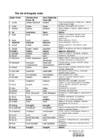
kannatama, taluma 250. wring wrung wrung kõvasti pigistama, väänama 251. write wrote written kirjutama 252. 253. 254. 255. 256. 257. 258. 259. 260. 7 Aari Juhanson, MA Updated 2021 The list of irregular verbs, groups 1.pv/ sõna- 2.pv / 3.pv/ Past eestikeelne vaste raamatuvorm lihtmineviku Participle vorm beat beat beat / beaten peksma, lööma; alistama burst burst burst purustama; puhkema (nutma, etc.) cost cost cost maksma (minema) cut cut cut lõikama, vähendama hit hit hit lööma, hoopi andma; sobima
Contents Contents.................................................................................................................................. 1 # When the Tigers Broke Free................................................................................................ 2 # In The Flesh ?...................................................................................................................... 3 # The Thin Ice......................................................................................................................... 4 # Another Brick in the Wall part 1........................................................................................... 5 # The Happiest Days of our Lives........................................................................................... 6 # Another Brick in the Wall part 2........................................................................................... 7 # Mother..........................................................
249. withstand withstood withstood (millelegi) vastu seisma või panema; välja kannatama, taluma 250. wring wrung wrung kõvasti pigistama, väänama 251. write wrote written kirjutama 252. 253. 254. 255. 256. 257. 258. 259. 260. 7 Aari Juhanson, MA 2007 The list of irregular verbs, groups Basic Form Simple Past Past Participle Form (II) Form (III) burst burst burst cost cost cost cut cut cut hit hit hit hurt hurt hurt let let let put put put quit * quit (quitted) quit (quitted) set set set shut shut shut
 annaabi.ee







Kõik kommentaarid