Estonia is located in the Northern Europe and is a state in the Baltic region It is bordered to the north by the Gulf of Finland, to the west by the Baltic Sea, to the south by Latvia, and to the east by Lake Peipus(Peipsi) and the Russian Federation.Estonia also has a number of islands: Saaremaa and Hiiumaa, which are the most known are also the two biggest ones.The territory of Estonia covers 45,227 km2. There is 3,794 kilometers of coastline marked by numerous bays, straits, and inlets. The Republic of Estonia is divided into fifteen counties: Hiiumaa, Saaremaa, Läänemaa, Harjumaa, Lääne-Virumaa, Ida-Virumaa, Tartumaa, Jõgevamaa, Järvamaa, Raplamaa, Viljandimaa, Pärnumaa, Valgamaa, Põlvamaa
the Mall, the Strand (teed) the Eiffel Tower NB! Kui need hooned on saanud nime kellegi inimese järgi, siis artiklit ei kasuta: Victoria Station Westminster Abbey Lloyd´s Bank Järved: Jõed, kanalid, väinad, merehoovused: Lake Peipus (NB! the Peipus) the Thames, the Nile the Seine, the Rhine the English Channel, the Amaxon the Strait of Dover (väin) the Gulf Stream Mäed, mäetipud: Mäestikud, mäeahelikud: Mont Blanc the Alps
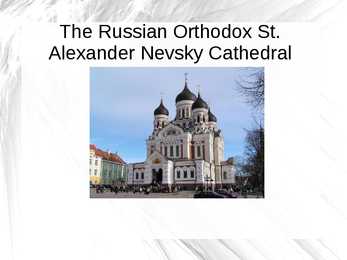
The Russian Orthodox St. Alexander Nevsky Cathedral is designed by Mikhail Preobrazhensky ( a professor at St. Petersburg Academy of Arts) And built on the order of Alexander III between 1894 and 1900,during the period when the country was part of the Russian Empire The Alexander Nevsky Cathedral is Tallinn's largest and oldest orthodox cathedral It is dedicated to Saint Alexander Nevsky who in 1242 won the Battel of the Ice on Lake Peipus The church's towers' hold Tallinn's most powerful church bell ensemble,consisting of 11 bells (one of them weighing 15 tonnes) Orthodoxy in Estonia is practiced by 12.8 % of the population,making it the second most identifield religion after Lutheran Christianity with 13.6 % Orthodoxy is mostly practiced within Estonia's Russian ethnic minority The first mention of an Orthodox congregation in Estonia dates from 1030 Cathedral : Kasutatud allikad: http://en.wikipedia
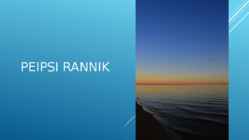
vajub vesi rohkem lõuna poole ja sealsed alad ongi rohkem kinnikasvanud PEIPSI JA PEIPSI RANNIKU TEKE Peipsi areng algas mandrijää taandumisega järvenõo lõunaosast põhja suunas. Algselt oli väike Peipsi (Ürg-Peipsi), hiljem Suur Peipsi Peipsi nime esimest korda 1400 (Peybas); järgmisi maininguid: 1433 Peupes, 1449 ja 1475 Peibas, 1502 Peybsaz, 1503 Beybasse, 1509 Pebesse, 1585 Beips, 1684 Peipus. TÄNAN KUULAMAST! KASUTATUD ALLIKAD: http://www.visitpeipsi.com/ https://et.wikipedia.org/wiki/Peipsi_j%C3%A4rv https://www.google.ee/maps/search/peipsi/@58.4595191,27.1 947114,11z http://www.peipsiveere.ee/ http://www.miksike.ee/documents/main/referaadid/peipsi.htm https://annaabi.ee/Eesti-j%C3%A4rved-m151556.html http://www.ctc.ee/peipsi-piirkond/faktid-peipsi-kohta
DORPAT Lisette-Brett Poll 10.klass Estland 1,3 Millionen Einwohner Tallinn "Mu isamaa, mu õnn ja rõõm" Kersti Kaljulaid Jüri Ratas F Von Tartu Süden Estlands 93 715 Stadtbewohner Die zweitgrößte Stadt in Estland Urmas Klaas Fluss Emajõgi Die größten Flüsse in Estland Länge 100km Breite 20-145m Von Westen nach Osten, vom Võrtsjärv-See zum Peipus-See. Tartu Universität Gründung ist 1632 Toomas Asser Die älteste und größte Universität in Estland Küssende Studenten Brunnen mit der Statue Mati Karmin 1. September 1998 40 Tonnen Theater Vanemuine Es ist das älteste Theater estnischer Sprache und geht auf das Jahr 1870 zurück. Drama, musikalische Darbietungen und Ballett. Toomas Peterson. Estnisches Nationalmuseum Kultur und der estnischen Geschichte sowie der finno- ugrischen Völker in Tartu
Estonia is a state in the Baltic region of Northern Europe. It is bordered to the north by the Gulf of Finland, to the west by the Baltic Sea, to the south by Latvia (343 km), and to the east by Lake Peipus and Russia (338.6 km). Across the Baltic Sea lies Sweden in the west and Finland in the north. The territory of Estonia covers 45,227 km2 (17,462 sq mi), and is influenced by a humid continental climate. The Estonians are a Finnic people, and the official language, Estonian, is a Finno-Ugric language closely related to Finnish, and distantly to Hungarian and to the Sami languages. Estonia is a democratic parliamentary republic divided into fifteen counties, with its capital and
Võnnu Keskkool ESTONIA Referaat Autor: Klass : 9 Juhendaja: Võnnu 2013 Estonia officially the Republic of Estonia, is a state in the Baltic region of Northern Europe It is bordered to the north by the Gulf of Finland, to the west by the Baltic Sea, to the south by Latvia and to the east by Lake Peipus and Russia.Across the Baltic Sealies Sweden in the west and Finland in the north. The territory of Estonia covers 45,227km2 The Estonian climate resembles that of other countries on the Baltic littoral. On account of the country's proximity to the sea, the skies are often cloudy, and rain often falls in the spring and autumn, in the winter the rain turns to snow. The highest point in Estonia is Suur Munamäg It is in fact the highest point in the Baltic region
Estonia, officially the Republic of Estonia is a country in Northern Europe. Estonia has land borders to the south with Latvia and to the east with Russia. It is separated from Finland in the north by the Gulf of Finland and from Sweden in the west by the Baltic Sea. Average elevation reaches only 50 meters and the country's highest peak is the Suur Munamägi in the southeast at 318 meters.Estonia boasts over 1,400 lakes. Most are very small, with the largest, Lake Peipus, (Peipsi in Estonian) being 3555 km². There are many rivers in the country. The largest are the Võhandu (162 km), Pärnu (144 km), and Põltsamaa (135 km). Estonia also boasts numerous bogs, and 3794 kilometers of coastline marked by numerous bays, straits, and inlets. The number of islands and islets is estimated at some 1,500. Two are large enough to constitute their own counties: Saaremaa and Hiiumaa. Estonia lies in the northern part
Sea. Estonian highest point is the Suur Munamägi winces height is 318 m. Estonia has 3794 km of coastline. The number of islands is estimated around 1500 and two of the largest are called Saaremaa and Hiiumaa. Estonia is situated in the northern part of the temperate climate zone and in the transition zone between maritime and continental climate. Estonia has four seasons of near-equal length. Estonia has over 1,400 lakes. Most are very small, with the largest, Lake Peipus being 3,555 km2. Culture of Estonia The culture of Estonia incorporates indigenous heritage, as represented by the Estonian language and the sauna, with mainstream Nordic and European cultural aspects. Due to its history and geography, Estonia's culture has been influenced by the traditions of the adjacent area's various Finnic, Baltic, Slavic and Germanic peoples as well as the cultural developments in the former dominant powers Sweden and Russia. Independence of Estonia
There is a nice coastline here. Sout- estonia is hilly, but there are no high mountains in Estonia. The highest point is Suur-Munamägi, is only 318 meters above sea level. The largest industrial urban areas are in East-Estonia and there are some beautiful nature reserves in West-Estonia. Estonia is mainly agricultural country. Estonia is famous for its thousands of lakes and beautiful nature. One of the most interesting sights is the Jägala waterfall. The largest lake is Lake Peipus. The Rivers Pärnu has the largest river basin. There are vast thickly forested areas in Estonia. Main natural rsources are sand, limestone and oil-shale. The climate is temperate by the sea but inland winters are rather severe. Estonia is democratic republic and its parliament is called Riigikogu. The natioanal currency is the Estonian kroon. The largest town of Estonia are the capitaan ette, l Tallinn which is the indusrial and cultural centre of
Here is a nice coastline with coves, capes and a high coast. South-Estonia is more hillier, but there aren't any mountains or mountain ranges. The highest peak in Estonia is Suur Munamägi and its 318m above sealine. The largest industrial areas are situated in East-Estonia. There are beautiful nature parks in West-Estonia. The inland is mainly agricultural. Estonia is known for its 1000 lakes and beautiful nature. One of the most interesting sight is Jägala Waterfall. Lake Peipus separates Estonia from Russia. The largest river basing is round the Pärnu eastern. In Estonia there are huge forest areas and wood is an important export article. Unfortunately Estonia is not rich on other natural resources. STATISTICS The average Estonian is a woman (54%) between age 20 and 72 years old. She lives in a private house. The house is situated in town or near it. It has 4 bedrooms, 1 or 2 bathrooms, an utility room and a kitchen. The
318 meters. There is 3,794 kilometers of coastline marked by numerous bays, straits, and inlets. The number of islands and islets is estimated at some 1,500. Two of them are large enough to constitute separate counties: Saaremaa and Hiiumaa. A small, recent cluster of meteorite craters, the largest of which is called Kaali is found on Saaremaa, Estonia. Estonia has over 1,400 lakes. Most are very small, with the largest, Lake Peipus, (Peipsi in Estonian) being 3,555 km2. There are many rivers in the country. The longest of them are Võhandu (162 km), Pärnu (144 km), and Põltsamaa (135 km). Estonia has numerous fens and bogs. Estonia is situated in the northern part of the temperate climate zone. Thanks to the Atlantic Ocean and the Gulf Stream, the impact of the weather in Estonia is much softer then on the same typical latitude of continental climate. Estonia has four seasons of near-equal length.
and Tartu in the south, in addition to a distinct kirderanniku dialect, Northeastern coastal Estonian. · The northern group consists of the keskmurre or central dialect that is also the basis for the standard language, the läänemurre or western dialect, roughly corresponding to Lääne County and Pärnu County, the saarte murre dialect of Saaremaa and Hiiumaa and the idamurre or eastern dialect on the northwestern shore of Lake Peipus. · South Estonian consists of the Tartu, Mulgi, Võro and Seto varieties. These are sometimes considered either variants of South Estonian or separate languages altogether. Thank you for listening!
järelromantismi perjoodi laulukest, lõi nendele ilmaliku sisuga eestikeelsed tekstid ja avaldas need trükis. Luunja mõisa noorparun E. M. Nolcken lubas laulupeo korraldada oma Kabina mõisa pargis. Lastelaulupeost võtsid osa Tartu Maarja kihelkonna, Nõo kihelkonna, Tartu linna lastekoorid, üle poole tuhande täiskasvanud laulja ja kolm pasunakoori.2. juunil päikesepaistelisel hommikul oli tee Kabinasse vankreid täis ning mööda Emajõge sõidutasid aurulaevad Peipus, Dorpat ja Aleksander laulupidulisi peopaika. Ajakirjanduse andmetel ulatus piduliste koguarv 2000-ni. Emajõe kallast mööda mindi rongkäigus Väike-Kabinasse, kus toimus jumalateenistus. Peale välijumalateenistust mindi läbi metsa Suur-Kabinasse peoplatsile, milleks oli väikese liivakünkaga ala Emajõe kaldal hõreda metsa ääres loodus kaunis kohas (praeguse lastelaagri territooriumil). Hobuse monument 1. mail 1990. a. tähistati Luunjas riigimajandi 70. aastapäeva
kalatoodangust). Kalaliike on 37; põhilised tööstus- kalad on peipsi tint, rääbis, ahven, haug, latikas ja peipsi siig. Kalandus ja teised kasutusvaldkonnad Peipsi kala- püügist saavad Eestis tulu "Peipsi Kaluri" järglased aktsiaseltsid "Kallaste Kalur", "Latikas" ja "Peipsi Selts" ning aktsiaselts "Peipsi Laine". Tähtsamad paadisadamad on Alajõe, Lohusuu, Kallaste, Kolkja, Varnja, Piirisaare, Meerapalu ja Mehikoorma, suurim kalatööstusettevõte on aktsiaseltsi "Peipus Fish" Kallaste kalatehas. Venemaal on tähtsamad kalurikülad Vetvennik, Ostrovtsõ, Samolva, Terebistse, Ostrov-Zalit, Kulje ja Budoviz, kalatehased asuvad Gdovis, Kruppis ja Stsiglitsõs. Erakordselt tähtis on Peipsi kui Põhja-Eesti ja Tallinna tuleviku veevaru. Järvel tegutsevad kala-(talvine sikutipüük) ja purjespordiharrastajad. Peipsi liivarikkal põhjarannikul asub rohkesti puhkekohti (tuntumad suvituskohad on Rannapungerja, Kauksi ja Uusküla)
Estonia Estonia, officially the Republic of Estonia, is a state in the Baltic region of Northern Europe. It is bordered to the north by the Gulf of Finland, to the west by the Baltic Sea, to the south by Latvia, and to the east by Lake Peipus and Russia. Across the Baltic Sea lies Sweden in the west and Finland in the north. The territory of Estonia covers 45,227 km 2, and is influenced by a humid continental climate. The Estonians are a Finnic people, and the official language, Estonian, is a Finno-Ugric language closely related to Finnish, and distantly to Hungarian and to the Sami languages. The population of Estonia is 1.5 million. Of this number 62 per cent are Estonians. The geography of the land is surprisingly varied
Estonia Where it is? Republic of Estonia is a state in the Baltic region of Northern Europe .It is bordered to the north by the Finland, to the west by the Baltic Sea, to the south by Latvia (343 km), and to the east by lake Peipus and Russia (338.6 km). Across the Baltic Sea lies Sweden in the west and Finland in the north. Towns Tallinn is the capital and the largest city of Estonia. It lies on the northern coast of Estonia, along the Gulf of Finland. There are 33 cities and several town-parish towns in the country. In total, there are 47 linna, with "linn" in English meaning both "cities" and "towns". More than 70% of the population lives in towns.
The Alexander Nevsky Cathedral is an orthodox cathedral in the Tallinn Old Town,Estonia. It was built to a design by Mikhail Preobrazhensky in a typical Russian Revivalstyle between 1894 and 1900, during the period when the country was part of theRussian Empire. The Alexander Nevsky Cathedral is Tallinn's largest and grandest orthodox cupola cathedral. It is dedicated to Saint Alexander Nevsky who in 1242 won the Battle of the Ice on Lake Peipus, in the territorial waters of present-day Estonia. The late Russian patriarch, Alexis II, started his priestly ministry in the church. Interior of the Cathedral. The Alexander Nevsky Cathedral crowns the hill of Toompea where the Estonian folk hero Kalevipoeg is said to have been buried according to a legend. (There are many such legendary burial places of him in Estonia.) The cathedral was built during the period of late 19th
between 57.3° and 59.5° N and 21.5° and 28.1° E. Average elevation reaches only 50 metres (164 ft), and the country's highest point is the Suur Munamägi in the southeast at 318 metres (1,043 ft). Oil shale (or kukersite) and limestone deposits, along with forests which cover 47% of the land, play key economic roles in this generally resource- poor country. Estonia boasts over 1,400 lakes. Most are very small, with the largest, Lake Peipus, (Peipsi in Estonian) being 3555 km²; 1372 sq. mi. There are many rivers in the country. The largest are the Võhandu (162 km), Pärnu (144 km), and Põltsamaa (135 km). Estonia also boasts numerous bogs, and 3794 kilometers (2,357 mi) of coastline marked by numerous bays, straits, and inlets. The number of islands and islets is estimated at some 1,500. Two are large enough to constitute their own counties: Saaremaa and Hiiumaa.
On all arable land soils with a low or very low content of lactate soluble potassium account for 40 - 65 %. Considerable phosphorus deficit occurs in 20 - 35 % of soils in the arable area. The soils of Põlva, Valga and Võru counties are exceedingly poor in humus. The available water supply in the metric profile of arable soils at the beginning of vegetation period varies from 140 to 255 mm. Gleyic and gley soils occupy the large areas in the West-Estonian depression, in the Peipus Lowland and Hiiumaa. In cental Estonia soil conditions are relatively favourable for agricultural production. On the other hand in the north and south - east of Estonia and on the islands occupy less - fertile soils. In drawing up plans of development and planning land use local self - goverments should take account of concrete natural conditions more than before. Also, more attention should be given to alternative possibilities of land use.
Valga Falk Kuressaare Arensburg, Kingissepa Võru Werro Paldiski Baltische Port, Baltiiski Port 15 JÕED, JÄRVED jm. Nimi Toponüüm Väina jõgi Daugava, Düüna, Zapadnaja Dvina Võrtsjärv Virtssee Peipsi järv Tsutskoje ozero, Peipussee, See Peipus Koiva jõgi Gauja Emajõgi Embach MAAD, MAAKONNAD Nimi Toponüüm Eestimaa Estland, Viro, Estonia, Igaunia, Estonija, Estljandija Liivimaa Livland, Livonia, Livljandija Kuramaa Kurland, Kurljandija Ugandi Ugaunia Sakala Sackala Virumaa Virland, Vironia Järvamaa Jervia Harjumaa Harriaen Vaiga Vegele Mõhu Møge Nurmekund Norumegunde Alempois Alempos Rävala Reuaelae
 annaabi.ee