1970s Starr released two albums before the end of 1970 "Sentimental Journey" and "Beaucoups of Blues" Other Studio albums "Ringo" (1973) "Goodnight Vienna" (1974) "Ringo's Rotogravure" (1976) "Ringo the 4th" (1977) "Bad Boy" (1978) In 1975, Starr founded his own record label called Ring O'Records 1980s After Lennon was murdered in 1980, he flew to New York to comfort Lennon's widow (lesk) Yoko Ono In 1984 and 1986, he narrated the children's series "Thomas the Tank Engine & Friends" In October 1988, he attended a detox (mürgi eemaldamine) clinic in Tucson, Arizona, receiving a sixweek treatment for alcoholism In July 1989, performance `'Ringo Starr & His AllStarr Band`' Studio Albums Stop and Smell the Roses (1981) · Old Wave (1983) · 1990s He recorded a version of the song "I Call Your Name" for a television special
Personal life In 1965 he married with Maureen Cox. He got three kids: Zak, Jason and Lee. Personal life Ringo and Maureen Personal life · They broke up in 1975. · In 1981 he married with Barbara Bach, who played Bond girl in James Bond movie "The Spy Who Loved Me" Personal life Ringo and Barbara Personal life * When Lennon was murdered in 1980, Starr and Bach flew to New York to comfor Lennon's widow Yoko Ono Ringo Starr * In 1984 and 1986 he narrated childern's series "Thomas the Tank Engine & Friends", which was first shown in Central Television. Ringo Starr * He has played in many Beatles movies ("A Hard Day's Night", "Help", "Let it Be", "Magical Mistery Tour") and in several other movies, such as "Candy", "The Magic Christian", "Caveman". Ringo in "Caveman" Ringo Starr albums 14 STUDIO ALBUMS: Sentimental Journey (1970) Beaucoups of Blues (1970) "Ringo" (1973) Goodnight Vienna (1974) Ringo's Rotogravure (1976)
Stevens's new employer is a wealthy American named Mr Farraday. As the book progresses, increasing evidence of love between Stevens and Miss Kenton, is revealed. Unfortunately they fail to admit their true feelings towards each other. At the end of the novel, Stevens instead focuses on his future service with Mr Farraday. A Pale View of Hills His first novel, A Pale View of Hills (1982), narrated by a Japanese widow living in England, draws on the destruction and rehabilitation of Nagasaki. Never Let me Go Never Let Me Go (2005) addresses some contemporary issues. Never Let Me Go was extremely well-received critically, and is included in the curriculum of many high-school and college courses. It was adapted into a film by Mark Romanek in 2010. The Buried Giant Thee Buried Giant is the
was critical even in the beginning of their meeting and August constantly humiliated Jankowski. Things did get better between them after Jankowski schooled the circuses new starRosie the elephant, for which August was grateful. The good relations only lasted until August noticed the feelings between Jankowski and August's wife Marlena. August even tried to kill Jankowski several times, but always failed. 6. What is the style like? The book was narrated by the main character, Jacob Jankowski. When he is older, the narration is mostly his thoughts and emotions at the time, with some dialogue. When he is younger, there is more action and less descriptions. The sentences was quite long. 7. Who is main character? What is he like? How does he change during the story? The main character is Jacob Jankowski. He is an emotional and extremely kindhearted person, who loves animals and can't see them suffer
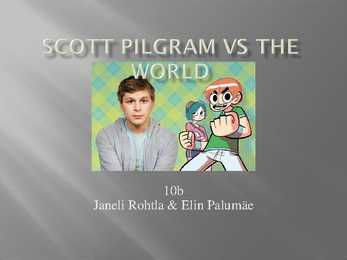
10b Janeli Rohtla & Elin Palumäe Directed by Edgar Wright Produced by Edgar Wright,Marc Platt, Eric Gitter,Nira Park Screenplay by Edgar Wright, Michael Bacall Based on Scott Pilgrim by Bryan Lee O'Malley Narrated by Bill Hader Budget $8590 million $60 million after tax rebates Gross revenue $47,566,905 Michael Cera Scott Anna Kendrick Pilgram Stacey Pilgrim Alison Pill Kim Pine Aubrey Plaza Johnny Simmons Julie Power "Young" Neil Nordegraf Mary Elisabeth Mark Webber Winstead Ramona Steven Still
When Bucky and Madeline are in the little room, there are shadows from blinds. In Film Noir blinds usually express restriction and make the audience feel that the room is like cage/prison. The lightning is surrealistic in many ways, it is used to create mood, not to represent life. It fuses expressionism. Developments in Noir include the fact that ``The Black Dahlia`` is set in colour, but usually, many Film Noirs were black and white. The closing scene (and this film in general) is narrated by Bucky and there is used much flashbacks like in the opening scene of ``LA Confidential``, in ``LA Confidential`` the narrator is a news reporter Sid Hudgens (played by Danny DeVito). The use of narrator, as an narrative device, is used in previous Film Noir-s like ``Double Indemnity``, too. The narrator is there to help audience to understand, what is going on and also to sympathise with the anti-hero, to be able to see his point of view and even be on his side
backpacking period as a moratorium from their life-paths at home (Maoz & Bekerman, 2010). As Jackie (English, 26), a former nurse in the army, noted of her expectations of her first trip: ‘I was hoping it would broaden my mind a bit, but nothing more than that. I certainly wasn’t expecting to make it a lifestyle. I intended to go home, but I don’t think that will happen now.’ Alec (Scottish, 34), who supported himself teaching yoga and managing a small budget beach resort, narrated how travel eventually became integrated into his self-concept: It’s exactly half my life I’ve been constantly travelling. I’ve got a base here in Thailand but I’m always back and forth, 17 years on the road. Maybe travelled about 43 countries. I think once you get used to this lifestyle, it becomes part of who you are. This perspective illustrates the actor-level intersection between self-concept and lifestyle
cannot be predicted with any certainty. One can hope only to foresee what is able and meet the unforeseen with dignity and resolution. That's the poem's deepest wisdom. A similar view of life is to be found in many other OE poems. 2. Chrst. Elem. In OE lit. The dream of the road. This poem stands supreme with its peculiar boldness and brilliancy. It describes not the biblical event itself but a vision or dream in which that event, the Crucifixion, is both symbolically represented and narrated by a participant. The functions of both symbol and narrator are performed by the rood, Christ's Cross. It first appears as a visionary symbol of overpowering mystery. It is a towering tree, at one moment covered in gold and jewels, at the next soaked in blood. But then the Cross begins to address the dreamer as an ordinary tree which got involved long ago in events which passed its own comprehension. This narrative of the Crucifixition is
characters with magical and surreal qualities, specific sense of humour and a melodramatic prose style, postcolonial element. The Satanic Verses (1988) – historical accounts of Indian history; caused outrage among conservative Muslims, who demanded Rushdie’s death. Midnight’s Children (1981). Narrated by Saleem Sinai, born in India at midnight 14/15th August, 1947 – independence declared from Britain. Actual historical context and events, combined with fictional elements. Magical qualities. Strives to challenge recorded history and retell it from an individual’s point of view. It
Their presence ensures verisimilitude to their narratives, and they, occasionally, add humorous touches that may also signal the author's (and her home readers') distancing from the narrated culture, people, and events. Dervla Murphy pays particular attention to the accurate transcription of some Romanian words and phrases (proper names of people and places, culture-specific items, greetings, very short fragments of direct speech, etc
The role of media and ideology. Humanist book-culture--technological stimulation of consciousness. Post war vs postmodern · Ethical, individualist existentialism, humanism vs skeptical, anti humanist attitudes · Realism vs anti-realism, deconstructivism, poststructuralist theory · Philosophico-emotional states of angst and absurdity vs coled, contradiciton-filled attitude · Mimetic engagements of traditionally narrated novel vs anti-narrative method · Coheret narrative suspense interest vs play of authorial language Postmodernism vs modernism · Modernism: enjoyable artistic embodiment, formal sophistication, art for the elite · Postmodernism interpretataive implications, play, not elitist-do not favour humour 14. Anthony Burgess. A Clockwork Orange as a satiric dystopia. The philosophy of free choice. Burgess's linguistic experiments. Anthony Burgess ,,a clockwork orange"
Their work shows a lot of initiative. Innovative adj. something newly introduced; creative n. innovator Syn. creative n. innovation This innovative project is worthy of support. There have been many innovations in the field of genetic engineering. narrate v. to tell a story; relate adj. narrative Syn. relate n. narrative n. narration n. narrator Walter Cronkite narrated the documentary film. Her fabricated narrative generated a lot of excitement. nevertheless conj. in spite of that Syn. nonetheless She was quite sick; nevertheless, she attended all of her classes. His project was flawed; nevertheless it won second prize. occasionally adv. now and then; once in a while adj. occasional Syn. sometimes n. occasion Extreme heat occasionally causes health problems.
Nevertheless, it is very poetic and popular. The first Estonian symphony was composed in 1908 as his diploma work in composition.1 The symphony marks the peak of his symphonic output, complete both in orchestration (triple scoring) and in form (four movements). Some instruments not regularly used were added (Piccolo, Cor anglais, Tuba and Harp). The work begins with a serious and noble introduction expressing tranquillity and vitality: Example 13. The main theme is wistfully narrated yet becoming excitable: Example 14. The subsidiary theme is lucid and warm, the emotion rising to passionate at times: Example 15. The concluding theme is jubilant. In the developmental process the main theme is always recognisable, the composer producing an extensive melodious breath. The vigorous culmination is put forward in the Coda; the introductory theme appears in the major key, having forged its way through the developmental process. Here are hope and power. Though some
 annaabi.ee