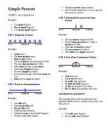
Leidsid 33 sarnast õppematerjali, mis on seotud failiga "Minu perekond - My family". Need materjalid aitavad sul teemat sügavamalt mõista.
other, ways, interest, ready, father, year, parents, years, interesting, apartment, mother, forty, doesn, times, profession, come, find, friend, place, brother, sometimes, something, local, interior, five, works, morning, paper, till, best, hope, photography, quite, before, retirement, move, teacher, there, important, living, consists, listen, sharegreatly benefit from this step-by-step approach to English grammar basics. This is the ideal supplement to your language arts program whether your students are native English speakers or beginning English language learners. Skill-specific lessons make it easy to locate and prescribe instant reinforcement or intervention. · Illustrated lessons are tightly focused on core concepts of grammar · Nearly 70 practice exercises are included for ready reinforcement · A wealth of examples are provided on every topic · Concise explanations are bolstered by extra grammar tips and useful language notes Book 1 Anne Seaton · Y. H. Mew Three Watson Irvine, CA 92618-2767 Web site: www.sdlback.com First published in the United States by Saddleback Educational Publishing, 3 Watson, Irvine,
Age 15 is legally a "young person" not a "child". Age 16 is a school leaving age. They can leave home, drive a moped, marry with "parents' consent" buy beer. Age 17 can drive a car. Age 18 can vote, get married, drink in pubs. Education is a very important part in the life of British youth. One can't become an independent person without it. When time comes to enter a college a young Englishman chooses one far away from home. It is a necessary part of becoming adult. During the last 30 years there were a lot of different trends in youth movements. All of them were characterized by their own philosophy, way of life, style of dressing. Each tendency was born by the influence of economic and political changes in the society. Those trends are known as the "hippies" the "punks" the "rockers". But certainly there are different traditional youth organizations in Great Britain. Among them -- the Scout Association, the Girl Guides Association, the National Union of
(NOT I think you have better see the doctor.) We'd better ask John to help us. 11. Use the present progressive am playing, is raining etc to talk about things that are continuing at the time of speaking. I'm playing very badly today. (NOT I play very badly today.) Look! It's raining! (NOT Look! It rains!) 12. Use for with a period of time. Use since with the beginning of the period. for the last two hours = since 9 o'clock for three days = since Monday for five years = since I left school I've been learning English for five years. (NOT I've been learning English since three years.) We've been waiting for ages, since eight o'clock. 13. Don't separate the verb from the object. VERB OBJECT She speaks English very well . (NOT She speaks very well English.) Andy likes skiing very much. (NOT Andy likes very much skiing.) 14. Don't use the present perfect have/has seen, have/has gone etc with words that name a finished time.
Chapter 21 Chapter 42 Chapter 1 It is a truth universally acknowledged, that a single man in possession of a good fortune, must be in want of a wife. However little known the feelings or views of such a man may be on his first entering a neighbourhood, this truth is so well fixed in the minds of the surrounding families, that he is considered the rightful property of some one or other of their daughters. "My dear Mr. Bennet," said his lady to him one day, "have you heard that Netherfield Park is let at last?" Mr. Bennet replied that he had not. "But it is," returned she; "for Mrs. Long has just been here, and she told me all about it." Mr. Bennet made no answer. "Do you not want to know who has taken it?" cried his wife impatiently. "You want to tell me, and I have no objection to hearing it." This was invitation enough. "Why, my dear, you must know, Mrs
accomplishes took off Transcript WB 01 10 think 3 heroic exploits 7 emulating Hmm. That's a very interesting question 11 didn't / didn't use to 4 subterfuge 8 surge ... Well, physically, I take after my mum, 12 say 13 don't / won't Challenge! Students' own answers I suppose. Our facial features are pretty similar same eyes, same-shaped 14 borrowed forehead. I've seen photos of her when
_ 2 She is an actress and often _________________________________ (appear) on television. _ 3 At the moment she _________________________________ (have) a rest because she is tired. _ 4 Mike is a doctor and he _________________________________ (live) in Manchester. _ 5 I _________________________________ (start) work at 8.30 every morning. _ 6 He is a good cook but she _________________________________ (prefer) to eat out. _ 7 English tests _________________________________ (get) more and more interesting. _ 8 They _________________________________ (have) a party because it's her birthday. _ 9 I sometimes _________________________________ (ride) my bicycle to school. 10_ She usually _________________________________ (go) to the gym on Friday evenings. Marks: /10 2 Choose the correct tense (present simple or present continuous) in these sentences.
topic of school. Both photos show page 4 6 He dropped a leaf into the water students in class. In the first photo I imagine that 1 1 ate and watched it drift under the they're about 13 years old. 2 have/'ve met bridge. It looks like a science lesson 3 have/'ve caught 7 As she got older, her health and judging by the students' 4 lived deteriorated
I leave your house, I tell you, quite disgusted; You do the opposite of my instructions; You've no respect for anything; each one Must have his say; it's perfect pandemonium. DORINE If . . . MADAME PERNELLE You're a servant wench, my girl, and much Too full of gab, and too impertinent And free with your advice on all occasions. DAMIS But . . . MADAME PERNELLE You're a fool, my boy--f, o, o, l Just spells your name. Let grandma tell you that I've said a hundred times to my poor son, Your father, that you'd never come to good Or give him anything but plague and torment. MARIANE I think . . . MADAME PERNELLE O dearie me, his little sister! You're all demureness, butter wouldn't melt In your mouth, one would think to look at you. Still waters, though, they say . . . you know the proverb; And I don't like your doings on the sly. ELMIRE But, mother . . . MADAME PERNELLE Daughter, by your leave, your conduct In everything is altogether wrong; You ought to set a good example for 'em;
Friends and Friendship I have several friends. But my best friend is Anette. Anette is a little younger than i am- 14. I first met Anette when i was 8 years old, but we didnt become friends at first. Our fathers used to work together, so we first met each other in my fathers office. We became friends about 3 years ago, when Anette came to my traning group. It had been 3 years since we last saw each other so i didnt recognize her at first, and Anette did not recognize me either. So we bacame true friends without knowing that we had known each other for many years already. We found out that our fathers are friends about two yeas ago, when they met each other in one of our competitons and later asked us if we knew that they used to work together. The thing I most like about Anette is her character. Our characters just fit together and we have almost nerver been in a fight
to write a novel. e) Thank you for helping me. It was very ……………. of you. f) Peter refuses to change his mind, although he is wrong. He's so ……………. g) It was very……………. of Sheila to put out the fire on her own. h) Our neighbours look down on us. They are a bit ……………. i) Don't eat all the cakes! You really are becoming……………. ! j) If you lend me the money, I'll be very ……………. k) I am very ……………. of my new motorbike. 1) My parents don't mind my crazy hairstyle. They are very ……………. 4. Use the word given in capitals at the end of each line to form a word that fits in the space in the same line. Jack's real character How easy is it to understand another person's character? My friend Jack, was once a rather (1) ANNOY person. He was always getting into trouble at school because he was so (2) OBEY. In class he was very (3)TALK and never stopped making jokes
· How do they differ? · Which extracts are examples of formal letters? · How is the reader addressed in a formal letter? · What are the closing remarks for formal letters? · What is the salutation in a friendly letter? · How would you end extracts 1,2,3 ? · How would you begin the extracts 4 and 5? 1. Dear Mr Miller, I received your kind invitation to the reception. Unfortunately, owing to other commitments. I will be unable to attend ... 2. Dear Ralph, l just got your invitation to the company's event. l `m afraid I can't make it because I've a/ready made plans which l can "t change ... 3. Dear Sirs, I am writing to complain about the poor quality of the items which I received from your company. I have no other alternative but to cancel the order which 1 placed earlier this week ... 4. ... thus, I recommend that you accept this advice on the matter
N: He had not been speaking. · sometimes interchangeable Q: Had he been with past perfect simple speaking? · putting emphasis on the duration or course of an action Future Simple A: He will speak. · action in the future that in a year, N: He will not speak. cannot be influenced next ..., Q: Will he speak? tomorrow · spontaneous decision assumption: I · assumption with regard to the think, probably, future perhaps A: He will be speaking
1271 Avenue of the Americas, New York, NY 10020 Visit our Web site at www.lb-teens.com First Edition: September 2005 The characters and events portrayed in this book are fictitious. Any similarity to real persons, living or dead, is coincidental and not intended by the author. Library of Congress Cataloging-in-Publication Data Meyer, Stephanie, 1973-- Twilight : a novel / by Stephanie Meyer. -- 1st ed. p. cm. Summary: When seventeen-year-old Bella leaves Phoenix to live with her father in Forks, Washington, she meets an exquisitely handsome boy at school for whom she feels an overwhelming attraction and who she comes to realize is not wholly human. ISBN 0-316-16017-2 [1. Vampires -- Fiction. 2. High schools -- Fiction. 3. Schools -- Fiction. 4. Washington (State) -- Fiction.] I. Title. PZ7.M57188Tw2005 [Fic] --dc22 2004024730 Printed in the United States of America For my big sister, Emily, without whose enthusiasm this story might still be unfinished.
for a particular purpose. No warranty may be created or extended by sales representatives or written sales materials. The advice and strategies contained herein may not be suitable for your situation. The publisher is not engaged in rendering professional sevices, and you should consult with a professional where appropriate. Neither the publisher nor author shall be liable for any loss of profit or any other commercial damages, including but not limited to special, incidental, consequential, or other damages. For general information on our other products and services, please contact our Customer Care Department within the United States at (800) 762-2974, outside the United States at (317) 572-3993 or fax (317) 572-4002. Wiley also publishes its books in a variety of electronic formats. Some content that
Ex. 7 p. 33 1. Katarina is not as older than her brother. 2. Towns are more as inconvenient than villages. 3. The journey was not as bad than it was last time. 4. The train is not as slower than bus. 5. London is not as smaller than Birmingham. 6. The country is much not as noisier than the city. Ex. 2 p. 34 Interview 1: Alex 1. Alex wants to have brothers and sisters. F 2. She likes being with adults. T 3. Her parents thinks she is spoilt. F Interview 2: Henry 1. Henry and his brothers like doing the same things. F 2. He has to look after his younger brothers. T 3. He would like to be the youngest child. F Ex. 3 p. 34 1. Alex spend most her time talking a phone and send text messengers. 2. Alex says she is ambitious and independent and little bit spoilt. 3. Henry feel his brothers was annoying his. 4. Ex. 7 p. 35 1 2
ESSAY about my family Everyone has his own definition of what is a family. The meaning of a family is different to every one of us. I think that the family in this point of view is one of the most important things in our life. If you have someone who can do everything for you and you can do the same you are lucky you have a family. I might say that I'm lucky. My lovely family consists of fourth members: mother, father, brother and me. I'm the youngest member in my family. We have pure love and affection for one another. My father live in Finland but he visit us once in a month and he stays here a couple of days. Mother, brother and I live in Anne street. My mother is the most important person in my life. She had done everything that I and my brother will have an amazing life. She only wants the best for us! My brother is four years older than me
opportunities available." You might even like your new role so much that your partner decides to copy you. When Chris Oldale, 43, an HR manager, went on a taster course about becoming a gas engineer, he took his wife, 49, along. "What I had not expected was to see her getting stuck in with a blowtorch. She wound up liking it so much that she gave up her IT job to join me in my career change." The same happened with Annie and Paul Clayton, both 42. "We both worked in the police for nearly 20 years," says Annie. "But Paul had become disillusioned and had a friend who was a tree surgeon. He started helping him out and he loved it, so he gave up the police. I'd turn up with sandwiches and realised I loved it too, so now we run a business together." Some of the most successful career changes come out of pursuing a hobby, as Bob Jennings, 53, knows all too well. Having been offered redundancy from a laboratory
More praise for Influence: Science and Practice! "We've known for years that people buy based on emotions and justify their buying decision based on logic. Dr. Cialdini was able, in a lucid and cogent manner, to tell us why this happens." --MARK BLACKBURN, Sr. Vice President, Director of Insurance Operations, State Auto Insurance Companies "Dr. Cialdini's ability to relate his material directly to the specifics of what we do with our customers and how we do it, enabled us to make significant changes. His work has enabled us to gain significant competitive
This one is full. I certainly didn’t expect such a beautiful present! He was late, of course. 3 Position of Adverbs Adverbs of Manner normally come 1. 1) at the end of a statement: Since then I have answered all the letters personally. 2) in shorter sentences they can stand in front of the verb: He quietly shut the door. 3) but after the verb to be Mary is frequently late. 2. before Adjectives and other Adverbs: reasonably cheap (adverb + adjective) terribly sorry (adverb + adjective) incredibly quickly (adverb + adverb) It’s a reasonably cheap restaurant and the food is extremely good. I’m terribly sorry. I didn’t want to hurt you. Maria learns languages incredibly quickly. 3. before a Past Participle (injured/organised/written etc.): Two people were seriously injured in the accident. The meeting was very badly organised.
Catherine Morland My name is Catherine Morland. I would like to tell you a bit about myself. To begin with, I am seventeen years old and grew up in a countryside in a small town named Fullerton with my parents and nine siblings. As a child I was interested in many things like drawing, sports and music. I was very lively and cheerful, enjoyed cricket, horse riding and just hated cleanliness and restriction. As I grew up, I chose reading over sports and all of the wild games I used to like. Undoubtedly, I would now describe myself with the word naivety. I am very naïve and do not notice the most obvious things happening around me. I really hope that it
The main question is what makes a human being happy? In my opinion, as a person claims that he is happy, then we can firmly say that this person is successful in life because he feels content with his life. Contentedness and happiness are the key factors in determing how succesful someone is. It is often said that for a small town inhabitant, it is a lot harder to achieve something in life. I totally disagree with this statement. There are just other values in a town with a small population density. Values concerning family life are coming more forth, career and such kind of personal ambitions are kept in the backround. Also it is often mentioned that making a successful career in a small town is largely impossible, because of the lack of different resources and opportunities. By these it is commonly ment a uncompetitive education and few opportunities to develop extracurricular activities. In my opinion it is again a misunderstanding
and where they originated, and what should be considered the first book in the world. Ancient document, written on parchment, papyri and vellum can hardly be qualified as books the way we understand the word today. Centuries went before paper replaced parchment and papyri. In the 15 th century Johann Gutenberg invented a mechanical process of duplicating texts, which we today call book printing. The first book was printed between 1444 and 1446, so these years can be considered as the beginning years of book printing. His most important preserved printings are the 40 copies of the Bible. By the end of the 15 th century there were about 1000 print-shops in Europe already. The oldest Estonian book dates back to 1535. Libraries form a vital part of education. They make available-through books, films, recordings and other media- knowledge that has been accumulated through the ages
Mary........blue eyes and blond hair, but her brother ........dark hair. He ........in his late twenties. He........married and........two sons. I........short, but my sister........tall. We........a dog and a cat. Our uncle........two dogs. They........brown. 2. Choose the correct item. ( 5 points ) e.g. The residents were made...D....their homes by the authorities. A leave B leaving C left D to leave 1) Ann is my best friend! We........each other for years A know B knew C knows D have known 2) Nicky........to San Francisco when the accident happened. A flies B has flown C was flying D has been flying 3) Why don`t you let her........her story? A finish B to finish C finishing D have finished 4) Tim........in a cafe at present, but he has already applied for a new job
beach every day. = house) Look at the boy in the blue shirt over there. (the boy I am pointing at) = • because we have already mentioned it: A woman who fell 10 metres from High Peak was lifted to safety by a helicopter. The womanfell while climbing. The rescue is the latest in a series of incidents on High Peak. In January last year two men walking on the peak were killed in a fall. We also use the definite article: • to say something about all the things referred to by a noun: The wolf is not really a dangerous animal (= Wolves are not really dangerous animals) The kangaroo is found only in Australia (= Kangaroos are found only in Australia) The heart pumps blood around the body. (= Hearts pump blood around bodies) We use the definite article in this way to talk about musical instruments: Joe plays the piano really well
The couple leave for Europe - leaving behind Anna's son Seryozha - without obtaining a divorce. Much more straightforward is Stiva's matchmaking with Levin: a meeting he arranges between Levin and Kitty results in their reconciliation and betrothal. Part 5 Levin and Kitty marry and immediately go to start their new life together on Levin's country estate. The couple are happy but do not have a very smooth start to their married life and take some time to get used to each other. Levin feels some dissatisfaction at the amount of time Kitty wants to spend with him and is slightly scornful of her preoccupation with domestic matters, which he feels are too prosaic and not compatible with his romantic ideas of love. A few months later, Levin learns that his brother Nikolai is dying of consumption. Levin wants to go to him, and is initially angry and put out that Kitty wishes to accompany him
........................................................183 The New Earth Is No Utopia.....................................................................184 Notes...........................................................................................................186 About the Author........................................................................................189 CHAPTER ONE THE FLOWERING OF HUMAN CONSCIOUSNESS EVOCATION Earth, 114 million years ago, one morning just after sunrise: The first flower ever to appear on the planet opens up to receive the rays of the sun. Prior to this momentous event that heralds an evolutionary transformation in the life of plants, the planet had already been covered in vegetation for millions of years. The first flower probably did not survive for long, and flowers must have remained rare and isolated phenomena, since conditions were most likely not yet favorable for a widespread flowering to occur
Source: Feedbooks 1 About Shakespeare: William Shakespeare (baptised 26 April 1564 – died 23 April 1616) was an English poet and playwright, widely regarded as the greatest writer in the English language and the world's pre-eminent dramatist. He is often called England's national poet and the "Bard of Avon" (or simply "The Bard"). His surviv- ing works consist of 38 plays, 154 sonnets, two long narrative poems, and several other poems. His plays have been trans- lated into every major living language, and are performed more often than those of any other playwright. Shakespeare was born and raised in Stratford-upon-Avon. At the age of 18 he married Anne Hathaway, who bore him three children: Susanna, and twins Hamnet and Judith. Between 1585 and 1592 he began a successful career in London as an actor, writer, and part owner of the playing company the Lord Chamberlain's Men, later known as the King's Men. He ap-
she treated it that way. Thank you, Martha! To Victoria Colotta, for all her hard work on the interior design and typesetting. She took my plain text and made it gorgeous. Thank you, Victoria! To Tera Kleinfelter, who read the first half of Bared to You and told me she loved it. Thank you, Tera! To all girls who were at Cross Creek at some point in your adolescence: May all your dreams come true. You deserve it. And to Alistair and Jessica, from Seven Years to Sin , who inspired me to write Gideon and Eva's story. I'm so glad the inspiration struck twice! 1 "We should head to a bar and celebrate." I wasn't surprised by my roommate's emphatic pronouncement. Cary Taylor found excuses to celebrate, no matter how small and inconsequential. I'd always considered it part of his charm. "I'm sure drinking the night before starting a new job is a bad idea." "Come on, Eva
THE CAPITALIST NIGER Chika Onyeani ………………………Every African must internalise this book - period….DAA INTRODUCTION In October 1960, Nigeria received its independence from Britain. By then, Ghana the former Gold Coast had been independent for three years under the great Osagyefo Kwame Nkumah. It was a time for celebrating Africa’s coming of age, as more and more African countries received their independence either from Britain or France. It was especially a poignant time for Africa, as then British Prime Minister Harold McMillan articulated his now famous “winds of change” sweeping Africa. We had high hopes for Africa, for the Black race, that the insidious imposition of foreign rule on us, the looting of Africa’s
Lohkva, Luunja vald Tartumaa 62207 --- 3 xxx 1. The Big Apple 1. Write the verbs in the present continuous or the past continuous tense. Do you remember? am is are was were verb -ing 1 Sorry. I ... (write) a report at the moment. I can't come with you. 2 When Peter arrived, his friends ... (play) football. 3 I ... (sleep) when the alarm went off in my sister's room. 4 Dad's mobile phone is switched off because he ... (fly) to Paris. He's on the plane at the moment. 5 I ... (read) an interesting book. It's a collection of memories. 6 Leo was late again. He ... (step) out of his father's car when the bell rang. 7 Helen ... (lie) on the sofa when an ambulance stopped in front of the house. 8 I ... (give) this report from inside the school radio studio. Right now, the two teams ... (take) their places on the football field. 9 Mrs Watson ... (make) her speech when the girls rushed in. --- 4 2. Write the verbs in the past simple, the future simple, or the present perfect tense.
· You are watching TV. · Are you watching TV? · You are not watching TV. USE 1 Now Examples: · I am meeting some friends after work. · I am not going to the party tonight. · Is he visiting his parents next weekend? · Isn't he coming with us tonight? Examples: USE 4 Repetition and Irritation with · You are learning English now. "Always" · You are not swimming now. · Are you sleeping? · I am sitting. · I am not standing. · Is he sitting or standing? · They are reading their books. Examples:
"Not that he deserves any sympathy. The man's an ass." "Nothing of the kind. A most intelligent young man, as young men go." "Young? Would you call him young? Fifty, I should have said, if a day." "Are you out of your senses? Heacham fifty?" "Not Heacham. Smithers." 4) "Are you employed on a farm?" "I was employed on a farm." "Pigs?" said Lord Emsworth in a low, eager voice. "Among other things." Lord Emsworth gulped. His fingers clutched at the tablecloth. 5) "Hullo, guv'nor" "Well, Frederick?" "How are you feeling?" "Extremely ill." "Might have been worse, you know." "Bah!" "Watery grave and all that." "Tchah!" 6) "I'll er I'll think it over, McAllister." "Mphm." "I have to go to the village now. I will see you later." "Mphm." Meanwhile, I will er think it over." "Mphm." 7) "Well, McAllister
Disney company and as a teacher of story construction have been through a fresh battery of challenges in the real world that I hope have made them stronger. T h e new chapters of this book will, I hope, reflect some of the ideas that have continued to evolve around the Hero's Journey concept. T h e r e are new chapters on the life force operating in stories, on the mechanism o f polarity that rules in storytelling, on the wisdom of the body, catharsis, and other concepts that I have developed in recent years in my lectures and in practical work in H o l l y w o o d and in Europe. I have gathered together this new material near the end of the book, in an appendix following "Looking Back on the Journey." In the nine years since the last edition, I have traveled widely, applied my ideas to writing, publishing, and producing projects of my own, and done a few more "tours of duty" as it were for major H o l l y w o o d studios
 annaabi.ee