Leidsid 33 sarnast õppematerjali, mis on seotud failiga ""Learning and speaking foreign languages.."". Need materjalid aitavad sul teemat sügavamalt mõista.
language, foreign, languages, important, know, english, learning, difficult, them, useful, other, workers, gives, open, doors, process, certainly, ability, good, employer, prefer, same, besides, native, stand, others, advantage, russian, finnish, places, even, compulsory, opportunity, find, whole, loves, travel, country, survive, importance, seenWhy learn foreign languages Everyone knows that nowadays English is the most common language in the world. For that reason, it is extremely important for young people to improve their skills and to learn as much as they can of, this important language. To begin with, speaking foreign languages allows you to travel wherever you want without any problems. If you are visiting a place far away, it would probably be useful for you to know a little bit of English or some other languages. For example, if you get lost in a strange country you could ask somebody for information without any problems. Furthermore, having a good knowledge of different languages could help you to find jobs. These days, it is always more common to find businesses which are looking for a good English or some other languages speaker. In addition, it could be important for you to learn language if you are interested in studying abroad
Everyone should be made to learn English Everybody knows their own language, but it is useful to know foreign languages. In present society we have to, at least, know basic English, because nowadays it plays a major international role and everything is based on English. Nowadays you can go almost everywhere and you can (make through everything when you know some English. For example; It is a whole lot easier to find a job, read English literature in the original. If you know the language of the country, where you're travelling to, it will be easier to go there. Knowledge of foreign languages helps us to develop friendship and understanding among the other people and it is easy to find and visit such camps and speak with people who do not know Estonian. Also you can read something and also understand films without any help. I find that English connects different people and helps us to feel like a big
My languages I love different languages. I mean, I really, really love different languages. I also believe and have been told that I pick them up rather easily. That might be true, although I did not pick any Greek up in Greece but that might have been because they spoke so damn fast that I could not tell if it was a word or an entire sentence. The first foreign language I learned was Russian. Considering I was ten when Estonia became a Republic, it makes sense. We began studying Russian in first grade, though it was simplified – "koška" instead of "kot", "medvešonok" instead of "medved", "saichik" etc. Did not make much sense and we mostly played some games in Russian (Tare-tareke etc). Learned as much playing outside, since we had Estonian-Russian kids around as well. Not that we played with them. It's sad
To give an answer by topic I decided to hear the views of other people. I was published a topic in Facebook. The theme was "How to survive in Estonia. Guide for foreigner". Analyzing the answers I see the stratification of society, where one side is set extremely negative, but I am glad that there are positive opinions about living in Estonia. But everything in order: The first group of people are inclined to say that in Estonia is difficult even for local people and what to say about those who come from abroad. The problem is particularly acute elderly (old people). Their pensions are small, wherefore they are often forced to work. When people say about government, they responds terms like "corruption" and "incompetence". It is sad to state the fact that the percentage of dissatisfied respondents is higher than the percentage of people who satisfied of their life. The second group of people are more positive
Tallinna Mustamäe Humanitargümnaasium Valeria Jefremenkova ENGLISH AS A GLOBAL LANGUAGE INGLISE KEEL KUI ÜLEMAAILMNE KEEL Research work Supervisor: Jevgenija Kozlova Tallinn 2016 1 Table of Contents СONTENT…………………………………………………………………………………...2 INTRODUCTION…………………………………………………………………………...3
English is the only foreign language worth learning Every people should speak some foreign language. Knowing different languages is important, we can communicate with other people around the world. But is English the only foreign language worth learning? English is one of the most important languages in the world. It helps us to communicate with other people. If you know English then you have a better chance to get the work you want. You have a better chance to work and make a career. When you go to traveling, then English is the best language to speak. You can speak English almost everywhere you go. People should learn some other languages too. In some countries people don’t speak English, they have their own mother language, so they don’t speak other languages inluded English. For example if you live in Estonia you should know well Russian. I think that in
To Protect or not Protect Minor Languages Minor language is a language that is spoken in a minor area in a territory. For example Estonian is a minor language, because it has so little amount of speakers, just over a million comparing to German that has at least 100 million native speakers. Many minor languages have been mixed together or been developed from other languages. I think that the minor languages should be protected, because with languages come with a part of culture and if we terminate the variety of cultures that have developed throughout the evolution of mankind then the world would be boring. There would be no languages to learn, no foreign songs to sing and no joy of knowing that you can speak to a foreigner in his mother tongue. Also people are more friendly and open to you if they can speak freely in their mother language. But not protecting the minor languages can also be a good thing. As we know the world is
Why we learn the english language? It is necessary to learn foreign languages. That´s why the pupils have such subjects as a foreign language at school. Everybody knows his own language, but it is useful to know foreign languages. I learn English, because I understand that I can use it. For example, if I go to England I shall be able to speak English there. If I go to the USA, I shall speak English too, because English is used not only in England, but also in other parts of the world. I leran English because I want to read foreign literature in the original. I know and like such English as Ch.Dickens, M.Twain, L.Carroll and others. I understand that I must learn English. If I know English well, shall be able to go to the library and take books by English and American writers in the original. I like to travel. But it is difficult to visit countries, when you don´t know the language of these countries
Me and languages. To begin with, language is a congrecation of thoughts and feelings through a system of signals, such as voice sounds, gestures, or written symbols. Communication or language is a process every child learns from birth and during our life we will usually learn many different languages. Due to the fact that both of my parents are Estonians , my mother tongue is Estonian, therefore I can speak and write in it very fluently. I also prefer read the books in Estonian. I know that some people like to do it in some other languages, in English for instance. I am really amused by the Estonian literature. I like to read books and stories from Andrus Kivirähk and F.R
Me and languages Nowdays it is very common that one person can speak more than one language. There are people who have to learn different languages at school and people who do it , beacause they want to educate themselves. I think that every person should speak at least 3 languages. My mother tongue is Estonian. I can speak and write it very fluently. I like to read books in estonian and listen songs in Estonian. I know some people who prefer to do it in English. But for me it is more enjoyable to do it in my mother tounge. English is one of the most common languages in the world. Therefore it is very important to speak it. I started learning English in the third grade like most of the students. Before the lessons at school I had already learned the basic of English. My sister is older than me and I was really interested in studying with her. Also very helpful things were cartoons and hollywood films. In everyday life I use English very
Essey How does the United States influence Estonia? The United States of America with it's global economic and political superpower is one of the most influential countries in the world and therefore it’s influence can also be felt in Estonia. Fluctuations in Estonia’s status as an independent country have had significant impact on the amount of influence from other countries, whether it is the language, eating habits or lifestyle. But how has United States influenced Estonia after we gained our independence? Estonia is not economically dependent on the United States as they are not one of our most important trading partners, but as the economics of the United States has a great influence on the world economy, they can still indirectly have an influence on Estonian economy. In Estonian politics the influence of the United States can be seen the most in relations with NATO
Why Languages? Languages are very important nowadays. There are more than seven thousand languages in the world. Some of the languages are more widely spread than others like English, German and Mandarin language. It is important to learn languages because people travel a lot and then the communication is easier. In the world there are so many languages and it is impossible that we could speak them all. That's why there are some dominant languages. I think one of the most spoken languages is English, because so many people in the world can speak it. Some foreign languages are taught in very young age children. For example in Estonian children learn in school German, Russian and English. Main is English. Main reason why English is so widely spread is because many young people learn English. So when you travel, English is main language you should speak. And it´s good when there are
By these it is commonly ment a uncompetitive education and few opportunities to develop extracurricular activities. In my opinion it is again a misunderstanding. I am at the moment eighteen years old and I have spent all my life in a beautiful small town called Tartu. From the early age I have been interested in photography and the world in general. Photography is a pretty expensive hobby and starting with it was quite difficult in the beginning. I had to take photographs with really poor cameras and more than once I heard how somebody was laughing over me because of my uncompetitive equipment. Still I remained selfconfident and full of determination. Time passed and I had enough money to buy a bit better camera and from this point, things started to go uphills. By the present moment I have achieved good results in different competitions and I am working as a photographer for two youth magazines
They say it's unimaginable, boring, tasteless, it's chips with everything and totally overcooked vegetables. The basic ingredients, when fresh, are so full of flavour that British haven't had to invent sauces to disguise their natural taste. What can compare with fresh pees or new potatoes just boiled and served with butter? Why drown spring lamb in wine or cream and spices, when with just one or two herbs it is absolutely delicious? If you ask foreigners to name some typically English dishes, they will probably say "Fish and chips" then stop. It is disappointing, but true that, there is no tradition in England of eating in restaurants, because the food doesn't lend itself to such preparation. English cooking is found at home. So it is difficult to a good English restaurant with a reasonable prices. In most cities in Britain you'll find Indian, Chinese, French and Italian restaurants. In London you'll also find Indonesian, Mexican, Greek..
'How are you?' Very often people expect you to say something positive. Here's a breakdown of how you can express how you really are without complaining too much. · Fine, thanks. / On top of the world, thanks. · OK, thanks · Not so bad, thanks. / Can't complain, thanks. · So so, thanks. / So and so, thanks. · Not so good, actually 1 The English alphabet Spelling Work with your partner and spell out first your name and then some names of places. Write down each letter as you hear it, and then say the word. The English alphabet on the phone: You might find the following alphabet (used by international airlines) useful when trying to spell a word on the telephone. A Alpha O Oscar Ä Alpha-Echo Ö Oscar-Echo
Private School of Audentes Links between English speaking countries and Estonia Author: Kristin Liiv Supervisor: Mari Martma Tallinn 2006 2 Table of contents Introduction..........................................................................................................................4 First links............................................................................................................................. 5
http://www.tandfonline.com/loi/rmps20 When `we' are `the other'. Travel books on Romania as exercises in intercultural communication a Rodica Dimitriu a Department of English , Alexandru Ioan Cuza University of Iaþi , Romania Published online: 06 Aug 2012. To cite this article: Rodica Dimitriu (2012) When `we' are `the other'. Travel books on Romania as exercises in intercultural communication, Perspectives: Studies in Translatology, 20:3, 313-327, DOI: 10.1080/0907676X.2012.702400 To link to this article: http://dx.doi.org/10.1080/0907676X.2012.702400 PLEASE SCROLL DOWN FOR ARTICLE
modest. But sometimes I can lose my tempo and become either angry or sad. I like staying alone and sometimes I retire into my shell. But at the same time I like my friends, I like to laugh and joke. I have got a sense of humour. It means I understand humour and appreciate it. There are many things in our life I like and some I dislike. I like when everything is OK. Being happy is one way of being wise. I like to study because knowledge is useful sometimes. I'm fond of reading as it gives not only knowledge, but wonderful moments of joy and pleasure. I am neither short nor tall, so I like to wear highheeled shoes, trousers or jeans. I was born on the 25th of April 1985 in the town of Molodechno where I live now together with my parents and my younger sister (older brother). My early years which I remember badly, were typical of a child living in a town. I was born in a family of a teacher and a doctor. I was sent to a
They can help and assist us if we need some technological help. Another thing is that in schools, in classes generally students are not allowed to use their appliances, so it means they have to communicate verbally as well. I think that teachers should be creative to blend so-called digital learning/teaching with old-fashioned learning/teaching. · Sir Ken Robinson: Do schools kill creativity? Sir Ken Robinson claims in the clip that " creativity in education is as important as literacy, we should treat it with the same status." I totally agree with all what he said. We have very strict education systems that don't allow a room for mistakes and they categorize people based on their achievements in exams. There is nothing like potentials, creativeness, possibilities or even 2nd chances. Families put high expectations on academic achievements and they always compare their kids with other's kids. A minority in
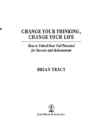
I would like to thank my editor, Matthew Holt of John Wiley & Sons, for his unflinching support of this book, and his constant en- couragement over the many months that it has taken to write and edit. Not least, I thank my wonderful wife Barbara and my fabulous children—Christina, Michael, David, and Catherine—for their sup- port and patience during the long hours away from them to finish this book. xi ccc_tracy_fm_i-xviii.qxd 7/7/03 3:23 PM Page xii ccc_tracy_fm_i-xviii.qxd 7/7/03 3:23 PM Page xiii Introduction There is nothing on earth that you cannot have once you have mentally accepted the fact that you can have it.
Education Education is so multifaceted that it is difficult for me to know where to begin discussing it, or how to prioritize the many factors. Relaying my own experience is easy: I had a standard classroom approach, supplemented by inordinate reading. In only the briefest and least memorable instances did I receive any individual tutoring. Education is commonly thought of as the job of schools. Adults cry "educate our children!" Everyone has opinions about the best way to do the job. It is of urgent importance, and all the
English structure revision for the exam 1. Terms Language → A systematic, conventional (tavakohane) use of sounds, signs or written symbols in a human society for communication and self-expression. Human language at all levels is rule- or principle- governed (valitsema) meaning that language corresponds to the grammar. Natural language is usually spoken, while language can also be encoded into symbols (such as letters, morse etc) For example: Estonian, English. Linguistics → The scientific study of human natural language. Broadly, there are three aspects to the study which are Pragmatics (studies the use of language → interested in the gap between the sentence’s meaning and the speaker’s meaning). Semantics (concerned with the meaning of the language aspects and the way they change, also how objects and language and thinking and language are related).
...................... 2 Global Problems ........................................................................................................................................ 3 Health and fitness ..................................................................................................................................... 3 Jobs and employment ............................................................................................................................... 3 English speaking countries ........................................................................................................................ 3 Food And Drink ......................................................................................................................................... 4 Exam House and Home I live in the center of Tallinn. In villardy street, it is near Kristiine. I have a very nice flat there with four rooms
My future career. I often think about my future plans and career. Now I am studying at the secondary school. But after finishing school I try to enter at the university. It is very difficult for me to make the right choice of my future profession. There are many different professions and you can find exactly that which interests you. For example, waiter, manager, actress, lawyer, doctor and so on. To decide, what kind of work suits me, helps communication with adults, meetings with representatives of universities and large selection of useful literature. Also I need to think about how well I can do what I would like to do.
Diplomat Diplomat's job isn't that easy. You have to be well educated. Knowledge in languages have to be high and you have to speak the language very well if not fluently. Everytime you change country, it is required to know basic things about it, like language, history, differences and so many other important things. In Estonia you can learn how to be a diplomat in Diplomatic School. It is very difficult to get in because every year they accept only around 30 students. You have to be flexible in your working hours because probably with the job you have to attend a lot of meetings or gatherings in the evenings. Conditions might be different depending on the country you are staying, like in America you'll probably have very good living environment, but if you have to compare it wiht Ukraine or Belarus then there are differences
the cost of losing the identity of smaller nations. Problems of 21th century city The cities of the 21th century are the biggest mankind has created besides incorporating newest technological innovations, however, even despite all the advanced technological applications, modern metropolises have many of the same problems as cities 200 years ago. Only this time around these issues are even greater due to the size of cities, so what are the two biggest problems? One of them is most likely going to be overpopulation, which is inevitable due to the overall growth of the human population and urbanisation. However, that is not all, as pollution levels are on the rise and with like everything else, the bigger the city, the bigger the problem. These matters are the results of multiple factors, thus in order to solve these issues, multiple coherent solutions are called for. The first problem is the result of growing human populous of Earth; this can be halted only
) We'd better ask John to help us. 11. Use the present progressive am playing, is raining etc to talk about things that are continuing at the time of speaking. I'm playing very badly today. (NOT I play very badly today.) Look! It's raining! (NOT Look! It rains!) 12. Use for with a period of time. Use since with the beginning of the period. for the last two hours = since 9 o'clock for three days = since Monday for five years = since I left school I've been learning English for five years. (NOT I've been learning English since three years.) We've been waiting for ages, since eight o'clock. 13. Don't separate the verb from the object. VERB OBJECT She speaks English very well . (NOT She speaks very well English.) Andy likes skiing very much. (NOT Andy likes very much skiing.) 14. Don't use the present perfect have/has seen, have/has gone etc with words that name a finished time. I saw him yesterday. (NOT I have seen him yesterday.)
Why? I don't think so. I don't eat any especial things like prawns, unusual animal meat and so on. My eating choice is quite ordinary. And I think that I don't want to try out any animal meat. I think that it's distasteful. 3. What do you consider a healthy diet? I think that healthy diet is quite good choice to reduce weight. But I think that certainly the human who want to have a healthy diet must do the healthy diet in doctor directed. Sometimes the healthy diet is more harmful than useful. But I support that. 4. Do you prefer buying Estonian food to imported food? Yes, I do. That because then I know what I'm eating. Sometimes the imported food is not very clean. Imported food consist many preservatives and toxics. It's not very healthy. But sometimes the Estonia food choice is quite small. Sometimes we must buy food what is imported to our country. 5. Which Estonian foods would you export? Why?
6 have/'ve known interested and it looks as though shipwrecked three times. 7 walked they are working hard. Most of She was lucky because she survived 8 have you phoned them are looking at the experiment each of the three disasters. 2 1 written 8 was trying and working together. They are 4 1 D 3 F 5 G all wearing uniform it's quite an 2 been meaning 9 came
LEL 2E Notes on Vocabulary One of the key facts about the lexicon of any language is that it reflects in various ways the physical and cultural environment in which the language is spoken. A people unfamiliar with, say, horses is unlikely to have a word for `horse'; similarly with ploughs, printing presses, and internet porn sites. For the most part this is trivial it's hard to imagine how it could be otherwise, given the general nature of human language. People tend to make a great deal of the alleged fact (see Pullum 1989) that "the Eskimos have lots of words for snow", but it doesn't take much thought to realise that any language spoken in a given physical and cultural environment is likely to have efficient ways of referring to distinctions that are important in that environment. That doesn't mean that you can read very much into individual words and individual facts about the lexicon of a given language (this topic has
Changing career: 'These days, I go home feeling relaxed' Starting a new career is a daunting prospect for many. But Kate Hilpern discovers that plenty of help is at hand Some of the jobs that career changers are most keen to break into PR and teaching, among them are the very same jobs that people are queuing to get out of, says John Lees, author of How to Get a Job You'll Love and Take Control of Your Career. Many of us get to the point, whether in our twenties, thirties, forties or fifties where we decide to change careers. Some of us will make radical changes, while others will move to the edge of their comfort zone, perhaps shifting from acupuncturist to homeopath or PR office to journalist
noticed when I was born! 3 1 Laura was offered a place at much. Personality-wise, I've got a lot of my Manchester University but she dad's traits in me. We're both quite bubbly and friendly (or so people 1C The origins of English turned it down. page 5 2 Whilst some people are in favour say), and we share quite a laid-back of the monarchy, others think we approach to life. When it comes to 1 1 Anglo-Saxon 8 Conquest
Essay: People gain a lot from foreign travel There is a saying that many people gain a lot from foreign travel. In myopinion, it is certainly true. Every person tries to travel as much as possible. There is a huge number of advantages of foreign travel and I would like to describe some of them. One of the significant benefits is knowledge that we gain from travelling. It is quite an expensive hobby and poor people can`t afford it. They are not able to get experience in different foreign cultures because such people do not travel at all. Every culture differs from another and it is not possible to learn all of them. But everyone should try to see the difference between our and foreign culture. Furthermore, learning from travelling is more interesting and funny than learning at home. Moreover, one particular thing about culture is the unique food. Foreign cuisine has a big variety of cooking methods from the unusual ingridients. Obviously, all travelers prefer to experience it
 annaabi.ee