Introduction The United States of America is a very big country. Its territory is about 9.4 million square kilometres and its population is more than 260 million people, 12% of them are the Afro-Americans. It is the world's third-largest country by size and by population. The population density is about 27 people per square kilometre. Most of the people live in towns. There are 50 states in America. The biggest of the state is Texas, next by size are California, Alaska and Montana. Six states - Maine, Vermont, New Hampshire, Connecticut ,Rhode Island and Massachusetts are called New England. They are all small states in the U.S. that lie in the north-east. The first colony of immigrants settled down in Virginia, in the eastern part of the U.S.A. The biggest cities are New York, Washington, Chicago, Los Angeles, San Francisco, etc. The official language of the USA is English; Spanish is also...
Water pollution Water pollution is the contamination of water bodies such as lakes, rivers, oceans, and groundwater caused by human activities, which can be harmful to organisms and plants and for all of us. First, we have to talk about the causes of water pollution. Domestic households, industrial and agricultural practices produce wastewater that can cause pollution of many lakes and rivers. Industry is a huge source of water pollution, it produces pollutants that are extremely harmful to people and the environment. Dumping of litter in the sea can also cause huge problems. Different items take different lengths of time to degrade in water. Oceans are polluted by oil on a daily basis from oil spills, everyday shipping and dumping. Secondly, it is very significant to know about dangers of water pollution. Virtually all types of water pollution are harmful ...
Taking up cycling instead of using a car is too dangerous in cities. It could be argued that taking up cycling is very healthy for people. It supports people more to move and it is like doing a sport. Besides it is very good for environment. Thanks to using bicycles cities air will be cleaner and air is not such impure. Thanks to cleaner air people's can breathe better air. This is partly true, but taking up cycling instead of using a car is really more dangerous than use only cars. Thanks to taking up cycling traffic will go busier and messier. There is much different kind of movers in traffic and it makes traffic really dangerous. It is clear that it is not too dangerous. There are many cities where cycling is very popular, for example in Copenhagen. If this method will be chosen, city needs to build special cycling roads. Thanks to these roads traffic should be safer. More energy is used up taking items to re...
Estonia Where it is? Republic of Estonia is a state in the Baltic region of Northern Europe .It is bordered to the north by the Finland, to the west by the Baltic Sea, to the south by Latvia (343 km), and to the east by lake Peipus and Russia (338.6 km). Across the Baltic Sea lies Sweden in the west and Finland in the north. Towns Tallinn is the capital and the largest city of Estonia. It lies on the northern coast of Estonia, along the Gulf of Finland. There are 33 cities and several town-parish towns in the country. In total, there are 47 linna, with "linn" in English meaning both "cities" and "towns". More than 70% of the population lives in towns. History • Estonia was settled near the end of the last glacial era, beginning from around 8500 BC. Before the German invasions in the 13th century proto-Estonians of the Ancient Estonia worshipped the spirits of n...
Canada. Canada is a very big country in the continent of North America. It is about 10 million square kilometres and that makes it the second largest country in the world after Russia. Quebec (the province) is six times as big as the UK. Canada borders the Atlantic Ocean, the Pacific Ocean, the Arctic Ocean and the USA. The capital of Canada is Ottawa and other main cities are Toronto, Montreal and Vancouver. It is a very developed country. Montreal is the largest city and it is called the Paris of North America because most of the people there speak French. The population of Canada is 28 million people. It is a very multicultural country. People from many different countries have come to live there. The natives are Eskimos and Indians. Eskimos have their own self-governing homeland called Nunavut. In Canada there are also 2 official languages English and French. One third of th...
Geography New Zealand is an island country in the Southwest Pacific Ocean. It lies about 1600 kilometres southeast of Australia, its nearest continental neighbour. New Zealand belongs to Polynesia, a large island group. The country consists of two main islands The North Island and the South Island and several dozen much smaller islands. The population is 4.1 million. New Zealand is a beautiful country of snowcapped mountains, green lowlands, beaches and many lakes and waterfalls. No place is more than 130 kilometres from the coast. Lakes, rivers, and waterfalls are found throughout New Zealand. Most of the lakes lie in the volcanic plateu of the North Island and in glacial valleys near the Southern Alps of the South Isaland. On both islands the rivers rise in the mountains and flow down to the sea. The rapid flow of New Zealand's rivers makes them important sources of hydroelectric power. New Zealan...
Table of contents 1. Introduction 2. Geographical position 3. Mountains, lowlands 4. Rivers, lakes 5. The territories and provinces 6. Towns, economy, agriculture 7. Climate 8. Animals, plantlife 9. Population 10. Sports 11. Culture 12. History 13. Political system, symbols 14. Conclusion 15. Materials 1. Introduction If you had to use two words to describe Canada, they might be large and diverse. Canada is the second largest country in the world, bordered by three oceans, and across the country, Canadians experience many different landscapes from rolling plains and mountains to the cold tundra of the north. Despite Canada's great size, it is one of the world's most sparsely populated countries. This fact, coupled with the grandeur of the landscape, has been central to the sense of Canadian national identity. 2. Geographical position Canada is the second largest country in the world after Russia. In the Arctic,...
English speaking countries English is world-wide language. Its spoken in very many countries. For example many countries in Europe, Asia, America and even in Africa. In many of them it's spoken as an official language. But it's also spoken as the dominant (domineeriv, valdav) language. Nowadays you can go almost everywhere and you can make through everything when you know some English. But still, no matter in which country you go, they're still very different. For example Australia, United Kindgom and its parts Endland and Scotland. Australia is located in the Pacific ocean and it's sixth country in the world for it's size. It's total area is 7741220 km². This country doesn't have an official language, but it's national language is English. Australia has much lakes and rivers in it. More exactly about 68 920 km² is made up by lakes and rivers. Climate in australia is dampish and warm. Australia's capital is Canberra, but the largest c...
Topic Canada Tallinn English College 2006 1. Introduction If you had to use two words to describe Canada, they might be large and diverse. Canada is the second largest country in the world with a territory of about 10 million square kilometers and it is bordered by three oceans: the Arctic, the Pacific and the Atlantic Oceans. The population of Canada is about 31 million people. About 77% of the people live in cities which lie in a band about 100 miles wide above the border of the United States. The capital of Canada is Ottawa. Other large cities are Montreal, Toronto, Vancouver, Winnipeg and Quebec. 2. Geographical position Canada is a huge country in the continent of North America. It is bordered with the Atlantic Ocean in the east, the Pacific Ocean in the west, the United States of America in the south and the Arctic Ocean in the north. Canada is a vast ...
Presentation „Floods“ Flood ● A flood is an overflow of an expanse of water that submerges land. ● Flooding usually happens by overflowing rivers and lakes. ● Floods often cause damage to homes and businesses if they are placed in natural flood plains of rivers. Major causes of floods ● Heavy rainfall ● Huge snow melting ● Tidal waves ● Something blocking the flow of rivers Different types of floods ● Slow-Onset Floods – usually lasts the longest, sometimes up to months. ● Rapid-Onset Floods – does not last so long, up to 2 days only. Usually causes more damage than slow-onset flood. ● Flash Floods – lasts up to few hours. Causes the greatest damages to the society. Deadliest floods ● Huang He yellow river, China 1931 Death toll: 1,000,000-3,700,000 ● Huang He yellow river, China 1887 Death toll: 900,000-2,000...
Common Kingfisher Common Kingfisher is 16-20cm tall and weighs 38-45 grams. It's wings are short and wide and about 7-8cm long. It has short and straight-cut tail. Beak is long, straight and with suddenly outreaching end. Common Kingfisher's head, back and wing feathers are azurite blue, pate has black and light blue stripes. Common Kingfisher is also known as Eurasian Kingfisher or River Kingfisher. Common Kingfisher lives in Eurasia and North-Africa, except for North-Scandinavia. In Finland it lives at south coast, in Africa it lives in north from Sahara. In Asia it lives in North-Turkey, Caucasia, West-Iran, India, East-China and more. It is resident in much of its range, but migrates from areas where rivers freeze in winter. In winter Common Kingfisher travels from north to Mediterranean countries. It is a rare bird in Estonia, up to 1000 birds in summer, and 100 birds in winter. Commo...
HAAPSALU By Marika Form 7 HAAPSALU Seaside resort town located on the west coast of Estonia Administrative centre of Lääne County Population - 11,618 Tallinn 100 km away White Lady Western Region Administrative Centre Area - 10,59 km2 HISTORY The German Knights of the Sword conquered this region in 1224, and Haapsalu became the bishop's residence, with a fortress and cathedral built soon afterwards. The Danes took control during the Livonian War then the Swedish had their turn in the 17th century, but they lost it to the Russians during SYMBOLS Flag-blue and white, the flag is confirmed on 27 September 1994 Coat of arms- of the 27th confirmed September 1994 NATURE A few rivers and lakes A lot of deciduous trees and coniferous trees Lakes- Vaikeviik lake Rivers- Asuküla Main Ditch Haapsalu Bay FAMOUS PEOPLE Kaia Kanepi - tennis player Eda-Ines Etti - singer Eia Uus - writer ...
Võnnu Keskkool ESTONIA Referaat Autor: Klass : 9 Juhendaja: Võnnu 2013 Estonia officially the Republic of Estonia, is a state in the Baltic region of Northern Europe It is bordered to the north by the Gulf of Finland, to the west by the Baltic Sea, to the south by Latvia and to the east by Lake Peipus and Russia.Across the Baltic Sealies Sweden in the west and Finland in the north. The territory of Estonia covers 45,227km2 The Estonian climate resembles that of other countries on the Baltic littoral. On account of the country's proximity to the sea, the skies are often cloudy, and rain often falls in the spring and autumn, in the winter the rain turns to snow. The highest point in Estonia is Suur Munamäg It is in fact the highest point in the Baltic region Forest cover over one half of Estonia. The most common types of tree are pine, spruce and birch. Estonia, along...
Tallinna Inglise Kolledz Canada. The land of diversity. Tallinn 2006 Canada. If you had to use two words to describe Canada, they might be large and diverse. Canada is the second largest country in the world with a territory of about 10 million square kilometers and it is bordered by three oceans: the Arctic, the Pacific and the Atlantic Oceans. The population of Canada is about 31 million people. About 77% of the people live in cities which lie in a band about 100 miles wide above the border of the United States. The capital of Canada is Ottawa. Other large cities are Montreal, Toronto, Vancouver, Winnipeg and Quebec. Canada has two official languages English and French. It's interesting to know that about 61% of Canadians name English and 24% French their mother tongue. There are also many other languages spoken in Canada such as: Italian, Chinese, German, Polish,...
Miina Härma Gymnasium Acid Rain Report Compiler: Teisi Timma 8a Teacher: Esther Linask Tartu 2009 Acid Rain Acid rain is rain consisting of water droplets that are unusually acidic because of atmospheric pollution - most notably the excessive amounts of sulfur and nitrogen released by cars and industrial processes. Acid rain is also called acid deposition because this term includes other forms of acidic precipitation such as snow. Acidic deposition occurs in two ways: wet and dry. Wet deposition is any form of precipitation that removes acids from the atmosphere and deposits them on the Earth's surface. Dry deposition polluting particles and gases stick to the ground via dust and smoke in the absence of precipitation. This form of deposition is dangerous however because precipitation can eventually wash pollutants into strea...
I'd like to present the main issues of our planet and today i'll name 5 of them. These are air pollution, water pollution, endangered animals, deforestation and rubbish. Air pollution Firstly, lets talk about air pollution, which endangeres our life in cities and also the forests near by. Cars and factories blow poisoned gas in the air and it mixes with the oxygen, so the air that we breathe, becomes dangerous to our health. The ozone layer around the Earth, there is a special type of oxygen called ,,ozone". Ozone is important because it stops ultraviolett radiation from the sun. Many aerosol sprays and factories destroy ozone and they have made a very big hole in the ozone layer. This means that too much ultraviolet radiation now enters the Earth. This is very dangerous because it can cause cancer. Poisonous chemicals ...
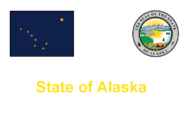
State of Alaska State of Alaska Arctic Ocean Pa c ific Yukon Oc e an British Columbia Facts about Alaska ● Juneau - the capital city ● 1,717,854 km2 - area ● 735,132 - population 20th century ● 38°- highest, -62° - lowest ● 112 different mammal and 492 bird species. ● 3 million lakes and over 3000 rivers. ● 100 000 glaciers Refrences ● http://en.wikipedia.org/wiki/Alaska ● http://www.adn.com/article/20140727/trail-monuments-m en-border-crews-cut-20-foot-swath-alaska-yukon-line ● http://alaskannature.com ● http://www.alaska.org Thanks for listening!
Ecology and Environment I Word formation Noun Verb Adjective Eruption Protection Pollution - Penetration Contamination Emission - Depletion - Prediction Reduction Consumption Campaign/campaigner Disaster - Radiation Destruction - II Give the opposite ... Renewable resources Use Protect Admissibly Predicted III Fill in the correct word 1. The polar bear's .......................... is the icy waste...
CANADA Pavel Zubarev 8.a Geographical position Canada is the second largest country in the world. Only Russia has a greater land area. Canada is situated in North America. Canada is a federation of 10 provinces and 2 territories. The population Canada is slightly larger than the United States, but has only about a tenth as many people. About 28 million of people live in Canada. About 80% of the population live within 320 km of the southern border. Much of the rest of Canada is uninhabited or thinly populated because of severe natural conditions. Canada's people are varied. About 57% of all Canadians have some English ancestry and about 32% have some French ancestry. Native people American Indians and Eskimos make up about 2% of the country's population. 77% of Canada's people live in cites or towns. The Capital of Canada Ottawa is the capit...
Acid rains Stefani Nimtsuk What is acid rain? Rain or any other form of precipitation that is unusually acidic It can have harmful effects on plants, aquatic animals, and infrastructure through the process of wet deposition Acid rain is caused by emissions of compounds of ammonium, carbon, nitrogen, and sulfur which react with the water molecules in the atmosphere to produce acids History Since the Industrial Revolution, emissions of sulfur dioxide and nitrogen oxides to the atmosphere have increased In 1852, Robert Angus Smith was the first to show the relationship between acid rain and atmospheric pollution in Manchester, England Though acidic rain was discovered in 1852, it was not until the late 1960s that scientists began widely observing and studying the phenomenon The term "acid rain" was generated in 1972 Canadian Harold Harvey was among the first to research a "dead" lake Public awareness of acid rain in the U.S in...
What might attract foreigners to Estonia? Estonia is a small country in Nothern Europe, but it is visited by people all over the world. One of the things that definitely attracts people is the seasons. There are four seasons in Estonia- spring, summer, autumn, winter. I think they make Estonia very special. Another thing is the climate. It is not too cold in winter or too warm in summer. Winters are usually snowy and you can go skiing and ice skating. In the summer you can enjoy days at the beach. The capital city of Estonia is Tallinn, which has a very beautiful Old Town. Pärnu is the summer capital, which attracts people with its beautiful beach. There are a lot of isalands, lakes and rivers in Estonia. Saaremaa is the biggest island, and it is very beautiful. Saaremaa has a lot of places to visit like Angla's Windmill park, different churches, camping places. Hiiumaa is another island, but it is smaller than Saare...
Acid rain is rain or any other form of precipitation that is unusually acidic. It can have harmful effects on plants, aquatic animals, and infrastructure through the process of wet deposition. Acid rain is caused by emissions of compounds of ammonium, carbon, nitrogen, and sulfur which react with the water molecules in the atmosphere to produce acids. Governments have made efforts since the 1970s to reduce the production of sulfuric oxides into the Earth's atmosphere with positive results Since the Industrial Revolution, emissions of sulfur dioxide and nitrogen oxides to the atmosphere have increased.[2][3] In 1852, Robert Angus Smith was the first to show the relationship between acid rain and atmospheric pollution in Manchester, England.[4] Though acidic rain was discovered in 1852, it was not until the late 1960s that scientists began widely observing and studying the phenomenon. The term "acid rain" was generated in 1972. [5] Canadi...
Presentation about enviroment Good afternoon everyone. First, let me introduce myself. My name is Valter and I am a student of Tallinn University of Technology. I'd like to talk about environment, its pollution and protecting. I shall only take 3 minutes of your time. Let me begin with the word enviroment and what it means! It means surroundings in which people, animals and plants exist. These are the things that we need, to be alive, but they are also many man-made things and technical progresses that harm the nature. Therefore we can´t live on this planet without basic components which are needed for human existence - air, water and soil. Firstly air, which is mostly a mixture of oxygen and nitrogen. People, animals and plants can ´t live without air. Without oxygen there would be no fire. So we can see, that air is the basic condition for life on the Earth. Did you know that till 18th century people...
What Might Attract Tourists to Estonia? Despite Estonia being a little country, it still manages to attract thousands of tourists to visit that beautiful place. One of many virtues in Estonia is its nature. We have amazing virgin forest, may little islands, different landscapes, a lot of lakes and small rivers where you can go hiking. We also have towns that are worth visiting. For example our capital Tallinn, which has an amazing old town. Also Tartu is very beautiful, known as the capital of University. Smaller towns, like Otepää, Võru, Põlva may charm you with their scilence and calmness. During the summer, there are very many cultural events to visit. For example, the Folk Festival in Viljandi, Rabarock in Järvakandi, Opera Days in Pärnu, different open-air plays etc. In conclusion, in Estonia you can never be bored, because that little country has something to offer to everybody.
The Republic of Estonia is a country in Northern Europe. The territory of Estonia covers 45,227 km2 . Tallinn is the capital and largest city of Estonia.The city is an important industrial, political and cultural center, and seaport Estonia is a democratic parliamentary republic and is divided into fifteen counties. Estonia is one of the least-populous members of the European Union. Estonia lies in the northern part of the temperate climate zone Estonia has four seasons of near-equal length. The official language is Estonian.Võro and Seto in southern counties are spoken along with Estonian. The Estonian national flag is a tri-color- blue, black and white. The national currency is the Eestonian kroon. Estonia has over 1,400 lakes. Most are very small, with the largest, Lake Peipsi being 3,555 km² .There are many rivers in the country. The longest of them are Võhandu (162 km), Pärnu (144 km), and Põltsamaa (135 km).Estonia has numerous f...
Estonia Estonia is small but beautiful country in the east of Europe. Estonia area is about 45 thousand km2 and there is living about 1,4 million people. Estonia is very developed country in IT clime. Example in our country you can choose parliament through the internet. Estonia has a lot of forest. Almost half of Estonia terrestrial has capped with forest. Estonia is washed and influenced by the Baltic sea from west and the Gulf of Finland in the North. Estonia has very good geographical location. This gorgeous country is European union east border (since May 2004). Estonia is quite low country. The highest peak is 316 meter high. It is called Munamägi, and it lies in east of Estonia. Estonia has over the thousand lakes. The biggest lake is Peipsi, which separates Estonia from Russia. The biggest rivers are the river Pärnu and the river Võhandu. The main lowland areas are in west Estonia. Estonia has ...
Environment in Estonia Nowadays environmental problems are too big to be managed by individual persons or individual countries. In other words, it is an international problem. But what are the biggest problems in Estonia,why and how people could solve it? Air, water, and land pollution rank among Estonia's most significant environmental challenges. The combination of 300,000 tons of dust from the burning of oil shale by power plants in the northeast part of the country and airborne pollutants from industrial centers in Poland and Germany poses a significant hazard to Estonia's air quality. Estonia's water resources have been affected by agricultural and industrial pollutants, including petroleum products, which have also contaminated the nation's soil. Some rivers and lakes within the country have been found to contain toxic sediments in excess of 10 times the accepted level for safety...
Tallinna Inglise Kolledz Estonia Topic Alice Tärk, 9b Tallinn 2007 FACTFILE Area: 45 228 sq km Poplulation: under 1.4 million Capital: Tallinn Language: Estonian Currency: Eesti kroon (EEK) Main religion: Lutheran National holiday: 24 February (anniversary of the republic) National flower: Cornflower National bird: Barn Swallow National stone: Limestone LOCATION The Republic of Estonia is the northernmost and smallest of the three Baltic States. It is located on the eastern shores of the Baltic Sea in the north east of Europe. To the east the country borders Russia. Latvia is the countries neighbour to the south. From the west the coast of Estonia is washed by the Baltic Sea and from the north by the Gulf of Finland. The length of the coastline is approximately 3 800 km. The longest distance from east to west is 350 km, while nort...
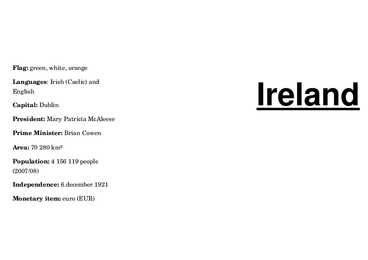
Flag: green, white, orange Ireland Languages: Irish (Caelic) and English Capital: Dublin President: Mary Patricia McAleese Prime Minister: Brian Cowen Area: 70 280 km² Population: 4 156 119 people (2007/08) Independence: 6.december 1921 Monetary item: euro (EUR) Ireland is the second biggest island in Sights: Malahid Castle; Howth the Drink: Irish coffee is one of the best the Europe. It is washed and ritch peole live there; rocks; sea; coffees in the world. influenced by the Atlantic Ocean in Temple Bar for tourists only; Trinity the west and the Irish Sea in the College it has very old library. east. Sport: Ireland's national sports ...
Tallinn English College Topic The United States of America Form Tallinn 2005 Introduction The United States of America is a very big country. Its territory is about 9.4 million square kilometres and its population is more than 260 million people, 12% of them are the Afro-Americans. It is the world's third-largest country by size and by population. The population density is about 27 people per square kilometre. Most of the people live in towns. There are 50 states in America. The biggest of the state is Texas, next by size are California, Alaska and Montana. Six states - Maine, Vermont, New Hampshire, Connecticut ,Rhode Island and Massachusetts are called New England. They are all small states in the U.S. that lie in the north-east. The first colony of immigrants settled down in Virginia, in the eastern part of the U.S.A. The...
France Hanna Kristiina Käerdi Location and neighbors General info Capital: Paris Area: 640 679 km2 Population: 66 616 416 National language: French President: François Hollande Prime minister: Manuel Valls Currency: euro (franc) Largest cities Paris famos for Louvre and Eiffel tower Population: 2 125 246 Largest cities Marseille poplation: 850 600 University of marseille est 1409 Largest cities Lyon population 445,452 The city is known for its historical and architectural landmarks Flag Tricolour Blue White Red Symbols National emblem: The National Anthem: La Marseillaise The official motto: Liberté, Egalité, Fraternité (Liberty, Equality, Fraternity) Nature Forests Nature Mountains Nature Rivers The longest river of France: The Rhine Nature Lakes Largest lake of france is Lac du Bourget (Lake Bourget) Famous people Coco Chanel Famous people Marie Antoinette Famo...
About Estonia Estonia, officially the Republic of Estonia is a country in Northern Europe. Estonia has land borders to the south with Latvia and to the east with Russia. It is separated from Finland in the north by the Gulf of Finland and from Sweden in the west by the Baltic Sea. Average elevation reaches only 50 meters and the country's highest peak is the Suur Munamägi in the southeast at 318 meters.Estonia boasts over 1,400 lakes. Most are very small, with the largest, Lake Peipus, (Peipsi in Estonian) being 3555 km². There are many rivers in the country. The largest are the Võhandu (162 km), Pärnu (144 km), and Põltsamaa (135 km). Estonia also boasts numerous bogs, and 3794 kilometers of coastline marked by numerous bays, straits, and inlets. The number of islands and islets is estimated at some 1,500. Two are large enough to constitute their own counties: Saaremaa and Hiiumaa. Estonia lies in the...
The Republic of Estonia Estonia lies on the shores of the Baltic Sea. Its nearest neighbours are Finland, Sweden, Latvia and Russia. The total are of Estonia is 45,215 square kilometres. Estonia is one of the most sparsely populated countries in Europe. It has population neraly 1.4 million. There are lot of bays and peninsulas along the coast of Estonia.It has about 1,200 islands, the largest of which are Saaremaa and Hiiumaa. Nort-estonia is relatively flat and low-lying. There is a nice coastline here. Sout- estonia is hilly, but there are no high mountains in Estonia. The highest point is Suur-Munamägi, is only 318 meters above sea level. The largest industrial urban areas are in East-Estonia and there are some beautiful nature reserves in West-Estonia. Estonia is mainly agricultural country. Estonia is famous for its thousands of lakes and beautiful nature. One of the most interesting sights is...
The Republic of Estonia Estonia officially the Republic of Estonia is a country in the Baltic region of Northern Europe. It is bordered to the north by Finland across the Gulf of Finland, to the west by Sweden across the Baltic Sea, to the south by Latvia and to the east by the Russian Federation. The territory of Estonia covers 45,227 km² and is influenced by a temperate seasonal climate. Estonia is a democratic parliamentary republic and is divided into fifteen counties. The capital and largest city is Tallinn. With a population of only 1.4 million, it is one of the least- populous members of the European Union. Estonia was a member of the League of Nations from 22 September 1921, has been a member of the United Nations since 17 September 1991, of the European Union since 1 May 2004 and of NATO since 29 March 2004. Estonia has also signed the Kyoto protocol. Estonia regained its ind...
Given opportunity, which country would you like to visit: England, Australia, or the United States of America? I have always though of my country as a huge ,,multicultural city". We have so many different cultures from different places put into a little place all together that I could almost say we are a huge city not a country. I would not leave here, but if I had an opportunity to choose which country I would like to visit, I definitely would choose Australia. But why Australia? Australia is located in the Pacific ocean and it's sixth country in the world for it's size. This country doesn't have an official language, but it's national language is English. Australia has much lakes and rivers and climate is dampish and warm. I´ve reasearched and also heard that Australia is a pretty safe country and especially good for beach life, partying, relaxing with friendly locals, wide-...
„Birds of Estonia“ E. Leibak, V. Lilleleht, H. Veromann Nimi Eesti Maaülikool, Tartu 2014 Introduction: v Bird protection in Estonia v Bird habitats of Estonia v Examples of Estonian birds • Grasshopper Warbler • Brambling • Common Kingfisher Bird protection in Estonia: v The first bird sanctuary Vaika, 1910 v The first Nature Conservation Act in Estonia, 1935 v Estonian Red Data Book v Protection nowadays v Bird habitats of Estonia: v Estonian climate v More than 1400 lakes v Estonian rivers v Estonian islands v Forests v Natural or seminatural grasslands Grasshopper Warbler (võsa- ritsiklind): v Breeder, transit migrant v Medium-sized v Insectivorous v Colour: adult – brown back, gray underparts v Consevation status – least concern v Eggs and nest v The song Brambling (põhjavint): v Breeder, transit m...
ARTICLES INDEFINITE ARTICLE (A/AN) 1.The indefinite article a/an is only used in front of a singular countable noun mentioned for the first time.The is used when it is mentioned.The is used when it is mentioned a second time, e.g. I bought a jacket and a dress. The jacket was quite cheap 2.Other uses: -to talk about someone's job, e.g. She's an architect. -with numbers and fractions, e.g. a hundred, a million, a third -to mean every with expressions of time, e.g. once a week, five times a year -with What...! exclamations, e.g. What a strange person! ZERO ARTICLE (NO ARTICLE) There is no article: -in front of plural countable nouns when making general statements, e.g. Apples are good for you. -in front of an uncountable noun when making general statements, e.g. Coffee keeps me awake. -in front of abstract nouns, e.g. Honesty is the best policy. -in front of meal times ,e.g. We have lunch at one. -in front of certain places like ho...
Quebec. Factfile Land area - 1,365,128 square km Capital - Quebec City Largest city Montreal Official language French Population 7, 6 mln Emblems Coat of arms Flag Motto "Je Me Souviens" Flower blue flag iris Bird snowy owl Mineral asbestos Tree yellow birch Quebec's National Holiday 24 June Geography Situated in eastern part of Canada Highest point Mont D'lberville Largest river the St. Lawrence River Canadian Shield 90% of the territory Appalachian Mountains History First inhabitants were the indigenous people First French explorer Jacques Cartier 1534 First it was called New France In 16. 17. century population grew massively The Seven Year's War in 1756-1763, New France was renamed the Province of Quebec Act of Union in 1840 Economy The St. Lawrence River Valley is a agricultural region The nothern coniferou...
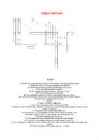
GREAT BRITAIN Across 6. What is the language that is spoken in Scotland by more than 70,000 people 7. Which part of the UK has the population of 2,965,900 10. What was first used in Britain to smelt ores such as iron 13. It is the official religion in Britain 15. A Cumbria's lake that is knows as ''Queen of Lakes'' 16. The second highest top in Britain 18. One of Britains great ports which is connected to the sea by rivers 19. South of the Pennines, also knows as the industrial heart of the United Kingdom 20. Agriculture contributes 2 per cent of... Down 1. Type ...
Estonia Topic Tallinn 2007 2 List of Contents page Facts and figures 3 Geography 3 Climate 3 Nature 4 History 5 Economy 6 Culture 6 Biggest towns 7 Language 8 3 Facts and figures The Republic of Estonia is a small country. Covering only 45, 228 sq km it is slightly bigger than Denmark, Belgium or Switzerland. Estonia's population is under 1.4 million. The official language is Estonian but since very many Russians live here Russian is also wide spread. The capital of Estonia is Tallinn. The currency used in Estonia is Eesti kroon. The Estonian national flag is blue-black-white. It was originally the flag of the Estonian Students' Society. The flag was first consecrated in Otepää Church in 1884. For a while, during the Soviet occupation, the flag was banned but it was again seen in p...
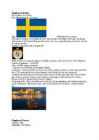
Kingdom of Sweden The capital is Stockholm The official language is Sweden Flag: (Pildid peavad ka olema) The flag of Sweden is a Scandinavian cross that extends to the edges of the flag. The design and colours of the Swedish flag are believed to have been inspired by the present Coat of arms of Sweden of 1442. Symbols blackbird,male European elk Three Crowns is a national emblem of Sweden, present in the Coat of Arms of the Realm of Sweden. Population - 9,415,295 Size - 449,964 square kilometres Sweden is a world leader in a number of fields. Landscape - Traveling north, you'll pass by endless numbers of lakes, streams, pine and birch trees. The landscape becomes more dramatic, and rolling hills rise into mountains. Southern and central parts of the country have warm summers and cold winters, the northern part of the country has shorter, cooler summers and longer, colder and...
Territory and landscape Canada is one of the largest countries in the world. It covers nearly 4 million square miles. It is dividend into ten provinces( British Columbia, Manitoba, New Brunswick, Alberta, Nova Scotia, Ontario, Prince Edward Island, Quebec, Saskatchewan, Newfoundland ) along with two territories( the Yukon, the Northwest territories ). The capital city is Ottawa. Canada is a country rich in forests. It borders in the south with The United States and it's surrounded in the west by the Pacific Ocean, in the east by the Atlantic Ocean and above by many smaller bays, but is also borderedd with Alaska in the north-west. To the north of Canada is the broad Canadian Shield, an area of rock scoured clean by the last ice age, thinly soiled, rich in minerals, and dotted with lakes and rivers. Canada by far has more lakes than any other country and has ...
Topic The United States of America The U.S.A. is situated in the central part of the North American continent. The area of the U.S.A. is over nine million square kilometres. Its western coast is washed by Pacific Ocean and its eastern coast by the Atlantic ocean and the Gulf of Mexico. The continental United States is bounded to the North by Canada and to the South by Mexico. There are two mountain ranges in the continental United States: the Appalachians in the east and the Rockies in the west. In the very middle of the continent is the Mississippi river. The five Great lakes, between the U.S.A. and Canada, are joined together by short rivers or canals. They are connected with the Atlantic Ocean by the St. Lawrence River, and with the Hudson River by a canal. In the west of the U.S.A. there is another big lake called the Great Salt Lake. Hawaii, a...
CANADA Geography Canada is the world's second largest country in total area after Russia , since it covers nearly 10 million square kilometres, but is one of the most sparsely populated, with only about 34 million inhabitants. The majority of them live within 300 kilometres of Canada's southern border. Much of the rest of Canada is uninhabited or thinly populated, because the country has a rugged terrain and severe climate. Canada extends across the continent of North America, from Newfoundland on the Atlantic coast to British Columbia on the Pacific coast and northward into the Arctic Ocean. Canada shares land borders with the United States to the south and north-west. Canada is a land of great variety. Towering mountains, crystal-clear lakes, and lush, green forests make Canada's far west a beautiful region. Farther inland, fields of wheat and other grains cover Canada's vast prairi...
Unusual animals Thea Nigol 9.r Kangaroos Second most recognisable icons Shortly called ‘Roos’ Can be found all around Australia Joey – a baby kangaroo Only eat plants Koala Best known, tourist icon Found all over Australia Koala bear? Feed on eucalyptis leaves Are active about 2 h of the day The Thorny Devil Lizard Dragon lizards Found in the outback One of the least agressive reptiles Need sunlight to warm up Only grow about 20 cm Live up to 20 years Lumholtz Tree Kangaroo Only found in Queensland Stay on trees the majority of their life Can leap up to 15 m Feed on leaves, fruits Cushioned feet Sugar Glider Native to Australia Found along eastern and northen Australia 40 cm long from nose to tail, weigh 150 grams Fee...
DEFINITE ARTICLE (THE) THE IS USED BEFORE: · nouns which are unique (the moon) · names of: o cinemas (the Opera) o hoteles (the Hilton) o theaters (the Palladium) o museums (the Louvre), o newspapers/magazines (the European but: Newseek) o ships (the Titanic), o galleries (the Tate Gallery) o rivers (the Thames) o seas (the Black Sea) o groups of islands/states (the USA) o mountain ranges (the Alps) o deserts (the Negev Desert) o oceans o canals o names or nouns with ''of'' (the Queen of Spain) · musical intruments (the piano) · dances (the samba) · names of families (the Browns) · nationalities ending in sh, -ch or ese (the Welsh). Othe plural nationalities are used with or without ''the'' (the Australians or Australians) · titles (the King, the Profess...
CULTURE OF NEW ZEALAND GEOGRAPHY Island country in the Pacific Ocean Two main islands: Northern and Southern. 600 smaller islands The capital is Wellington, was built in 1839 and named after the first mayor Highly mountainous with lots of rivers and lakes 14,000 earthquakes a year, many floods and tsunamis CLIMATE Reversed seasons compared to Europe Oceanic climate POPULATIO N SYMBOLS 4,836,520 People Bird Kiwi 74.0% European Plant Silver fern 14.9% Mori Flower - Kowhai 11.8% Asian 7.4% Pacific peoples 1.2% Middle Eastern/Latin Americans/African 1.7% Other GOVERNME NT Constitutional monarchy with a parliamentary democracy Elizabeth II is the Queen of New Zealand and the head of state Currency is New Zealand Dollar NZD LANGUAGES New Zealand English Te Reo Maori New Zealand Sign HISTORY Ancestors of Mori, arrived from Polynesia betwe...
Estonia is located in the Northern Europe and is a state in the Baltic region It is bordered to the north by the Gulf of Finland, to the west by the Baltic Sea, to the south by Latvia, and to the east by Lake Peipus(Peipsi) and the Russian Federation.Estonia also has a number of islands: Saaremaa and Hiiumaa, which are the most known are also the two biggest ones.The territory of Estonia covers 45,227 km2. There is 3,794 kilometers of coastline marked by numerous bays, straits, and inlets. The Republic of Estonia is divided into fifteen counties: Hiiumaa, Saaremaa, Läänemaa, Harjumaa, Lääne-Virumaa, Ida-Virumaa, Tartumaa, Jõgevamaa, Järvamaa, Raplamaa, Viljandimaa, Pärnumaa, Valgamaa, Põlvamaa and Võrumaa. The capital city of estonia is Tallinn. Estonia is influenced by a temperate seasonal climate. Estonia has four seasons of near-equal length. July is the warmest month, and February is the coldest month. Snow cover, which is d...
THE NO ARTICLE · Names in the plural = countries: the Nether- * Names of countries / towns (also with an es- lands, the USA; the West Indies ablished modifier): (South) Estonia, Tartu · Names of the countries, and towns with a * Expressions from North to South etc. characteristing / spacifying modifer: the Tartu of th 19th century * Names of streets, bridges, airports, parks, squares, buildings, railway stations, shops, · Names of rivers, channels / canals, seas, addresses: Fleet Street, Tower Bridge, oceans, streams, straits: the Danube; the Suez Kennedy Airport, Hyde Park, Trafalgar Canal; the Baltic Sea; the Pacific Ocean; the Square, Buckingham Palace, Victoria Station, Bering...
Project ESTONIA MAP OF ESTONIA Southern Viljandimaa The southern part of Viljandi county catches the eye with its sublime scenery. The area today lies in the very heart of the historical Mulgimaa the home of hills, deep valleys and lakes brought together by a beauty spot Halliste primeval valley. According to several folk tales, it is also in these valleys, woods and bogs that Old Nick found refuge.The great variety displayed in the nature is also reflected in the local cultural heritage. At the beginning of the 19th century growing linen spread and became the basis of the legendary wealth of Mulgi farms. The ancient barn-dwellings and decaying manor houses are the mute witnesses of those times. The riches and cultural heritage of Mulgimaa owe to the diligence and tenacity of the local people. Village handicraftsmen and masters have always been honoured. Mulgikapsad (stewed sauerkraut with barley gro...
 annaabi.ee