Leidsid 33 sarnast õppematerjali, mis on seotud failiga "Karud.". Need materjalid aitavad sul teemat sügavamalt mõista.
bear, bears, black, live, polar, north, asia, than, uljana, mammals, living, eastern, brown, near, good, ride, pieces, eating, fish, birds, trees, thanksMOST ENDANGERED BEARS SIIRI PAURSON EMÜ 2016 TOPICS 1. GIANT PANDA (hiidpanda e. bambuskaru) 2. SUN BEAR (päikesekaru e. malai karu e. biruang) 3. ASIATIC BLACK BEAR (kaeluskaru) 4. SLOTH BEAR (huulkaru) 5. ANDEAN BEAR (prillkaru) 6. POLAR BEAR 7. BROWN BEAR 8. THE AMERICAN BLACK BEAR (baribal) 1. GIANT PANDA • The giant panda remains the world's most threatened bear species. • A very high risk of extinction (väljasuremine) in the wild. • Despite "the establishment of nearly 60 panda reserves, a ban on logging (metsaraie keeld), and widespread reforestation programmes," habitat destruction and degradation are still the panda's greatest enemies. 2. SUN BEAR • The world's smallest bear species. • We estimate that sun bears have declined by at least 30 percent over the past 30 years and continue to decline at this rate.
Tundra animals Reindeer Reindeer were first domesticated in Norway and northern Asia. When it was seen how valuable they were, they were brought to Alaska in 1887 and later to parts of Canada. These North American reindeer became known as caribou. Although they are called by different names, they are both considered to be a single species. Unlike deer, both the male and female have antlers. The antlers of the male are long, branched and massive, and they are a little flattened at the ends. The antlers of the female are much shorter, simpler and more slender and irregular. Their large, spreading hooves support the animal in snow in the winter and marshy tundra in the
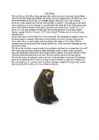
Polar bear Ursus maritimus or the "sea bear." Polar bears live near the circumpolar at north in areas where they can hunt seals at open leads. Scientists estimate that there are between 22000 to 27000 polar bears. Its closest relative is the brown bear. Adult male polar bears are 2,5 to 3 meters tall. They weigh 250 to 770 kilograms. Adult female bears are smaller. They are about 1,8 to 2,5 meters tall and weigh 90 to 320 kilograms. Polar bears usually eat seals usually the ringed seasl, but sometimes the bearded seals. When hunting is good, polar bears will typically eat only the fat and leave the rest of the carcass for scavengers including arctic foxes, ravens, and younger bears. Polar bears also sometimes kill and eat both walrus and beluga whales. They have even hunted short-legged reindeer and sometimes even birds and bird eggs
olar bear communication P Polar bear v The polar bear or the sea/ice bear are the world's largest land predators. They can be found in the Artic, Canada, Russia, Denmark (Greenland), and Norway. v In the wild polar bears live up to age 25. v Polar bears have been known to swim 100 miles at a stretch. v Polar bears primarily eat seals. Communication v When a Polar bear wants to play, he communicates this to another bear by wagging his head from side to side. Such play sessions involve ritualised fighting or mock battles. v A mother Polar bear can comfort, protect, or punish her cubs by using her body, muzzle, or paws and scold her cubs with a low growl or a soft cuff. Communication v Among Polar bears, hissing, snorting and a lowered head signifies aggression. An attacking Polar bear will charge forward with head down and ears laid back.
Tundra Tundra is the world's youngest biome. It was formed 10 000 years ago. Located at latitudes 55° to 70° North. Almost all tundras are located in the Northern Hemisphere, encircling arctic desert and extending south to the coniferous forests of the taiga. The ecotone (ecological boundary region) between the tundra and the forest is known as the tree line or timberline. Tundra comes from the Finnish word tunturi, meaning treeless plain. It is noted for its frost-moulded landscapes, extremely low temperatures, little precipitation, poor nutrients, and short growing seasons
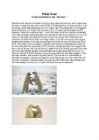
Polar Bear Kristjan Paal 6.c The polar bear (Ursus maritimus) is a bear native largely within the Arctic Circle encompassing the Arctic Ocean, its surrounding seas and surrounding land masses. It is the world's largest land carnivore and also the largest bear, together with the omnivorous Kodiak bear, which is approximately the same size. A boar (adult male) weighs around 350 700 kg (7701,500 l while a sow (adult female) is about half that size. Although it is closely related to the brown bear, it has evolved to occupy a narrower ecological niche, with many body characteristics adapted for cold temperatures, for moving across snow, ice, and open water, and for hunting the seals which make up most of its diet. Although most polar bears are born on land, they spend most
Sun Bear The Sun Bear is 120-150 cm long, making it the smallest member in the bear family. Males tend to be 10-45% larger than females the former normally weigh between 30 and 70 kg , and the latter between 20 and 40 kg. The shoulder height is about 60-72cm .The Sun Bear possesses sickle-shaped claws that are relatively light in weight. It has large paws with naked soles, probably to assist in climbing. Its inward-turned feet make the bear's walk pigeon toed, but it is an excellent climber. It has small, round ears and a stout snout. The tail is 1.2-2.8 inches (3-7 cm) long. Despite its small size, the Sun Bear possesses a very long, slender tongue, ranging from 8 to 10 inches (20-25 cm) in length. The bear uses it to extract honey from beehives.
Wildlife of Alaska. Triin Õismaa Brown bear. Most widely distributed. Cubs birth. Extremely fast. Range in colours. Cubs can climb. Male bear's heavier. Poor eyesight. Black bear. Seen in different shades. Shy, easy to frighten, curious. Good climbers and swimmers. Live over 25 years. Good hearing, sense of smell. Polar bear. Only humans prey or hunt. Fur is not white. Tend to overheat more. Can swim up to 100 miles (161 km). Cubs learn to freeze. Caribou. Covered with winter coat. Wear antlers. Releases special scent when faced with danger. Live about 4,5 years. Very fast. Moose. Largest members of the deer family. Good sense of smell and hearing. Lives about 1525 years. "Twig eater." Can run up to 56 km. Very good swimmers. Mountain goat. Goatantelopes. Thick white fur (double coat)
cultural diversity of different nations in Canada. All the communities living in the country are encouraged to remember their origins and hold their own ethnic events and national festivals. Cultural diversity makes Canada even more interesting. In spite of this, in recent years there is a strong movement in French-speaking Quebec to become an independent country. There are many different native people throughout Canada like the Crees, Mohawks, Troquois and Sioux. In the north of the country, the Inuit (Eskimos) now have a self-governing homeland called Nunavut, meaning our land. It is over two million square kilometers and it is inhabited by 17,500 Inuits. The national symbol of Canada is the maple leaf. The national tree is the maple. Canada is also the most tolerant societies in the world because only 13% of Canadians say that they would object their children marrying somebody of a different race, compared with 32% in the USA.
Samas loodame ekspeditsiooni lõpuosas saada osa Gröönimaa elusloodusest ja ehk õnnestub kohata mõnda põtra või muud looma. http://www.greenland-guide.gl/animal_life.htm ehk siis loomade pildid ja txt In Greenland whale watching can be enjoyed from the streets or even from your hotel room. During the late summer and early autumn whales swim close to the coast and are sometimes seen in the harbours. But of course the best way to spot these huge mammals is at sea. Whale-watching tours are offered in several towns in Greenland. When you sail along the coast on a passenger ship, the captain will often notify you when whales are close. There are many different species of whales in Greenlandic waters including the two largest, the blue whale and the fin whale. Humpback whales, minke whales, narwhales, beluga or white whales, sperm whales, pilot whales and Greenland whales are among the other species here. At sea you'll also see seals
about 3,353 metres (11,000 feet). Underneath the ice cover are the ancient rocks of the Greenland Shield, which is geologically related to the Canadian Shield. Drainage is afforded mainly by the so called ice fjords, in which glaciers from the ice caps pass through valleys to the sea, where they form thousands of icebergs each year. The climate is extremely cold, although the south experiences a short summer. The mammals of Greenland are more American than European and include muskox, wolves, lemmings, and reindeer. The varieties of seal and whale, and most of the species of fish and seabird, are also American rather than European. Circumpolar animals, such as polar bears, arctic foxes, polar hares, and stoats, are also found. Greenlanders are a people of mixed ancestry, primarily Inuit and European, especially Danish Norwegian. Nearly all live on the narrow southwest coastal fringe. Fishing, sealing, and
Zoos are sometimes seen as necessary alternatives to a natural environment. Not only people are trying to keep endangered species and rare animals in the nature reserves, but also the number of zoos built around the world is slowly growing. Do we actually need those kind of man-made "homes" for animals or is it better for them to live outside cement walls in their natural habitat? First of all, nowadays we need to help the nature and animals that are the ones facing quite big danger of becoming extinct. Mostly it is caused by our selfish attitude: we do not take care of nature. Zoo is one of the solutions to help to preserve nature and to protect it from poachers. For example Loxodonta africana is an African elephant who has been hunt down and whose population was significantly reduced in 20th century
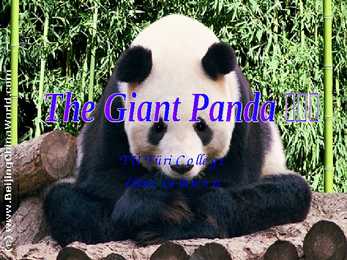
T Ü T üri C o lle g e Liina Le inm e ts Introduction · Panda (Ailuropoda melanoleuca) is a mammal classified in the bear family, native to centralwestern and southwestern China. It is easily recognized by its large, distinctive black patches around the eyes, over the ears, and across its round body. · The Giant Panda lives in a few mountain ranges in central China. · It once lived in lowland areas, but farming, forest clearing, and other development now restrict the Giant Panda to the mountains. In the wild · The Giant Panda is a · Pandas communicate terrestrial animal and through vocalization primarily spends its life and scent marking such
Topic Canada Tallinn English College 2006 1. Introduction If you had to use two words to describe Canada, they might be large and diverse. Canada is the second largest country in the world with a territory of about 10 million square kilometers and it is bordered by three oceans: the Arctic, the Pacific and the Atlantic Oceans. The population of Canada is about 31 million people. About 77% of the people live in cities which lie in a band about 100 miles wide above the border of the United States. The capital of Canada is Ottawa. Other large cities are Montreal, Toronto, Vancouver, Winnipeg and Quebec. 2. Geographical position Canada is a huge country in the continent of North America. It is bordered with the Atlantic Ocean in the east, the Pacific Ocean in the west, the United States of America in the south and the Arctic Ocean in the north
Different types of forests Forests are divided into following main types: o Tropical forest o Subtropical forest o Plantations o Boreal forest o Temperate forest o Seasonal or monsoon forest Tropical and Subtropical Forests Tropical and subtropical forests, also known as rainforests or tropical rainforests, are lavish and ample forests with broad leave tree. They are mostly found at lowlands near the equator - Asia, Africa, South & Central America and on many of the Pacific Islands. Almost 50% forests of the world are tropical and subtropical in nature. Rainforests are characterized by high rainfall. They are home to two-thirds of all the living animal and plant species on the planet. Tall, broad-leaved evergreen trees are the dominant plants, forming a leafy canopy over the forest floor. The undergrowth or understory in a rainforest generally
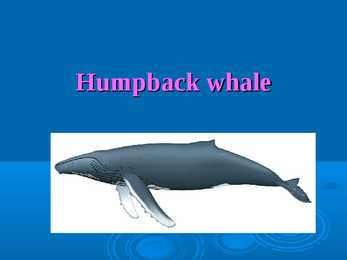
Humpback whale Humpback whale Megaptera novaeangliae CLASS: Mammalia ORDER: Cetacea SUBORDER: Mysticeti FAMILY: Balaenopteridae GENUS: Megaptera SPECIES: Novaeangliae Physical Description The head is broad and rounded when viewed from above, but slim in profile. The body is quite round, narrowing to a slender peduncle. The top of the head and lower jaw have rounded, bump-like knobs, each containing at least one stiff hair. The body is black on the dorsal side, and mottled black and white on the ventral side. About 2/3 of the way back on the body is an irregularly shaped dorsal fin. Its flippers are very long, between 1/4 and 1/3 the length of its body, and have large knobs on the leading edge. The flukes, which can be 5.5 m wide, is serrated and pointed at the tips. Adult males measure 12.2-14.6 m, adult females measure 13.7-15.2 m. They weigh 25 to 40 tons. Feeding
CANADA Canada is a vast country, second largest country of the world after Russia. It stretches from the Atlantic Ocean in the east to the Pacific Ocean in the west and to the Arctic Ocean in the North. Canada Covers most of the northern part of North America and its geography is very diverse. Canada's area is about 10 million square kilometers and its population is 31 000 000. Its capital is Ottowa and other main cities are Toronto, Montreal and Vancouver. Almost 75 % of canadians lives within 300 kilometer of the USA border, because the climate is softer in the South. 89 % of Canada is almost unhabited. Its official languages are English and French, but many other languages are spoken too
written in 1814 by Francis Scott Key. There are 6 time zones. From east to west they are: Eastern Standard Time, which is 5 hours behind Greenwich Time, Central Standard Time, Mountain Standard Time, which is 7 hours behind Greenwich Time, Pacific Standard Time. Alaska and Hawaii have their own time zones: Alaska Standard Time and Hawaii Standard Time. Geographical Position The USA lies in the Northern Hemisphere in North America. It covers a big part of the continent and is also the third largest country in the world. The country consists of 50 states, but two of them lie separately. One of them is Alaska, which is near the Arctic Circle. And the other state is Hawaii, which is a group of island is the Pacific Ocean. The USA shares the border with Canada in the north and Mexico in the south. In the east the coast is washed by the Atlantic Ocean and in the west by the Pacific Ocean
We say "eh?" a lot. We live in igloos. We all speak French. We ride polar bears.. There is no summer; it's always cold and snowy Everyone watches/liked/plays hockey. We're polite. They hate Americans. It snows non stop in canada Canada beer is better than American beer Canadians pronounce the word "about" ..."aboot They wear funny hats They eat blubber Canada hokey players are mullets Canadians are fat They don't have water toilets They are all monarchists All Canadians snowboard They all are jealous of Americans Canada is where Avril Lavigne and Eskimos come from Peaceful hippies They put maple syrup on EVERYTHING They don't have roads Canadians drive dog sleds everywhere They have monopoly money They have no army
This article was published in Daily mail, on 17 October 2011. The author of the article is Tamara Cohen. The article discusses about animals who are shrinking due to global warming. Scientist have warned, that animals such as sheep, deer, birds and reptiles are shrinking due to climate change. Researchers say warmer temperatures over the past few years have made some animals adapt to need less body fat to survive while others are struggling for food. In the next few decades, some types of mammals, fish, birds and plants are getting smaller and evolve into miniature versions of what they are today. This could force some creatures, that people eat, to become extinct, Dr David Bickford from the National University of Singapore reviewed research showing creatures from deer to tortoises, gulls, goshawks and even polar bears have already shrunk over the past 50 years. 'Because recent climate change may be faster than past historical changes in climate, many
Tundra swans Tundra swans ● Whooper swan, Bewick´s swan and mute swan (laululuik, väikeluik, kühmnokk-luik) Whooper swan ● Large white swan (bigger than bewick) ● Lenght – 140 to 165 cm ● Deep honking call and powerfull fliers ● Require large areas to live in ● Adult birds – feathers entirely white, black feet, mostly black bill ● Pens (females) – slightly smaller than cobs (males) ● Immatures – white mixed with some dull grey feathering; bills – black, large dirty-pink patch ● In Estonia first nesting - 1979 Whooper swan Behaviour of whooper swan ● Pair for life, cygnets stay with them all the winter ● Breffered breeding habitat – wetlands ● Both build the nest ● Male will stand guard over the nest while female incubates ● 4 to 7 eggs Influence of whooper swan ● Much admired in Europe
No trees grow in the tundra so houses can not be made from wood unless it is transported from elsewhere. However, during a large part of the year, the cold part, there is a lot of snow in the tundra. And it turns out that snow can be a very good construction material. In the winter, Inuit lived in round houses made from blocks of snow called "igloos". In the summer, when the snow melted, Inuit lived in tent-like huts made of animal skins stretched over a frame. Although most Inuit people today live in the same community year-round, and live in homes built of other construction materials that have to be imported, in the past Inuit would migrate between a summer and winter camp which was shared by several families. Getting Around To travel from one place to another, Inuit used sleds made of animal bones and skins pulled over the snow and ice by dogs. Strong dogs with thick fur like huskies, bred by Inuit, were used. On
Re d Pa nda Jarita Maaria Rintamäki 6.klass Appe a r a nc e o Head and body are 50 to 65 cm long, Klõpsake juhtslaidi teksti laadide redigeerimiseks tail 30 to 50 cm. Teine tase Kolmas tase o They have red and black fur. Neljas tase Viies tase o Red pandas have long, bushy tails. o On their heads are two large white and black ears. o The muzzle area around the nose is also covered in white fur. Ha b i t a t o
Temperate deciduous forests, woodlands and shrub Tartu 2008 Location: Temperate forests are typical of all European continent, the Eastern region of Asia (in special, Chinese and Japan) and North America. Also are finded in tempered areas of South America. Climate: The average temperature in temperate forests is 50° F. Summers are mild, and average about 70° F, while winter temperatures are often well blow freezing. The average yearly precipitation is 30-60 inches. This precipitation falls throughout the year, but in the winter it falls as snow. There are four seasons in this biome, with warm summers and cold winters, often snowy
Global Warming One of the biggest issues our planet and its inhabitants are facing nowadays is global warming. Global warming, also often referred to as the greenhouse effect, has not always been a problem. However, over the last centuries, since the Industrial Revolution things have changed. Polar regions are melting, species are dying, climate zones are shifting, migration patterns for animals such as polar bears and birds are being disrupted our world as we know it is changing. Some scientists believe that the climate will reach a tipping point, a point at which even a tiny additional increase would throw the system into violent change. We started doing harmful things and only now do we realize what we have done and what we are doing. At this current rate by the middle of next century the Earth's temperature may rise a predicted from 2 to 6 degrees Celsius
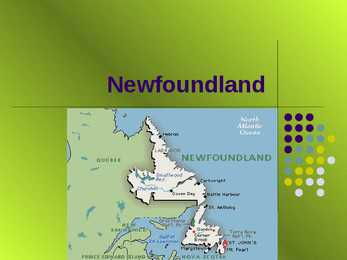
Newfoundland Geography Newfoundland and Labrador is located on the eastern edge of North America. Newfoundland and Labrador is home to Iceberg Alley, one of the best places in the world to view icebergs. Just off the coast, the meeting of the cool Labrador Current and the warm Gulf Stream creates an abundance of marine life that attracts thousands of whales, and provides rich nesting grounds for millions of seabirds. To put things in perspective, Newfoundland and Labrador is a little smaller than California, slightly bigger
Canada is the second largest country in the world. Situated to the north of the United States, in North America, it has both English and French as its official languages. Even though its area is bigger than that of the United States, its population is only about 11% of that of the USA some 35 million. Because of that, Canada has one of the lowest population densities in the world. The capital of Canada is Ottawa the name of whose comes from the old Algonquin language, with the original word meaning `to trade'. Due to the country's huge size and position, it is very diverse. It is bordered by the Pacific Ocean to the west, the Atlantic to the east, and the Arctic to the north
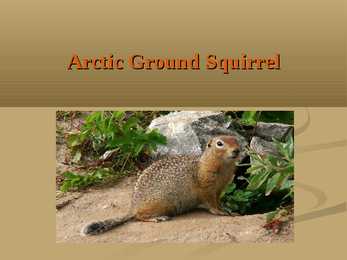
border of the Northwest Territories, as well as Alaska and Siberia. Physical description A beige and tan coat with a white-spotted back. A short face, small ears, a dark tail and white markings around its eyes. Strong front paws that are well adapted for digging and burrowing. Average length of an Arctic Ground Squirrel is approximately 39 cm. The average mass 750 g. However, males generally are around 100 g heavier than females. Diet Herbivore. Eats a wide variety of plants including seeds, berries, willow leaves, mushrooms, grasses and flowers. In the summer, it begins to store willow leaves, seeds and grasses in its burrow. Hibernates in the winter (from September to April) and it uses this store of food after it wakes up while it is waiting for spring plants to grow. Sometimes this squirrel carries food back to it's den within its cheeks.
2. Where is prairie, pampas, steppe, and veldt situated? EurasiaSteppe, North America-Prairie, South AmericaPampa, South AfricaVeldt 3. Using the climate diagram describe the climate of the region. Temperate deciduous forest -Well-defined seasons with a distinct winter characterize this forest biome. Moderate climate and a growing season of 140-200 days during 4-6 frost-free months distinguish temperate forests. Temperature varies from -15° C to 25° C. Precipitation (750-1500 mm) is distributed evenly throughout the year
Tallinn English College Topic The United States of America Form Tallinn 2005 Introduction The United States of America is a very big country. Its territory is about 9.4 million square kilometres and its population is more than 260 million people, 12% of them are the Afro-Americans. It is the world's third-largest country by size and by population. The population density is about 27 people per square kilometre. Most of the people live in towns. There are 50 states in America. The biggest of the state is Texas, next by size are California, Alaska and Montana. Six states - Maine, Vermont, New Hampshire, Connecticut ,Rhode Island and Massachusetts are called New England. They are all small states in the U.S
Tallinn English College Topic The United States of America Tallinn 2007 1. Introduction The United States of America's territory is over 3.7 million square miles (over 9.6 million km²) and population more than 300 million people. The capital city is Washington D.C. Although the United States has no official language at the federal level, English is the de facto national language. English is the most common language for daily interaction among both native and non-native speakers. Spanish is the second language. The largest city is the New York City. The Government is Federal constitutional republic and the president is George W. Bush. 2. Geographical position
6. Towns, economy, agriculture 7. Climate 8. Animals, plantlife 9. Population 10. Sports 11. Culture 12. History 13. Political system, symbols 14. Conclusion 15. Materials 1. Introduction If you had to use two words to describe Canada, they might be large and diverse. Canada is the second largest country in the world, bordered by three oceans, and across the country, Canadians experience many different landscapes from rolling plains and mountains to the cold tundra of the north. Despite Canada's great size, it is one of the world's most sparsely populated countries. This fact, coupled with the grandeur of the landscape, has been central to the sense of Canadian national identity. 2. Geographical position Canada is the second largest country in the world after Russia. In the Arctic, Canada reaches almost as far north as Greenland. To the south it extends to the same latitude as southern France. The distance from Canada's west coast, the Pacific Ocean, to its
CANADA Geography Canada is the world's second largest country in total area after Russia , since it covers nearly 10 million square kilometres, but is one of the most sparsely populated, with only about 34 million inhabitants. The majority of them live within 300 kilometres of Canada's southern border. Much of the rest of Canada is uninhabited or thinly populated, because the country has a rugged terrain and severe climate. Canada extends across the continent of North America, from Newfoundland on the Atlantic coast to British Columbia on the Pacific coast and northward into the Arctic Ocean. Canada shares land borders with the United States to the south and north-west. Canada is a land of great variety
 annaabi.ee