 50 punkti
Autor soovib selle materjali allalaadimise eest saada 50 punkti.
50 punkti
Autor soovib selle materjali allalaadimise eest saada 50 punkti.
 ~ 21 lehte
Lehekülgede arv dokumendis
~ 21 lehte
Lehekülgede arv dokumendis
 2011-05-14
Kuupäev, millal dokument üles laeti
2011-05-14
Kuupäev, millal dokument üles laeti
 9 laadimist
Kokku alla laetud
9 laadimist
Kokku alla laetud
 0 arvamust
Teiste kasutajate poolt lisatud kommentaarid
0 arvamust
Teiste kasutajate poolt lisatud kommentaarid
 Andra16
Õppematerjali autor
Andra16
Õppematerjali autor
limited integration with existing telephony environments. However in the last couple of years the situation changed dramatically since some open source tools such as asterisk as well as low-cost VoIP telephone adapters and services become available. In fact, today it is quite common for internet providers to provide their customers VoIP calls at very low cost, if any, in addition to standard xDSL connectivity. The VoIP uses Internet protocol (IP) to send digitized voice traffic over the Internet or private networks. An IP packet consists of a train of digits containing a control header and a data payload. The header provides network navigation information for the packet, and the payload contains the compressed voice data. While circuit-switched telephony deals with the entire message, VoIP-based data transmission is packet-based, so that chunks of data are packetized (separated into units for transmission),
Acknowledged connectionless ("Type 3") provides acks, but For example, if the PPP link is configured to connect with IP, Advantages · Large packet size = low overheads = high efficiency · Batch Transfers · Auto receive · Asynchronous Response Mode (ARM): the secondary does not have to wait doesn't provide error recovery, sequencing or flow control. then the Internet Protocol Control Protocol (IPCP) will Disadvantages · Relatively susceptible to noisy lines · Not available in all comms packages Kermit: to receive explicitpermission from the primary to transfer any frames. · Connection-oriented ("Type 2") mode is similar to TCP. negotiate and configure the link to carry IP.
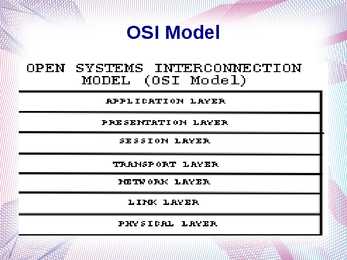
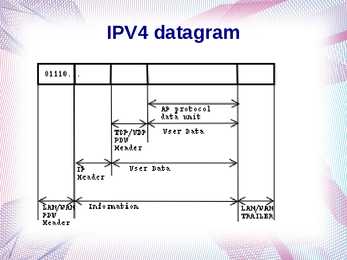
standarditele (tarkvarale). Kaks osapoolt samal kihil suhtlevad protokollide abil. Kuid standardeid on vaja ülemistele kihtidele ostatavate teenuste tarvis(alumiselt kihilt tuleb ülemisele teenus). 7. TCP/IP mudel Pakett erinevates kihtides: sõnum rakenduskihis, segment transpordikihis, datagramm võrgu kihis, kaader(frame) kanalikihis ISO OSI mudeli ja TCP/IP mudeli vaheline võrdlus: 8. Internet ja hajusrakendused Võrgus võib olla miljoneid ühendatud seadmeid: *hostid, lõppsüsteemid(PC, serverid, PDA, aga ntks ka rösterid) * kommunikatsiooni ühendused(fiiber, raadiovõrgud, satelliit) *ruuterid(edastada andmepakette läbi võrgu) Protokollid on selleks, et kontrolida võrgus sõnumite saatmist
inspired by SETL). Python 2.0 was released in 2000, with many major new features including a full garbage collector and support for Unicode. Python 3.0, a major, backwards-incompatible release, was released in 2008 1990 HTML, http and the browser are born The World Wide Web was born when Tim Berners-Lee, a researcher at CERN, the high-energy physics laboratory in Geneva, developed HyperText Markup Language. HTML, as it is commonly known, allowed the Internet to expand into the World Wide Web, using specifications he developed such as URL (uniform resource locator) and HTTP (hypertext transfer protocol). 1991 Berners-Lee designed both the first World Wide Web server and browser -- available to the general public in 1991. 1990 Internetiotsake Eestis: e-post, USENET Tampere tehnikaülikoolist laenuks saadud moodemi Robotics Courier V.32 abil panid Küberneerika Instituudi teadurid Aleksander Shmundak, Mari Kõpp ja
Agent Building and Learning Environment [IBM] ABM Asynchronous Balanced Mode ABR Available Bit Rate ABRD Automatic Baud Rate Detection ABRS Automated Book Request System [British Library] ABS Address Book Synchronization [IBM] + Absolute ABT Abort ABTS ASCII Block Terminal Services AC Autocheck + Automatic Computer + Alternating Current ACAP Application Configuration Access Protocol ACC Accumulator ACCMAIL Accessing the Internet Via Email ACD Automatic Call Distribution ACDI Asynchronous Communications Device Interface ACE Access Control Encryption/Entry + Adobe Certified Expert + Advanced Composition Explorer [JHUAPL] + Advanced Computing Environment [SCO] + Adverse Channel Enhancements [Microcom] + * Automatic Computing Engine ACF Access Control Field + Advanced Communications Function ACH Automated Clearing House
The only thing stopping them right now is keeping it legal, as there is no real protection against hackers, who can cause a malfunction to happen. Resulting in a drone falling and potentially harming an innocent bystander.[16] Furthermore, Tesla has recently released a new car with an autopilot feature [17]. They also announced a car with full self-driving capabilities is plausible in a not so distant future. And it is all possible due to the fact that big data is easily accessed through the internet connection for updates to be carried out. In big data, the software packages provide a rich set of tools and options where an individual could map the entire data landscape across the company, thus allowing the individual to analyze the threats faced internally [18]. Making big data somewhat secure as in whole and also allowing different algorithms to function. In fact, nowadays, every bigger company, who has to deal with massive amounts of users, has
microchips tiny pieces of silicon containing complex electronic circuits design to make or draw plans for something financial relating to money or how money is managed electronic involving the use of electric current in devices such as TV sets or computers Internet the large system of connected computers around the world print to produce text and pictures using a printer unformatted a disk that is completely blank, so information can't be recorded onto it Extranet a network that allows communication between a company and the people it deals with transmission the process of sending data over a communication channel reboot to restart the computer, without switching it off completely microbrowser a web browser designed for small screens on handheld devices software engineer a person who designs and maint
GNU (anacronym for ``GNU's Not Unix''), and thereby give computer users the freedom that most of them have lost. GNU is free software: everyone is free to copy it and redistribute it, as well as to make changes either large or small. 1984 The Massachusetts Institute of Technology (MIT) begins developing the X Window System. X is the basic window system for almost all UNIX machines nowadays. 1985: Main highlihts The modern Internet gained support when the National Science foundation formed the NSFNET, linking five supercomputer centers at Princeton University, Pittsburgh, University of California at San Diego, University of Illinois at Urbana-Champaign, and Cornell University. Able to hold 550 megabytes of prerecorded data, the new CD-ROMs grew out of regular CDs on which music is recorded. The C++ programming language emerged as the dominant object-oriented language in
 annaabi.ee







Kõik kommentaarid