 10 punkti
Autor soovib selle materjali allalaadimise eest saada 10 punkti.
10 punkti
Autor soovib selle materjali allalaadimise eest saada 10 punkti.
 ~ 7 lehte
Lehekülgede arv dokumendis
~ 7 lehte
Lehekülgede arv dokumendis
 2020-12-17
Kuupäev, millal dokument üles laeti
2020-12-17
Kuupäev, millal dokument üles laeti
 1 laadimist
Kokku alla laetud
1 laadimist
Kokku alla laetud
 0 arvamust
Teiste kasutajate poolt lisatud kommentaarid
0 arvamust
Teiste kasutajate poolt lisatud kommentaarid
 Opilane1710
Õppematerjali autor
Opilane1710
Õppematerjali autor
Estonian in multilingual Baltic-Sea Europe: language contacts and linguistic landscapes. Kordamisküsimused Questions for the exam 1. What is meant by SAE? Give a few examples of possible SAE features. SAE – Standard Average European. Martin Haspelmath: 12 typical structural features (concentrated in Europe, rare outside of Europe) and some other possible common features. Examples: Definite and indefinite articles, e.g., a book vs. the book Relative clauses with relative pronouns, e.g., I woke up a student who had nodded off ‘have’-perfect, e.g., has done Nominative experiencers, e.g., I like, I need Participial passive, e.g., you are invited Particles in comparative constructions, e.g. She is older than me 2. Is Estonian a typical SAE language? Why do you think so?
Tallinna Mustamäe Humanitargümnaasium Valeria Jefremenkova ENGLISH AS A GLOBAL LANGUAGE INGLISE KEEL KUI ÜLEMAAILMNE KEEL Research work Supervisor: Jevgenija Kozlova Tallinn 2016 1 Table of Contents СONTENT…………………………………………………………………………………...2 INTRODUCTION…………………………………………………………………………...3
Tutkimushankkeen nimi: Reseptiivinen monikielisyys: lähisukukielten keskinäinen ymmärrettävyys (REMU) (Receptive multilingualism: Mutual intelligibility of close related languages (REMU)) Tutkimuksen tausta ja aihepiiri Hämmästyttävän vähän tiedetään reseptiivisestä monikielisyydestä, mahdollisuudesta hyödyntää läheisten sukukielten samankaltaisuutta kommunikaatiossa, jolloin keskusteluissa kukin osallistuja puhuu omaa äidinkieltään. Tällainen menettely on tuttua muun muassa Pohjoismaissa. Kun Euroopan neuvoston kieliohjelman tavoitteen mukaan jokaisen eurooppalaisen olisi hyvä osata
LEL 2E Notes on Vocabulary One of the key facts about the lexicon of any language is that it reflects in various ways the physical and cultural environment in which the language is spoken. A people unfamiliar with, say, horses is unlikely to have a word for `horse'; similarly with ploughs, printing presses, and internet porn sites. For the most part this is trivial it's hard to imagine how it could be otherwise, given the general nature of human language. People tend to make a great deal of the alleged fact (see Pullum 1989) that "the Eskimos have lots of words for snow", but it doesn't take much thought to realise that any language spoken in a given physical and cultural environment is likely to have efficient ways of referring to distinctions that are important in that environment. That doesn't mean that you can read very much into individual words and individual facts about the lexicon of a given language (this topic has
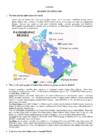
physical geography are determined 2. Who are the native people of Canada? Into which three groups can they be divided? Canada's constitution specifies three categories of aboriginal peoples: Indian (First Nations), Métis, Inuit. According to Canadian census 2011, 1.4 mln people of Aboriginal origin (4.3%): 852,000 First Nations persons, 452,000 Métis, 59,000 Inuit. Indian (First Nations) - No written history before the contact with Europeans. Chief historical sources European priests, travellers and traders not interested in the preservation of "pagan"myths. Different estimates about their number in Canada when Europeans reached North America from 300,000 to 1 mln. Saw themselves as part of nature, not as its masters. The First Nations were called "Indians" by Christopher Columbus when he landed in North America, because he thought he had reached India. Many now prefer to call themselves First Nations, though many still call themselves
Russian philology The meaning of the word "philology" is "love for word". This is love that unites teachers and researchers of modern and Classical languages and literature, interpreters and diplomats, journalists and publishers, writers and poets. Russian philologis are highly demanded in various spheres of scholarly research and education, in the mass media, in civil service at the Ministry of Foreign Affairs, in archives, libraries, museums, in travel agencies, as well as Russian and international companies. Curriculum within in philological faculty includes courses of Russian and European
Me and languages. To begin with, language is a congrecation of thoughts and feelings through a system of signals, such as voice sounds, gestures, or written symbols. Communication or language is a process every child learns from birth and during our life we will usually learn many different languages. Due to the fact that both of my parents are Estonians , my mother tongue is Estonian, therefore I can speak and write in it very fluently. I also prefer read the books in Estonian. I know that some people like to do it in some other languages, in English for instance. I am really amused by the Estonian literature. I like to read books and stories from Andrus Kivirähk and F.R
upper teeth), dental/interdental(between the teeth), alveolar(the ridge bbehind the upper front teeth), alveo-palatal or post-alveolar(the area between the alveolar ridge and the hard palate), palatal(hard palate or roof of the mouth), velar(the soft palate or velum), glottal or laryngeal(space between the vocal cords). 3. Speech organs and the articulation of speech sounds Speech organs or articulators, produce the sounds of language. Organs used for speech include the lips, teeth, alveolar ridge, hard palate, velum (soft palate), uvula, glottis and various parts of the tongue. In phonetics and phonology, articulation is the movement of the tongue, lips, jaw, and other speech organs (the articulators) in order to make speech sounds.Sound is produced simply by expelling air from the lungs. 4. All the symbols used for representing **English** speech sounds (i.e. symbols for transcription) 5
 annaabi.ee













Kõik kommentaarid