Estonia is divided into 15 counties which are divided in turn into 207 rural municipalities and 47 towns. The Republic of Estonia, the northernmost and smallest of the three Baltic countries, is located on the eastern shores of the Baltic Sea in the north-east of Europe. Lying between East and West, it has served as junction of international trade routes for centuries. Moreover, Estonian neighbours are Russia and Latvia. Estonia is accessible, both from a logistical and social point of view - Tallinn is within 3 hours flight from major European capitals and the power distance is very low. In the west, the coast of Estonia is washed by the Baltic Sea. It is a land of great natural beauty with a long and varied history and rich culture. That's their nature especially concerning national symbols such as their music or their language. Even if Estonia is tiny, it still offers a breathtaking amount of nature. It is safe or safer than most pl...
Estonia Location Estonia officially the Republic of Estonia is a state in the Baltic region of Northern Europe. It is bordered to the north by the Gulf of Finland, to the west by the Baltic Sea, to the south by Latvia and to the east by the Lake Peipsi and the Russian Federation. Across the Baltic Sea lies Sweden in the west and Finland in the north. Size and population The territory of Estonia covers 45,227 km2 Estonian population is 1.34 million Largest cities of Estonia 1. Tallinn (Estonian capital city) 2. Tartu 3. Narva 4. Kohtla-Järve Tallinn Tartu Narva Kohtla-Järve Largest islands of Estonia There are 1521 islands. 1. Saaremaa 2. Hiiumaa 3. Muhu 4. Vormsi Hiiumaa Saaremaa Vormsi Muhu Longest river of Estonia 1. Võhandu 2. Pärnu 3. Põltsamaa Võhandu river Põltsamaa river Pärnu river Estonian seasons There are four se...
Traditional Estonian food has its roots firmly in the countryside, relying heavily on pork, potatoes and garden variety vegetables. The main culinary influences were from Germans, who ruled over Estonia for so many centuries. The eating habits of the Estonian population are related to the season, which severely affect the availability of fresh food. The spring and summer are the seasons of fresh food, in this period are used vegetables, berries and herbs, with the warmer climate the Estonians also like to cook meat grilled outdoors. During the winter are used mushrooms, jams, and preserved foods. Among the typical Estonian dishes are: Baltic fish in acid sauce, pork with sauerkraut and boiled potatoes, blood sausage and barley, marinade anguilla, boiled pork in jelly, tongue, smoked fish and a kind of dry cake-like barley bread. Milk and all kinds of dairy products such as fermented milk, yogurt and various dishes made with rennet are ...
Eating habits in Estonia Mari-Ann Lepp 9th A class History Traditional Estonian food has its roots firmly in the countryside The main culinary influences were from Germans The Estonian cuisine is historically pretty poor- pork, fish, cabbage soup, potatoes, vegetables and dairy products. Eating times and habits Depending on the rhythm of life, different Estonians also have different preferences in meal times and meals. a light breakfast most important meal of the day lunch around six or seven o'clock we have dinner. Eating habits:when, what, why? Estonian eating habits have historically been closely linked to the seasons. black rye bread mushrooms, jams, and preserved foods as modestly spiced.The most coveted spice was salt Traditions... the age-old combination of potato and sauce although stews, roasts and soups are quite popular as well fond of chicken and red fish. About overweight Every tenth child in Estonia is overwei...
Report about Estonia Introduction The purpose of this report is to describe Estonia's. I'm going to write little about the geography, culture, Geography of Estonia Estonia has 4 neighbours Latvia, Sweden, Finland and Russia. Estonian land border with Latvia is 267 km, with Russia its 290 km. Estonia lies on the east of the Baltic Sea. Estonian highest point is the Suur Munamägi winces height is 318 m. Estonia has 3794 km of coastline. The number of islands is estimated around 1500 and two of the largest are called Saaremaa and Hiiumaa. Estonia is situated in the northern part of the temperate climate zone and in the transition zone between maritime and continental climate. Estonia has four seasons of near-equal length. Estonia has over 1,400 lakes. Most are very small, with the largest, Lake Peipus being 3,555 km2. Culture of Estonia The culture of Estonia incorporates indigenous heritage, as represented by the Estonian language and the...
The Republic of Estonia is a country in Northern Europe. The territory of Estonia covers 45,227 km2 . Tallinn is the capital and largest city of Estonia.The city is an important industrial, political and cultural center, and seaport Estonia is a democratic parliamentary republic and is divided into fifteen counties. Estonia is one of the least-populous members of the European Union. Estonia lies in the northern part of the temperate climate zone Estonia has four seasons of near-equal length. The official language is Estonian.Võro and Seto in southern counties are spoken along with Estonian. The Estonian national flag is a tri-color- blue, black and white. The national currency is the Eestonian kroon. Estonia has over 1,400 lakes. Most are very small, with the largest, Lake Peipsi being 3,555 km² .There are many rivers in the country. The longest of them are Võhandu (162 km), Pärnu (144 km), and Põltsamaa (135 km).Estonia has numerous f...
ESTONIA ·Republic of Estonia is a country in Norhern Europe. Our president is Toomas Hendrik Ilves ·Territory of Estonia is 45,227 ( square kilometer) km² ·Population is 1.4 million. Estonia is one of the least-populous members of the European Union. ·The capital and largest city is Tallinn wich is in North-Estonia ·We are special because we have own language estonian ·Estonia is bordered to the north by the Gulf on Finland, to the west by the Baltic Sea, to the south by Latvia and to the east by Russian Federation ·Estonia is divided into 15 counties (maakond) ·In Estonia are 33 cities and several town-parish towns in the country. More than 70% of the population lives in towns. ·Estonia has summer capital it's Pärnu, autum capital it's Türi, winter capital it's Otepää ·The Estonia Theatre is an opera house and concert hall in Tallinn . It was built on 1913 ·The oldest records of...
Estonian holidays Robert Rootsi Allan Marran LE10 Christmas Christmas , also referred to as Christmas Day, is an annual holiday celebrated on December 25 or January 7 that commemorates the birth of Jesus of Nazareth. Modern customs of the holiday include gift-giving, Church celebrations, and the display of various. Estonian people bring Christmas tree indoors and decorate it with straw ,glass balls and candles. On the 24th December people leave work early, families gather, Santa Clouse comes , everybody gives gifts. People are very calm at Christmas time and they support each other. New Year's Eve New Year's Eve is on December 31, the final day of the Gregorian year, and the day before New Year's Day. New Year' s Eve is celebrated all around world because it's final day of the Gregorian year. New Year's Eve is usually celebrated with families or with...
Estonia is located in the Northern Europe and is a state in the Baltic region It is bordered to the north by the Gulf of Finland, to the west by the Baltic Sea, to the south by Latvia, and to the east by Lake Peipus(Peipsi) and the Russian Federation.Estonia also has a number of islands: Saaremaa and Hiiumaa, which are the most known are also the two biggest ones.The territory of Estonia covers 45,227 km2. There is 3,794 kilometers of coastline marked by numerous bays, straits, and inlets. The Republic of Estonia is divided into fifteen counties: Hiiumaa, Saaremaa, Läänemaa, Harjumaa, Lääne-Virumaa, Ida-Virumaa, Tartumaa, Jõgevamaa, Järvamaa, Raplamaa, Viljandimaa, Pärnumaa, Valgamaa, Põlvamaa and Võrumaa. The capital city of estonia is Tallinn. Estonia is influenced by a temperate seasonal climate. Estonia has four seasons of near-equal length. July is the warmest month, and February is the coldest month. Snow cover, which is d...
Mari-Liisa Reigo Jaanipäev Jaaniõhtu, also called Jaanilaupäev and Jaanipäev are the most important days in the Estonian calendar, apart from Christmas. The short summer seasons with long days and brief nights hold special significance for the people of Estonia. Jaanipäev is celebrated in the night between 23rd and 24th of June, a few days after the summer solstice, when night seems to be non-existent. For Estonians, Jaanipäev celebrations were merged with the celebration of Võidupüha during the War of Independence when Estonian forces defeated the German troops on 23 June 1919. After this battle against Estonia's traditional oppressors, Jaaniõhtu and the lighting of the traditional bonfires became linked with the ideals of independence and freedom. Jaanipäev marks a change in the farming year, specif...
Independence day 24 February. Estonian people often have a day-off from school and work, to celebrate this day. People often make big dinners and sit around in the circle of family. They often light a few candles on the window and all houses have an Estonian flag out. This is by law the most important holiday, commemorating the declaration of independence in 1918. New Year's Eve 31December The New Year's Eve is an event that happens when Estonians celebrates the end of one year and the beginning of the next year. Estonians launch a big amount of fireworks up to the sky at midnight. It's a celebration with family and friends. After launcing the fireworks people watch and toast and wich a happy new year to each other. Christmas Eve 24 December Most of the traditions, such as Christmas dinner and gift giving are observed in Estonia on this day. Santa Claus visits homes in person, played by an older family member or a rent-a-Santa. In Est...
Estonian Public holidays New Year's Day January 1 New Year is the time at which a new calendar year begins and the calendar's year count is incremented. In many cultures, the event is celebrated in some manner. The New Year of the Gregorian calendar, today in worldwide use, falls on 1 January, as was the case with theRoman calendar. There are numerous calendars that remain in regional use that calculate the New Year differently Independence Day Independence from the Russian Empire in 1918. Independence re-declared from the Soviet Union in 1991 An Independence Day is an annual event commemorating the anniversary of a nation's assumption of independent statehood, usually after ceasing to be a group or part of another nation or state; more rarely after the end of a military occupation. Most countries observe their respective independence days as a national holiday, and in some cases the observance date is controversial or contested. Goo...
What are the Estonians like? Estonia is a very small country, therefore its population is quite small. We, Estonians, are very friendly and care about each other. When our country is going through rough times , we stick together and try to go through them as one . There aren't many riots in our country, because we aren't violent people. We like to stay quiet, so only a few of us have the courage to say their opinion out loud. Estonians have quite good manners. We say hi to each other and we often say sorry, even if our acts aren't so bad. There are also many gentlemen in Estonia, who open doors for women and make a lot of compliments. I really like that, because one opened door or one little compliment can make your mood for the entire day. Our country has four seasons and every season changes our mood. In summer and winter Estonians are very happy, but in autumn, when the weather is rainy, foggy a...
Estonian national holidays Christmas Christmas , also referred to as Christmas Day, is an annual holiday celebrated on December 25 or January 7 that commemorates the birth of Jesus of Nazareth. Modern customs of the holiday include gift-giving, Church celebrations, and the display of various decorations--including the Christmas tree, lights, mistletoe, nativity scenes, and holly. In many countries there are many different types of decorations used depending on the traditions and available resources. However , in Estonia people bring Christmas tree in and decorate it with straw ,glass balls and candles. Estonians eat sauerkraut and black pudding. On the 24th December people leave work early, families gather, Santa Clouse comes , everybody gives gifts. People are very calm at Christmas time and they support each other. New Year's Eve New Year's Eve is on December 3...
Estonian geography The territory of Estonia covers 45,227 km2. Estonia is situated in the Baltic Region of Northern Europe. It is bordered to the north by the Gulf of Finland, to the west by the Baltic Sea. Its neighbor countries are to the south Latvia, to the east Russia, to the north and over the Gulf of Finland, Finland and to the west and over the Baltic Sea, Sweden. Most of the lowland areas are in the middle of Estonia. Average elevation reaches only 50 meters and the country's highest point is the Suur Munamägi in the southeast at 318 meters. There is 3,794 kilometers of coastline marked by numerous bays, straits, and inlets. The number of islands and islets is estimated at some 1,500. Two of them are large enough to constitute separate counties: Saaremaa and Hiiumaa. A small, recent cluster of meteorite craters, the largest of which is called Kaali is found on Saaremaa, Estonia. Estonia h...
Markko Märtin Markko Märtin (born November 10, 1975 in Tartu) is a rally car driver from Estonia, who competed in the World Rally Championship from 2000 until 2005. Märtin, as understudy to then-team mates Colin McRae and Carlos Sainz, shot to prominence with Ford in 2002. He was on target to notch up victory on that year's Acropolis Rally Greece, his career first, until suffering two punctures and instead being forced to concede to the more experienced McRae. But Märtin still impressed during his time as pilot of the Ford Focus WRC. He won the equivalent event in Greece the following year as well as being only the third driver in the history of the WRC to break the Scandinavian stranglehold on the Neste Rally Finland. In addition to this, Märtin was a winner, again with Ford, of the Corona Rally Mexico in 2004. He also won the Tarmac rallies of Corsica and Catalunya in the same year. These victories happened to be the last for the Mär...
Estonia Estonia lies in the North-Europe and it is the member of European Union. In the north, Estonia is washed by the Gulf of Finland, in the west by the Balic Sea, in the south there is Latvia and in the east there lies Russian Federation. The territory of Estonia is 45,227 km 2 and it is divided into 15 counties. The capital and also the largest city in Estonia is Tallinn. The population is not large only 1.3 million people. The official language is Estonian. Although we have only few speakers in word terms, we are proud of our language which is considered to be one of the world's most beautiful ones. Estonia is an independent country, the government is parliamentary republic and the president of Estonia is Toomas-Hendrik Ilves. In Estonia, there are many places worth visiting. For example, the ruins of the Order Castle in Viljandi, national parks in Soomaa and definitely Old ...
The climate in Estonia As in other northern countries, seasons varie widely in Estonia. The length of the longest day in summer is over 19 hours, while the shortest winter day lasts only 6 hours. It is not completely dark at night from the beginning of May until the end of July. Estonia, on the coast of the Baltic Sea, is at the same latitude in Europe as central Sweden and the northern tip of Scotland. In North America, the middle latitude of Estonia passes through the Labrador peninsula and southern coast of Alaska. However, due to the influence of the Atlantic Ocean and Gulf Stream, the weather in Estonia is considerably milder than the continental climate characteristic of the same latitude. The temperature in the summer months (June September) is typically 15ºC...18ºC and in winter 4ºC...5ºC. Estonian weather offers many surprises. Temperatures may fluctuate by 20ºC. In the early m...
TALLINN History Tallinn is one of the oldest cities in the Baltic Sea region. Tallinn was first mentioned in written sources of the 1154th, when the Arabian geographer Al Idris took a world map the city 'Kaleveny "/ Kolõvan. Through the years, the city of Tallinn had several names: Lindanisa, Kolõvan, Reval and eventually Tallinn. Tallinn was granted the Lübeck law in 1248 and became the member of the Hanseatic League in 1285. General Data l Country - Estonia l County - Harju County l First appeared on map - 1154 l Town rights - 1248 l Mayor - Edgar Savisaar l Aera - Total 159.2 km2 (61.5 sq mi) l Population - (1 Mar 2012) Total - 416,470 Denisty - 2,614.0/km2(6,766.6/sq mi) Tallinn Coat of arms Flag Top 5 Attractions 1. Kiek in de Kök Visitors to the museum will see examples of Medieval firepower, displays detailing how the city's system of walls and towers devel...
The county of Saaremaa Siiri Tabri Kaia Vask Saaremaa - an exciting island Saaremaa - the biggest island of Estonia is known as a good recreation place with unique nature and a lot of sights. Saaremaa has retained its uniqueness due to its location and insulation. Junipers, dolomite, windmills and the famous local home- brewed beer are considered the symbols of Saaremaa. Rich nature. Because of its mild maritime climate and soil rich in lime, Saaremaa has very rich flora and fauna. In Saaremaa a great number of Roman snails, rare butterflies and beautiful orchids can be found. Each year hundreds of thousands of migratory birds visit Saaremaa and a great number of them are under protection, e.g. barnacle goose and mute swan. Besides Viidumae and Vilsandi Nature Reserves, there are over two hundred single nature objects under protection - parks,...
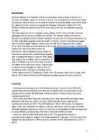
Estonia Topic Tallinn 2007 2 List of Contents page Facts and figures 3 Geography 3 Climate 3 Nature 4 History 5 Economy 6 Culture 6 Biggest towns 7 Language 8 3 Facts and figures The Republic of Estonia is a small country. Covering only 45, 228 sq km it is slightly bigger than Denmark, Belgium or Switzerland. Estonia's population is under 1.4 million. The official language is Estonian but since very many Russians live here Russian is also wide spread. The capital of Estonia is Tallinn. The currency used in Estonia is Eesti kroon. The Estonian national flag is blue-black-white. It was originally the flag of the Estonian Students' Society. The flag was first consecrated in Otepää Church in 1884. For a while, during the Soviet occupation, the flag was banned but it was again seen in p...
Introduction Estonia, officially the Republic of Estonia (Estonian: Eesti or Eesti Vabariik) is a country in the Baltic region of Northern Europe. It is bordered to the north by Finland across the Gulf of Finland, to the west by Sweden across the Baltic Sea, to the south by Latvia (343 km), and to the east by the Russian Federation (338,6 km). The territory of Estonia covers 45,227 km² and is influenced by a temperate seasonal climate. The Estonians are a Finnic people closely related to the Finns, with the Estonian language sharing many similarities to Finnish. The modern name of Estonia is thought to originate from the Roman historian Tacitus, who in his book Germania (ca. AD 98) described a people called the Aestii. Similarly, ancient Scandinavian sagas refer to a land called Eistland, close to the German term Estland for the country. Early Latin and other ancient versions of the name are Estia and Hestia. Until the late 1930s, the ...
Estonian cuisine The traditional cuisine of Estonia has substantially been based on meat and potatoes, and on fish in coastal and lakeside areas, but is influenced by many other cuisines by now. In the present day it includes a variety of international foods and dishes, with a number of contributions from the traditions of nearby countries. German, Scandinavian, Russian and other influences have played their part. The most typical foods in Estonia have been rye bread, pork, potatoes and dairy products. Estonian eating habits have historically been closely linked to the seasons. In terms of staples, Estonia belongs firmly to the beer, vodka, rye bread and pork "belt" of Europe. The Cold Table Flounder The first course in traditional Estonian cuisine is based on cold dishes - a selection of meats and sausages served with potato salad or Rosolje, an Estonian signature dishes based on beetroot, meat and herring ...
Hunting in Estonia Ants Nokkur Metsandus I Introduction Hunting is the practice of killing or trapping any living organism 14 198 hunting license oweners in Estonia. In order to have the right to hunt a person must be at least 16-years old. Hunting seasons and limits Bag limits are provisions under the law that control how many animals of a given species or group of species can be killed There are seasonal bag limits in Estonia Open and closed hunting season. Big game 1. Brown Bear Ursus arctos 2. Wolf Canis lupus 3. Lynx Lynx lynx 4. Wild boar Sus scrofa 5. Moose Alces alces 6. Roe deer Capreolus capreolus Brown Bear (Ursus arctos) Hunting season 01.08-31.10 Biggest predator in Klõpsake juhtslaidi teksti laadide redigee Estonian forest. Teine tase Average weight 200kg Kolmas tase Neljas tase Record 3...
To give an answer by topic I decided to hear the views of other people. I was published a topic in Facebook. The theme was "How to survive in Estonia. Guide for foreigner". Analyzing the answers I see the stratification of society, where one side is set extremely negative, but I am glad that there are positive opinions about living in Estonia. But everything in order: The first group of people are inclined to say that in Estonia is difficult even for local people and what to say about those who come from abroad. The problem is particularly acute elderly (old people). Their pensions are small, wherefore they are often forced to work. When people say about government, they responds terms like "corruption" and "incompetence". It is sad to state the fact that the percentage of dissatisfied respondents is higher than the percentage of people who satisfied of their life. The second group of people are more positive. They like to live in Eston...
Tallinn English College Topic Estonia Tallinn 2008 1. Introduction Estonia is a small country about the size of Switzerland, or New Hampshire and Massachussetts combined. Estonia is named after the people called "Ests" who lived in the region in the 1 st century AD. The Republic of Estonia is one of the three countries commonly known as the "Baltic States". The other Baltic States are Latvia and Lithuania. 2. Geographical position Estonia is situated in northeastern Europe. Estonia is bounded on the north by the Gulf of Finland, on the east by Russia, on the south by Latvia and on the west by the Baltic Sea. In the north it borders on Finland. The coastline of the Baltic Sea in Estonia is characterized by numerous gulfs and bays, the biggest of them being the Gulf of Finland, the Gulf of Riga and the Gulf of Pärnu. Bays include the Narva Bay, Matsalu Bay, Kolga Bay, Kunda Bay, Tallinn Bay etc....
TartuWaldorf School FINLAND Report Johan Mähar Tartu 2008 Contents p. 1. Introduction....................................................................................................1 2. Nature and geography.....................................................................................2 3. Position and size.............................................................................................2 4. Climate..............................................................................................
UNO SOOMERE ESTONIAN SYMPHONIC MUSIC. THE FIRST CENTURY 1896-1996. AN OVERVIEW With a Historical and Cultural Summary IN MEMORY OF THE GREAT ESTONIAN COMPOSERS CONTENTS ESTONIA AND THE ESTONIANS FOREWORD IN THE FOLD OF TSARIST RUSSIA. EMERGENCE AND FIRST STEPS ON THE CLASSICAL-ROMANTIC PATH. HISTORICAL INTRODUCTION I. MUSICAL LIFE IN TARTU AT THE TURN OF THE CENTURY. TRAILBLAZERS: ALEKSANDER LÄTE, RUDOLF TOBIAS, ARTUR KAPP. II. THE FIRST DECADE OF THE 20TH CENTURY. ARTUR LEMBA: THE BEGINNING OF ESTONIAN SYMPHONY AND OPERA. III. NEW DEVELOPMENTS IN CULTURAL AND MUSICAL LIFE: THE END OF THE TSARIST PERIOD. THE INDEPENDENT REPUBLIC OF ESTONIA: THE INTRODUCTION OF INNOVATIONS FROM WESTERN ART AND THE EVOLUTION OF NATIONALLY ORIENTED MUSICAL TRENDS. IV. THE TWENTIES. ARTUR KAPP: ROMANTICIST AND DRAMATIST. V. THE INFLUENCE OF NEW WESTERN MUSIC...
http://www.abiks.pri.ee FREE TIME 1. Is music popular in your family? What music do you like? 2. What musical instruments have you got in your home? 3. Can you play any musical instruments? 4. Do you sing? 5. Have you sung at a song festival? 6. Has your school got a choir? 7. When do you last go to a concert? What concert was it? 8. Have you ever been to an openair concert? What was it like? 9. Do you sing at family parties? Where else Estonians like to sing? 10. Have you got a collection of cassettes, CD´s or LP´s at home? 11. Have you watched a ballet on TV? 12. Which do you prefer ballet, drama or musical? 13. How often do you go to the theatre? 14. Do you prefer going to the theatre or watching TV? Why? 15. Do you prefer buying a cheap ticket and getting a seat at the back or spending more money and sitting in the...
MODULE 1 Greeting. Introducing oneself and the others. The alphabet. Spelling. The tenses. How to introduce yourself and others Formal introductions How to respond and reply to an May I introduce myself? I am John introduction Smith. How do you do. Allow me to introduce John Smith to Pleased to meet you. you. Standard introduction Nice to meet you. I'd like you to meet John Smith. Hello. I want you to meet John Smith. I'm so pleased to meet you. This is Jane Smith. I'm Jane Smith. My name's John Smith. Informal introduction Hi. John. Jane. Hello. Titles: Mr Mrs Miss Ms Ms is a modern form of address for women. It replaces the traditional forms of Mrs and Miss. Greetings Good morning/afternoon/evening...
1. Basic Phrases ¡Buenos días! ¡Buenas tardes! ¡Buenas noches! bway-nohs dee-ahs bway-nahs tard-ays bway-nahs noh-chays Hello! / Good morning! Good afternoon! Good evening! / Good night! ¡Hola! / ¡Chao! Adiós. Por favor. oh-lah / chow ah-dee-ohs por fah-bor Hi! / Bye! Good bye. Please. Hasta la vista / Hasta luego. Hasta pronto. Hasta mañana. ah-stah lah vees-tah / ah-stah ah-stah prohn-toh ah-stah mahn-yahn-ah loo-ay-go See you soon. See you tomorrow. See you / See you later. (Muchas) Gracias. De nada. Bienvenidos (moo-chah...
 annaabi.ee