 50 punkti
Autor soovib selle materjali allalaadimise eest saada 50 punkti.
50 punkti
Autor soovib selle materjali allalaadimise eest saada 50 punkti.
 ~ 3 lehte
Lehekülgede arv dokumendis
~ 3 lehte
Lehekülgede arv dokumendis
 2022-04-14
Kuupäev, millal dokument üles laeti
2022-04-14
Kuupäev, millal dokument üles laeti
 0 laadimist
Kokku alla laetud
0 laadimist
Kokku alla laetud
 0 arvamust
Teiste kasutajate poolt lisatud kommentaarid
0 arvamust
Teiste kasutajate poolt lisatud kommentaarid
 carita09
Õppematerjali autor
carita09
Õppematerjali autor
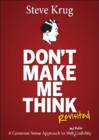
Hard and fast usability rules.I’ve been at this for a long time, long enough to know that there is no one “right” answer to most usability questions. Design is a complicated process and the real answer to most of the questions people ask me is “It depends.” But I do think that there are a few useful guiding principles it always helps to have in mind, and those are what I’m trying to convey. Predictions about the future of technology and theWeb.Honestly,your guess is as good as mine. The only thing I’m sure of is that (a) most of the predictions I hear are almost certainly wrong, and (b) the things that will turn out to be important will come as a surprise, even though in hindsight they’ll seem perfectly obvious. Bad-mouthingofpoorlydesignedsitesandapps.Ifyouenjoypeople pokingfunatthingswithobviousflaws,you’rereadingthewrongbook.
e t o t h e n e w e r a o f b i g d a t a . P ii s Big a v data a l in t C o clou o l d I T opportu I 0 Academic essay (ITI0103) 2019 spring Introduction “Data is Everything and Everyone is Data. “[1] The ability to collect, organize, structure and analyse data on a large scale is probably the most significant trait that sets us, humans, apart from our primate friends. [1] To comprehend the opportunities and threats regarding big data located within the cloud, one must first realize the essence of them. Big data is not only what its name says, but it is also so much more. What is Big data?
........................................................................ 32 3.1.2. Denver Art Museum ..................................................................................... 41 3.2. Propositions ............................................................................................................ 52 Chapter 4: Conclusion ................................................................................................ 66 4.1. Future Trends .......................................................................................................... 71 4.2. BIM in Estonia and Neighboring Countries ........................................................... 73 4.2.1. BIM in Finland ............................................................................................. 75 4.2.2. BIM in Norway.........................................................................................
often valuable - commentaries to the main text in them. It's a shame the book wasn't read as a hard copy or Norman's daydreaming of hypertext (p.??) wasn't incorporated into the digital edition. This formatting decision I consider a shortcoming of the book too. DOET is about to be republished in a new, updated edition this year, and should this edition include major updates to sections pertaining anticipation of the future, a lot of portions in the present edition may be forgiven - it is quite uncomfortable to read Norman's musings and fears for how the future will deal with complexity of objects that he prophesizes to appear when they are already integral parts of our everyday life and amongst them there are definitely examples of successful design - and it detracts from perceiving Norman in a wholly positive light and believing him.
risk management, system acquisition, information technology (IT) services and personnel management. Total Quality Management •Total Quality Management (TQM) is the application of quantitative methods and human resources to improve: 1 –the material and services supplied to an organization 2 –all the processes within an organization 3 –the degree to which the needs of the customer are met, now and in the future Põhimõisted Tarkvaraprotsessi võimekus (software process capability) näitab, millist tulemit võib loota organisatsiooni järgmiselt tarkvaraprojektilt. Tarkvaraprotsessi tulemuslikkus (software process performance) esindatab tegelikku tulemit, mis saadi tarkvaraprotsessi järgides. Tarkvaraprotsessi küpsus (software process maturity) on määr, milleni protsesson määratletud, juhitud, mõõdetud, kontrollitud – on tarkvaraprotsessi tõhususe mõõt.
Figure 1.3 Basic idea of conventional management, source Koskela 2000. Many researchers point out the lack of a specific theory for construction. At the same time, a bad implementation of the few existing theories has been the root cause of construction industry underperformance and insufficiency (Koskela & Howell, 2002). Consequently, an explicit theory is the crucial and single most important issue for the future of the project management profession (Koskela and Howell 2002). Production in construction can and should be seen as a flow (Santos 1999). 2.2.22 Conventional project management theory in construction Conventional project management tries to manage projects by scheduling (mainly by applying the critical-path method (CPM)), cost, and output. The CPM method was developed by DuPONT and Remington Rand around 1957. It was developed to mathematically calculate the sequence of activities
The evaluation section is also where you describe any physical prototypes that you constructed. It may seem odd to you that physical prototypes would not be part of the design description section, but that is because the purpose of building a prototype is to determine if the design works. Finally, the evaluation section is where you summarize the strengths and weaknesses of your design and describe recommendations for future work. The evaluation section should have the following subsections using the suggested labels for each subsection: Overview In this section, you provide an overview of your approach and an overview of the test plan for evaluating the design. Here is where you state whether the approach was by experimental testing of a prototype, computer simulation, hand calculations, user testing or a combination of these methods.
STRUCTURAL TESTING OF HOMEBUILTS Editor's Note: Alex Strojnik's Aviation articles on laminar flow in in all cases of new designs. He writings and aircraft designs have lightplane design, Alex designed also believes load testing may be in appeared in Sport Aviation many and built a very low drag powered order in a number of instances times in the past decade. A native sailplane, the S-2 (Sport Aviation, involving composite airframes. of Yugoslavia, Alex has very April 1982), which would become While there has been no history of impressive academic credentials. the first homebuilt motorglider in structural failure in composite He holds a degree in electrical engi- which International FAI Silver, Gold homebuilts that have been con- neering, a Ph. D. in aerodynamics .. and Diamond badges would be
 annaabi.ee









Kõik kommentaarid