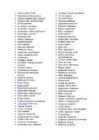
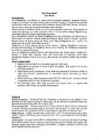
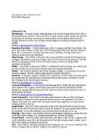
POSITIVE generous - suuremeelne, helde creative - loov, loominguline faithful - ustav, truu Jovial - lustlik Dynamic - dünaamiline, jõuline, liikuv Compassionate - kaastundlik sociable- seltskondlik, seltsiv, sõbralik charming- võluv urbane- suurlinlik, lihvitud kommetega pleasant- meeldiv artistic- kunstipärane Genial- südamlik, lahke, leebe Humanitarian-Abivalmis, Hooldav. Ethereal-Rahuline, Õnnelik. Dry humor-Teeb hääli ja nägusi et nalja paremini väljendada. Humorous- humoorikas, naljakas Careful- hoolas, tähelepanelik Practical- praktiline Prudent- mõistlik Magnanimous- suuremeelne Exuberant- ülevoolav Warmhearted- südamlik
· business-oriented-äri suunitlusega · Internist- sisehaiguste arst · camouflage-maskeering · Intriguing- intrigeeriv · Cascade- kaskaad · Jovial-lustakas · Circuit- vooluring · Knotty-keeruline, raske lahendada · Clot- hüübima · Latter tagumine, viimane · Cognitive- tunnetuslik · Levity-kerglus · compassionate-kaastundlik · Lipocytes- rasvarakud · Conduct- läbi viima · Longevity- pikaealisus, kestvusaeg · Constitute- moodustama · Mandible- alalõug · Counterpart- teisik, dublikaat · Maternal- emapoolne · Maxillary- ülalõug · Transmitter- saatja, ülekandja · Mid-brain- keskaju · Transparent- läbipaistev · Molar- purihammas · Tremendous- hiiglasuur
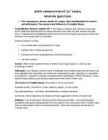
When I read the passage, I get strong feelings about love, and I tried to preserve that when switching to English. However, I think that this came out better in my literary version. My literal translation is plain and easy to understand, but doesn't have the lovely flow that the Spanish does (really, none of the English versions do. For me anyways). When I wrote the literary translation, I tried to reinstate that artistic and compassionate flow of the original. "True love conquers all", "universal truths", and "succumb" are some of the 4 compassionate phrases that I feel demonstrate the feeling of the original. The last statement, about God and him putting that force in place, was tricky. I handled it by modifying the entire sentence structure and using key words to tie ideas together
He, like Sophie, has a great affection for puzzles of all kinds. Read an in-depth analysis of Robert Langdon. Rémy Legaludec - Manservant to Leigh Teabing and participant in the plot to recover the Grail. Rémy is a mercenary who gets involved in the plot only for the money. Sophie Neveu - A cryptologist with the French Judicial Police, and the female protagonist of the novel. Sophie, who is about thirty years old, is attractive, single, compassionate, and very intelligent. She was raised by her grandfather after her parents, brother, and grandmother died in a car accident, and her grandfather instilled in her a love of puzzles and codes. In her twenties, Sophie trained in Britain in cryptology. In the novel, she is one of the major players who attempt to crack her grandfather's code. She is also a descendent of Jesus and Mary Magdalene. Read an in-depth analysis of Sophie Neveu.
Natasha born on June 10, 2001. They were both delivered by their parents' friend Dr. Anita Blanchard at University of Chicago Medical Center. Before his inauguration, President Obama published an open letter to his daughters in Parade magazine, describing what he wants for them and every child in America: "to grow up in a world with no limits on your dreams and no achievements beyond your reach, and to grow into compassionate, committed women who will help build that world. While living in Chicago, the Obamas kept busy schedules, as the Associated Press reports: "soccer, dance and drama for Malia, gymnastics and tap for Sasha, piano and tennis for both." In July 2008, the family gave an interview to the television series Access Hollywood. Obama later said they regretted allowing the children to be included. Malia and Sasha attend the private Sidwell Friends School in Washington, DC, the same
suggest he may be a forester. The Prioress (est: NUNN/PRIORESS): What is her name? Describe her in terms of looks, manners, character. What is said about the way she speaks French? Who accompanied her? Described as modest and quiet, this Prioress (a nun who is head of her convent) aspires to have exquisite taste. Her table manners are dainty, she knows French (though not the French of the court), she dresses well, and she is charitable and compassionate. The Monk (est: MUNK): Describe him in terms of his personality? What are his views about religion? What is his passion? How was he dressed? Most monks of the Middle Ages lived in monasteries according to the Rule of Saint Benedict, which demanded that they devote their lives to "work and prayer." This Monk cares little for the Rule; his devotion is to hunting and eating
Hazard and the gang in Philadelphia. The idealized, small-scale communities they described reminded her of the hunting and gathering bands of pre-history. So she was a bit concerned that their creators didn't seem to be searching for individuals with different skill sets. Dr. Fisher, whose new book, "Why Him? Why Her?" explores the neurochemistry of gender differences, concluded that the ad writers were by and large "estrogen-expressives, or what I call Negotiators," which she defined as "compassionate, verbal and emotive," as well as "Explorers, meaning those expressive of the dopamine system, or people who are energetic, creative, politically liberal." She also noted that they all seemed to crave roommates who shared their values, which, she pointed out, "is how many relationships are built -- it's probably the right the thing to do. You don't want to come home and spend your evening fighting with someone over health care. You want someone who agrees with you."
Though spiteful and insolent, she is also beautiful and indulged. Her sister Eliza foils her marriage to a wealthy Lord. · Bessie Lee: The plain-spoken nursemaid at Gateshead. She sometimes treats Jane kindly, telling her stories and singing her songs. Later she marries Robert Leaven. · Robert Leaven: The coachman at Gateshead, who brings Jane the news of John Reed's death, which brought on Mrs. Reed's stroke. · Mr. Lloyd: A compassionate apothecary who recommends that Jane be sent to school. Later, he writes a letter to Miss Temple confirming Jane's account of her childhood and thereby clearing Jane of Mrs. Reed's charge of lying. · Mr. Brocklehurst: The clergyman headmaster and treasurer of Lowood School, whose mistreatment of the students is eventually exposed. · Miss Maria Temple: The kind, superintendent of Lowood School, who treats Jane
about 1.6 billion followers of Islam and it makes around 23% of earth's population. Islam's most fundamental concept is a rigorous monotheism, called tawhid. Muslims and Jews repudiate the Christian doctrien of the Trinity and divinity of Jesus, comparing it to polytheism. In Islam, God is beyond all comprehension and Muslims are not expected to visualize God. God is described and referred to by certain names or attributes, the most common being Al-rahman, meaning ,,The Compassionate" and Al-Rahim, meaning ,,The Merciful". There is a strong believe amongst Muslims that the creation of everything in the universe was brought into being by God's sheer command, ,,Be and so it is," and that the purpose of existence is to worship God. He is known as a personal God who responds whenever a person in need or distress calls him. There are no intermediaries, such as clregy, to contact God who states, I am nearer to him than jugular vein
ideas, imagination, and curiosity. • Vastutustundlikkus/Conscientiousness - a tendency to show self-discipline, act dutifully, and aim for achievement; planned rather than spontaneous behaviour. • Ekstravertsus/Extraversion - energy, positive emotions, surgency, and the tendency to seek stimulation and the company of others. • Kooskõlalisus/Agreeableness - a tendency to be compassionate and cooperative rather than suspicious and antagonistic towards others. • Neurootilisus/Neuroticism - a tendency to experience unpleasant emotions easily, such as anger, anxiety, depression, or vulnerability; sometimes called emotional instability. PROJEKTRIIVSED TESTID • Hermann Rorschach (20 saj algus) – värviplekitest • Henry Murray (1930dad) – TAT • Projektiivsete testide interpreteerimine ja kasutusalad UURMISSTRATEEGIAD
tormenting Kantorek when Kantorek is conscripted as a Paul Bäumer As the novel's narrator and protagonist, Paul is the central figure in All Quiet on the Western Front and serves as the mouthpiece for Remarque's meditations about war. Throughout the novel, Paul's inner personality is contrasted with the way the war forces him to act and feel. His memories of the time before the war show that he was once a very different man from the despairing soldier who now narrates the novel. Paul is a compassionate and sensitive young man; before the war, he loved his family and wrote poetry. Because of the horror of the war and the anxiety it induces, Paul, like other soldiers, learns to disconnect his mind from his feelings, keeping his emotions at bay in order to preserve his sanity and survive. As a result, the compassionate young man becomes unable to mourn his dead comrades, unable to feel at home among his family, unable to express his feelings about the war or even
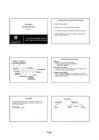
Industrious · Factor analysis: test for which items group together with the others by looking at the correlations between items Conscientious Meticulous · Groups of similar items are known as factors Compassionate · Decisions about the number of factors can vary: hence, researchers Tender-hearted have ended up with different `solutions' to the problem of personality Loving description Mild Brainy Knowledgeable
the first Women's Liberation Conference in Britain took place in 1969, at Ruskin College, and its major publications such as Spare Rib and off our backs not founded until 1970 and beyond. Literature of Feminism Feminism has gradually become more far-ranging and subtle in its attacks on male-dominated society. Many injustices still need to be corrected, but equally necessary is a more down-to-earth, tolerant and compassionate view of fellow human beings. Critics, being generally male, had not generally concerned themselves with gender issues. Most of the world's great literature had been written by men. Sappho, Austen, the Brontës and Emily Dickinson apart, it was difficult to think women really had it in them to write at the highest level. Literature was literature, and critics saw no need to distinguish a specifically feminine way of writing or responding to a text.
The book is critical of the treatment of slaves and contains many images by William Blake and Francesco Bartolozzi depicting the cruel treatment of runaway slaves. It was an example of what became a large body of abolitionist literature. Historians and literary critics find the roots of English nineteenth century abolitionist literature in the preceding century. Eighteenthcentury Enlightenment ideals such as compassionate humanitarianism and a new concept of liberty, combined with a growing religious zeal which stressed the perfectibility of mankind and the brotherhood of all races, caused profound changes in how the English thought and wrote about slavery. A great deal of scholarship has devoted itself to tracing the growth of antislavery sentiment in English poetry and literature from the eighteenth century, especially in that century's romantic idealization of the "noble savage
We have a very short attention span, and have a very short burst of energy which easily extinguishes in the face of impediment. We prefer to be parasites of a culture which we had no hand in creating, a Caucasian culture which took them years to perfect, and which we cannot easily emulate in its basic tenets a predisposition to make wars not only on themselves but more so on others for intimidation and supremacy. Unlike his Caucasian counterpart, the African is a compassionate #%!&, easily influenced to hospitality of known enemies because of their acts of deceitful intentions. The balkanization of Africa by the six Caucasian nations, Britain, France, Spain, Italy, Portugal and Germany, resulted in the creation of disparate and at best, baseless boundaries, countries without geographical significance. The fight to gain independence was not so much the aggressive pursuit of the
place of all the other identifications that have collapsed through the loss. In other words, the ego quickly finds a new form. The fact that this new form is a deeply unhappy one doesn't concern the ego too much, as long as it has an identity, good or bad. In fact, this new ego will be more contracted, more rigid and impenetrable than the old one. Whenever tragic loss occurs, you either resist or you yield. Some people become bitter or deeply resentful; others become compassionate, wise, and loving. Yielding means inner acceptance of what is. You are open to life. Resistance is an inner contraction, a hardening of the shell of the ego. You are closed. Whatever action you take in a state of inner resistance (which we could also call negativity) will create more outer resistance, and the universe will not be on your side; life will not be helpful. If the shutters are closed, the sunlight cannot come in. When you yield internally, when you
Bennet; it came from Netherfield, and the servant waited for an answer. Mrs. Bennet's eyes sparkled with pleasure, and she was eagerly calling out, while her daughter read, "Well, Jane, who is it from? What is it about? What does he say? Well, Jane, make haste and tell us; make haste, my love." "It is from Miss Bingley," said Jane, and then read it aloud. "MY DEAR FRIEND,-- "If you are not so compassionate as to dine to-day with Louisa and me, we shall be in danger of hating each other for the rest of our lives, for a whole day's tete-a-tete between two women can never end without a quarrel. Come as soon as you can on receipt of this. My brother and the gentlemen are to dine with the officers.--Yours ever, "CAROLINE BINGLEY" "With the officers!" cried Lydia. "I wonder my aunt did not tell us of that." "Dining out," said Mrs. Bennet, "that is very unlucky."
"Could I talk to you a minute?" "Of course." I grabbed my tablet, even though his grim face and tone warned me they might not be needed. When Mark shut the door behind me, my apprehension increased. "Is everything all right?" "Yes." He waited until I was seated; then took the chair beside me rather than the one behind his desk. "I don't know how to say this..." "Just say it. I'll figure it out." He looked at me with compassionate eyes and a cringe of embarrassment. "It's not my place to interfere. I'm just your boss and there's a line that comes with that, but I'm going to cross it because I like you, Eva, and I want you to work here for a long time." My stomach tightened. "That's great. I really love my job." "Good. Good, I'm glad." He shot me a quick smile. "Just...be careful with Cross, okay?" I blinked, startled by the direction of the conversation. "Okay."
It's not an easy thing, not something you could forget." "Your parents?" "They had already died from the disease. I was alone. That was why he chose me. In all the chaos of the epidemic, no one would ever realize I was gone." "How did he... save you?" A few seconds passed before he answered. He seemed to choose his words carefully. "It was difficult. Not many of us have the restraint necessary to accomplish it. But Carlisle has always been the most humane, the most compassionate of us... I don't think you could find his equal throughout all of history." He paused. "For me, it was merely very, very painful." I could tell from the set of his lips, he would say no more on this subject. I suppressed my curiosity, though it was far from idle. There were many things I needed to think through on this particular issue, things that were only beginning to occur to me. No doubt his quick mind had already comprehended every aspect that eluded me.
than M E N T O R . In the meeting that followed the storyboard presentation, I suggested taking him a little more seriously as a M E N T O R . Perhaps Zazu was still suspicious and 261 T H E W R I T E R ' S JOURNEY ~ T H I R D EDITION Christopher Vogler would try to run him off, but the more wise and compassionate Mufasa would let him approach the child. I had the impulse to accentuate the ritualistic aspects of the moment, referring to the rituals of baptism and christening, or the coronation ceremonies in which a new king or queen is anointed on the forehead with holy oil. Rafiki would bless the baby lion, perhaps with berry juice or some substance from the jungle. One of the animators said Rafiki already carried a stick with strange
 annaabi.ee