frith) is an area with a high density of trees. Forests cover approximately 30% of land and 9.4% of all the planet earth. They are also responsible for regulating our planet's climate and act as large purifiers of airs, by absorbing carbon dioxide, and giving out oxygen. Different types of forests Forests are divided into following main types: o Tropical forest o Subtropical forest o Plantations o Boreal forest o Temperate forest o Seasonal or monsoon forest Tropical and Subtropical Forests Tropical and subtropical forests, also known as rainforests or tropical rainforests, are lavish and ample forests with broad leave tree. They are mostly found at lowlands near the equator - Asia, Africa, South & Central America and on many of the Pacific Islands. Almost 50% forests of the world are tropical and subtropical in nature.
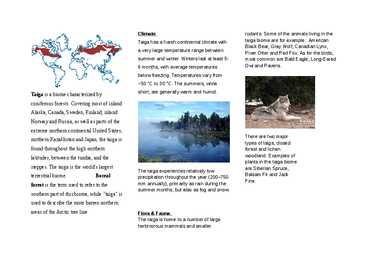
latitudes, between the tundra, and the woodland. Examples of plants in the taiga biome steppes. The taiga is the world's largest are Siberian Spruce, The taiga experiences relatively low terrestrial biome. Boreal Balsam Fir and Jack precipitation throughout the year (200750 Pine. forest is the term used to refer to the mm annually), primarily as rain during the summer months, but also as fog and snow. southern part of this biome, while "taiga" is
4. Natural eutrophic lakes with Magnopotamion or Hydrocharition -type vegetation 5. Natural dystrophic lakes and ponds 6. Semi-natural dry grasslands and scrubland facies on calcareous substrates (Festuco-Brometalia) (* important orchid sites) 7. Fennoscandian lowland species-rich dry to mesic grasslands 8. Hydrophilous tall herb fringe communities of plains and of the montane to alpine levels 9. Northern boreal alluvial meadows 10. Lowland hay meadows (Alopecurus pratensis, Sanguisorba officinalis) 11. Fennoscandian wooded meadows 12. Active raised bogs 13. Degraded raised bogs still capable of natural regeneration 14. Transition mires and quaking bogs 15. Depressions on peat substrates of the Rhynchosporion 16. Alkaline fens 17. Western Taïga 18. Fennoscandian herb-rich forests with Picea abies 19
T. 2002. Blackwell Science, Ltd Influences of fire history and topography on the pattern of a severe wind blowdown in a Colorado subalpine forest.- Journal of Ecology, 90, 806-819. Laas, E., Uri, V., Valgepea, M. 2011. Metsamajanduse alused. Tartu: Tartu Ülikooli Kirjastus. 862 lk. Mitchell, S.J. 2012. Wind as a natural disturbance agent in forests: a synthesis.- Forestry, 00, 1-11. Nummi, P., Kuuluvainen, T. 2013. Forest disturbance by an ecosystem engineer: beaver in boreal forest landscapes.- Boreal Environment Research, 18(A), 13-24. Seidl, R., Schelhaas, M.J., Lexer, M.J. 2011. Unraveling the drivers of intensifying forest disturbanceregimes in Europe.- Global Change Biology, 17, 2842-2852. Stadelman, G., Bugmann, H., Wermelinger, B., Bigler, C. 2014. Spatial interactions between storm damage and subsequent infestations by the European spruce bark beetle. – Forest Ecology and Management, 314, 167-174. Swift, K., Ran, S. 2012
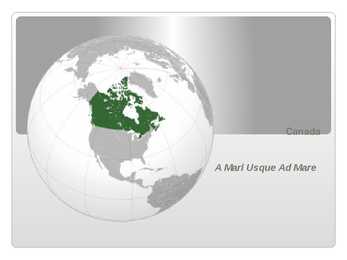
dependence on the British parliament Click to edit Master text styles Second level Third level Fourth level Fifth level Ottawa Capital 45°24N 75°40W / 45.4°N 75.667°W / 45 Largest city Toronto Capital, Largest City Since the end of the last glacial period, Canada has consisted of eight distinct forest regions, including extensive boreal forest on the Canadian Shield Canada has more lakes than any other country, containing much of the world's fresh water Geography There are also freshwater glaciers in the Canadian Rockies and the Coast Mountains Canada is geologically active, having many earthquakes and potentially active volcanoes, notably Mount Meager, Mount Garibaldi, Mount Cayley, and the Mount Edziza volcanic complex
1,500 lichens and nearly 1,000 bryophytes. The total number of vascular species is low by world standard but lichens and bryophytes are abundant and the latter form a population of global importance. Various populations of rare fern exist, although the impact of 19th century collectors threatened the existence of several species. The flora is generally typical of the north west European part of the Palearctic ecozone and prominent features of the Scottish flora include boreal Caledonian forest (much reduced from its natural extent), heather moorland and coastal machair. In addition to the native varieties of vascular plants there are numerous nonnative introductions, now believed to make up some 43% of the species in the country. The are a variety of important trees species and specimens; a Douglas Fir near Inverness is the tallest tree in the United Kingdom and the Fortingall Yew may be the oldest tree in Europe. The Shetland Mouseear and
Canada's largest geographical feature, it stretches east to Labrador, south to Kingston on Lake Ontario and northwest as far as the Arctic Ocean. The Shield is considered to be the nucleus of the North American continent and is made up of roots of ancient mountains. Its gneiss and granite rocks are 3.5 billion years old, three quarters the age of the Earth. Scraped by the advance and retreat of glaciers, the Shield has only a thin layer of soil that supports a boreal forest of spruce, fir, tamarack and pine. The region is a storehouse of minerals, including gold, silver, zinc, copper and uranium, and Canada's great mining towns are located there: Sudbury and Timmins in Ontario, Val d'Or in Quebec, and Flin Flon and Thompson in Manitoba. St. Lawrence Lowlands - The Great Lakes Southern Quebec and Ontario, the industrial heartland of Canada, contain Canada's two largest cities, Montreal and Toronto
Sea and Black Sea. The Czech Republic also leases the Moldauhafen, a 30,000-square-metre (7.4-acre) lot in the middle of the Hamburg Docks, which was awarded to Czechoslovakia by Article 363 of the Treaty of Versailles, to allow the landlocked country a place where goods transported down river could be transferred to seagoing ships. Phytogeographically, the Czech Republic belongs to the Central European province of the Circumboreal Region, within the Boreal Kingdom. According to the World Wide Fund for Nature, the territory of the Czech Republic can be subdivided into four ecoregions: the Central European mixed forests, Pannonian mixed forests, Western European broadleaf forests and Carpathian montane conifer forests. There are four national parks in the Czech Republic. The oldest is Krkonose National Park (Biosphere Reserve), Sumava National Park (Biosphere Reserve), National Park Podyjí, Ceské Svcarsko National Park.
9. Lisad Joonis 1. Metsa pindala Euroopa riikides (2005a seisuga) http://epp.eurostat.ec.europa.eu/cache/ITY_OFFPUB/KS-78-09-993/EN/KS-78-09-993- EN.PDF 22 Joonis 2. Metsast puidu kätte saadavus. http://epp.eurostat.ec.europa.eu/cache/ITY_OFFPUB/KS-78-09-993/EN/KS-78-09-993- EN.PDF 23 Kasutatud kirjandus 1. Larsson, S., Danell, K. (2001). Science and the Managment of Boreal Forest Biodiversity. Oslo. 2. Lamp, M. (2008). Peeti Euroopa metsakaitsekonverentsi. Eesti Mets, 1, 10-11. 3. CEPF. (2008). Põhja- ja Läänemere maad majandavad metsi säästlikult. Eesti mets, 3, 8. 4. Karoles, K. (2004). Euroopa Liit hakkab senisest tugevamini mõjutama Eesti metsandust. Eesti Mets, 2. 5. http://europa.eu/index_et.htm 6. http://www.roheline.ee/content/view/278/7/lang,et/ 7. http://infoeuropa.sliven
" 62 ,,Näiteks jooksiklane Sericoda quadripunctata on tüüpiline põlendikuala asukas juba esimesest põlengujärgsest suvest alates."63 ,,Uuringud näitavad inimese pikaajalist sõltuvust metsapõlengutest ja nende kasutamist inimese 58 Metsatulekahjud. Alton, H., Kiil, A. D. Lk 10. 59 http://www.envir.ee/989284 (11.04.2010). 60 Forest Fire Behavior and Managment. Kiil, A. D. 61 Forest Fire Behavior and Managment. Kiil, A. D. 62 The Short-term Impact of fire on thee Beetle Fauna in Boreal Coniferous Forest. Muona, J., Rutanen, I. Lk 109-121. 63 Clear-cutting Before Burning Prevents Establishment of the Fire-adapted. Wikars, L-O. Lk 375-384. poolt. Metsa raadamine asulate rajamiseks ja tööstuse arendamiseks on põhjustanud ulatuslikke metsatulekahjudest tingitud kahjusid paljudes metsapiirkondades."64 64 Forest Fire Behavior and Managment. Kiil, A. D. Tulemused ja arutelu Uurimistöö käigus on kogutud andmeid ilmastiku, metsatulekahjude arvu, leviku ning asukoha,
Ontario to the frigid Arctic plains of the Northern Canada, from the wet temperate rainforests of the west coast to the arid deserts, badlands and tundra plains, the biodiversity of Canada's plants is extensive. Many of the plants seen in Canada are introduced, either intentionally or accidentally. Canada offers a wide range of habitats across varied vegetation. Arctic Tundra can be found in Canada's north which leads south into boreal forests which is most typical of Canada and covers more of the country than any other type of vegetation. The Maritimes are home to the Acadian forests which are made up from spruce, for, birch, pine and maple trees. West of the Maritimes in Quebec and Ontario are the Laurentian Forests and Mountains leading into the Canadian Shield in the north and the Great Lakes in the south and west of Ontario
year) year) m²) Tropical rain forest 17.00 2,200.00 37.40 45.00 765.00 20.50 Tropical monsoon forest 7.50 1,600.00 12.00 35.00 262.50 21.88 Temperate evergreen forest 1,320.00 6.60 35.00 175.00 26.52 Temperate deciduous forest 7.00 1,200.00 8.40 30.00 210.00 25.00 Boreal forest 12.00 800.00 9.60 20.00 240.00 25.00 Mediterranean open forest 2.80 750.00 2.10 18.00 50.40 24.00 Desert and semidesert scrub 18.00 90.00 1.62 0.70 12.60 7.78 Extreme desert, rock, sand or ice 24.00 3.00 0.07 0.02 0.48 6.67 sheets Cultivated land 14.00 650.00 9.10 1
(2006) Scots pine (Pinus sylvestris L.) and its habitat in Muraka bog under the influence of wastes from the Narva power plants (North-East Estonia). – Special issue on effects of industrial wastes on Florest. Proceedings of the Estonian Academy of Sciences, Biology, Ecology. Nr. 2, lk 137- 148. 23. Paal, J., Degtjarenko, P., Suija, A., Liira, J. (2012). Vegetation responses to long- term alkaline cement dust pollution in Pinus sylvestris-dominated boreal forests- niche breadth along the soil pH gradient. – Applied Vegetation Science. Nr. 16, lk 248-259. 24. Pietiläinen, P., Moilanen, M., Vesala, H. (2005). Nutrient status and growth of Scots pine (Pinus sylvestris L.) on Rained peatlands after potassium fertilisation. – Finnish Peatland Society. Nr 3, lk 101-113. 25. Pihelgas, E. (1983). Metsa bioloogia. Tallinn: Valgus. lk 224. 26. Pleijel, H. (1993). Ökoloogiaraamat. Tallinn: Tallinna Raamatutrükikoda, lk 95. 27
Sellised metsi sisaldavad kaitsealad on suure tähtsusega kogu Euroopas, need moodustavad olulise osa Eesti Natura 2000 võrgustikust. Eesti metsad on mitmekesised ja väärtuslikud ning väärivad kaitset. Viited 1. Jõgiste, K., Kuuba, R., Viilma, K., Korjus, H., Kiviste, A., Kalda, A., Parmasto, E., Jüriado, I., Lõhmus, P., Õunap. 2008. Metsade looduslikkuse taastamine. Tartu. 97+31 lk. 2.Kuris, M., Ruskule, A. 2006. Favourable conservation status of boreal forests: monitoring, assessment and management. 40 p. 3. Laasimer, L. 1965. Eesti NSV taimkate. Valgus, Tallinn. 4. Lilleleht, V. (ed.) 1998. Red Data Book of Estonia. Endangered fungi, plants and animals. - Eesti TA Looduskaitse Komisjon, Tartu, in Estonian with English summary. 5. Andersson, L., Martver, R., Külvik, M., Palo, A. ja Varblane, A. 2003. Vääriselupaikade inventuur eestis 1999-2002. Regio AS, Tartu. 112 lk. + 80 lk. 6. Lõhmus, A. 2002
 annaabi.ee