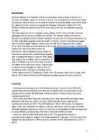
The Republic of Estonia Estonia officially the Republic of Estonia is a country in the Baltic region of Northern Europe. It is bordered to the north by Finland across the Gulf of Finland, to the west by Sweden across the Baltic Sea, to the south by Latvia and to the east by the Russian Federation. The territory of Estonia covers 45,227 km² and is influenced by a temperate seasonal climate. Estonia is a democratic parliamentary republic and is divided into fifteen counties. The capital and largest city is Tallinn. With a population of only 1.4 million, it is one of the least- populous members of the European Union. Estonia was a member of the League of Nations from 22 September 1921, has been a member of the United Nations since 17 September 1991, of the European Union since 1 May 2004 and of NATO since 29 March 2004. Estonia has also signed the Kyoto protocol. Estonia regained its ind...
The Republic of Estonia Estonia lies on the shores of the Baltic Sea. Its nearest neighbours are Finland, Sweden, Latvia and Russia. The total are of Estonia is 45,215 square kilometres. Estonia is one of the most sparsely populated countries in Europe. It has population neraly 1.4 million. There are lot of bays and peninsulas along the coast of Estonia.It has about 1,200 islands, the largest of which are Saaremaa and Hiiumaa. Nort-estonia is relatively flat and low-lying. There is a nice coastline here. Sout- estonia is hilly, but there are no high mountains in Estonia. The highest point is Suur-Munamägi, is only 318 meters above sea level. The largest industrial urban areas are in East-Estonia and there are some beautiful nature reserves in West-Estonia. Estonia is mainly agricultural country. Estonia is famous for its thousands of lakes and beautiful nature. One of the most interesting sights is...
Kerli Uue 10.r The Republic of Estonia Estonia is a democratic parliamentary republic divided into 15 counties. The capital and largest city is Tallinn. Estonia's neighbours are Latvia, Russia and Finland. The parliment is named ,,The Riigikogu." The Estonian parliament has 101 members and influences the governing of the state primarily by determining the income and the expenses of the state. The Riigikogu elects and appoints several high officials of the state, including the President of the Republic. The Parliament of Estonia is elected by people for a four year term by proportional representation. The Government of Estonia is formed by the Prime Minister of Estonia, nominated by the president and approved by the parliament. The government exercises executive power pursuant to the Constitution of Estonia and the laws ...
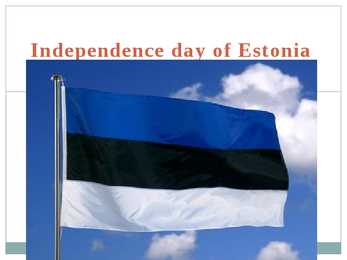
Independence day of Estonia Independence Day, officially known as Eesti Vabariigi aastapäev is a federal holiday in Estonia when it declared independence in 1918 February 24: Independence Day The Republic of Estonia was founded on 24 February 1918, when the Salvation Committee (Päästekomitee) declared the independence of the Republic of Estonia. A Quest for Independence The 1917 revolution and the generally unstable situation in Russia created the opportunity for Estonia to gain its independence. Celebration of the 95th Anniversary of the Proclamation of the State Independence of the Republic of Estonia Saturday, 23 February 11.00 Placing of wreaths on the graves of Estonian state figures 13.00 Handing out of state decorations by President of the Republic Toomas Hendrik Ilves Sunday, 24 February 07.33 Formal flag-raising ceremony on Pikk Hermann tower in Tallinn ...
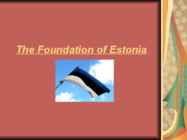
The Foundation of Estonia Estonia The history of Estonia The history of Estonia is a part of the history of Europe. Estonia was settled near the end of the last glacial era, beginning from around 8500 BC. Before the Germans invaded in the 13th century proto-Estonians of the Ancient Estonia worshipped the spirits of nature. Since the Northern Crusades Estonia became a battleground for centuries where Denmark, Germany, Russia, Sweden and Poland fought their many wars over controlling the important geographical position of the country as a gateway between East and West. Being conquered by Danes and Germans in 1227, Estonia was ruled initially by Denmark in the north, by the Livonian Order, an autonomous part of the Monastic state of the Teutonic Knights and Baltic German ecclesiastical states of the Holy Roman Empire. From 1418–1562 the whole of Estonia was part of the Livonian Confederation. A...
Estonian state system The Resolution of the National Independence of Estonia was adopted on August 20, 1991. The Constitution of Estonia is the fundamental law of the Republic of Estonia and it was adopted in June 1992. Estonia is a Democratic Parliamentary Republic where the supreme power is vested in the people. The head of State of Estonia is the President of the Republic who can be elected for two five-year terms. The Legislature. The Parliament of Estonia is called Riigikogu and it is elected by people for a four year term. The election is universal, uniform and direct. Voting is secret. The Riigikogu is comprised of one hundred and one members. The Riigikogu has three main functions: legislation, reviewing the activities of the executive power, representation. The members of the Riigikogu have the rights to form factions. The Executive. The Executive of Estonia consists of the body of the Prime Minister and cabinet of ministers. ...
February 24: Independence Day The Republic of Estonia was founded on February 24, 1918 when the Salvation Committee, Päästekomitee, declared the independence of the Republic of Estonia. This date was celebrated as the Day of Independence until the Soviet occupation of Estonia in 1940. During the Soviet occupation, the Independence Day was festively celebrated in Estonian communities around the world. Every year, the US Secretary of State sent greetings on the occasion to the Ambassador of the Republic of Estonia to the United States, Ernst Jaakson. On February 24, 1989, the red flag of Soviet Estonia was replaced by the blue-black-white Estonian national flag on Toompea and since that time the Independence Day has been celebrated as a public holiday again. This year Estonia will celebrate the 83rd anniversary of the declaration of the state independence. A Quest for Independence For centur...
Official name: Republic of Estonia Territory: 45 227 km Population: 1 342 000 Official languafe: Estonian Largest ethnic groups: Estonians 68%, Russians 26%, Ukrainians 25, Belarussians 1%, Finns 1% Capital of Estonia: Tallinn Number of islands: 1 521 Highest point: Suur-Munamagi (Great Egg Hill) 318 m Religion: Lutheran Currency: Estonian Kroon (EEK),1 EUR = 15,65 EEK Estonia has two Independence Days - Estonia first achieved independence from the Soviet Union on the 24th February 1918 and again on the 20th August 1991 after 51 years of occupation. The second date is known as the Restoration of Independence Day The Estonian language belongs to the Finno-Ugric group and is most similar to Finnish Estonia was the first country in the world to introduce online political voting Estonia won the Eurovision Song Contest in 2001 with the song Everybody There are over 1500 Islands, 1000 lakes and 7000 rivers in Estonia Chess Grandmaster Paul ...
HISTORY OF ESTONIA Estonians are one of the longest-settled European peoples, whose forebears, known as the "comb pottery" people, lived on the southeastern shores of the Baltic Sea over 5,000 years ago. Like other early agricultural societies, Estonians were organized into economically self-sufficient, male-dominated clans with few differences in wealth or social power. By the early Middle Ages most Estonians were small landholders, with farmsteads primarily organized by village. With the collapse of the Russian empire in World War I, Russia's provisional government granted national autonomy to Estonia. A popularly elected assembly (Maapaev) was formed but was quickly forced underground by opposing extremist political forces. The Committee of Elders of the underground Maapaev announced the Republic of Estonia on February 24, 1918, 1 day before German troops invaded. After the withdrawal of Ger...
President of Estonia Kadi Hõim Form 10 The President of the Republic (in Estonian: Eesti Vabariigi President) is the head of state of the Republic of Estonia. Estonia is a parliamentary republic, therefore President is mainly a symbolic figure and holds no executive power. Presidential Flag of Estonia The President is elected by the Parliament or a special electoral body for a five-year term. The electoral body is convened in case no candidate secures a two-third-majority in Parliament after three rounds of balloting. The President can not be elected for more than two consecutive terms. History Estonia didn't have a president from 1918 to 1938. This institution was intentionally left out of the first Estonian constitution, for its authors tried to avoid the concentration of power in one person's hands by all means possible. Esto...
Introduction of Estonia The Republic of Estonia is beautiful country which is located in northeastern Europe, bordering the Baltic Sea on the west, the Gulf of Finland on the north, Latvia on the south, and Russia on the east. Estonia is the smallest of the Baltic countries. Administrative division: Estonia has an area of 45,226 square kilometers and Estonia is administratively divided into counties. There are 15 counties in Estonia. The capital is Tallinn which is located in Harjumaa. Counties are divided into 194 rural municipalities. Population: The population of Estonia was estimated at 1.34 million in January 2011, with a density of 30 persons per square kilometer. According to the last census the number of inhabitants has decreased. In 2010 the birth rate was 11,82 per 1,000 population, while the death rate was exactly the same, so population growth rate is 0%. The proportion of urban p...
Estonian War of Independence During World War I the greatest colonial power in Europe the Russian Empire seized to exist. On its ruins the formerly enchained nations founded their own states. Among them was the Estonian Republic, officially declared on February 24, 1918. When Germany surrendered to the Western Allies on November 11, 1918 a strategic vacuum arose in Eastern Europe. The new rulers of Russia the Bolsheviks decided to use it as a proper moment to re-conquer their lost territories. The ultimate goal was international communist revolution and Germany was the first standing on their way. Thus on November 13, 1918 the Government of Soviet Russia denounced peace with Germany. On November 16 the Commander-in-Chief of the Red Army, Jukums Vacietis, gave orders to start a massive attack on a long front from the Gulf of Finland to the Ukraine. On November 28, two divisions of the Red Army (altogether 12,000 troops) crossed...
Estonia Estonia, officially called the Republic of Estonia is a small country in Northern Europe. It has land borders with Latvia in the south and Russia in the east. It is separated from Finland in the north by the Gulf of Finland and from Sweden in the west by the Baltic Sea. The capital of Estonia is Tallinn, it's also the biggest city we have. The national flag of Estonia is a tricolour: horizontally blue, black and white, called "sinimustvalge". The President of Estonia is Toomas Hendrik Ilves and the Prime Minister is Andrus Ansip. Estonia has been occupied several times during its history. The last occupiesation happened 16 June 1940 and it was declared 20 August 1991. Republic of Estonia has only one offical language - the Estonian language. Estonia is a constitutional democracy, with a president elected by its parliament. The elections are held every four years. Estonia became a member of the European Union 1 May 2004 and NATO...
The Republic of Estonia is a country in Northern Europe. The territory of Estonia covers 45,227 km2 . Tallinn is the capital and largest city of Estonia.The city is an important industrial, political and cultural center, and seaport Estonia is a democratic parliamentary republic and is divided into fifteen counties. Estonia is one of the least-populous members of the European Union. Estonia lies in the northern part of the temperate climate zone Estonia has four seasons of near-equal length. The official language is Estonian.Võro and Seto in southern counties are spoken along with Estonian. The Estonian national flag is a tri-color- blue, black and white. The national currency is the Eestonian kroon. Estonia has over 1,400 lakes. Most are very small, with the largest, Lake Peipsi being 3,555 km² .There are many rivers in the country. The longest of them are Võhandu (162 km), Pärnu (144 km), and Põltsamaa (135 km).Estonia has numerous f...
The most important key dates in Estonian history Every country has its history and some moments are more important than the others. Here are some of the most notable dates from Estonian history. 3rd millennium BC the Finno-Ugric tribes arrive in Estonia 1154 First written mention of Tallinn (by al-Idrisi) 13th century German and Danish invade Estonia. Estonians' numerous attempts to restore independence fail 1343 St. George's Night uprising 1558-1583 the Livonian War after which Northern Estonia is occupied by Sweden and Southern Estonia occupied by Poland 1632 Tartu University was founded 1860-1885 the era of national awakening, the foundation for Estonian journalism was laid, collection of folklore 1869 First all-Estonian Song Festival in Tartu 1884 The blue-black-and-white flag of Estonian Students' Society was consecrated ...
Estonia is located in the Northern Europe and is a state in the Baltic region It is bordered to the north by the Gulf of Finland, to the west by the Baltic Sea, to the south by Latvia, and to the east by Lake Peipus(Peipsi) and the Russian Federation.Estonia also has a number of islands: Saaremaa and Hiiumaa, which are the most known are also the two biggest ones.The territory of Estonia covers 45,227 km2. There is 3,794 kilometers of coastline marked by numerous bays, straits, and inlets. The Republic of Estonia is divided into fifteen counties: Hiiumaa, Saaremaa, Läänemaa, Harjumaa, Lääne-Virumaa, Ida-Virumaa, Tartumaa, Jõgevamaa, Järvamaa, Raplamaa, Viljandimaa, Pärnumaa, Valgamaa, Põlvamaa and Võrumaa. The capital city of estonia is Tallinn. Estonia is influenced by a temperate seasonal climate. Estonia has four seasons of near-equal length. July is the warmest month, and February is the coldest month. Snow cover, which is d...
Estonia officially the Republic of Estonia, is a country in the Baltic region of Northern Europe. It is bordered to the north by the Gulf of Finland, to the west by the Baltic Sea, to the south by Latvia and to the east by Russia. Across the Baltic Sea lies Sweden in the west and Finland in the north. The territory of Estonia covers 45,227 km2, and is influenced by a humid continental climate. Estonia is a democratic parliamentary republic divided into fifteen counties, with its capital and largest city beingTallinn. With a population of 1.3 million, it is one of the least-populous member states of the European Union. The Estonians are a Finnic people, and the official language, Estonian, is a Finno-Ugric language closely related to Finnish The history of Estonia is a part of the history of Europe. Estonia was settled near the end of the last glacial era, beginning from around 8500 BC. Before the Germans invaded in the 13th century pro...
Topic Estonia, Tallinn The Republic of Estonia is the northernmost of the three Baltic States on the eastern shore of the Baltic Sea. To the east Estonia borders on Russia and Lake Peipsi and on the south on Latvia. The area of Estonia is 45 100km2, its coastline is 774km long. The geography of the land is surprisingly varied. Islands make up 9,2 per cent of Estonian's total territory, the largest islands are Saaremaa, Hiiumaa and Vormsi. The highest point is Suur Munamägi, which is 317m high. Estonia has a surprisingly mild climate for an area so far north. Sea winds keep the weather from becoming very cold or hot. The population of Estonia is 1.5 million. Of this number 62 per cent are Estonians. Estonians speak the Estonian language, which is closely related to Finnish. Estonia's flag has three horizontal stripes. The blue stripe at the top of the fla...
The Membership of World Organisations Merilin Tamme Xa Tallinna Järveotsa Gymnasium 2008 The schedule · 04.04.1949 establishment of NATO. · 1951 Supreme Headquarters Allied Power Europe (SHAPE) was created near Paris in France. Later, SHAPE was relocated to Mons in Belgium. · 1952 Greece and Turkey join NATO. · 1955 Western Germany joins NATO. · 1982 Spain joins NATO. · 1991 Rome summit. Estonia is one of the founding members of the NACC. · January 1994 Brussels summit. Estonia joins PFP on 3 February. · March 1995 Estonia submits the first Individual Partnership for Peace (IPP) to NATO. It contains priority areas of cooperation with NATO and future cooperation events, altogether in 23 subject fields. · March 1997 beginning of involvement of Estonia in peacekeeping mission in SFOR (Stabilisation Force) in Bosnia Herz...
Estonia Estonia, officially the Republic of Estonia, is a state in the Baltic region of Northern Europe. It is bordered to the north by the Gulf of Finland, to the west by the Baltic Sea, to the south by Latvia, and to the east by Lake Peipus and Russia. Across the Baltic Sea lies Sweden in the west and Finland in the north. The territory of Estonia covers 45,227 km 2, and is influenced by a humid continental climate. The Estonians are a Finnic people, and the official language, Estonian, is a Finno-Ugric language closely related to Finnish, and distantly to Hungarian and to the Sami languages. The population of Estonia is 1.5 million. Of this number 62 per cent are Estonians. The geography of the land is surprisingly varied. Islands make up 9,2 per cent of Estonian’s total territory, the largest islands are Saaremaa, Hiiumaa and Vormsi. The highest point is Suur Munamägi, which is 317m...
A single nation. A million voices. The fall of and empire. Main events in Estonian history NIMI Ancient Estonia · Begins from around 8500 BC. · Worshipped the spirits of nature. · Own gods. · 5 periods: mesolithic, neolithic, bronze age, iron age, early middle ages. Click icon to add picture Click icon to add picture Estonian crusade · One of the last corners of medieval Europe to be christianized. · Against pagans in Estonia. ...
Born: February 23rd, 1874 (Tahkuranna Parish) Died: January 18th, 1956 (Kalninin, Russia) Lawyer (University of Tartu) First president of Republic of Estonia Päts was born in Tahkuranna Parish to a family of Jakob Päts and Olga Tumanova. He started learning in local school. Continued in Riga's seminar and then went to Pärnu's Gymnasium. He graduated in Tartu University In 1898, Päts graduated from the faculty of Law of Tartu University. From 1901 to 1905 he worked as an editor in newspaper "Teataja". Päts had to escape from Estonia, because he was found guilty for rebellious activity. Päts lived in Finland and Switzerland and returned to Estonia in 1909, when he had to serve nine months in St. Petersburg's prison. Päts was a member of the Salvation Committee that issued the Estonian Declaration of Independence on 24 February 1918. On the same ...
Latvia Capital city: Riga Total area: 65 000 km² Population: 2.3 million Language: Latvian Latvia, officially The Republic of Latvia, is a country in the Baltic region of the Nothen Europe. The country has a temperate seasonal climate. Latvia and Estonia share a long common history. As a consequence of the Soviet occupation both countries are home to a large number of ethnic Russians (26.9% in Latvia and 25.5% in Estonia). Latvia was found on 18th November 1918. However, its independence was interrupted at the outset of World War II. In 1940, the country was forcibly incorporated into the Soviet Union, invaded and occupied by Nazi Germany in 1941, and re-occupied by the Soviets in 1944 to form the Latvian for the next fifty years. The peaceful Singing Revolution, started in 1987. Lithuania Capital city: Vilnius Total area: 65 200 km² Population: 3.5 milion Language: Lithuanian Lithuania, officially The Republic of Lithuania, ...
The Most Interesting Historical Events in Estonia Liana Põldver · The nationwide Song Festival tradition began with the first Song Festival in Tartu, June 18 20, 1869. · 1860 marks the beginning of the period of the National Awakening. A singing society led by Johann Voldemar Jannsen started and carried through the nationwide idea of Song Festival. · During 1879 1910 six Song Festivals were held that played an important part in the nation's cultural and economical awakening and growth. In the independent Estonian Republic the Song Festivals were held in every five years (1923 1938). After World War II, the Song Festival tradition began again in 1947. Since 1950 General Song Festivals were held in every five years again. 1969 was an exception though when 100th anniversary of the Song Festival was celebrated. · The foreign authorities have tried to use the ...
Estonian presidents Estonia has only had 4 presidents, since it's been a republic for little time. Konstantin Päts (1874-1956) was the first president of Estonia. His reign as a president started in 1938 and ended in 1940. Päts' political career started early. He served as a municipal advisor in 1904 and had many political positions after that. With his speech during the War of Independence he put a basis to Estonian economy. Päts' position as a president ended when Soviet Union occupied Estonia in 1940. Päts was forced to leave his office and was deported to Leningrad with his family. In 1941, he was arrested. In time he ended up in psychiatric hospital, where he died in 1956. Konstantin Päts giving a speech in 1919. Lennart Meri (1929-2006). His reign as the second president of Estonia started in 1992 and ended in 2001. He started out as a writer and filmmaker. Through his political activeness he got the position of Foreign mi...
Estonia, Hiiumaa & School Ken Pähn Kärdla Gymnasium 11th grade Estonia Officialy the republic of Estonia Territory: 45 000 sq km Population: 1,3 million Capital: Tallinn 15 counties Language:Estonian Estonian Flag Coat of Arms Blue the blue sky above the native land. Black - the attachment to our black soil. White - hard work and purity. National emblems Barn swallow Corn flower National emblems limestone Estonia President: Toomas Hendrik European Union since 2004 Ilves Nato since 2004 Prime minster: Andrus Ansip United Nation since 1991 Democratic parliamentary republic Andrus Ansip Toomas Hendrik Il...
Eesti Eesti laiub Läänemere idakaldal. Eesti kogupindala on ligikaudu 45 000 ruutkilomeetrit ja tema elanike arv on umbes 1,5 miljonit. Eesti on üks hõredamini asustatud riike Euroopas, ainult 35 inimest ruutkilomeetri kohta. Ligi kolmandik rahvastikust elab pealinnas Tallinnas. Piki Eesti rannajoont paikneb mitmeid lahtesid ja poolsaari. Lääne ja põhjakaldast eemal asuvad arvukad saared. Suurimad neist on Saaremaa ja Hiiumaa. Geograafiliselt saab Eestijagada neljaks : Põhja, lõuna, lääneja idaeestiks. PõhjaEesti on suhteliselt tasane ja madal. Siin on kena rannajoon abajate, neemede ja pankrannikuga. LõunaEesti on künklikum, kuid siin pole ühtegi mäge ega mäeahelikku. Eesti kõrgeim punkt SuurMunamägi on 318 m üle merepinna. Suurimad tööstuslinnakud asuvad IdaEestis. LääneEestis asuvad kaunid looduskaitsealad. Sisemaa on p...
ERLE MAIDO TAAB11 Report Purpose The purpose of this report is to give an overview of Estonian population, political factors, technological factors, economic factors and the trends in Estonian economy compared to Germany and to briefly discuss Estonian business environment. Estonian population The total population of Estonia is 1 313 271 according to Statistics Estonia, of which 69.1% are Estonians, 25.1% Russians, 4.9% of which are of different nationalities for example Ukrainians, Belarusians and Finns. Rest are of unknown nationality. 68.5% of population speaks Estonian as a mother language, 29.6% speaks Russian as a mother language and 0.6% Ukrainian. Estonia has only one official language which is Estonian. Ac...
This is Toompea Castle. The history of Toompea is actually the story of rulers and power in Estonia. The times and rulers changed and so did power and mentalities – each new ruler built and fortified this place according to his needs and taste. Today, visitors to Toompea can find here buildings mostly dating from three periods: the medieval order’s stronghold with its impressive western wall and towers, the most well-known of which is the tower of Tall Herman; the Russian-era government administration building with a facade representing classical styles and opening onto Castle Square; and the building of the Riigikogu, which originates from the time of the First Republic of Estonia and is hidden behind the walls of the castle Time has been generous to Toompea castle. The well-protected fortress has been almost impregnable. It has been spared big fires and, even more importantly, the palace has always had its masters. Being a centre of...
Tallinna Inglise Kolledz Estonia Topic Alice Tärk, 9b Tallinn 2007 FACTFILE Area: 45 228 sq km Poplulation: under 1.4 million Capital: Tallinn Language: Estonian Currency: Eesti kroon (EEK) Main religion: Lutheran National holiday: 24 February (anniversary of the republic) National flower: Cornflower National bird: Barn Swallow National stone: Limestone LOCATION The Republic of Estonia is the northernmost and smallest of the three Baltic States. It is located on the eastern shores of the Baltic Sea in the north east of Europe. To the east the country borders Russia. Latvia is the countries neighbour to the south. From the west the coast of Estonia is washed by the Baltic Sea and from the north by the Gulf of Finland. The length of the coastline is approximately 3 800 km. The longest distance from east to west is 350 km, while nort...
Artikkel Artikkel puudub Määrav artikkel Isikunimed: Perekonnanimed mitmuses: Veiko the Tamms Tom Smith the Talvistes Riiginimed, kontinendid: Riigi või piirkonna nimed, mis on mitmuses Estonia või kus on täiendina pärisnimi, kingdom, France state või republic: Asia the United Kingdom = the UK Europe the United States of America = the USA = the US the Republic of Estonia the Estonian Republic the United Arab Emirates ...
Võnnu Keskkool ESTONIA Referaat Autor: Klass : 9 Juhendaja: Võnnu 2013 Estonia officially the Republic of Estonia, is a state in the Baltic region of Northern Europe It is bordered to the north by the Gulf of Finland, to the west by the Baltic Sea, to the south by Latvia and to the east by Lake Peipus and Russia.Across the Baltic Sealies Sweden in the west and Finland in the north. The territory of Estonia covers 45,227km2 The Estonian climate resembles that of other countries on the Baltic littoral. On account of the country's proximity to the sea, the skies are often cloudy, and rain often falls in the spring and autumn, in the winter the rain turns to snow. The highest point in Estonia is Suur Munamäg It is in fact the highest point in the Baltic region Forest cover over one half of Estonia. The most common types of tree are pine, spruce and birch. Estonia, along...
Estonia Estonia is small but beautiful country in the east of Europe. Estonia area is about 45 thousand km2 and there is living about 1,4 million people. Estonia is very developed country in IT clime. Example in our country you can choose parliament through the internet. Estonia has a lot of forest. Almost half of Estonia terrestrial has capped with forest. Estonia is washed and influenced by the Baltic sea from west and the Gulf of Finland in the North. Estonia has very good geographical location. This gorgeous country is European union east border (since May 2004). Estonia is quite low country. The highest peak is 316 meter high. It is called Munamägi, and it lies in east of Estonia. Estonia has over the thousand lakes. The biggest lake is Peipsi, which separates Estonia from Russia. The biggest rivers are the river Pärnu and the river Võhandu. The main lowland areas are in west Estonia. Estonia has ...
Report on Estonia Estonia is a country in northern Europe. Estonia has land borders in the south with Latvia and in the east with Russia, it's oversea neighbours are Finland and Sweden. Estonia has got 15 counties. Estonia has been an independent country since 1991. Tallinn is the capital city of Estonia. Estonia is a member of European Union nad NATO. Estonia is a democratic republic and it's president is Toomas Hendrik Ilves. The official language of Estonia is Estonian, which is Finno-Ugric language and has many similarities with Finnish. The population of Estonia contains mainly Estonians but some Russians and other ethnicities too. Many foreign people think of Estonia as an old-timed soviet union country, but in my opinion Estonia is quite far-advanced country. Estonian national symbols are cornflower, slate, swallow and it's blue-black-white flag. There is very high level of education in Estonia, m...
Tallina Lillekyla Gymnasium Tallinn Port and Airport Student: Margit Reinsalu Supervisor: Meeri Sild Tallinn 2010 1 Table of Contents Table of Contents.................................................................................................................... 2 Introduction............................................................................................................................. 2 Lennart Meri Tallinn Airport..................................................................................................... 4 Port of Tallinn.......................................................................................................................... 5 Statistics.................................................................................................................................. 6 Introduction The top...
Arti Hunt IT-14E The Republic of Estonia is a country in Northern Europe. Estonia is located on the eastern coast of the Baltic Sea. The capital of Estonia is Tallinn Estonia has an area of 45 227 km2 In Estonia, there are about 1 340 021 people The colours of Estonian flag are blue, black and white National flower is cornflower National bird is swallow National stone is limestone National anthem is ,,Mu isamaa , mu õnn ja rõõm’’ National Coat of Arms is a golden shield which includes three lions in the middle, with oak branches along the side of the shield. Estonia has 1521 islands and the biggest of them are Saaremaa and Hiiumaa. Estonia is divided in to 15 different counties. The biggest cities in Estonia are Tallinn, Tartu , Pärnu, Narva In Tartu there is the biggest and oldest University in Estonia Suur Munamägi is the highest peak of Estonia and also in the Balti...
History of Estonia Elina, Rasmus, Joosep Pre-history The Mesolithic Period The Neolithic Period The Bronze Age The Iron Age Early Middle Ages Click to edit Master text styles Second level Third level Fourth level Fifth level Counties of Ancient Estonia The Middle Ages Danish Estonia Swedish Coastal Settlements Terra Mariana The Reformation Period Division of Estonia in the Livonian War PolishLithuanian Commonwealth Estonia in the Swedish Empire Estonia in the Russian Empire Age of Enlightenment National Awakening Road to Republic Occupation of Estonia by German Empire. United Baltic Duchy Declaration of Independance As a result of the availability of education Age of awakening Red Army's retreat and arrival of German troops in Pärnu on 23 February in Tallinn on 24 February 1918 Independence (1918-1939) Tartu peace treaty in 1920 First recognized by Finl...
Estonia Topic Tallinn 2007 2 List of Contents page Facts and figures 3 Geography 3 Climate 3 Nature 4 History 5 Economy 6 Culture 6 Biggest towns 7 Language 8 3 Facts and figures The Republic of Estonia is a small country. Covering only 45, 228 sq km it is slightly bigger than Denmark, Belgium or Switzerland. Estonia's population is under 1.4 million. The official language is Estonian but since very many Russians live here Russian is also wide spread. The capital of Estonia is Tallinn. The currency used in Estonia is Eesti kroon. The Estonian national flag is blue-black-white. It was originally the flag of the Estonian Students' Society. The flag was first consecrated in Otepää Church in 1884. For a while, during the Soviet occupation, the flag was banned but it was again seen in p...
Dear Elijah, I’m writing to tell you about the Estonian flag and what are the symbols of Estonia. The national symbols of the Republic of Estonia are the Estonian flag, coat of arms, anthem, but also the national bird and flower. They all have great meaning for Estonia, although nowadays it often tends to forget. The Estonian national flag is a rectangular piece of cloth, which consists of three equal width horizontal bands of colour: the upper band is blue, medium black and white underside. The correlation of the width and length is less imporatnt, but fixed as 7:11.
Report about Estonia Introduction The purpose of this report is to describe Estonia's. I'm going to write little about the geography, culture, Geography of Estonia Estonia has 4 neighbours Latvia, Sweden, Finland and Russia. Estonian land border with Latvia is 267 km, with Russia its 290 km. Estonia lies on the east of the Baltic Sea. Estonian highest point is the Suur Munamägi winces height is 318 m. Estonia has 3794 km of coastline. The number of islands is estimated around 1500 and two of the largest are called Saaremaa and Hiiumaa. Estonia is situated in the northern part of the temperate climate zone and in the transition zone between maritime and continental climate. Estonia has four seasons of near-equal length. Estonia has over 1,400 lakes. Most are very small, with the largest, Lake Peipus being 3,555 km2. Culture of Estonia The culture of Estonia incorporates indigenous heritage, as represented by the Estonian language and the...
Introduction Estonia, officially the Republic of Estonia (Estonian: Eesti or Eesti Vabariik) is a country in the Baltic region of Northern Europe. It is bordered to the north by Finland across the Gulf of Finland, to the west by Sweden across the Baltic Sea, to the south by Latvia (343 km), and to the east by the Russian Federation (338,6 km). The territory of Estonia covers 45,227 km² and is influenced by a temperate seasonal climate. The Estonians are a Finnic people closely related to the Finns, with the Estonian language sharing many similarities to Finnish. The modern name of Estonia is thought to originate from the Roman historian Tacitus, who in his book Germania (ca. AD 98) described a people called the Aestii. Similarly, ancient Scandinavian sagas refer to a land called Eistland, close to the German term Estland for the country. Early Latin and other ancient versions of the name are Estia and Hestia. Until the late 1930s, the ...
Lennart Meri Lennart Meri was a writer, film director and statesman who served as the second President of Estonia. Meri was a leader of the Estonian independence movement. His lifestory: Lennart Georg Meri was born in Tallinn, 29 March 1929, a son of the Estonian diplomat and later translator Georg Meri, and Estonian Swedish Alice-Brigitta Engmann. Because his father was a diplomat, Lennart left Estonia at an early age and studied abroad, in nine different schools and in four different languages. In addition to his native Estonian, Lennart Meri fluently spoke five other languages: Finnish, French, German, English and Russian. The family was in Tallinn when Estonia was occupied by the armed forces of the Soviet Union in June 1940 and in 1941, the Meri family was deported to Siberia. They came back to Estonia 1945. In 1953, Lennart Meri graduated cum laude from t...
Estonia is a pretty small country in northern Europe. Estonia has land borders in the south with Latvia and in the east with Russia, it's oversea neighbours are Finland and Sweden. Estonia divided into fifteen counties. Estonia has been an independent country since 1991. Tallinn is the capital city of Estonia. It's not very large, there lives about 400 000 pedestrians. Estonia is a member of European Union and NATO. Estonia is a democratic republic and it's president is Toomas Hendrik Ilves. The territory of Estonia covers 45,227 km² and is influenced by a temperate seasonal climate. The surface there is mainly flat, but in the southern parts of Estonia it gets little bumpy. The official language of Estonia is Estonian, which is Finno-Ugric language and has many similarities with Finnish. The population of Estonia contains mainly Estonians but some Russians and other ethnicities too. Many foreign people think of Estonia as an old-timed...
Lennart Meri Lennart Meri was a writer, a film director and a statesman who served as the second President of Estonia. Meri was a leader of the Estonian independence movement. His lifestory: Lennart Georg Meri was born in Tallinn, 29 March 1929, a son of the Estonian diplomat and later translator Georg Meri, and Estonian Swedish Alice-Brigitta Engmann. Because his father was a diplomat, Lennart left Estonia at an early age and studied abroad, in nine different schools and in four different languages. In addition to his native Estonian, Lennart Meri fluently spoke five other languages: Finnish, French, German, English and Russian. The family was in Tallinn when Estonia was occupied by the armed forces of the Soviet Union in June 1940 and in 1941, the Meri family was deported to Siberia. They came back to Estonia 1945. In 1953, Lennart Meri graduated cum laude fr...
The History of Estonia 8000 BC traces of first settlement at Pulli 3000 BC Finno-Ugric tribes arrive 1st cent AD Estonians mentioned in written records by Tacitus 1030 first written mention of Tartu 1154 first written mention of Tallinn, map of Estonia 1219 Danish invasion by the Teutonic Order 13th century German invasion by the Livonian Order 1343 St George's Night uprising 15th century serfdom begins to develop 16th century Reformation 1558.1583 The Livonian War between Sweden, Poland, Denmark, Russia 1629.1710 Swedish era 1700.1721 The Northern War, Russian invasion 1860.1885 era of national awakening 1918.1920 the War of Independence 1918.1940 the Republic of Estonia 1940.1941 first Soviet occupation 1941.1944 German occupation, World War II 1945.1991 second Soviet occupation 1991 the Decla...
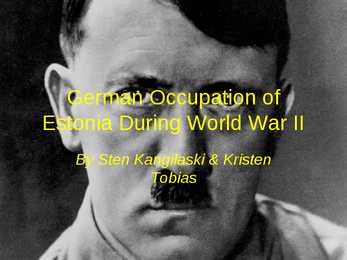
German Occupation of Estonia During World War II By Sten Kangilaski & Kristen Tobias The Beginning · WWII began with the invasion of Poland · Poland was an important regional ally to Estonia · On september 24th, 1939, the Moscow press and radio started attacking Estonia as "hostile" to the Soviet Union. Summer War · After Germany invaded the Soviet Union on June 22, 1941, Finland sided with Germany in the Continuation War. · Thousands of people including a large portion of women and children were killed. · Dozens of villages, schools and public buildings were burned to the ground. German Occupation · Most Estonians greeted the Germans with relatively open arms. · In April 1941, Alfred Rosenberg laid out his plans for the East. · Rosenberg felt that Estonians were the most Germanic out of the people living by the Baltic Sea. The Holocaust · The first...
Private School of Audentes Links between English speaking countries and Estonia Author: Kristin Liiv Supervisor: Mari Martma Tallinn 2006 2 Table of contents Introduction..........................................................................................................................4 First links............................................................................................................................. 5 20th century..........................................................................................................................5 Recognition.......................................................................................................................... 9 Conclusions...............................................................................................................
Setomaa The extreme south-eastern corner of Estonia - this is the location of SETOMAA, a peculiar historical and ethnical province in Estonia. Setomaa is bounded in the north-east by Lake Pihkva, in the east and south-east by Russia, in the south by Latvia and in the west by Võru County. The greatest extent from north to south is 65 km and from east to west 40 km. Today Setomaa is divided between three administrative units: Võru and Põlva counties of Estonia and Pechorsky district of Russia. On the territory of Estonia, Setomaa comprises four municipalities: Misso, Meremäe, Värska and Mikitamäe municipalities. According to the latest archaeological finds the area of Setomaa has been inhabited for as long as 8 400 years.The ancestors of the people speaking the Võro-Seto dialect belonged to the Balto-Finnic eastern tribes. In old chronicles they have been mentioned probably under the name of the...
Tallinn English College Topic Estonia Tallinn 2008 1. Introduction Estonia is a small country about the size of Switzerland, or New Hampshire and Massachussetts combined. Estonia is named after the people called "Ests" who lived in the region in the 1 st century AD. The Republic of Estonia is one of the three countries commonly known as the "Baltic States". The other Baltic States are Latvia and Lithuania. 2. Geographical position Estonia is situated in northeastern Europe. Estonia is bounded on the north by the Gulf of Finland, on the east by Russia, on the south by Latvia and on the west by the Baltic Sea. In the north it borders on Finland. The coastline of the Baltic Sea in Estonia is characterized by numerous gulfs and bays, the biggest of them being the Gulf of Finland, the Gulf of Riga and the Gulf of Pärnu. Bays include the Narva Bay, Matsalu Bay, Kolga Bay, Kunda Bay, Tallinn Bay etc....
About Estonia Estonia, officially the Republic of Estonia is a country in Northern Europe. Estonia has land borders to the south with Latvia and to the east with Russia. It is separated from Finland in the north by the Gulf of Finland and from Sweden in the west by the Baltic Sea. Average elevation reaches only 50 meters and the country's highest peak is the Suur Munamägi in the southeast at 318 meters.Estonia boasts over 1,400 lakes. Most are very small, with the largest, Lake Peipus, (Peipsi in Estonian) being 3555 km². There are many rivers in the country. The largest are the Võhandu (162 km), Pärnu (144 km), and Põltsamaa (135 km). Estonia also boasts numerous bogs, and 3794 kilometers of coastline marked by numerous bays, straits, and inlets. The number of islands and islets is estimated at some 1,500. Two are large enough to constitute their own counties: Saaremaa and Hiiumaa. Estonia lies in the...
 annaabi.ee