 50 punkti
Autor soovib selle materjali allalaadimise eest saada 50 punkti.
50 punkti
Autor soovib selle materjali allalaadimise eest saada 50 punkti.
 ~ 9 lehte
Lehekülgede arv dokumendis
~ 9 lehte
Lehekülgede arv dokumendis
 2009-05-04
Kuupäev, millal dokument üles laeti
2009-05-04
Kuupäev, millal dokument üles laeti
 8 laadimist
Kokku alla laetud
8 laadimist
Kokku alla laetud
 0 arvamust
Teiste kasutajate poolt lisatud kommentaarid
0 arvamust
Teiste kasutajate poolt lisatud kommentaarid
 Agn3s
Õppematerjali autor
Agn3s
Õppematerjali autor
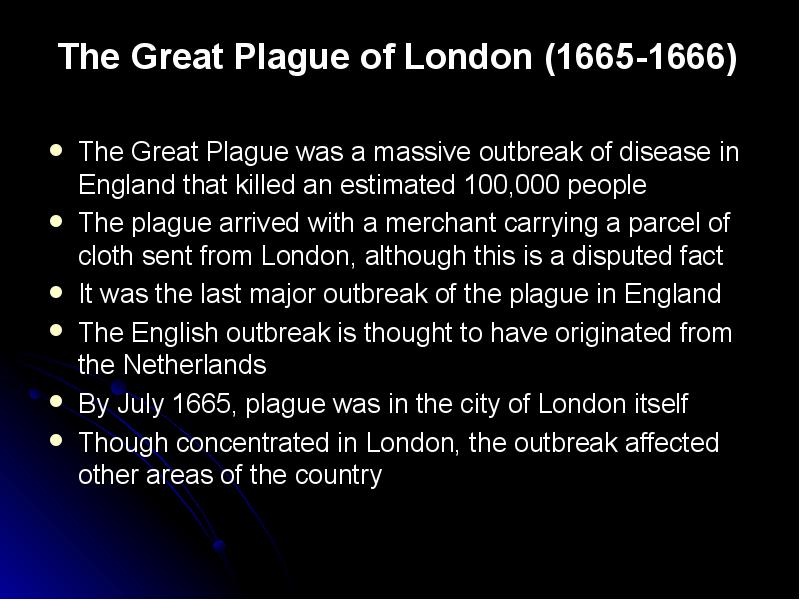
Jüri Gümnaasium THE GREAT PLAGUE IN LONDON Research paper Ervin Sagor 10.h Supervisor: Kristel Kriisa Jüri 2011 TABLE OF CONTENTS INTRODUCTION The history of England has always been fascinating for me and plague was one the most horrifying diseases in human history with millions of deaths across the world. That is why I chose the Great Plague as the topic of my research. The purpose of my study is to educate myself and gain more knowledge on the history and find out how people lived in England in the seventeenth century. For a start, I will give a short review what the bubonic plague is. Then I tell about Black Death in England before the Great Plague, city life before and during the plague
unsuccessful. They made their way to the river Thames and sailed up it. The Romans knew it was important to control a crossing point at the river Thames, so they decided to build a settlement on the north bank. Although small settlements had been built on the banks of the Thames, the Romans were the ones who built the first city. They called their city Londinium. The Roman engineers noticed that the point where the swampy river narrowed would make an ideal crossing point, they built London Bridge. Less than 20 years later the native Iceni tribe, led by Queen Boudicca, rose up against the Romans in revenge for mistreatment and burnt Londinium to the ground. The well disciplined Roman army defeated her forces and Londinium was rebuilt. By AD 100 it had also become the capital of the Roman province. A massive wall was built to protect the city from further attacks. The Roman Empire came under increasing attack across Europe and in AD 410 they retreated.
What is London? London is one of the largest cities in the world, with an area of 1706,8 km2. It is the capital of England and The United Kingdom. It is in Central Europe. The city lies on the river Thames. London has 7,556,900 inhabitants, which is more than a quarter of the countries in Europe! For one city, London is very special. The beginning of London Before the founding of London, there had already been smaller groups of people in the area. There aren't any records on who they were. The first mayor settlement of London was in 43 AD. Romans came to the banks of the river Thames. They built houses, a port and a bridge over the river (later known as London Bridge). They named the place Londinium. In the year 200 they built a wall around their city. The wall doesn't exist today, but a part of it can be seen near the Museum of London. In the year 61 Londinium was burned down
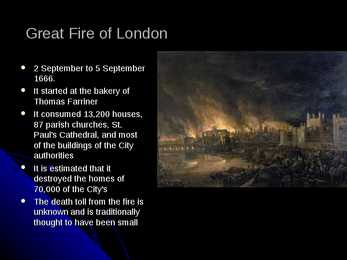
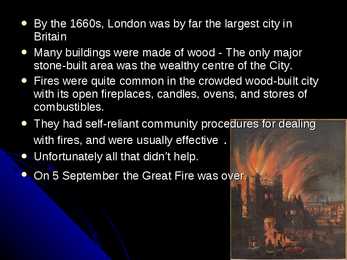
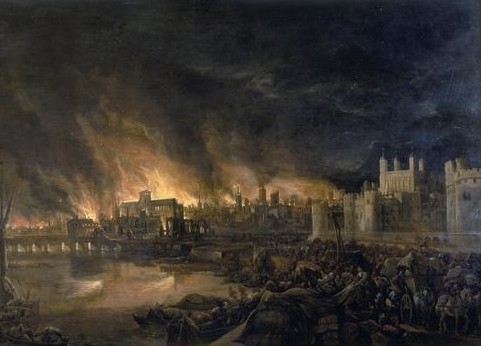
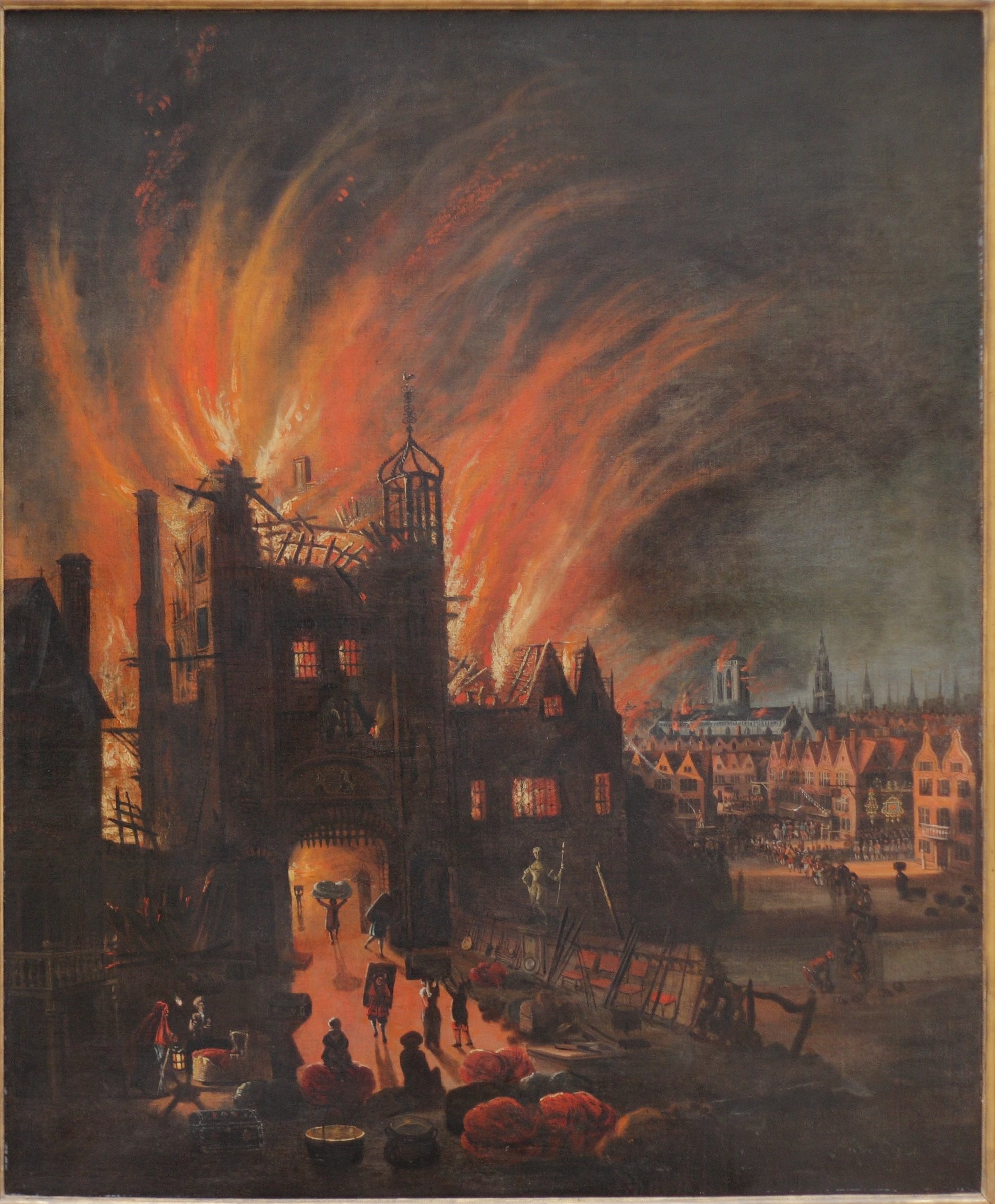
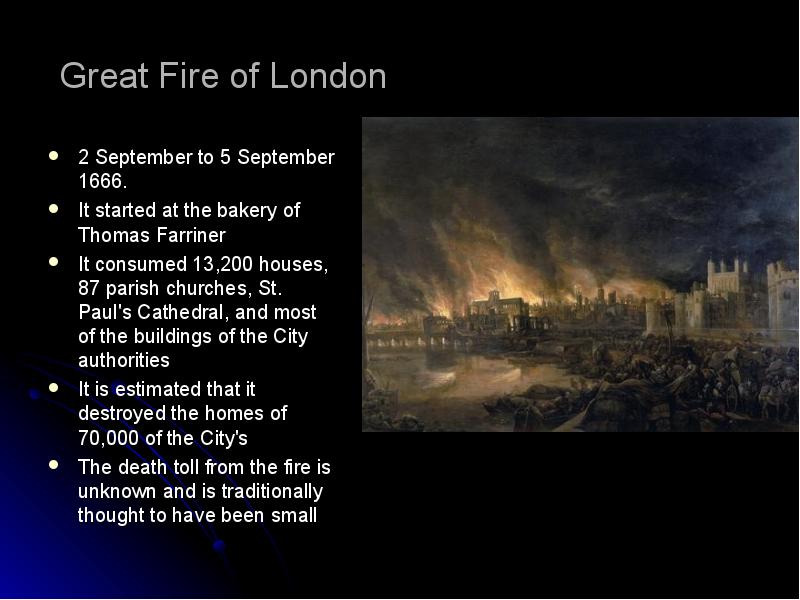
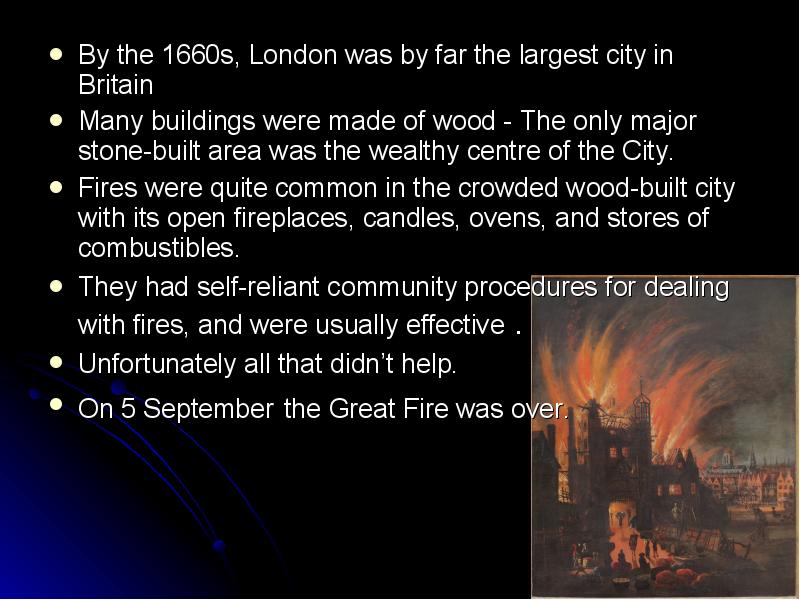
England. It was the second tragedy to hit the city in the space of 12 months. The fire started in Pudding Lane. The fire started in a baker's shop owned by Thomas Farriner who was the king's baker. His maid failed to put out the ovens at the end of the night. Once it started, the fire spread quickly. The city was basically made out of wood and with September following on from the summer, the city was very dry. Strong winds fanned the flames. In 1665, during the plague, the king, Charles II, had fled in London. His plan, in 1666 (he stayed in London and took charge of the operation to save the city) was to create fire-breaks. The heat created by the fire was so great that the lead roof on the old St Paul's Cathedral melted. The actual human casualty rate was remarkably small with possibly only 5 people dying in this fire. The wind that had helped the fire spread, turned on itself and drove the flames back into what had already been burned
Topic London Tallinn English College Tallinn 2007 1. Introduction London is the capital city of the United Kingdom and the largest urban area in England. The ancient City of London, to which the name originally belonged, still maintains its medieval boundaries, but the name "London" has long applied more to the whole metropolis that has grown up around it. London has been an important settlement for over two millenniums. It is also one of the world's leading business, financial and cultural centres and its influence in politics, education, entertainment and even fashion contribute to its status as a major global city. London is a major tourist attraction with four world heritage sites, several royal parks and numerous iconic landmarks such as the Houses of Parliament, Towe Bridge, the Tower of London, Westminster Abbey and the London Eye. 2. History
Although the site was not important during the Celtic period (400 BC 43 AD) During the Roman occupation Londinium, as it was called then, was not influential politically, but was, however an important crossing point for the romans over the river Thames. Londinium was at a very good place, so it soon became a trading centre. In AD 61 the city was devastated by Boudicca, who led a revolt againt the Roman conquest of Britain. The city was burned down and its inhabitants massacred. London was rapidly rebuilt, becoming the capital of the province Britannia. AD 122 Roman walls were built around it as a Around AD 400 the Anglo-Saxons invaded Britain. They destroyed the roman towns and formed many kingdoms that were hostile to one another. London fell into ruins. King Egbert united all the small kingdoms and formed one kingdom named Englad. Later king Alfred the Great chose London to be the capital of the country.
Contents Introduction...................................................3 London's early history.....................................45 The people of London......................................6 Buildings and bridges......................................7 Intruduction London is the capital of the united kingdom (UK), which is made up of Great Britain(England, Scotland, Wales) and Northern Ireland. The city lies in the southeast of England and covers an area of about 1,578 square kilometres on either side of the River Thames. With population of seven million, London is by far the largest city in the UK. Birmingham, the second largest, has just over one million inhabitants. Cultural life London is the worldclass centre
The Middle Ages The Middle Ages are one of the most turbulent periods in English history. The Middle Ages are so called as the middle period between the decline of the Roman Empire and the Renaissance. The Middle Ages started in 1066. with the Battle of Hastings and the Norman Conquest. William the Conqueror took all the lands from the Saxon English and gave these to French nobles. Normans were known as great builders. This is assured by the fact that many great castles and other buildings, including the Tower of London, were built during the Norman Conquest. In 1086. Domesday Book was compiled. It is a detailed survey of England ordered by William the Conqueror. The reign of King William Rufus who was the son of William started in 1087 and lasted until 1100. Next king was Henry I who was the brother of William Rufus. His reign was from 1100-1135. In 1135 Henry I nephew Stephen got to the throne of England and reigned the country for 19 years
 annaabi.ee








Kõik kommentaarid