 10 punkti
Autor soovib selle materjali allalaadimise eest saada 10 punkti.
10 punkti
Autor soovib selle materjali allalaadimise eest saada 10 punkti.
 ~ 1 leht
Lehekülgede arv dokumendis
~ 1 leht
Lehekülgede arv dokumendis
 2008-01-24
Kuupäev, millal dokument üles laeti
2008-01-24
Kuupäev, millal dokument üles laeti
 88 laadimist
Kokku alla laetud
88 laadimist
Kokku alla laetud
 1 arvamus
Teiste kasutajate poolt lisatud kommentaarid
1 arvamus
Teiste kasutajate poolt lisatud kommentaarid
 aronniin
Õppematerjali autor
aronniin
Õppematerjali autor
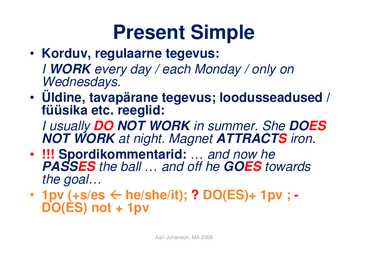
She's being really nasty to us. · Do you see that red car over there? I'm seeing a dentist tomorrow morning. / I'm afraid he's seeing things. · We hear something new each day. I thought I was hearing things when music suddenly began to play. · I consider him to be a very lucky man. I'm considering changing jobs. · Kids love visiting amusement parks. Kids are loving visiting the amusement park. Aari Juhanson, MA 2008 Past Simple · Ära toimunud (regulaarne) tegevus: I WORKED yesterday. S/he didn't WORK last Monday. · Lõpetatud tegevus: I already CALLED them today. (I'm not going to call again!) Which countries did you VISIT? (You're back ...) BUT: Which countries have you VISITED so far? (You're not back yet or you travel regularly ...) · Jutustused, mineviku sündmuste kirjeldus: Once upon a time there LIVED a Garfield who HAD many friends. The first one WAS Odie, ... · 2pv;
Golden Grammar rules 1. Don't use an with own. Sue needs her own room. (NOT Sue needs an own room.) I'd like a phone line of my own. (NOT ... an own phone line.) 2. Use or rather to correct yourself. She's German or rather, Austrian. (NOT She's German or better, Austrian.) I'll see you on Friday or rather, Saturday. 3. Use the simple present play(s), rain(s) etc to talk about habits and repeated actions. I play tennis every Saturday. (NOT I am playing tennis every Saturday.) It usually rains a lot in November. 4. Use will ..., not the present, for offers and promises. I'll cook you supper this evening. (NOT I cook you supper this evening.) I promise I'll phone you tomorrow. (NOT I promise I phone you tomorrow.) 5. Don't drop prepositions with passive verbs. I don't like to be shouted at
The Present Simple Lihtolevik Moodustamine: Jaatav lause Eitav lause Ksiv lause I pv DO + not + I pv Do + I pv I pv + (e)s -3. pre ainsus DOES + not + I pv Does + I pv I work hard every day. I do not work hard every day. Do I work hard every day? You work hard every day. You do not work hard every day. Do you work hard every day? He/she/It works hard every day. He/She/It does not work hard every day. Does he/she/it work hard every day? We work hard every day. We do not work hard every day. Do we work hard every day? You work hard every day. You do not work hard every day. Do you work hard every day? They work hard every day. They do not work hard every day. Do they work hard every day? NB! Lihtoleviku moodustamisel kasutatakse tegusna ma-tegevusnime vormi, millele ainsuse 3.prdes lisatakse lpp -(E)S.
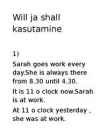
Will ja shall kasutamine 1) Sarah goes work every day.She is always there from 8.30 until 4.30. It is 11 o clock now.Sarah is at work. At 11 o clock yesterday , she was at work. At 11 o clock tomorrow , she will be at work. Will +infinitive (will be / will win / will come etc.): I/we/you/they Will (`ll Be He/she/it} Will not (won`t Win Eat Come etc. I/we/you/they Be? He/she/it Win? Eat? Will Come? Ect. `ll=will : I`ll (I will) / you`ll/ she`ll etc. Won´t= will not :I won`t (=I will not) / you won`t / she won`t etc. 2.We use will for the future(tomorrow/next week etc.): *Sue travels a lot.Today she is in Madrid.Tomorrow she`ll be in Rome.Next week she`ll be in To
Konspekt 1.Kui me teame tulevikust, me tavaliselt kasutame oleviku. Me kasutame lihtoleviku selle jaoks mis on planeeritud või korraldatud. ● I have concert next week. ● The bus arrives at 7.30 in the morning. ● I have test tomorrow. ● We’ll have party next friday. Me saame kasutada kestva oleviku plaanide või korralduste jaoks. ● I’m playing basketball today. ● They are coming to see us tomorrow. ● I’am celebrating my birthday next week. 2.Me kasutame will et rääkida tulevikust. Kui me teeme ennustusi. ● It will be hard day tomorrow. ● I think my brother will buy me a car. ● I’m sure my ex will be jealous about my new girlfriend. Mõeldes want to(olla) või be willing to (olla valmis ehk abivalmis) ● I hope you will help me at my project. ● Marika says he will help me Teha Offers(pakkumisi) ja promises(lubadusi). ● We’ll talk about this t
INGLISE KEEL Sisukord Sisukord.................................................................................................................................. 2 Ajavormid Tense vorms.......................................................................................................3 Lihtolevik The present simple..................................................................................... 3 Lihtminevik The past simple....................................................................................... 3 Lihttulevik The future simple...................................................................................... 3 Kestev olevik The present continuous......................................................................... 3 Kestev minevik The past continuous
INGLISE KEEL Sisukord Sisukord 2 Ajavormid Tense vorms 3 Lihtolevik The present simple 3 Lihtminevik The past simple 3 Lihttulevik The future simple 3 Kestev olevik The present continuous 3 Kestev minevik The past continuous 4 Kestev tulevik The future conrinuous 4 Täisminevik The present perfect 4 Enneminevik The past perfect 4 Ennetulevik Future perfect 5 Üldminevik Past tense 5 Üldtulevik Future indefinite 5 Artiklid ja eessõnad 7 Eessõnad 7 Kesksõnad 8
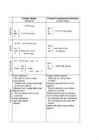
Ing Present Simple Present Progressive/Continuous (lihtolevik) (kestev olevik) I vorm (play) am JAATAV he is I vorm+ing (playing) she I vorm+s (plays) are it do not I vorm (don't play)
 annaabi.ee







Kõik kommentaarid