Tartu Kutsehariduskeskus Tko09 Egle Erm DMC SOUTH-ESTONIA Praktikaaruanne Juhendaja Liis Pärtelpoeg Tartu 2011 SISUKORD SISSEJUHATUS..............................................................................................................3 1. PRAKTIKAKOHA KIRJELDUS.................................................................................4 2. ETTEVÕTTE PLUSSID JA MIINUSED....................................................................
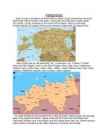
Saaremaa, Läänemaa, Harjumaa, Lääne-Virumaa, Ida-Virumaa, Tartumaa, Jõgevamaa, Järvamaa, Raplamaa, Viljandimaa, Pärnumaa, Valgamaa, Põlvamaa and Võrumaa. The capital city of estonia is Tallinn. Estonia is influenced by a temperate seasonal climate. Estonia has four seasons of near-equal length. July is the warmest month, and February is the coldest month. Snow cover, which is deepest in the south-eastern part of Estonia, usually lasts from mid-December to late March. South-Estonia is the most mountainous part of the country . The country's highest point is the Suur Munamägi. It is 318 meters high. There are some craters in Estonia. The biggest one is Kaali crater in Saaremaa. Estonia has over 1,400 lakes. Most are very small, but the largest is lake Peipus. There are many rivers, too. The longest of them are Võhandu (162 km), Pärnu (144 km) and Põltsamaa (135 km). Estonia has numerous fens and bogs. Estonia is quite sparsely populated country
Estonian language Seliin-Doris Tsinjakov 11. Klass Kehra Gümnaasium · Estonian is the official language of Estonia. · Spoken natively by about 1.1 million people. · It belongs to the Finnic branch of the Uralic language family. Classification · Belongs to the Finnic branch of the Uralic languages, along with Finnish, Karelian, and other nearby languages. · Estonian has been influenced by Swedish, German and Russian, though it is not related to them genetically. History · The two different historical Estonian languages, the North and South Estonian languages, are based on the ancestors of modern Estonians migration into the territory of Estonia in at least two different waves, both groups speaking considerably different Finnic vernaculars. · Modern standard Estonian has evolved on the basis of the dialects of Northern Estonia. · The domination of Estonia a...
Report on Estonia Estonia is a country in northern Europe. Estonia has land borders in the south with Latvia and in the east with Russia, it's oversea neighbours are Finland and Sweden. Estonia has got 15 counties. Estonia has been an independent country since 1991. Tallinn is the capital city of Estonia. Estonia is a member of European Union nad NATO. Estonia is a democratic republic and it's president is Toomas Hendrik Ilves. The official language of Estonia is Estonian, which is Finno-Ugric language and has many similarities with Finnish. The population of Estonia contains mainly Estonians but some Russians and other ethnicities too. Many foreign people think of Estonia as an old-timed soviet union country, but in my opinion Estonia is quite far-advanced country. Estonian national symbols are cornflower, slate, swallow and it's blue-black-white flag. There is very high level of education in Estonia, m...
Estonia is a pretty small country in northern Europe. Estonia has land borders in the south with Latvia and in the east with Russia, it's oversea neighbours are Finland and Sweden. Estonia divided into fifteen counties. Estonia has been an independent country since 1991. Tallinn is the capital city of Estonia. It's not very large, there lives about 400 000 pedestrians. Estonia is a member of European Union and NATO. Estonia is a democratic republic and it's president is Toomas Hendrik Ilves. The territory of Estonia covers 45,227 km² and is influenced by a temperate seasonal climate. The surface there is mainly flat, but in the southern parts of Estonia it gets little bumpy. The official language of Estonia is Estonian, which is Finno-Ugric language and has many similarities with Finnish. The population of Estonia contains mainly Estonians but some Russians and other ethnicities too. Many foreign people think of Estonia as an old-timed...
Estonian geography The territory of Estonia covers 45,227 km2. Estonia is situated in the Baltic Region of Northern Europe. It is bordered to the north by the Gulf of Finland, to the west by the Baltic Sea. Its neighbor countries are to the south Latvia, to the east Russia, to the north and over the Gulf of Finland, Finland and to the west and over the Baltic Sea, Sweden. Most of the lowland areas are in the middle of Estonia. Average elevation reaches only 50 meters and the country's highest point is the Suur Munamägi in the southeast at 318 meters. There is 3,794 kilometers of coastline marked by numerous bays, straits, and inlets. The number of islands and islets is estimated at some 1,500. Two of them are large enough to constitute separate counties: Saaremaa and Hiiumaa. A small, recent cluster of meteorite craters, the largest of which is called Kaali is found on Saaremaa, Estonia. Estonia h...
ESTONIA ·Republic of Estonia is a country in Norhern Europe. Our president is Toomas Hendrik Ilves ·Territory of Estonia is 45,227 ( square kilometer) km² ·Population is 1.4 million. Estonia is one of the least-populous members of the European Union. ·The capital and largest city is Tallinn wich is in North-Estonia ·We are special because we have own language estonian ·Estonia is bordered to the north by the Gulf on Finland, to the west by the Baltic Sea, to the south by Latvia and to the east by Russian Federation ·Estonia is divided into 15 counties (maakond) ·In Estonia are 33 cities and several town-parish towns in the country. More than 70% of the population lives in towns. ·Estonia has summer capital it's Pärnu, autum capital it's Türi, winter capital it's Otepää ·The Estonia Theatre is an opera house and concert hall in Tallinn . It was built on 1913 ·The oldest records of...
Europe. With 35 people per square kilometer. Nearly 1/3 of the nation live in the capital Tallinn. Along the coast of Estonia lies many bays and peninsulas. Lots of islands lie off the west- and north coast. The largest of them are Saaremaa and Hiiumaa. Geographically Estonia can be divided into 4 parts: North-, South-, West-, and East-Estonia. North-Estonia is relatively flat. Here is a nice coastline with coves, capes and a high coast. South-Estonia is more hillier, but there aren't any mountains or mountain ranges. The highest peak in Estonia is Suur Munamägi and its 318m above sealine. The largest industrial areas are situated in East-Estonia. There are beautiful nature parks in West-Estonia. The inland is mainly agricultural. Estonia is known for its 1000 lakes and beautiful nature. One of the most interesting sight is Jägala Waterfall. Lake Peipus separates Estonia from Russia. The largest river basing is round the Pärnu eastern
Estonia Where it is? Republic of Estonia is a state in the Baltic region of Northern Europe .It is bordered to the north by the Finland, to the west by the Baltic Sea, to the south by Latvia (343 km), and to the east by lake Peipus and Russia (338.6 km). Across the Baltic Sea lies Sweden in the west and Finland in the north. Towns Tallinn is the capital and the largest city of Estonia. It lies on the northern coast of Estonia, along the Gulf of Finland. There are 33 cities and several town-parish towns in the country. In total, there are 47 linna, with "linn" in English meaning both "cities" and "towns". More than 70% of the population lives in towns. History • Estonia was settled near the end of the last glacial era, beginning from around 8500 BC. Before the German invasions in the 13th century proto-Estonians of the Ancient Estonia worshipped the spirits of n...
Estonia traditional costumes In Estonia traditional costume denotes mainly the festive peasant dress of the 19th century, which in its time referred besides social status also to national background, as the ruling class were mainly German at the time. The former peasant costume of regional variation has become today a national symbol and has turned due to its altered function into a national dress. Estonian country folk produced their clothing mainly from home-spun woollen or linen fabric: shirts and married women's head-wear was mostly made from linen, while various outer garments, gloves, stockings and socks, were made from wool. The majority of the clothes remained undyed for a long time: linen garments were bleached white, while woollen outer garments were mainly sheep-brown or black. The wool for making skirts was dyed with herbal dyes. The bedstraw root was particularly widely used to produce red colouring...
Setomaa The extreme south-eastern corner of Estonia - this is the location of SETOMAA, a peculiar historical and ethnical province in Estonia. Setomaa is bounded in the north-east by Lake Pihkva, in the east and south-east by Russia, in the south by Latvia and in the west by Võru County. The greatest extent from north to south is 65 km and from east to west 40 km. Today Setomaa is divided between three administrative units: Võru and Põlva counties of Estonia and Pechorsky district of Russia. On the territory of Estonia, Setomaa comprises four municipalities: Misso, Meremäe, Värska and Mikitamäe municipalities. According to the latest archaeological finds the area of Setomaa has been inhabited for as long as 8 400 years.The ancestors of the people speaking the Võro-Seto dialect belonged to the Balto-Finnic eastern tribes. In old chronicles they have been mentioned probably under the name of the...
For example, the ruins of the Order Castle in Viljandi, national parks in Soomaa and definitely Old Tallinn and the University of Tartu. There is a spectacular landscape in Estonia, which offers outstanding natural beauty and tranquillity for forigners. There are many pastures and forests but there isn't much untouched and wild landscape. The highest point in Estonia is Suur Munamägi (318 metres). The largest lake is Peipsi Lake and the longest river is the Võhandu River. South-Estonia offers superb varieties to have a picnic on the picturesque landscape. Inlanders appreciate our scenic contrasts on the peninsulas and there are also about 1,500 islands in Estonia. The biggest island is Saaremaa where you can admire the beauty of Kuressaare Castle and Kaali meteorite crater. The flag of Estonia is really simple but beautiful. There are only 3 colours blue, black and white. The national flower is the cornflower and the national stone is limestone. In
Estonia Anna-Kaisa Adamson Estonia, officially the Republic of Estonia, is a state in the Baltic region of Northern Europe. It is bordered to the north by the Gulf of Finland, to the west by the Baltic Sea, to the south by Latvia, and to the east by the Lake Peipsi and the Russian Federation. The territory of Estonia covers 45,227 km2. The capital, Tallinn, has around 400000 inhabitants.Tallinn's ability to blend medieval architecture with Scandinavian modernity with all the comforts you'd expect from a modern, competitive and innovative capital. Estonian language, does not belong to the Indo-European group. It belongs to the Finno-Ugric language family, which also includes Finnish and Hungarian. Estonian dialects are divided into two groups, Northern and Southern, usually associated with biggest cities of those regio...
Võru county By: Casper Gregory Tanner Leies From: Audru School Teacher: Sirje Aija Class: 7a Võru county is south of Estonia. It is bordered to Võru county the north by the Põlva county, west by Valga county, south by Latvia and east by Russia. W he re it is? There are 13 municipalities in Võru county. Municipalities Urban municipality: § Võru Rural municipalities: § Antsla Parish To Haanja Parish § § Lasva Parish Meremäe Parish wn § § Misso Parish Mõniste Parish s § § Rõuge Parish § Sõmerpalu Parish and § § Urvaste Parish Varstu Parish mu § § Vastseliina Parish ...
Harjumaa Harju County is situated in northern Estonia. Harju County, bordered by the south- westcounty, Rapla County in the south, south-east and east Järva county Lääne- Viru county. County, bounded on the north Gulf of Finland. Harju is composed of many islands, the largest of these is the Women's Island and the islands Pakri. Harju county has six self-governing city, a municipal city, 2 towns, 31 small towns and 395 villages. Harju county has 21 bigger cities Loksa, Nissi, Vasalemma, Paldiski, Kernu, Keila, Saue, Harku, Saku, Tallinn, Viimsi, Ostrava, Rae, Kose Kõue, Raasiku, Jõelähtme, Maardu, Anja, Kuusalu, Loksa, Aegviidu. 34 rivers flowing into the sea within the county and other watercourses, the drainage basin is the largest and tallest Jägala, Keila and the Pirita River and White River. Harjumaa Ülemiste Lake is the largest, and the Kahala Harku lake, too. Tallinn's surface w...
Estonia is a small country in Northern Europe with an area of about 45 000 sq km. The country's climate is determined by the proximity of the Atlantic Ocean. The summer temperatures are a little lower than the average of that latitude, but the winters are considerably warmer. As a part of the East-European Plain, the country has a rather flat surface. The highest and most topographically variagated region in Estonia is in the south-eastern part of the country. The Sakala Upland plains offer contrast to the hills of Ottepää, Karula and Haanja. At 318 metres, Suur Munamägi ('Great Egg Hill') is not only the highest point in Estonia, but of all the Baltic countries. The country has 3974 km of coastline, while the land border, in comparison, is only a mere 633 km. The coast varies from limestone cliff in the north to sandy beaches in the west. Most of Estonia's many islands belong to the West Estonian archipelago. The largest islands are Sa...
Estonia. Estonia, officially the Republic of Estonia is a country in Northern Europe. It is the smallest of the three Baltic countries. Estonia has land borders with Latvia (339 km) to the south and Russia (229 km) to the east. It is separated from Finland in the north by the narrow Gulf of Finland and from Sweden in the west by the Baltic Sea. Estonia has been a member of the European Union since May 1, 2004 and of the NATO since March 29, 2004. The area of Estonia is about 45000 square kilometres and the population is about 1.4 million people. The capital of Estonia is Tallinn and the official language is Estonian. The currency is Eesti kroon. The main religion is Lutheran. Anniversary of the republic is celebrated on February 20. The national flower is cornflower, national bird is barn swallow and national stone is limestone. It is a land of great natural beaut...
Estonia Estonia, officially called the Republic of Estonia is a small country in Northern Europe. It has land borders with Latvia in the south and Russia in the east. It is separated from Finland in the north by the Gulf of Finland and from Sweden in the west by the Baltic Sea. The capital of Estonia is Tallinn, it's also the biggest city we have. The national flag of Estonia is a tricolour: horizontally blue, black and white, called "sinimustvalge". The President of Estonia is Toomas Hendrik Ilves and the Prime Minister is Andrus Ansip. Estonia has been occupied several times during its history. The last occupiesation happened 16 June 1940 and it was declared 20 August 1991. Republic of Estonia has only one offical language - the Estonian language. Estonia is a constitutional democracy, with a president elected by its parliament. The elections are held every four years. Estonia became a member of the European Union 1 May 2004 and NATO...
the Antarctic the North of Germany the Midwest NB! geograaf. nimed, mis koosnevad pärisnimest ja täiendist, on ilma artiklita: Northern Ireland South-Estonia Great Britain
Tallinna Inglise Kolledz Estonia Topic Alice Tärk, 9b Tallinn 2007 FACTFILE Area: 45 228 sq km Poplulation: under 1.4 million Capital: Tallinn Language: Estonian Currency: Eesti kroon (EEK) Main religion: Lutheran National holiday: 24 February (anniversary of the republic) National flower: Cornflower National bird: Barn Swallow National stone: Limestone LOCATION The Republic of Estonia is the northernmost and smallest of the three Baltic States. It is located on the eastern shores of the Baltic Sea in the north east of Europe. To the east the country borders Russia. Latvia is the countries neighbour to the south. From the west the coast of Estonia is washed by the Baltic Sea and from the north by the Gulf of Finland. The length of the coastline is approximately 3 800 km. The longest distance from east to west is 350 km, while nort...
Cities of Estonia The capital of Estonia is Tallinn, most famous for its Old Town. The Old Town was built in the 13.-16th centuries. You can still feel the spirit of medieval times, when you are visiting The Old Town. The second biggest city of Estonia is Tartu. Tartu is the educational centre of Estonia. It is home to the largest and oldest university in Estonia, the University of Tartu. The University of Tartu first opened it`s doors in 1632. Through Tartu flows the second biggest river in Estonia, Suur Emajõgi ( Big Mother River). Pärnu is the summer capital of Estonia. It is located in south west Estonia on the coast of Pärnu bay. Pärnu is popular with the tourists for its spas and beautiful beaches. Otepää is known as the winter capital of Estonia. With its hilly terrain it is the perfect place for winter sports. There are many tracks for snowboarders, mountain and cross country skiers. Not far from Otepää is th...
Võnnu Keskkool ESTONIA Referaat Autor: Klass : 9 Juhendaja: Võnnu 2013 Estonia officially the Republic of Estonia, is a state in the Baltic region of Northern Europe It is bordered to the north by the Gulf of Finland, to the west by the Baltic Sea, to the south by Latvia and to the east by Lake Peipus and Russia.Across the Baltic Sealies Sweden in the west and Finland in the north. The territory of Estonia covers 45,227km2 The Estonian climate resembles that of other countries on the Baltic littoral. On account of the country's proximity to the sea, the skies are often cloudy, and rain often falls in the spring and autumn, in the winter the rain turns to snow. The highest point in Estonia is Suur Munamäg It is in fact the highest point in the Baltic region Forest cover over one half of Estonia. The most common types of tree are pine, spruce and birch. Estonia, along...
Tallina Lillekyla Gymnasium Tallinn Port and Airport Student: Margit Reinsalu Supervisor: Meeri Sild Tallinn 2010 1 Table of Contents Table of Contents.................................................................................................................... 2 Introduction............................................................................................................................. 2 Lennart Meri Tallinn Airport..................................................................................................... 4 Port of Tallinn.......................................................................................................................... 5 Statistics.................................................................................................................................. 6 Introduction The top...
Estonia Topic Tallinn 2007 2 List of Contents page Facts and figures 3 Geography 3 Climate 3 Nature 4 History 5 Economy 6 Culture 6 Biggest towns 7 Language 8 3 Facts and figures The Republic of Estonia is a small country. Covering only 45, 228 sq km it is slightly bigger than Denmark, Belgium or Switzerland. Estonia's population is under 1.4 million. The official language is Estonian but since very many Russians live here Russian is also wide spread. The capital of Estonia is Tallinn. The currency used in Estonia is Eesti kroon. The Estonian national flag is blue-black-white. It was originally the flag of the Estonian Students' Society. The flag was first consecrated in Otepää Church in 1884. For a while, during the Soviet occupation, the flag was banned but it was again seen in p...
The Republic of Estonia Estonia officially the Republic of Estonia is a country in the Baltic region of Northern Europe. It is bordered to the north by Finland across the Gulf of Finland, to the west by Sweden across the Baltic Sea, to the south by Latvia and to the east by the Russian Federation. The territory of Estonia covers 45,227 km² and is influenced by a temperate seasonal climate. Estonia is a democratic parliamentary republic and is divided into fifteen counties. The capital and largest city is Tallinn. With a population of only 1.4 million, it is one of the least- populous members of the European Union. Estonia was a member of the League of Nations from 22 September 1921, has been a member of the United Nations since 17 September 1991, of the European Union since 1 May 2004 and of NATO since 29 March 2004. Estonia has also signed the Kyoto protocol. Estonia regained its ind...
About Estonia Estonia, officially the Republic of Estonia is a country in Northern Europe. Estonia has land borders to the south with Latvia and to the east with Russia. It is separated from Finland in the north by the Gulf of Finland and from Sweden in the west by the Baltic Sea. Average elevation reaches only 50 meters and the country's highest peak is the Suur Munamägi in the southeast at 318 meters.Estonia boasts over 1,400 lakes. Most are very small, with the largest, Lake Peipus, (Peipsi in Estonian) being 3555 km². There are many rivers in the country. The largest are the Võhandu (162 km), Pärnu (144 km), and Põltsamaa (135 km). Estonia also boasts numerous bogs, and 3794 kilometers of coastline marked by numerous bays, straits, and inlets. The number of islands and islets is estimated at some 1,500. Two are large enough to constitute their own counties: Saaremaa and Hiiumaa. Estonia lies in the...
Estonia is a state in the Baltic region of Northern Europe. It is bordered to the north by the Gulf of Finland, to the west by the Baltic Sea, to the south by Latvia (343 km), and to the east by Lake Peipus and Russia (338.6 km). Across the Baltic Sea lies Sweden in the west and Finland in the north. The territory of Estonia covers 45,227 km2 (17,462 sq mi), and is influenced by a humid continental climate. The Estonians are a Finnic people, and the official language, Estonian, is a Finno-Ugric language closely related to Finnish, and distantly to Hungarian and to the Sami languages. Estonia is a democratic parliamentary republic divided into fifteen counties, with its capital and largest city being Tallinn. Estonia's population of 1.3 million makes it one of the least-populous member states of the European Union, Eurozone and the North Atlantic Treaty Organization. A developed country with an advanced, high-income economy, Estonia has ...
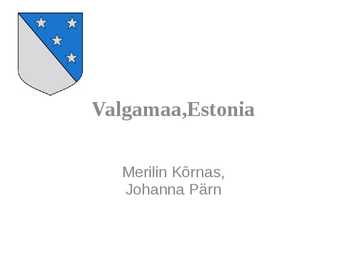
Valgamaa,Estonia Merilin Kõrnas, Johanna Pärn Location It´s in the south of Estonia and Valga´s city is next to the Latvian border. It´s next to Tartu , Viljandi , Põlvamaa , Võrumaa county . History of Valgamaa Back in 1783 counties 9 parishes from 11 were on Latvian area , only small pieces of Valgamaa`s 11 parishes Luke and Härgmäe were on Estonian area. were: Valgamaa´s people spoke Latvian. Koivaliina Härgmäe Luke Aluliina Apekalns Palsmane-Aumeisteri Gulbene Smilt...
Estonia Location Estonia officially the Republic of Estonia is a state in the Baltic region of Northern Europe. It is bordered to the north by the Gulf of Finland, to the west by the Baltic Sea, to the south by Latvia and to the east by the Lake Peipsi and the Russian Federation. Across the Baltic Sea lies Sweden in the west and Finland in the north. Size and population The territory of Estonia covers 45,227 km2 Estonian population is 1.34 million Largest cities of Estonia 1. Tallinn (Estonian capital city) 2. Tartu 3. Narva 4. Kohtla-Järve Tallinn Tartu Narva Kohtla-Järve Largest islands of Estonia There are 1521 islands. 1. Saaremaa 2. Hiiumaa 3. Muhu 4. Vormsi Hiiumaa Saaremaa Vormsi Muhu Longest river of Estonia 1. Võhandu 2. Pärnu 3. Põltsamaa Võhandu river Põltsamaa river Pärnu river Estonian seasons There are four se...
Test 18! Esimene ülesanne! 1. 15 km 15 km 2. 5 2 3. Yes Yes 4. Yes No 5. Yes No 6. No No 7. Yes Yes 8. Yes Yes 9. Yes No 10. No No 11. 132 pound 91 pound Teine ülesanne! 1. Estonia is rich in natural sights. 2. The landscape in Northern Estonia is mainly flat. 3. You can visit us at any time. 4. High limestone cliffs are popular with tourists. 5. Estonian forests are known for their rich wildlife. 6. Due to the maritime climate coastal areas have a unique bird life. 7. In the springtime you can often see rivers in flood. 8. I'm fascinated by the hilly landscape of South Estonia. Kolmas ülesanne! 1. At; on; up 2. -; by 3. On; with 4. For; on, off 5. In; - 6. On; -; in 7....
Estonia officially the Republic of Estonia, is a country in the Baltic region of Northern Europe. It is bordered to the north by the Gulf of Finland, to the west by the Baltic Sea, to the south by Latvia and to the east by Russia. Across the Baltic Sea lies Sweden in the west and Finland in the north. The territory of Estonia covers 45,227 km2, and is influenced by a humid continental climate. Estonia is a democratic parliamentary republic divided into fifteen counties, with its capital and largest city beingTallinn. With a population of 1.3 million, it is one of the least-populous member states of the European Union. The Estonians are a Finnic people, and the official language, Estonian, is a Finno-Ugric language closely related to Finnish The history of Estonia is a part of the history of Europe. Estonia was settled near the end of the last glacial era, beginning from around 8500 BC. Before the Germans invaded in the 13th century pro...
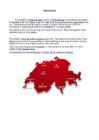
Schwitzerland Switzerland is a landlocked alpine country in Western Europe . Switzerland is surrounded by Germany to the north, France to the west, Italy to the south and Austria and Liechtenstein to the east. Switzerland is one of the smallest countries in Europe. With an area of 41285 km² Switzerland is smaller than Estonia, but the population is 7,6 million people. Switzerland is well known for the Alps in the south of the country . Most of the population lives north from Alps, on Swiss plateau Switzerland is one of the richest countries in the world. The capital of the country is Bern. Three biggest cities are Zürich,Geneva and Basel. Zürich and Geneva have respectively been ranked as having the first and second highest quality of life in the world. The country has a long history of neutrality -- it has not been at war since 1815. It is not a member of the European Union. Switze...
THE LEVEL OF CRIME IN DIFFERENT REGIONS OF THE WORLD Betti Säre 10b Crime rates around the world Europe is catching up to USA Life in the US has never been safer Less terrorism Less robbery USA, Germany, UK, Asia, Middle East The world has become safer Factors that affect crime levels Difference in legal systems Rates of crime report and police recording Differences in data quality Differences in the point at which a crime is measured Victimization rates for burglary, robbery, assault and threat, one-year period Terrorism Germany (Islamic Jihad- 100 or less) Turkey (PKK- 4000, over 37000 kills since 1978) England (Al- Qa'ida- 1600, 200 secret Al- Qa'ida units, 1600 fanatics) Sri Lanka (LTTE, aka Tamil Tigers- 10 000, " Death is better than caught by the State") j j Total international attacks by region 1997- 2002 Homicide rates...
Estonians... Estonia is quite a northern country and therefore Estonians may seem a bit peculiar to ones from south, but don't be scared, they will not eat you (alive). Estonians are quite tranquilly and bottled up people - they might love or hate you and if you're not an expert will not make a difference as they didn't care at all. Rarely tend they to kiss or hug each other unless their beloved ones. So if they nevertheless do it then there's a great chance you're dealing with some non- Estonians. But there's no reason for worrying- if a person is from a region where that kind of over-loving-behaviour is common and he or she practices it anyway then a bathetic Estonian will just bear it and play along. In case of visiting like in many other European countries in Estonia it's also polite to bring some presents with you, usually a box of chocolate or something like that will do the trick. To greet "Tere!" is the word you won't get wron...
Introduction of Estonia The Republic of Estonia is beautiful country which is located in northeastern Europe, bordering the Baltic Sea on the west, the Gulf of Finland on the north, Latvia on the south, and Russia on the east. Estonia is the smallest of the Baltic countries. Administrative division: Estonia has an area of 45,226 square kilometers and Estonia is administratively divided into counties. There are 15 counties in Estonia. The capital is Tallinn which is located in Harjumaa. Counties are divided into 194 rural municipalities. Population: The population of Estonia was estimated at 1.34 million in January 2011, with a density of 30 persons per square kilometer. According to the last census the number of inhabitants has decreased. In 2010 the birth rate was 11,82 per 1,000 population, while the death rate was exactly the same, so population growth rate is 0%. The proportion of urban p...
My home town of Valga Guide to Valga town ancient and modern Valga is the southern-most town in Estonia and despite its small size, the town straddles two countries. So it has two languages, two currencies and two cultures. Valga also has a rich history and a versatile cultural scene. Valga town is a pearl waiting to be discovered. In the south, Estonia shares a border with Latvia and here Valga town is split in half, the northern side, "Valga", belongs to Estonia and "Valka", on the southern side, belongs to Latvia. For years, this created a complicated situation where members of one family, even living on the same street, may have had different citizenships and had to go through customs and border guards in order to visit each other. Fortunately, after both countries joined the Schengen zone, border points were removed and Valga-Valka is fast overcoming the separation issues. Two different c...
THE NO ARTICLE · Names in the plural = countries: the Nether- * Names of countries / towns (also with an es- lands, the USA; the West Indies ablished modifier): (South) Estonia, Tartu · Names of the countries, and towns with a * Expressions from North to South etc. characteristing / spacifying modifer: the Tartu of th 19th century * Names of streets, bridges, airports, parks, squares, buildings, railway stations, shops, · Names of rivers, channels / canals, seas, addresses: Fleet Street, Tower Bridge, oceans, streams, straits: the Danube; the Suez Kennedy Airport, Hyde Park, Trafalgar Canal; the Baltic Sea; the Pacific Ocean; the Square, Buckingham Palace, Victoria Station, Bering...
Racism Racism is discrimination between different race people. Mostly people are discriminating people who aren't the same skin color as they are, but there are many more discriminations. Racism is belief, that people, who aren't the same skin color, who don't look like you or whose life standards aren't like yours, then you are better and more intelligent than them. White people mostly discriminate black people. They call them dumb and violent. Biggest issue with racism is in USA. Many centuries ago black people were white people's slaves, but when the slavery became unacceptable, white people and black people had to live together in America and have mixed. Nowadays many americans still believe, that black people aren't as intelligent as they are and call them violent and dumb. Some even are, but that doesn't mean that all white people in America are good intelligent. In my opinion white p...
Eesti Eesti laiub Läänemere idakaldal. Eesti kogupindala on ligikaudu 45 000 ruutkilomeetrit ja tema elanike arv on umbes 1,5 miljonit. Eesti on üks hõredamini asustatud riike Euroopas, ainult 35 inimest ruutkilomeetri kohta. Ligi kolmandik rahvastikust elab pealinnas Tallinnas. Piki Eesti rannajoont paikneb mitmeid lahtesid ja poolsaari. Lääne ja põhjakaldast eemal asuvad arvukad saared. Suurimad neist on Saaremaa ja Hiiumaa. Geograafiliselt saab Eestijagada neljaks : Põhja, lõuna, lääneja idaeestiks. PõhjaEesti on suhteliselt tasane ja madal. Siin on kena rannajoon abajate, neemede ja pankrannikuga. LõunaEesti on künklikum, kuid siin pole ühtegi mäge ega mäeahelikku. Eesti kõrgeim punkt SuurMunamägi on 318 m üle merepinna. Suurimad tööstuslinnakud asuvad IdaEestis. LääneEestis asuvad kaunid looduskaitsealad. Sisemaa on p...
favourite accommodation is a hotel or camping. They are ready to pay about 6000 EEK for one trip. Adults like to travel by car too and their favourite accommodation is a hotel, while older people like comfort. More than 90% of questioned adults found that a hotel is the best accommodation. Adults are willing to pay about 5000 EEK for one trip. Most of the questioned people would like to go to Spain, China and USA but in Estonia they would go on the islands and to the South-Estonia. To sum up can be said that adults and students do not have very different opinions. The biggest difference between the students and adults was the price that they are ready to pay for one trip. Students are ready to pay more money that adults.
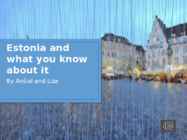
Estonia and what you know about it By Anšiel and Liza National symbols • The flag is blue, black and white horisontal lines, It represents the blue sky, the dirt, purity or snow. • The national bird is a swallow. • The national flower is a cornflower. History • The first settelments in Estonia came by supposedly about 11 000 years ago. • In the past most Estonians worshipped spirits of nature and their beliefs were seen as unholy by christian crusaders. Taara is believed to have been the name of the old Estonian god. • Starting with the Northern Crusades in the Middle Ages, Estonia became a battleground for centuries where many countries fought their wars over controlling the important geographical position of the country as a gateway between East and West, despite this the country has survived. • Estonia first got it’s independence in 1918 wich lasted 22 years. • The first president of Estonia during this period was Kon...
Tallinn Jane Jaakson, Kärt Aulik Leisi Secondary School Form 9 2015 Tallinn Location: Estonia ● Harju County ● ● near The Gulf of Finland South of Helsinki ● East of Stocholm ● West of St. Petersburg ● Tallinn Population: ● about 440,000 (1January 2014) ● 53,2% Estonians ● 38,1% Russians ● 0,6% Finns ● 6,3% others Tallinn Tourism: 58 museums ● 10 cinemas ● 247 hobby schools ● 40 art galleries ● Tallinn Symbols: Flag ● Coat of arms ● Old Toomas ● ● Toompea tower Tallinn References: www.Google.com ● Www.Tallinn.ee ● Www.Wikipeedia.ee ●
Estonia railway history The first railway was opened to traffic in Estonia 24th October 1870th In Paldiski - Tallinn - Narva - Gatshina section. This celebrate birth of Estonian Railways. That same year, from St. Petersburg - Warsaw railway. The Baltic To the Railway Company extended the 1870th In line Gatshinast Tosnoni, whereby the connection was present October Railway. thanks to the Baltic railways quickly began to evolve almost ice-free port of Tallinn, which was built at that time a large cropevator. The first narrow-gauge railway in Estonia was opened in 5th of October 1896 between Pärnu and Valga. In 1897 the railway reached Viljandi and in 1900 Tallinn. The supply railway was owned by the private company. In 1923 the supply railway was nationalized; after that it was joined with the Estonian Railway in 1926. Estonia developed its narrow-gauge railway network as an important economy factor: in 1...
Estonian cities Tallinn is the capital and largest city of Estonia. It occupies an area of 159.2 square kilometers with a population of 413,000. It is situated on the northern coast of the country, on the banks of the Gulf of Finland, 80 km south of Helsinki, east of Stockholm and west of Saint Petersburg. Tallinn was founded in the 12th century and has been under the rule of Denmark, Sweden, and Germany as well as Russia, and all left their mark on the city's architecture. It is one of the best preserved medieval towns in northern Europe, and makes a beautiful impression from the sea, with its ancient city walls, church spires, and red-tile roofed homes. Tallinn has previously been named as Kolõvan, Lindanise and Reval. Most well-known sights in Tallinn are Freedom Square, Kadriorg Palace, Rotermann Quarter, Tallinn Song Festival Grounds, Toompea Castle and Town Hall Square, the Old Town of Tallinn and many more. Tallinn's Old Town i...
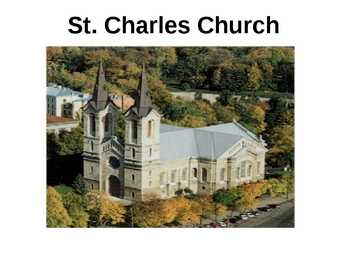
St. Charles Church Basic Information Built in pseudo-Romanesque style Architects: O.P.Hippius and R.von Bernhard Limestone church Built in 1862-1882 Area 1197 m2 Biggest church in Tallinn The Costruction of the Church The Altar Come to me- painted by Johann Köler It was ready in the 23 of juli in 1879 The bottom altarpieces are painted by Sally von Kügelgen in 1889 The Church Bells The North Tower The South Tower The Organ The first one was built in 1884 The second one was built in 1923 The biggest organ in Estonia
Private School of Audentes Links between English speaking countries and Estonia Author: Kristin Liiv Supervisor: Mari Martma Tallinn 2006 2 Table of contents Introduction..........................................................................................................................4 First links............................................................................................................................. 5 20th century..........................................................................................................................5 Recognition.......................................................................................................................... 9 Conclusions...............................................................................................................
ICE AGE The earth is very old. During its long history there have been many changes in climate. Between one and two million years ago one of these changes took place the great Ice Age began. It grew colder in the Far North. More snow fell in the winter than could melt away in the summer. The snow grew deeper and deeper. It changed to solid ice. As more snow fell, the ice grew thicker. It began to move. Great sheets of moving ice, or glaciers, were formed. The edges of the sheets were pushed outward. At last the ice covered most of what is now Canada. And it spread southward into what is now the United States. The ice was probably a mile deep in places. It moved over hills and valleys, rivers and forests. It moved slowly perhaps only a foot a day. Millions of plants were buried by the ice. Many animals moved south. Among the animals able to stand the cold near th...
and relatives, who you had to say goodbye to... Thinking of that, I have a marvellous suggestion for you! I know you've always wanted to have a nice summer cottage and why not to have it, here, in Estonia? I've found a lovely summerhouse for you! I also remember how much you adored these cute little hills we have in Estonia, so this lovely cottage is also on the foot of one and it's surrounded by a beautiful nature, you like to take photos of, too. It's located in the South-Estonia, near the Võru. This house has a view on a lake, where you can ride a boat and fish. It's surrounded by a little garden, in front of the house there are some beautiful roses growing. There is also a back yard suitable for barbecue partyes I know how much you like to cook with Markus, so it's a big pro. From the outside the cottage looks very pretty. It's finished with blue pine and is painted to light-green. It has also a marvelous thatched roof and it really reminds me one
PIRET JÄRVIS Piret Järvis born February 6, 1984 in Tallinn, Estonia. She is an Estonian musician, guitarist and songwriter. Piret Järvis is 22 years old. She has one brother, Peeter, who is 3 years younger and sister, Mari, who is 3 years older. She favourite drink is water, favourite car is Jaguar, favourite animal is dog, favourite season is summer, favourite fruits are banana and apple. She has blue eyes, dark blonde hair. She hobby is reading, drawing, playing the guitar and shopping. She nicknames are Pirks, Pirku, Piraat and Pirru. She went the school 7 year artlap, 3 year dance. She started sing already , 3 years old. Piret Järvis is Vanilla Ninja member. She writer Vanilla Ninja bands songs example ,, Clab Kung Fu" and any others songs. She play band guitar. Band idea came form Piret and Katrin. 2003. year May came first album. She favourites musicastyle is Nu Metal, Punk, Punkrock, R...
Tallinn Tallinn is situated on the southern coast of the Gulf of Finland, in north-western Estonia. A limestone cliff runs through the city. It is exposed, for instance, at Toompea and Lasnamäe. However, Toompea is not a part of the cliff, but a separate hill. Coastline is 46 kilometres long.The highest point of Tallinn, at 64 meters above the sea level, is situated in the district of Nõmme, in the south-west of the city. The first human steps, that archeologists found, are about 5000 years old. Tallinn`s first fortress was built in Toompea, in 1050. As an important port for trade between Russia and Scandinavia, it became a target for the expansion of the Teutonic Knights and the Kingdom of Denmark during the period of Northern Crusades in the beginning of the 13th century when Christianity was forcibly imposed on the local population. Danish rule of Tallinn and Northern Estonia started in 1219. In 1285...
 annaabi.ee