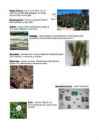
Regrowth forest -taastuv mets. Mets, mis ise uuesti üles kasvab peale põlenguid või loodus katastroofide toimel langeb. Rotation period rotatsiooni periood. Periood metsa asutamise ja raie vahel. Salinity - soolsus. Soola konsetratsioon mullas ja vees, mida mõõdetakse mg/l kohta. Seedlings seemik(seemnest kasvatatud taim). Noored puud, mida kasutatakse ettevalmistatud maade taasmetsastamiseks. Silviculture metsakasvatus. Kunst ja teadus mis kontrollib puude kasvu, koostist, tervisehoidu ja kvaliteeti. Soil erosion - pinnase erosiooni. Uhutakse ära mulla pealmine viljakas kiht paduvihmade ja üleujutuste mõjul. Sustainable forestry - säästev metsandus.
· Back aching jobs Mulch acts · Regulating the temperature · Insulator · Prevents competitions Organic mulch benefits · Decompose · Improves the soil increase aggregation, aeration, water-holding capacity, decrease soil erosion and runoff. · Cuts down evaportion · Prevents crusting of the soil surface · Adds to the beauty · prevent freezing injuries Mulch benefit · Extended the seeding season · It keeps the seed bed loose · Shades the seedlings · Keeping the vegetables clean and dry Mulching time · Winter mulch after the first hard frost · Summer mulch as soon as plants are established Pilt1 Mulch materials · Leaves · Manure · Hay · Sawdust · Seaweed · Straw · Grass clippings · Paper · Clover · Crop residue Pilt2 Pilt3 Stone mulching · Suitable for any vegetation · Particularly well for trees,
and savannas in India are a creation of human fire use. The maquis shrub savannas of the Mediterranean region were likewise created and maintained by anthropogenic fire. These fires are usually confined to the herbaceous layer and do little long term damage to mature trees. However, these fires do serve to either kill or suppress tree seedlings, thus preventing the establishment of a continuous tree canopy which would prevent further grass growth. Prior to European settlement aboriginal land use practices, including fire, influenced vegetation and may have maintained and modified savanna flora. It has been suggested by many authors that aboriginal burning created a structurally more open savanna landscape. Aboriginal burning certainly created a habitat mosaic that probably increased biodiversity and changed the
rate of herbicide, which would normally result in effective control • This happens trough evolutionary process, whereby a population changes from being susceptible to being resistant- • Happens when the same herbicide has been used over a period of years • Resistance can be passed from one generation to the next Prevention of resistance Cultural control methods • Cultivation- incession tillage can bury seeds to a depth from which seedlings of most weeds are unlikely to emerge (5cm or deeper) • Crop rotation – many annual weeds are strongly associated with specific crops Prevention of resistance Herbicidal control methods • Alternative herbicides – likely to have effect on resistant populations • Mixtures and sequences – use two or more herbicides which have different modes of actions • Herbicide rotations – rotation of herbicides from different chemical
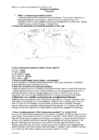
and cool, dry winters with an average temperature of 10° C. Most of the rain falls as convection rain in the summer and sometimes frost and snow may occur in the winter. 6. What is the role of wildfires in the temperate grassland plants’ lifecycle? Wildfires play a very important role. They allow the grasslands to be open and free of trees and shrubs. Any seedling of a tree that appears is killed off by the intense heat. If the fire does not clear out the seedlings, the grasslands would become a shrubland changing forever. Remarkably, the plants in the grasslands have adapted to the wildfires that come through, and actually need them to keep healthy and grow new vegetation in the spring 7. How are plants adapted to life in temperate grassland? (vt. ka õpik lk 61) During a fire, while above-ground portions of grasses may perish, the root portions survive to sprout again. Some prairie trees have thick bark to resist fire. Prairie shrubs readily resprout
the last three decades. ---------------------- According to annual data published by the Forestry Agency, the area reforested from natural to artificial forest constituted more than 150 000 ha annually for private forestry between 1960 and 1970. This means that more than 1% of private forests were cut and planted every year during the decade. Since 1955 the Forestry Agency has monitored the annual number of seedlings by species planted on forestland excluding national forest. According to the data, the major species have been sugi (Cryptomeria japonica - Jaapani seedripuu) and hinoki (Chamaecyparis obtusa - Jaapani küpress), representing 63% in 1955 and 73% in 1993 and maintaining a rate of over 60% during this period. Hinoki tended to increase, whereas sugi tended to decrease. Both are coniferous species whose timber is sawn into housing materials. ---------------------
make a lot of food for the tree in warm weather; when the weather gets cooler, the broad leaves cause too much water loss and can be weighed down by too much snow, so the tree drops its leaves. New ones will grow in the spring.; trees have thick bark to protect against cold winters. Temperate rainforest- epiphytes such as mosses and ferns grow atop other plants to reach light. Cool temperatures lead to slow decomposition but seedlings grow on "nurse logs" to take advantage of the nutrients from the decomposing fallen logs. Trees can grow very tall due to amount of precipitation. Temperate Grassland (Prairie)- During a fire, while above-ground portions of grasses may perish, the root portions survive to sprout again. Some prairie trees have thick bark to resist fire. Prairie shrubs readily resprout after fire. Roots of prairie grasses extend deep into the ground to absorb as much moisture as they can extensive
(some pioneer species) carry out nitrogen fixation; photosynthesis (fixing carbon); create habitats / provide shelter; AVP; e.g. increase weathering, stabilise sand / soil 2 max [2] 56. (i) final stage in succession / AW; (community) in equilibrium with environment; 1 max (ii) eat / trample, seedlings (of shrubs / trees) / AW; R eat grass prevents, succession / establishment of next sere; 1 max [2] 57. (a) award two marks if correct answer (18.4) is given incorrect answer (or no answer) but correct working = 1 mark 44 / 239 (× 100) 18.4%;; ecf applied for minor addition errors +/- 2 2
Mangrove trees have complex breathing roots above the surface of the organically rich and oxygen-depleted muds in which they live. Oil may block the openings of the air breathing roots of mangroves or interfere with the trees' salt balance, causing leaves to drop and the trees to die. The root systems can be damaged by fresh oil entering nearby animal burrows and the effect may persist for some time inhibiting recolonisation by mangrove seedlings. Protection of wetlands, by responding to an oil spill at sea, should be a high priority since physical removal of oil from a marsh or from within a mangrove forest is extremely difficult. Living coral grows on the calcified remains of dead coral colonies which form overhangs, crevices and other irregularities inhabited by a rich variety of fish and other animals. If the living coral is destroyed the reef itself may be subject to wave erosion. The effects of oil on
the head is visible. IV. Environment requirements: A. Climate: Sunflower is grown in many semi-arid regions of the world from Argentina to Canada and from central Africa into the Soviet Union. It is tolerant of both low and high temperatures but more tolerant to low temperatures. Sunflower seeds will germinate at 39°F, but temperatures of at least 46 to 50°F are required for satisfactory germination. Seeds are not affected by vernalization (cold) in the early germination stages. Seedlings in the cotyledon stage have survived temperatures down to 23°F. At later stages freezing temperatures may injure the crop. Temperatures less than 28°F are required to kill maturing sunflower plants. Optimum temperatures for growth are 70 to 78°F, but a wider range of temperatures (64 to 91°F) show little effect on productivity. Extremely high temperatures have been shown to lower oil percentage, seed fill and germination.
 annaabi.ee