 50 punkti
Autor soovib selle materjali allalaadimise eest saada 50 punkti.
50 punkti
Autor soovib selle materjali allalaadimise eest saada 50 punkti.
 ~ 7 lehte
Lehekülgede arv dokumendis
~ 7 lehte
Lehekülgede arv dokumendis
 2011-09-11
Kuupäev, millal dokument üles laeti
2011-09-11
Kuupäev, millal dokument üles laeti
 4 laadimist
Kokku alla laetud
4 laadimist
Kokku alla laetud
 0 arvamust
Teiste kasutajate poolt lisatud kommentaarid
0 arvamust
Teiste kasutajate poolt lisatud kommentaarid
 kevinkunila
Õppematerjali autor
kevinkunila
Õppematerjali autor
Introduction... I read a book abput the Galapagos islands writen by Paul D. Steward. I have devided my presentation in 3 paragraphs: Firstly i will tal about the origins of the islands and the history, secondly about life on the land and in the sea, finaly about conserving the Galapagos. The Galapagos Islands are situated on junctions between several shifting tectonic plates on the equator and about 1000 km off the Pacific coast of Ecuador. They are the product of one of the most volcanically active regions on our planet, a hot spot is situated directly beneath the islands and also It is the point where major ocean currents meet. These circumstances combine to make an area that truly is like no other place on earth. Galapagos is comprised of 13 major islands, more than 120 smaller islets and rocks, and the surrounding ocean. The total land mass is almost 8,000 sq. km. Highest peak is Wolf Volcano reaching 1707m. The present islands are all younger than 4 million years and were formed
ENVIRONMENTAL PROBLEMS Our environment is constantly changing. However, as our environment changes, so does the need to become increasingly aware of the problems that surround it. With a massive influx of natural disasters people need to be aware of what types of environmental problems our planet is facing. Current environmental problems make us vulnerable to disasters and tragedies, now and in the future. Unless we address the various issues seriously we are surely doomed for disaster. Current environmental problems require urgent attention. 1. Pollution: Pollution of air, water and soil require millions of years to recoup. Industry and motor vehicle exhaust are the number one pollutants. Heavy metals, nitrates and plastic are toxins responsible for pollution. While water pollution is caused by oil spill, acid rain, urban runoff; air pollution is caused by various gases and toxins released by industries and factories and burning of fossil
1. Key features for all studied biomes. Tundra The main seasons are winter and summer. The tundra is the world's coldest and driest biomes. The average annual temperature is -28° C. Nights can last for weeks when the sun barely rises during some months in the winter, and the temperature can drop to -70° C. During the summer the sun shines almost 24 hours a day. Summer are usually warm. Average summer temperatures range from 3° to 16°C. TaigaTaiga is the Russian word for forest and is the largest biome in the world. It stretches over Eurasia and North America. The taiga is located near the top of the world, just below the tundra biome. The winters in the taiga are very cold with only snowfall. The summers are warm, rainy, and humid. Some of the animals in the taiga hibernate in the winter, some fly south if they can, while some just cooperate with the environment. GrasslandsGrassland biomes can be found in the middle latitudes. They can have either moist continental climates or dry
GLOBAL WARMING Global warming is the observed century-scale rise in the average temperature of Earth's climate system. Since 1971, 90% of the increased energy has been stored in the oceans, mostly in the 0 to 700m region. Despite the oceans' dominant role in energy storage, the term "global warming" is also used to refer to increases in average temperature of the air and sea at Earth's surface. Since the early 20th century, the global air and sea surface temperature has increased about 0.8 °C (1.4 °F), with about two-thirds of the increase occurring since 1980.Each of the last three decades has been successively warmer at the Earth's surface than any preceding decade since 1850. More than 90% certain that most of global warming was being caused by increasing concentrations of greenhouse gases produced by human activities.In 2010 that finding was recognized by the national science academies of all major industrialized nations. Affirming these findin
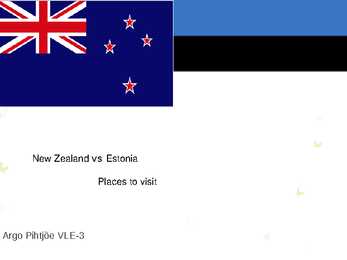
New Zealand vs Estonia Places to visit Argo Pihtjõe VLE-3 Some facts: Full name: Republic of Estonia Full name: New Zealand Population: 1.3 million (UN, 2010) Population: 4.3 million (UN, 2010) Capital: Tallinn Capital: Wellington Area: 45,227 sq km (17,462 sq miles) Area: 270,534 sq km (104,454 sq miles) Major languages: Estonian Major languages: English, Maori Major religion: Christianity Major religion: Christianity Life expectancy: 69 years (men), 79 Life expectancy: 79 years (men), 83 years (women) (UN) years (women) (UN) Monetary unit: euro Monetary unit: 1 New Zealand dollar Main exports: Machinery, textiles, wood ($NZ) = 100 cents products Main exports: Wool, food and dairy GNI per capita: US $14,060 (World products, wood and paper products Bank,
Water pollution Attention for water pollution exploded in the 1980s. The oil spill of the Exxon Valdez showed many around the world just how horrible the effects of water pollution could be. However, even the Exxon Valdez spill barely touched the surface of the problem of water pollution. The ship spilt only 5% of the oil spilt that year, and oil is just one of many pollutants that people dump into the water every year. Every year, 14 billions pounds of sewage, sludge, and garbage are dumped into the world's oceans. 19 trillion gallons of waste also enter the water annually. The problem of ocean pollution affects every nation around the world. This is especially true because water is able to transport pollution from one location to another. For many years, chemicals were dumped into bodies of water without concern. While many countries have now banned such behavior, it continues to go on today. As the world has industrialized and its population has grown, the problem of water poll
Global Warming One of the biggest issues our planet and its inhabitants are facing nowadays is global warming. Global warming, also often referred to as the greenhouse effect, has not always been a problem. However, over the last centuries, since the Industrial Revolution things have changed. Polar regions are melting, species are dying, climate zones are shifting, migration patterns for animals such as polar bears and birds are being disrupted our world as we know it is changing. Some scientists believe that the climate will reach a tipping point, a point at which even a tiny additional increase would throw the system into violent change. We started doing harmful things and only now do we realize what we have done and what we are doing. At this current rate by the middle of next century the Earth's temperature may rise a predicted from 2 to 6 degrees Celsius. This may not seem as much but with the Earth's delicate balance we will have lost several
Topic Australia Tallinn English College 2006 Australia 1 . Introduction The name Australia is derived from the Latin Australis, meaning of the south. In land area, Australia is the sixth largest nation, its territory is 7,686,850 sq km and its population reaches today over 20,5 million people. It is the only nation to govern an entire continent and its outlying islands. Australia's capital is Canberra, the only city with its own territory. It was built in the early 1900s just to be the capital. The official language is English and the official name of Australia is the Commonwealth of Australia. Australia is located on the Southern Hemisphere (because of that Australia is also called "A land down under"). 2 . Geographical position Australia is an island continent and it is located between the Indian and South Pacifi
 annaabi.ee









Kõik kommentaarid