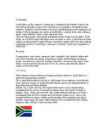
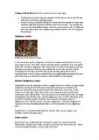
Geography South Africa, on the continent's southern tip, is bordered by the Atlantic Ocean on the west and by the Indian Ocean on the south and east. Its neighbors are Namibia in the northwest, Zimbabwe and Botswana in the north, and Mozambique and Swaziland in the northeast. Eleven languages are spoken in South Africa : english, xhosa, zulu, afrikaans, venda, swazi, ndebele, tswana, tsonga,sepedi and soutj. There are black people, white people and different Asians living in South Africa. South Africa was a British colony and Indians were used there as slaves. South Africa has three capitals: an administrative capital Pretoria, a legislative capital Cape Town and a judicial capital Bloemfontein
Ursula Potivar Geography of Madagascar Topography Madagascar is an island in the Indian Ocean off the eastern coast of southern Africa, east of Mozambique. At 587,000 square kilometres, Madagascar is the world's 46th-largest country and the fourth- largest island. Madagascar can be divided into five geographical regions: the east coast, the Tsaratanana Massif, the central highlands, the west coast, and the southwest. The east coast The east coast consists of a narrow band of lowlands, formed from the sedimentation of alluvial soils and zone, composed of steep bluffs, alternating with ravines bordering an escarpment of
South Africa Aivi Raja 11.a Location Click to edit Master text styles the continent of Second level Africa Third level Fourth level Fifth level the southern tip borders the Atlantic and Indian oceans bordered by Namibia, Botswana, Zimbabwe, Mozambique, Swaziland and the Kingdom of Lesetho General Information Pretoria - executive capital - warm valley - surrounded by the hills of the Magaliesberg Click to edit Master text styles Second level Third level Fourth level
crowded and polluted cities. · Funding for health research worldwide has grown dramatically in the past 20 years, only a fraction is spent on fighting disease in poor nations. 3 List of Developing Countries · Afghanistan · Brazil · Egypt · Kazakhstan · Solomon · Albania · Mozambique · Bulgaria · El Salvador · Kenya Islands · Algeria · Myanmar · Angola · Burkina Faso · Equatorial · Kiribati · Somalia · Namibia
Brazil's independence from Portugal. Cisplatina (today's sovereign state of Uruguay), in the south, was one of the last additions to the territory of Brazil under Portuguese rule. COLONIAL RESTORATION At the height of European colonialism in the 19th century, Portugal had already lost its territory in South America and all but a few bases in Asia. Luanda, Benguela, Bissau, Lourenço Marques, Porto Amboim and the Island of Mozambique were among the oldest Portuguese-founded port cities in its African territories. During this phase, Portuguese colonialism focused on expanding its outposts in Africa into nation-sized territories to compete with other European powers there. With the Conference of Berlin of 1884, Portuguese Africa territories had their borders formally established on request of Portugal in order to protect the centuries-long Portuguese interests in the continent from rivalries enticed by the Scramble for Africa
· Cookery practised by indigenous people of South Africa such as the Khoisan and Xhosa- and Sotho-speaking people · Settler cookery introduced during the colonial period by people of Indian and Afrikaner and British descent and their slaves and servants - this includes the cuisine of the Cape Malay people, which has many characteristics of Malaysia and Java, and recipes from neighbouring colonial cultures such as Portuguese Mozambique. Indigenous cookery traditional South African cuisine In the precolonial period, indigenous cuisine was characterized by the use of a very wide range of fruits, nuts, bulbs, leaves and other products gathered from wild plants and by the hunting of wild game. The domestication of cattle in the region about two thousand years ago by Khoisan groups enabled the use of milk products and the availability of fresh meat. However, during the colonial period the seizure of
Ööbimine Le Lac Hotel’is. 6. PÄEV 07.00 – 09.00 Hommikusöök 09.00 - 13.00 Sõit Isalo Rahvusparki 13.00 Lõunasöök 14.00 Tutvumine Isalo rahvuspargiga, kus on Monkey Canyon. Lisaks võimalus ujuda looduslikes basseinides. Soovi korral õhtusöök. Ööbimine Isalo Rock Lodge’is. 7. PÄEV 07.00 – 09.00 Hommikusöök 09.00 – 12.00 Sõit Tulear’i. 12.00 Iseseisev tutvumine Tuleari linnaga, mis asub Madagaskari edela osas. Mereäärne piirkond helesinise vee ja palmidega. Mozambique kanal. Soovi korral lõuna- ja õhtusöök. Ööbimine Ankasy Lodge & Spa’s 8 8. PÄEV 07.00 – 09.00 Hommikusöök 09.00 Lend Marondavasse Pärastlõunal tutvumine Baobabi oruga. Soovi korral lõuna- ja õhtusöök. Ööbimine Palissandre Cote Ouest Resort – Spa’s. 9. PÄEV 07.00 – 09.00 Hommikusöök Lend Marondavast Antananarivosse
Notary:___________________ HOW TO START BUSINESS IN GEORGIA - 14 Signatories to Appendix #9 the Hague Convention · Albania · Falkland · Mexico · American Islands · Moldova Samoa · Fiji · Monaco · Andorra · Finland · Montserrat · Anguilla · France · Mozambique · Antigua & · French Guiana · Namibia Barbuda · French · Netherlands · Argentina Polynesia Antilles · Armenia · Germany · Netherlands · Aruba · Gibraltar · New Caledonia · Australia · Greece · New Zealand · Austria · Grenada · Niue (Savage · Azerbaijan · Guadeloupe Island)
Inimühiskonnad ja inimeste käitumine on keskkonna poolt määratud ning nende muutumine allub keskkonna reeglitele. Marvin Harris (1927 2001) Üks tuntumaid, tähtsamaid teadlasi kultuurantropoloogias. Toetas ja arendas 'kultuurilise materjalismi' teooriaid. Haridus BA Columbia University, 1949 Ph.D. Columbia University, 1953 Välitöö Islas de la Bahia, Brazil (Town and Country in Brazil), 1956 Mozambique (Portugal's African `Wards': A First-Hand Report on Labour and Education in Mozambique), 1958 India, Ecuador, and Africa (Minorities in the New World. Six Case Studies), 1959 publikatsioone (1968) Rise of Anthropological Theory: A History of Theories of Cultures (1977) Cannibals and Kings: The Origins of Culture (1985) Good to Eat: Riddles of Food and Culture (1989) Our Kind: Who We Are, Where We Came from, Where We Are Going Kultuurimaterialism Sotsiaalne käitumine ja sotsiaalsed struktuurid tulenevad materiaalsetest tingimustest ja oludest
' ''-'- .--- J-:::~ ~h ~ .7 r" Cameroon Mozambique c6TE »>"") " Yaounde - ? Bangu l ~""""' ' . ~ (SOMALI} Douala 810,000 Maput o 989,000 [)'IVOIRE EQUATOlUAL ~. -r-tRE l'iOt'THE U5'"ANDA vrl, 'Mogadishu
8 60.3 600 6 Egypt 48.6 20.7 137 42.4 45.6 120 6 Ethiopia 39.4 16.8 103 49.9 53.2 390 6 Gabon 47.4 21.4 143 41.4 44.6 260 6 Gambia 44.4 13.1 90 52.2 55.8 390 6 Ghana 47 11.3 72 56.5 60.5 370 6 Kenya 44 9.4 82 59.1 62.56 5310 6 Libya 48.3 25 130 38.1 41.2 200 6 Malawi 35.5 9.8 82 59.1 62.5 960 6 Morocco 45 18.5 141 44.9 48.1 80 6 Mozambique 44 12.1 135 55 57.5 1030 6 Namibia 48.5 15.6 105 48.8 52.2 360 6 Nigeria 48.2 23.4 154 39.4 42.6 240 6 Sierra_Leone 50.1 20.2 132 43.4 46.6 120 6 Somalia 32.1 9.9 72 57.5 63.5 2530 6 South_Africa 44.6 15.8 108 48.6 51 480 6 Sudan 46.8 12.5 118 42.9 49.5 810 6 Swaziland 31.1 7.3 52 64.9 66.4 1440 6 Tunisia 52.2 15.6 103 49.9 52.7 220 6 Uganda 50.5 14 106 51
Africa Nigeria Armenia Africa Ghana Aruba Africa Cameroon Azerbaijan Africa Ivory Coast Australia Africa Uganda Austria Africa Zambia Bahamas Africa Madagascar Bahrain Africa Sudan Bangladesh Africa Senegal Barbados Africa Mozambique Belarus Africa Angola Belgium Africa Namibia Belize Africa Guinea Benin Africa DRC Bermuda Africa Cabo Verde Bhutan Africa Botswana Bolivia Africa Zimbabwe Bosnia and Herzegovina Africa Gabon Botswana
26 Gabon 3.27 Gambia 2.13 Ghana 0.58 Guinea 0.26 Guinea-Bissau 0.69 Kenya 0.81 Lesotho 0.96 Libya 6.79 Madagascar 0.27 Malawi 0.35 Mali 0.2 Mauritania 0.55 Mauritius 19.52 Morocco 5 Mozambique 0.36 Namibia 6.25 Niger 0.17 Nigeria 0.36 Réunion 35.13 Rwanda 0.28 S.Tomé & Principe 1.97 Senegal 1.32 Seychelles 19.56 Sierra Leone 0.39 South Africa 10.72 Sudan 0.4 Swaziland 2.41 Tanzania 0.33 Togo 0.58
 annaabi.ee