Leidsid 33 sarnast õppematerjali, mis on seotud failiga "Leicester Square". Need materjalid aitavad sul teemat sügavamalt mõista.
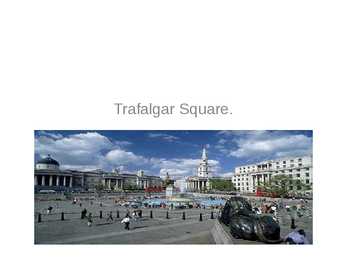
square, leicester, garden, theatre, ticket, centre, entertainment, middletatue, tickets, building, between, covent, north, trafalgarocialcene, theatres, clubs, aroundometimes, there, lovely, relax, hard, workhakespeare, charlie, chaplin, addedign, famous, popularhop, based, essential, part, visiture, join, queue, afternoon, eveningTrafalgar Square. Trafalgar Square Created in 1830-1841 1805 was named in honour Lord Nelson's Victory. In the centre of the square. Many museums and art galleries are around. Always full of people. Are famous for its thousands pigeons. You mustn't feed the pigeons, beacause if you do that you'll have to pay a fine. Leicester Square Lovely garden in the square, where people can relax. Statue of William Shakespeare. 1981 was added Charlie Chaplin. Popular with tourists Many cinemas,theatres,restaurants nearby. Pedestrians only. Near the square is the London's Chinatown. Leicester Square Click to edit Master text stylesClick to edit Master text styles Second level Second level Third level Third level Fourth level Fourth level
Squares of London Trafalgar Square Trafalgar Square is a public space and tourist attraction in central London, England, United Kingdom. At its centre is Nelson's Column, which is guarded by four lion statues at its base. There are a number of statues and sculptures in the square, with one plinth displaying changing pieces of contemporary art. The square is also used for political demonstrations and community gatherings, such as the celebration of New Year's Eve. The name commemorates the Battle of Trafalgar (1805), a British naval victory of the Napoleonic Wars over France. The original name was to have been "King William the Fourth's Square", but George Ledwell Taylor suggested the name "Trafalgar Square" Leicester Square Leicester Square is a pedestrianised square in the West End of London, England. The Square
Trafalgar Square. Trafalgar Square • Created in 1830-1841 • 1805 was named in honour Lord Nelson’s Victory. • In the centre of the square. • Many museums and art galleries are around. • Always full of people. Are famous for its thousands pigeons. You mustn’t feed the pigeons, beacause if you do that you’ll have to pay a fine. Leicester Square • Lovely garden in the square, where people can relax. • Statue of William Shakespeare. • 1981 was added Charlie Chaplin. • Popular with tourists • Many cinemas,theatres,restaurants nearby. • Pedestrians only. • Near the square is the London’s Chinatown. Leicester Square London’s Chinatown
Underground, but the best way to explore the city is walk. ● You will need: *A street map *Camera *Good walking shoes Piccadilly Circus Piccadilly Circus is a road junction. In this context, a circus, from the Latin word meaning "circle", is a round open space at a street junction. It is popular meeting place and there is a saying that if you wait enough at Piccadilly Circus, you’ll meet everyone in the world. Trafalgar Square Trafalgar Square was created in 1830-41 and was named in honour of Lord Nelson’s victory at the Battle of Trafagar in 1805. Nelson’s Column is in the centre of the Square. Trafalgar Square used to be be famous for its thousand of pigenos. Now feeding the pegenous is banned. Leicester Square In the middle of the garden there is a statue of William Shakespeare. In 1981 a life-size statue of Charlie Chaplin was added. The square is for pedestrians only. Covent Garden
The Romans gave us a language based on Latin, the calendar, law and legal system, the census and also straight roads, central heating and concrete. Anglo- Saxons around AD 400 Anglo- Saxons were warrior farmers from Germany, Denmark and the Netherlands. Later in the 5th century, Anglo-Saxons settled just west of Londinium, around the Strand, and formed the town of Lundenwic. The area of the old Roman city became a landing-place for ships and a centre for trade.The first English King to convert to Christianity, King Ethelbert, founded St Paul's Cathedral in 604. The Vikings 8th and 9th century By the 9th century, London was a very prosperous trading centre, and its wealth attracted the attention of Danish Vikings. The Danes periodically sailed up the Thames and attacked London. In 851 some 350 longboats full of Danes attacked and burned London to the ground.
The city's core, the ancient City of London, still retains its limited medieval boundaries; but since at least the 19th century, the name "London" has also referred to the whole metropolis that has developed around it. Today the bulk of this conurbation forms the London region of England and the Greater London administrative area, with its own elected mayor and assembly. London is one of the world's most important business, financial and cultural centres and its influence in politics, education, entertainment, media, fashion and the arts contributes to its status as a major global city.Central London is the headquarters of more than half of the UK's top 100 listed companies and over 100 of Europe's 500 largest companies. The city is a major tourist destination for both domestic and overseas visitors, with annual expenditure by tourists of around £15 billion. London hosted the 1908 and 1948 Summer Olympic Games and will host the 2012 Summer Olympic Games. Samuel Johnson, author of the
The West End Trafalgar Square is called the heart of London because it connects the political area of Westminster to the rest of West London. Lord Nelson's column stands in the center of the beautiful square. Horatio Nelson was a great British commander who defeated Napoleon in the Battle of Trafalgar but unfortunately he himself was killed. To the north and west from the Trafalgar Square is the West End, which is London's main shopping and entertainment area. Most of London's best residential and commercial areas are in the West End. You can find there expensive shops, restaurants, hotels, museums and many art galleries. Great Britain's biggest department store is in Knightsbridge. It was founded in 1834 by Charles Henry Harrod. Harrods is also the world's first building with an escalator. Today Harrods is an amazing place with over 330 shops, which includes twenty-six fine eating places, where you can go eat, when hungry.
1. Introduction London is the capital city of the United Kingdom and the largest urban area in England. The ancient City of London, to which the name originally belonged, still maintains its medieval boundaries, but the name "London" has long applied more to the whole metropolis that has grown up around it. London has been an important settlement for over two millenniums. It is also one of the world's leading business, financial and cultural centres and its influence in politics, education, entertainment and even fashion contribute to its status as a major global city. London is a major tourist attraction with four world heritage sites, several royal parks and numerous iconic landmarks such as the Houses of Parliament, Towe Bridge, the Tower of London, Westminster Abbey and the London Eye. 2. History Although there is some evidence of a permanent settlement before the Romans came in 43 A.D., it is more accepted by historians that the Romans were the first. The settlement was
the shopping. The famous sopping street is Oxford Street. It is the most famous street in London where you can buy souvenirs, clothes, and so on. Today Harrods's is among the world`s best known shops. The famous sights in London are British Airways London Eye, the Westminster Abbey, The Tower of London, St Paul`s Cathedral, The Houses of Parliament, Shakespeare`s Globe, Buckingham Palace, Piccadilly Circus, Trafalgar Square and so on. British Airways London Eye was built to celebrate the Millennium. It is the worlds largest and tallest observation wheel. You can get gorgeous views from it. It is perfect way to see city`s exciting architecture and landscape. The Westminster Abbey is one of the oldest buildings of London were many famous people are berried. The Westminster Abbey in known as The British Pantheon to. The Tower of London is one of London's most-visited sites
and the third-tallest free-standing clock tower in the world. The clock first ticked on 31 May 1859. The pendulum is installed within an enclosed windproof box sunk beneath the clockroom. It is 3.9m long, weighs 300 kg and beats every 2 seconds. The clockwork mechanism in a room below weighs 5 tons. · Buckingham Palace is the official London residence of the British monarch. Originally known as, the building which forms the core of today's palace was a large townhouse built for the Duke of Buckingham in 1703 on a site which had been in private ownership for at least 150 years. During the 19th century it was enlarged, principally by architects John Nash and Edward Blore, forming three wings around a central courtyard. Buckingham Palace finally became the official royal palace of the British monarch on the accession of Queen Victoria in 1837.
London London is one of the world's great cities. Located in the southeast of England, on the River Thames, it is the capital of the United Kingdom and has been the heart of its political, cultural and business life for centuries. London has always been the centre of the world. The origin of the city may be dated around the beginning of the 1st century when a Celtic tribe settled near the Thames. The Romans founded London about 50 AD. Its name is derived from the Celtic word Londinios, which means `the place of the bold one'. The Romans brought with them forts, roads and the rule of law. Then in 61 AD Queen Boudicca led a rebellion against the Romans. Her army marched on London. No attempt was made to defend London
Buckingham Palace is teh offical London residence of the Queen and the Royal Family. When the Queen is at home the Royal Flag flies on the top. Houses of Parliament stands on the north bank of the river Thames. St James's Park is the most ancient of London's parks. Hyde Park is the people's park. London As well as being the capital of England, London is aslo the capital of UK. London is a political centre, a commercial centre and a perfect place for shoppers. London is the favourite. City for those, who like to go to the theatre. London can also be very quiet because of the parks and old buildings and museums. London is also considered to be one of the most important culture centre with its museums and libraries. There are many places to go in London. Buchingham palace is the official London residence of the the Queen and the royal family
(if different from the above) Executive summary 1.1 Business summary: My business idea is simple: MP CANNED FOOD LIMITED is importing canned food (meat products and ready meals) from Estonia to the United Kingdom. Unique products like "Wild Boar In Its Own Juice", "Elk In Its Own Juice" and "Venison In Its Own Juice" are hard to find in the United Kingdom. We are selling Rannarootsi and Frank Pott brands and sell them online, http://www.mpwildgame.co.uk Future plans are to start trading also in Leicester Market in November/December as a Market Stall, supplying deli shops (including North European and International), wholesalers and supermarkets (including Tesco, ASDA, Morrison's, Sainsbury's). My three big business values: * Quality products * Professional customer service * 100% recyclable products I started as a Sole Trader on 1st of June 2012, because it's simple and straight forward structure for my business. As my business have been growing I registered in
The City of London History The City of London occupies one square mile in the middle of the capital. It once made up the entire town of London, surrounded by the wall first built by the Romans. The Roman Londinium grew up on the northern side of the "London Bridge" in the past. Products such as olive oil, wines and fruit were brought by ships from different parts of the Roman Empire and unloaded onto wooden quays along the river. In AD 61 the native Celtic Iceni tribe, led by Queen Boudicca, rose up against The Romans
There are also floor to ceiling windows, flat screen TV and complimentary mini bar soft drinks and snacks. Saturday At first we will go visit Buckingham Palace which is the official London residence and principal workplace of the British monarch. We would also like to see the nearby park where are a lot of birds and squirrels. Then we would like to see the river Thames and the Big Ben. Just a short walk from the Thames is situated Westminster Abbey which is a significant building in British history. This beautiful gothic church is a UNESCO World Heritage. Kings, Queens, statesmen, aristocrats, poets, priests, heroes and villains are all part of the church's fascinating history. Many of whom were buried at the Abbey including Charles Dickens, Geoffrey Chaucer, Dr. Samuel Johnson and Charles Darwin. There is a special Scientists corner at the church which is home to a memorial for Isaac Newton. On top of all this rich history, Westminster Abbey is
THE CITY OF LONDON History The City of London occupies one square mile in the middle of the capital. It once made up entire town of London, surrounded by the wall first built by Romans. The Romans also built a bridge over the Thames and there has been one in the same area ever since. The Roman Londinium grew up on the northern side of the bridge. In AD 61 the native Celtic tribe, led by Queen Boudicca, rose up against the Romans. They burnt down Londinium to the ground and killed most of its inhabitants
..................................................3 London's early history.....................................45 The people of London......................................6 Buildings and bridges......................................7 Intruduction London is the capital of the united kingdom (UK), which is made up of Great Britain(England, Scotland, Wales) and Northern Ireland. The city lies in the southeast of England and covers an area of about 1,578 square kilometres on either side of the River Thames. With population of seven million, London is by far the largest city in the UK. Birmingham, the second largest, has just over one million inhabitants. Cultural life London is the worldclass centre. It has more than40 theatres, where audiences enjoy everything from musicals to William Shakespeare's plays. The city also contain many cinemas, concert halls, museums and art galleries
the map so that you would not get lost and so that you could eventually get streetwise in London. Take the following questions with you, find answers to them and put them down for yourself in this MSWord document. Don’t forget to “take” photos - you are supposed to recognise the landmarks later on! At the end of the tour send the worksheet to yourself so that you could use it again. Good luck with exploring the city! DAY 1. The route: The Buckingham Palace – Trafalgar Square – National Gallery – Piccadilly Circus – The British Museum – Madame Tussauds – Oxford Street – Hyde Park – Harrods Destination 1: The Buckingham Palace What is its function? - Buckingham Palace has served as the official London residence of Britain's sovereigns since 1837 and today is the administrative headquarters of the Monarch. When was it built? 1703 Who was the first monarch to live there? Queen Victoria Is it open to public? Yes
- William the Conqueror initiated the construction of the Tower. Hyde Park 1. Who opened the park to the general public?- Charles I opened the park to the general public. 2. Name one famous landmark.- In example the Serpentine Lake/ Speakers' Corner/ the Diana, Princess of Wales Memorial Fountain. 3. For what is it famous for?- It's famous for its Speakers' Corner. Piccadilly Circus 1.When was it built?- It was built in 1819. 2. What is in the centre of the junction?- In the centre of the junction is a statue called Eros. 3. Name one tourist attraction near it.- In example the Shaftesbury Memorial/ Criterion Theatre/ London Pavilion. Trafalgar square 1. How many lion statues are guarding Nelson's Column?- 4 lion statues are guarding Nelson's Column. 2. When was it opened to the public?- It was opened to the public on 1 May 1844. 3. After who/what was it named for?- It was named in honour of Lord Nelson's victory at the Battle of Trafalgar. Covent Garden 1
to little crowds about all sorts of political, social and other ideas. The Greenwich Park is also special, because it is surrounding the national sea museum. The Regents Park is known, because there is the London zoo. The London zoo, opened in 1828 as a scientific zoo, is the oldest one in the whole world. In 1848, it was opened for people. The London zoo covers 36 acres and there are about 5000 animals in the zoo. The zoo is open every day except Christmas Day. The ticket costs 14 pounds for and adult and 10.75 pounds for a child. St. James's park is famous for its water birds, for example ducks and pelicans. Buckingham palace is near St James's park. The building of the Buckingham palace started in 1703. It was built for the Duke of Buckingham. The house was later bought by King George III for himself and Queen Charlotte. In 1820, King George IV commissioned John Nash to build a State Palace, much of the structure and decoration of which is seen today
Tallinn joined the German-dominated Hanseatic League in 1285 and became a junction of trade between East and West: furs, honey, leather and seal fat moved west, while salt, cloth, herring and wine moved east. Its geographical position was very favourable, with its wide bay protected by the two outlying islands of Aegna and Naissaar for a large port. Tallinn developed along three lines: fortress, port and market town. Tallinn grew rapidly and had developed into a well-known trading centre by the 15th century. Unfortunately, prosperity did not last long due to the weakening of the Hanseatic League, epidemics, hunger and wars. Sweden finally managed to take control of the whole of Estonia in 1629. Their rule ended after the Northern War in 1710 when Estonia was joined to the Russian Empire. Life changed for the better thanks to the opening of a railway line from St. Petersburg to Tallinn in 1870. Tallinn grew into a major port and an industrial centre, with huge shipyards
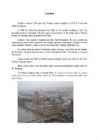
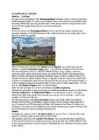
Trafalgar Square is a square in central London, England. With its position in the heart of London, it is a tourist attraction, and one of the most famous squares in the United Kingdom and the world. At its centre is Nelson's Column, which is guarded by four lion statues at its base. Statues and sculptures are on display in the square, including a fourth plinth displaying changing pieces of contemporary art, and it is a site of political demonstrations. The name commemorates the Battle of Trafalgar (1805), a British naval victory of the Napoleonic Wars. The original name was to have been "King William the Fourth's Square", but George Ledwell Taylor suggested the name "Trafalgar Square". The northern area of the square had been the site of the King's Mews since the time of
Much of Wales' beautiful and diverse landscape is mountainous. It has two major mountain systems: the Black Mountains and the Brecon Beacon in the south and the mountains of Snowdonia in the south. The highest mountains in Wales are in Snowdonia and include Snowdon, which at 1085 m (3,560 ft) is the highest peak in Wales. Welsh flag has a red dragon on a white and green background. It is not represented on the Union Jack. England is 130 000 square kilometres. Its capital is London. The population is about 50 million people and growing because of immigration. England is bordered to the north by Scotland and to the west by Wales. It is closer to continental Europe than any other part of Britain, divided from France only by a 38 km sea gap. The Channel Tunnel, near Folkestone, directly links England to the European mainland. The English/French border is halfway along the tunnel.
Chelsea is, definitely, an event most gardeners love to visit and remember long afterwards. But why it is so? I have read lot about that Show. Everybody seems to be like this, even if there are lots of not so good things. First I thought it could be very nice way to spend day with family but Chelsea is not a family day out and they take care in targeting the garnering market. There is no discount for children, no family tickets, no children's play areas. Exhibitions want customers and our job is to manage the balance between the needs of exhibitors and those of the visitors. It's important to have the right number of exhibitors in each category with a good range of prices, from expensive to economic. They try to pick those with good after sales service. If we discovered a rogue exhibitor and it has happened once or twice we swiftly replace them.
the right to own property, and so on. Peter the Great wanted to open a window onto Europe for Russia so he started the Northern War in 1700. Estonia remained under Russian rule and the Baltic-German nobility vowed allegiance to the Tsar; the barons were restored their former privileges. In 1870 a railway line was opened from St. Petersburg to Tallinn. Tallinn grew into a major port and an industrial centre. Estonians became conscious of their national identity. Tartu was the centre of the movement of national awakening. On 24 February 1918, Estonia was proclaimed an independent democratic republic. Tallinn developed into a modern European capital. A period of prosperity followed, but independence only lasted for 20 years. During World War II Estonia was occupied by both German and Russian invaders, and Tallinn suffered heavily. The bombing of the city by the Soviet air forces on 9 March 1944 left over 20,000 people homeless
It was part of the Westminster Palace, which was destroyed by a fire in 1834. The Houses of Parliament that we see today were rebuilt in the 19th century after the fire. The Big Ben clock tower is the largest four-sided ringing clock in the world and it is also one of the London's most famous symbols. Some think that Big Ben is the name of the clock on the tower, but actually it is the name of the big 13-ton bell that rings every fifteen minutes. The most historic religious building in Britain is Westminster Abbey, a beautiful church across the street from the Houses of Parliament. It was begun between 1042 and 1065 when the English king Edward the Confessor built a church on the site where the abbey now stands. In 1245, King Henry III began work on the main part of what is now Westminster Abbey. Poets' Corner in the Abbey is a place where Britain's greatest writers are either buried or remembered with a memorial plaque. Spenser, Dickens, Kipling and
Queen Caroline made a division between the two. THE TOWER OF LONDON: Her Majesty's Royal Palace and Fortress, more commonly known as the Tower of London (and historically as The Tower), is a historic fortress and scheduled monument in central London, England, on the north bank of the River Thames. It is located within the London Borough of Tower Hamlets and is separated from the eastern edge of the City of London by the open space known as Tower Hill. It is the oldest building used by the British government. [1] TOWER BRIDGE: Tower Bridge is a combined bascule and suspension bridge in London, England, over the River Thames. It is close to the Tower of London, which gives it its name.It has become an iconic symbol of London. WESTMINISTER ABBEY: Westminster Abbey is steeped in more than a thousand years of history. Benedictine monks first came to this site in the middle of the tenth century, establishing a tradition of daily worship which continues to this day
Brussels entertainment Cinemas Fancy something a little more relaxing in the evening? Or want to catch the latest art film that's only playing in one timeslot and one theatre in the whole city? Then Brussels will be able to satisfy both of these cravings. There are over 30 movie theatres in Brussels region; just a few of these will be able to satisfy your needs. The prices of films are affordable around 10 per adult ticket. UGC Cinema These cinemas are where you will find all the blockbuster movies, popular French and English language films that are released regularly throughout Europe. Kinepolis This is a large movie complex located next to the Atomium at Heyzel
London - The City and Beyond The statue of a bronze dragon on Fleet Street is the entrance to the City of London. This is where the Romans founded Londinium almost two thousand years ago. The City covers about 2,6 square km (1 square mile) and is often called the Square Mile. Today, the City of London is one of the world's most important business and financial centres, with over 500 banks. Over 400 000 people work within the Square Mile during weekdays and it is a crowded and noisy place. The Barbican Centre is a very big complex of buildings, towers, garages and walkways. It was built in the 70s and most Londoners don't like the way it looks. It is the largest performing arts centre in Europe and home to two
She talked about her adventures. When i was reading that it seemed so real, that i was there to. The city's charms can occasionally be obscured by too many tourists, congested traffic and tacky commercialism. Packed in among thousands of other visitors, trying like crazy to see the city in three days and worrying about getting ripped off, it's not surprising, may think the city is overrated. Just relax, take a deep breath. While the city centre is a mélange of stunning architecture, from Gothic, Renaissance and baroque to neoclassical, art nouveau and cubist, beyond the medieval lanes of the Old Town and the Castle District, there's an entire other cosmopolitan city to explore. Search out the riverside parks, lively bars and beer gardens, music clubs, museums and art galleries. Harness Prague's excellent public-transport system to explore emerging suburbs such as Zizkov, Vinohrady, Smíchov and Holesovice
My Town I live in Tallinn. It's the capital and main seaport of Estonia. Tallinn is a very beautiful city that lies on the Baltic Sea. It covers 158 square kilometres. The Mayor of Tallinn is Jüri Ratas. The population of our capital is about 400000 people. About 55% of them are Estonian, 37% Russians and the other 8% are from different nations. The people here are mostly engaged in industry- mainly the food industry (23%), trade (16%) and transport and communication (14%). History. Tallinn has a great history. It was first marked on a map of the world by the Arab geographer al-Idrisi in 1154, its name then being Kolyvan. In the 13 th-
Along with Italy and Germany, it's a home for many famous art galleries and museums. If you stand in Trafalgar Square in London with your back to Nelson's Column, you will see a wide horizontal front in a classical style. It is the National Gallery. It has been in this building since 1838 which was built as the National Gallery to house the collection of Old Masters Paintings (38 paintings) offered to the nation by an English Private collector, Sir George Beamount
The fire began in the kitchen of King's baker in Pudding Lane and lasted for five days. London is an exciting city which attracts people from all over the world. It is popular place to live because there is something new to see and do every day. Many visitors come to see the famous sights, museums and galleries; others come for the shopping. London has many concert halls and theatres which attract both the inhabitants and tourist. It is a city of seven million people covering 1606 Square miles. A quick and easy way to get to different places in London is to use the underground trains. But you can see much more of London from one of its famous red double-decker buses. Besides these there are special visitors buses that take you to the most important sights during one and a half hours , but you can always break your journey and get off at different places you want to visit. There are nine piers where you can get on a boat
 annaabi.ee